Thursday, August 17, 2006

Best Place in the World to Spot Orcas from Shore

The best place in the world for spotting killer whales (Orcas) from shore is the western coast of San Juan Island, Washington. Or so say the whale fans on the island, and the employees at the Whale Museum. We went there a couple of weeks ago hoping to spot Orcas from shore. Watching from shore has no harmful effects on the whales as whale-watching boats can. Lime Kiln State Park is the island's most popular and maybe most successful spot for watching from shore. June, July, and early August are among the best months.


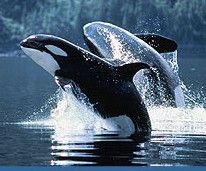
Orcas; photo from www.estuaries.org

Lime Kiln State Park is the center of a lot of Orca research. The windows of the park's small lighthouse are filled with graphs and data from doctoral research projects, posted there for whale-viewers to peruse while they wait for whales. A small crowd of 2 to 15 people gathers near the lighthouse every summer afternoon, waiting for the killer whales to come tooling down the Strait of Juan de Fuca, which is 8 miles wide at that point. The Orcas are eating salmon as they travel through. Researchers have identified 3 pods or family groups of Orcas that live in the strait - the J, K, and L pods. The members of a pod stay together most of the time. A pod is matriarchal - all are descendents of a single female who leads the group. J and K pods have 20 something members each; L pod has more than 40. The matriarch of each whale pod is several decades old, and great-grandma to some of the youngest whales.
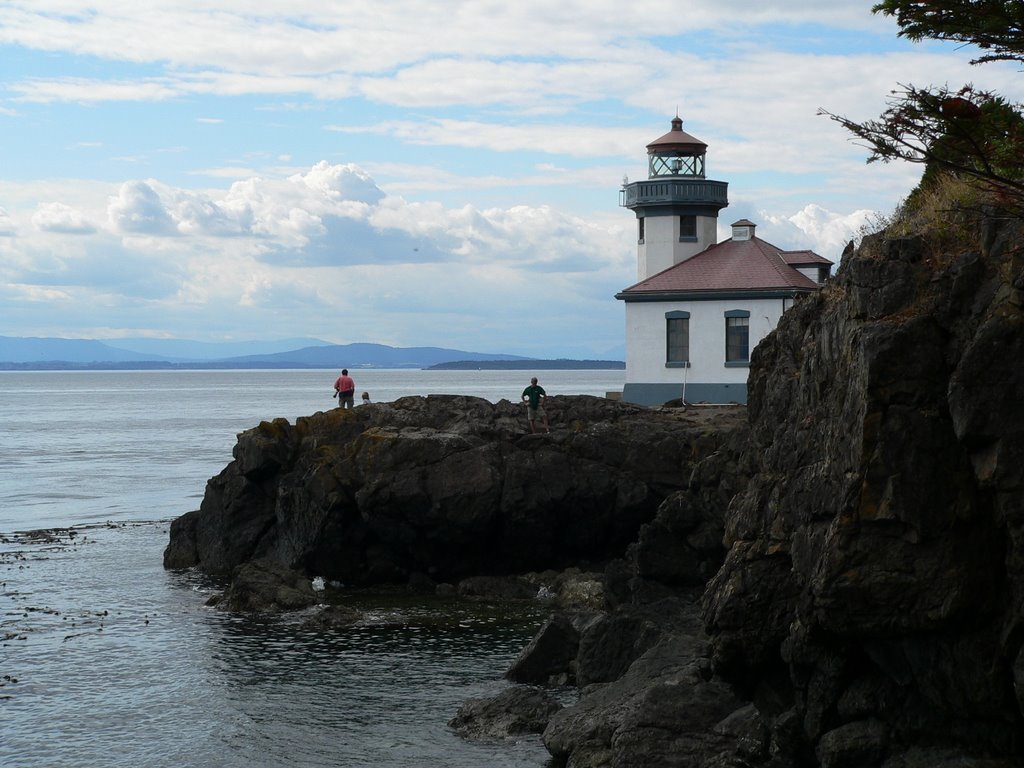

Lighthouse at Lime Kiln State Park, prime viewing spot for Orcas. By Sally Kneidel

The afternoon of August 2 we were hanging out at Lime Kiln State Park by the lighthouse, waiting. We were hoping the whales would come soon, we were hungry and tired. The only other people there were a pair of earnest-looking women perched on the rocky outcropping overlooking the water, discussing Orca sightings. One of them had what looked like an electric toothbrush - but it turned out to be a radio, a most useful tool in locating whales. She was listening in to the radio conversation among the whale-watching boats about the Orcas' whereabouts. I asked her what the scoop was, she told me the killer whales were headed our way. Sure enough, after about 5 minutes we could see the small clot of boats that generally follow the whales - three or four small whale-watching boats with clients, and one or two private boats. We could see the boats long before we could see any whales. The first we saw of the whales themselves was just the splashing water as they breached, or leapt from the water and slapped back down on the surface, something they apparently do just for fun.

Orca splashes; whale-watching boat with clients. From shore of San Juan Island, by Alan Kneidel


After a few more minutes, we could see more than splashing - we could see the beautiful black and white bodies of the killer whales, swimming and apparently playing.

Orcas playing. From shore of San Juan Island, by Alan Kneidel


Killer whales are the top of the food chain. No animals can kill adult Orcas, not even Great White Sharks. Orcas can kill almost anything they want to kill - other whales and sharks included. Although the resident J, K, and L pods eat mostly salmon, the "transient" Orcas that just move through the San Juan Island area on the way to somewhere else feed heavily on marine mammals. They can toss a seal in the air like popcorn, can snarf down sea lions that weigh a ton, literally. They don't eat humans though. We saw sea kayakers very near the whales - the whales never bother them. Why? Same with wolves. Wolves never attack humans, although they easily could. I don't know why.

We were told that, on some days at Lime Kiln State Park, the whales swim through the water right below the lighthouse, right through the sea kelp along the shore (which is deep right at the shore line). We weren't so lucky though. The whales we saw were much farther out. We could see and hear their spouts (exhaled breaths) though, at times. A spout started with a puffing sound, like air blown suddenly out of pursed lips. The subsequent whoosh had a resonance as of air coming from a deep and hollow chamber. Hard to describe. I guess the whales were 200 yards offshore.

The boats were keeping their distance pretty well - the guideline is at least 100 yards between whale and boat, to minimize disturbance to the whales. The sound of engines is thought to disrupt the whales' communication with each other. (Each pod has its own dialect!) Also, boat exhaust can be a health hazard when the Orcas come up to breathe. Not to mention just the harrassment factor of being trailed every day by a flotilla of boats. But....on the bright side....one of the graphs posted in the lighthouse showed that during the 1970s, an average of 26 boats followed each pod as it moved past Lime Kiln State Park on any given day. Now the average number of boats following a single pod of whales moving down the strait is 8. That's still a lot. But better than 26. The two days I watched though, I didn't see as many as 8 boats around any single group of whales. It was more like 4 or 5. Sometimes only a couple of boats. But maybe that's because the Orca-watching season begins to wane in August. As we watched, the whales stopped moving from time to time, playing and breaching. Then the pod would take off again, moving on down the Juan de Fuca Strait, seeking salmon.
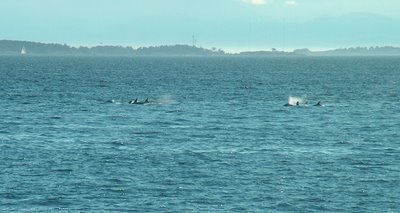
Orcas moving down Juan de Fuca Strait. From shore of San Juan Island, by Alan Kneidel

Salmon populations are declining in the area, overfished like everything else. (See www.wildsalmoncenter.org for info on salmon conservation efforts.) But the population of resident Orcas in Juan de Fuca Strait (pods J, K, and L) is holding steady nonetheless at present, numbering in the low 90s. A few decades ago, they were target practice for salmon fishermen. That "sport" has ended.

Most of the time we were watching the whales, all we could see were the fins sticking up. As the Orcas swim, they undulate up and down in an S-shaped path, so that a part of the back rises out of the water at the high points of the undulations. The whales breathe when the back is up, as in the picture below. The visible spout or cloud that results from their breathing is the warm vapor in their breath condensing into droplets in the cooler air. They even swim while they're sleeping - only half the brain sleeps at any given time.


Orca, by Janice Waite of the National Marine Mammal Laboratory

The resident population of Orcas in Juan de Fuca Strait was listed as endangered last year, even though their numbers are steady. They're threatened by water pollution, salmon decline, and boat traffic. In July of 2006, federal officials proposed naming the U.S. half of the strait as critical habitat. You can read more about the critical habitat proposal at Seattlepi.com. To read more about Orca conservation in the San Juan Island area of Washington and Orca biology in general, check out the www.whalemuseum.org. For more about Orca conservation issues in the north Pacific and Alaska area, see the National Marine Mammal Laboratory web site.

Orca in Alaska; photo from www.noaanews.noaa.gov

Orcas are pretty cool, and very predictable as whales go. I really enjoyed meeting the community of whale fanatics that hang out at Lime Kiln State Park every day, waiting for the whales to show - a group that ranged from kids carrying whale plush toys to research scientists. Wildlife watching used to be a solitary activity for me. But now, I realize that if we as conservationists are to make a difference for wildlife in the future, we have to involve communities of people. We have to develop sustainable ways for people to make a living from the ecosystems around them, such as ecotourism. We especially have to support local people who are trying to transition from "harvesting" of wild animals and plants to more sustainable ways of depending on their environment for their livelihoods. People who depend on the Orcas for their living are more likely to support limits on pollution and boat traffic, more likely to support salmon conservation measures.

If you like whales, if you're interested in seeing a community that is sustainably making a living from local wildlife and ecotourism, visit San Juan Island. And you want to see Orcas from shore, a great place to do it is Lime Kiln State Park.

Sally Kneidel, PhD
Co-author of Veggie Revolution

Friday, August 11, 2006

We Saw One Humpback Whale: The Good and Bad on Whale-Watching

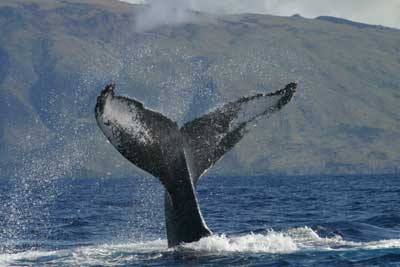
fluke of humpback whale; photo courtesy of National Marine Fisheries Service
www.nmfs.noaa.gov/.../humpbackfluke_hi_nms.jpg

We wanted to see Pacific marine wildlife, and in pursuit of that, we spent the last week of July at a hostel in Tofino, British Columbia - a small village on the wild Pacific coast of Canada's Vancouver Island. Tofino is on the northern edge of Pacific Rim National Park, halfway "up island" as the locals say.

The hostel is called Whalers on the Point Guesthouse (250 725-3443). It overlooks a relatively unpopulated bay where whales sometimes wander. The hostel has a rack of brochures for local whale-watching outfits that take tourists and photographers out to look for whales. The whales most commonly seen in the Tofino area are gray whales, humpbacks, and orcas. Most are migrating through seasonally. But a few are permanent residents. We learned from talking to various locals that two gray whales in particular spend a part of every day lounging in a specific area of sea kelp near one of the many small offshore islands, and have done so for years. Most of the whale-watching companies take their boats to view these two gray whales.

Whale-watching has good and bad aspects. The good is that it brings in around $10 billion in tourist dollars to North American Pacific coastal towns every year. Because a whale-watching outing usually includes viewing other coastal life as well - seals, sea lions, oceanic birds, sea otters, or bears - the income gives local people a strong incentive to preserve marine ecosystems. It gives coastal communities a good reason to leave enough fish to sustain wildlife populations. Ecotourism, which includes whale-watching, can be a sustainable way to "exploit" or make a living from natural resources without diminishing them. But it must have limits. Like all ecotourism, overzealous viewing is a hazard to wildlife populations. With that in mind, many conservation organizations and government bodies have published guidelines to limit and regulate whale-watching. The most widely accepted guideline is to approach no closer than 100 yards, the length of a football field. Another is to linger around a whale no longer than half an hour.

In my experience from staying in three different towns that cater to whale-watchers, these guidelines are generally respected. One boat I saw get too close was turned in by a whale-enthusiast who jotted down the boat's license tag or ID number.

So anyway we chose one of the whale-watching groups in Tofino and went out in their high speed "Zodiac" boat to see the two resident gray whales. A Zodiac is a small pontoon boat that jumps and slams over ocean swells in transit to the whales. The boats are constantly in radio contact with each other, so if there are whales in the area, then the guide for a particular outing already knows exactly where the whales are. But the animals may be miles offshore so the Zodiac can take 45 minutes at full throttle to reach the right area. People with back or neck problems or pregnancies not allowed on the boats, with good reason. It nearly jolted my teeth out. A Zodiac holds about 10 people in addition to the driver. We had to wear orange jump suits that looked like space suits, as protection against the cold and as flotation devices. (That's Sara Kate Kneidel suited up in photo.) British Columbia is cool even in late July - out on the ocean moving fast the air was cold.

It turned out the day we went that the two resident gray whales had taken the day off and meandered who knows where. We didn't get to see them. But our guide took us to look at a resident humpback whale that had been spotted instead, farther offshore than the boats usually go. The humpbacks have nicks in their tail flukes that make individual identification easy for the people who study them. The one we saw was #117, said our guide.

When we reached the right spot, we could tell because two other small boats were already there, waiting. Our guide cut the engine - the noise can interfere with whale communication underwater. We sat and waited. I'm not sure what I was expecting - that the whale would breach or what. Someone the night before at the hostel had told me that humpbacks are much more playful than grays - breaching and tail-lobbing (slapping the tail on the water) and flipper-slapping and generally making a spectacle.

But the whale didn't do any of that. What the humpback did do what stick its fluke (tail) up out of the water as it dove to feed. The first time all I saw was a quick blur. We waited ten more minutes and the whale did the same thing again. I saw the fluke that time, but barely. The third time the humpback dove, he/she waved the fluke high up in the air and I saw it clearly. #117 had a big chunk missing from one side of its fluke. If you picture a tail or fluke as having two fins or blades on it, one of the blades looked like a big bite had been taken out of it. Our guide said it was likely that an orca (killer whale) which are common in the area in spring had taken a bite when the whale was a baby. I hope he was right. I hope to God it wasn't an injury from a whale-watching boat.

After the third dive, we left - our half hour was up. I don't know for sure if we were annoying the whale or not. I know that it could have left the area easily and we would never have known. In the intervals we waited, we had no way of knowing where the whale was, or if it was still there. As much as I enjoyed seeing it, I felt guilty too. Whether we annoyed it or not, I felt we were trespassing. Anytime I'm close enough to wildlife to get a good look, I'm probably invading its space in some way, even if I'm being respectful.

We saw a bear later near Tofino, foraging in the woods. A park ranger told me that anytime a bear sees a human it's becoming accustomed to humans in a bad way. He said we should yell and be obnoxious to help the bear develop a fear of humans. Bears that get too fearless start foraging in yards and then towns, and such bears eventually wind up being shot as a danger to the community. I saw a newspaper for the nearby town of Ucluelet while we were there, and it featured an article on the front page about two bears being shot by wildlife officers for foraging in garbage cans in town. Ouch.

As our human population grows (the U.S. will soon reach 300 million, if we haven't already), our relationship with wildlife grows more difficult and more complicated.

But anyway back to humpbacks. They're found in both the Atlantic and Pacific, grow to a length of 50 feet. They have long pectoral fins, nearly a third of their body length and a very small dorsal fin well back on the body. They are black except for the white throat, breast, and underside of fluke and flippers. Their flippers have fleshy knobs along the front border, says my "Field Guide to the Mammals" book by Wm Burt, and the fluke is irregular in outline along the posterior border - hence the ease of individual identification. The spout of a humpback is an expanding column of exhaled air and water vapor about 20 ft high, and the baleen (mouthpart for filtering krill or plankton out of seawater) is black. The shape and height of the spout can be important in identifying them, since that's often all the viewer sees. Gray whale spouts are "quick and low", about 10 feet high.

According to the Pacific Biodiversity Institute, the world population of humpbacks is now about 15,000 and is gradually increasing. They are on our federal endangered species list and have been since 1973 when the Endangered Species Act was first passed. Their world population was at one time around 200,000, but declined due to intensive commercial hunting which has since tapered off. The Northern Pacific population is now around 6000. If it reaches 9000, they will be removed from the U.S. endangered species list.

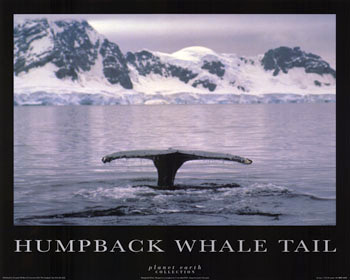
drawing of humpback whales courtesy of www.sfondideldesktop.com

For more information about humpbacks, check out the humpback-whale fact sheet from the American Cetacean Society. And see the PBS web site about humpback whales.

I would love to hear from readers your views about whale-watching and wildlife watching in general. The good, the bad and the ugly.

Wednesday, August 09, 2006

Fell Off Cliff While Seeking Seals, Whales, other Marine Mammals

photo courtesy of http://imagesource.allposters.com

I fell off a cliff last week and broke my arm. Okay, I didn't really fall off a cliff; it was more like sliding down a steep cliff face out-of-control.

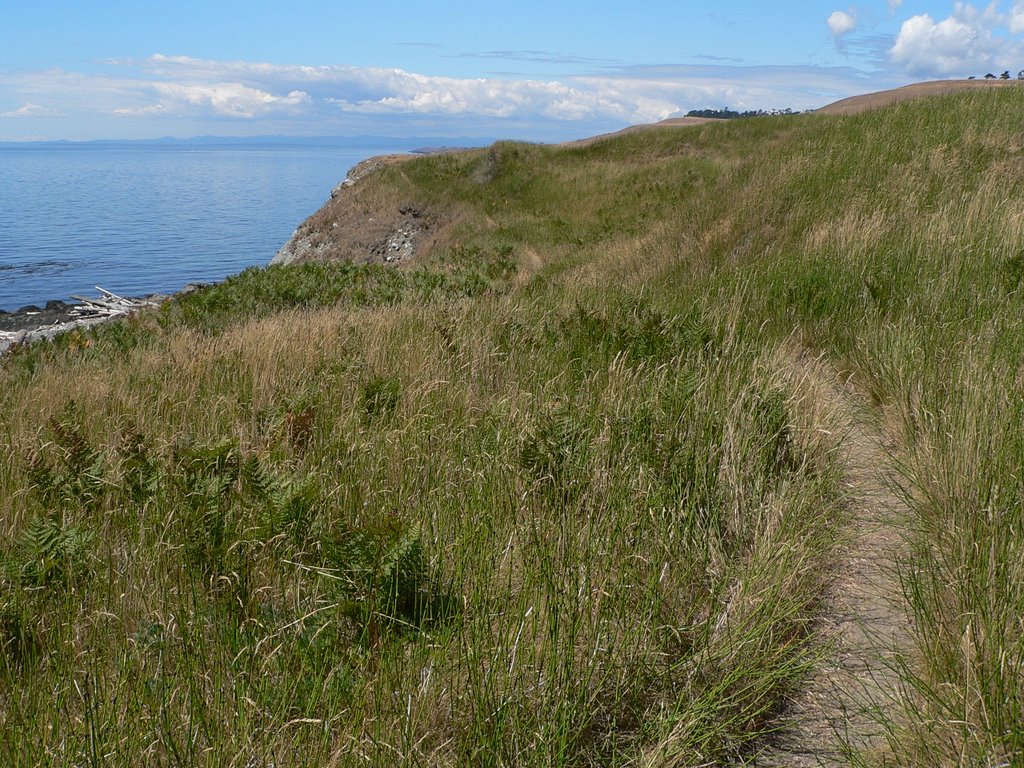
The day started serenely enough. We were camping and hiking in Washington State, looking for wildlife - my ecologist husband Ken and our two twenty-something kids, Sara Kate and Alan. On this particular day I was walking along a seaside cliff top on San Juan Island, looking out over the Pacific waters in Puget Sound. I spotted a baby harbor seal on the beach below, parked there by its mom as she went diving for food. I decided to clamber down the cliff to the beach for a better photo angle, while still keeping a respectful distance. (The Northwest Marine Fisheries Service recommends a minimum distance of 100 yards for all marine mammal viewing.) Finding no trail down the cliff, I went anyway, unable to resist the opportunity. I slid on the loose cobble, careened wildly, grabbed a boulder to stop my slide. But I grabbed it a little too vigorously, slammed it actually with my forearm. It hurt, but I didn't do anything about it until yesterday, 5 days after the incident, when we got home to North Carolina. Doctor said forearm is fractured, put a cast on it. C'est la vie ~ a little vacation souvenir. And yes, I discovered, one can hike and camp and manuever for 5 days with an untreated broken arm.

the cliff top I toppled from; Sally Kneidel

But anyway, back to the cliff and the seal....
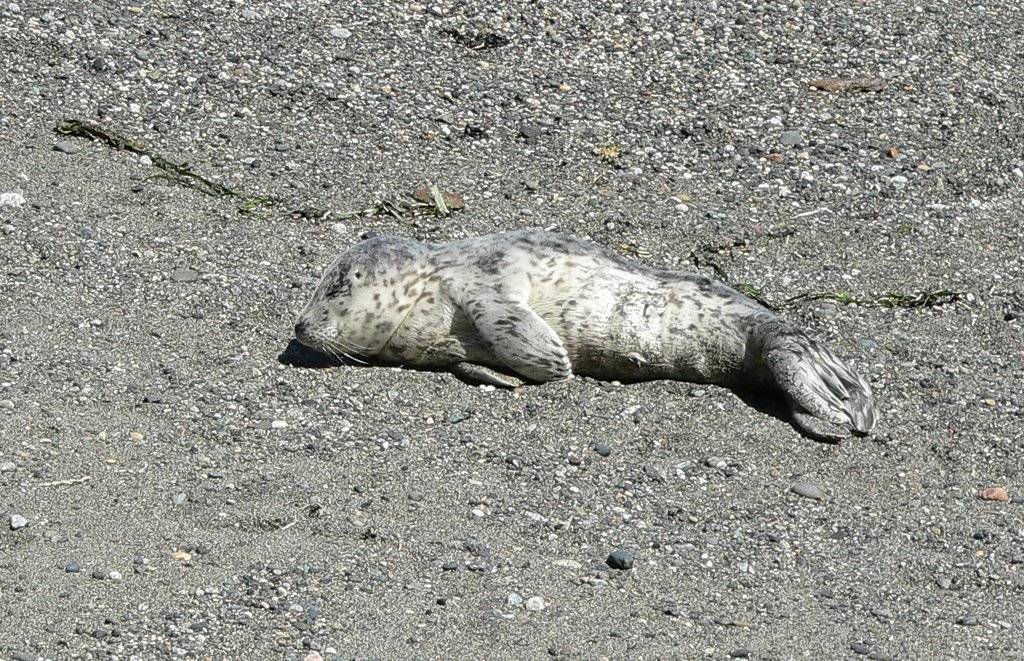
After my collision with the rock, I sat for a moment or two, cursing the cobble and waiting for the exploding stars in my arm to subside. Then I made my way down the remainder of the cliff face to the beach. The beach has lots of rocky outcroppings so it was easy to find a spot where I could photograph the little seal without alarming it. Here's a photo of the little critter napping, taken from a respectable distance.

baby harbor seal snoozing on beach at San Juan Island; Sally Kneidel

There are two different families of seals (pinnipeds) that are easy to tell apart. The most common ones in Washington are harbor seals. Harbor seals have rear flippers that point backwards only, and they move on land with an up-and-down undulating motion called "galluphing." They lack external ears - the ear is just an opening on the side of the head. Harbor seals propel themselves in water with their hind flippers. They have thin fur that doesn't trap air, so they rely on blubber for insulation. These features distinguish them from fur seals and sea lions, who have external ears, rear flippers that can face forward and allow them to move fast on land, dense fur that traps air for insulation, and large powerful fore flippers for moving through water.

Steller sea lions; photo courtesy of www.amnwr.com (Alaska Maritime Wildlife Refuge)

We saw harbor seals like the baby on the beach at several different spots on the coast of Washington and British Columbia, but saw sea lions only once, off the Pacific coast of Vancouver Island in Canada. I'll write about them in a later post. The male sea lions were huge - they can weigh more 2000 pounds!

After my ill-fated slide down the cliff and a few photos, I checked on the baby harbor seal periodically, from afar, for 2 or 3 hours. But the mom didn't return. So I went to a nearby ranger station for the national park service and told them about the baby - they said they would report it to the "marine mammalogy unit" who would watch it for the next 24 hours to make sure mom came back.

I just now called the park back (San Juan Island National Historical Park) and the fellow who answered the phone, Gordon, told me the beached baby went back out to sea at the next high tide that day, which suggests that mom came back. "They don't go to sea if the mother doesn't come back" said Gordon. I hope Gordon's right. And I hope curious hikers didn't frighten it into the sea before mom came back.

The population of harbor seals on the Pacific coast of the United States seems to be stable from the numbers I've been able to find. According to a 2003 article in the Journal of Wildlife Management, there are about 15,900 harbor seals along the Washington coast and 13,600 around the islands in Puget Sound, and their numbers are holding steady, in spite of challenges. Threats to harbor seals include reduced habitat, increased disturbance, and reduction in populations of fish prey such as hake and herring. I gathered from the journal article that harbor seals also prey on salmon, which generates friction with salmon fishermen. But seals are "protected," according to the federal government's Office of Protected Resources. The office's web site says "All marine mammals are protected under the Marine Mammal Protection Act of 1972."

EXCEPT....and there are a bunch of exceptions. The most insidious exception is "the taking of marine mammals incidental to commercial fishing operations." In other words, it's okay to kill marine mammals if you mean to be catching fish. As we learned while talking to salmon fishermen along Juan de Fuca Strait and Puget Sound and various other waterways of coastal Washington, the "gill nets" set to catch salmon there capture every living thing that comes in contact with the nets, including marine mammals and marine birds such as puffins and auklets. A salmon fisherman we talked with near Cape Flattery on the Olympic Peninsula said his waste "by-catch" from hauling in just one gill net on one day was more than 800 small sharks, all of which drowned, as sharks must keep moving in order to move water across their gills. He tossed all of them back in the water dead, he said.

To voice objections to the use of gill nets, you can check out the action underway by the Whale and Dolphin Conservation Society. Or google "gill net petition" or "gill net campaign" to find other conservation organizations working to limit the use of gill nets and other dangerous fishing techniques. When activists make a stink, things can and do change.

In the next few posts, I'll write about the other marine mammals we were most fortunate to spot - sea otters, Steller sea lions, and orcas. The August 11 post describes our sighting of a humpback whale, which was a thrill, along with links and conservation information. I'll also post a bit on what we learned about Washington's beautiful old-growth forests and the exploitive timber industry. Activists at work have made a difference. Stay tuned.


Thursday, July 27, 2006

Women Rising VIII: International Changemakers

Women are gaining influence as leaders throughout the world, fighting for peace, justice, the environment and civil society.

Listen to the program here


Clockwise from upper left: Anne Kajir,
Olya Melen, Dana Rassas and Ilana Meallam.

On this edition, we profile four courageous young ecology activists, going to court for environmental justice and leading regional cooperation to rescue precious natural resources and indigenous cultures. Anne Kajir is an indigenous lawyer fighting for the rainforest and the people of Papua New Guinea. Olya Melen is a Ukrainian lawyer who stopped her government from destroying the Danube Delta. Dana Rassas is a Palestinian activist on trans-boundary water policy issues in the Middle East. Ilana Meallam is an Israeli advocate for the indigenous Bedouin people of the Middle East.

Featuring:

Anne Kajir, Papua New Guinea indigenous lawyer and Goldman Environmental Prize recipient; Olya Melen, Ukrainian lawyer and Goldman Environmental Prize recipient; Dana Rassas, Palestinian activist; Ilana Meallam, Israeli advocate.

Host: Sandina Robbins
Producer/Writer:Lynn Feinerman
Mixing Engineer:Stephanie Welch

For more information:


Contact info for Ilana Meallem and Dana Rassas:

  • In Israel: The Arava Institute for Environmental StudiesKibbutz Ketura D.N. Hevel Eilot 88840 ISRAEL972-8-6356618; fax 972-8-6356634
  • In the U.S.: The Arava Institute North America293 Barnumville RoadManchester Center, VT 052551-866-31-ARAVA; roni@arava.org
    http://www.arava.org/

by NRP The National Radio Project
Greener Magazine

Friday, July 21, 2006

A Cat Trap Stops House Cat Predation of Birds and Small Animals

adult bullfrog

MY YARD FROGS
Over the years, we've put up with three neighborhood cats hunting in our yard. The cat next door cleaned all the bullfrogs out of our little pond, one by one. They were big frogs, 6 or 7 inches long not counting their legs. I loved the sound of their croaks on summer evenings. We live on a quarter-acre lot in suburbia, but the frogs migrated in to the pond on their own. We were so happy to have them. When they croaked, I could shut my eyes and pretend to be in the country. I loved them.

I had "trained" one of the bullfrogs to snatch crickets out of my hand. I started by tossing a cricket from the yard onto the surface of the pond. The frog would launch himself from his rock with his mouth wide open, engulfing the cricket as he hit the water. Gradually I began tossing the cricket closer to myself. Then I just held onto the cricket at water level, and the frog would jump and grab it while I still held it. Eventually, as I held it higher, he learned to leap a foot or more from the water and snatch it from my hand. Frogs have rudimentary teeth in the roof of their mouth - his "teeth" would rake the top of my fingers, but it didn't really hurt. I loved that old frog. I was only able to train one, the others were too timid.

I often saw the white cat from next door crouched by the pond, watching the frogs. I hoped the frogs were safe since they mostly sat on rocks surrounded by water. But they weren't safe. One day I found the chewed up remains of one of the frogs in the yard. Just the legs were left. After that, the white cat was on the prowl around the clock until all the frogs were gone. Even my cricket-eating frog. I was so mad!

TWO BAD CATS
Then the neighbors across the street got two Siamese cats. The slinky cats were only occasional visitors until fairly recently. The wildlife has been increasing on our street, I don't know why. More neighbors have gotten birdfeeders - that's part of it. Birdfeeders support small mammal populations too, who eat the seed that falls out. Our bird list for our end of our street is 109 species, not bad for a suburban land-locked area with no extensive woods nearby. We have a lot of rabbits, eastern chipmunks, gray squirrels, short-tailed shrews, and cotton rats in the yards on our end of the street. We have hawks and owls too, and it's fine with me if they eat all the wildlife they want. They're native predators and they were here before we were. Unlike the house cats.

A few months ago, the Siamese cats became a daily fixture in our yard. I work at a desk in the front bay window that faces out over the lawn. I spotted the cats stalking chipmunks and baby birds in the front yard this spring - which always sent me blasting out the door after them, a couple of times chasing the cats back home in my pajamas. More than once I banged on the neighbors' door to protest.

USEFUL LINKS TO CAT PREDATION ARTICLES; NEIGHBORS UNMOVED
But finally I asked the cat owners if I could talk to them in a calm moment. We've had cordial relations with them for years, if not cozy. I printed out a bunch of articles to take with me and met them on their front steps. As I described in a May 13 post, I started by telling them about an article from HSUS, the Humane Society, about dangers for free-roaming cats. HSUS' most compelling point is that free-roaming cats have an average life span of less than three years, compared to 15-18 years for indoor-only cats. Most roamers are killed by cars. Two-thirds of vets recommend keeping cats indoors at all times.

I also printed out for the neighbors a document from the American Bird Conservancy called "Human Attitudes and Behavior Regarding Cats." It's a really interesting paper full of cat stats, such as:

35% of cat owners keep their cats indoors all the time
53% of cat owners are concerned about cat predation
64% of survey respondents believe putting bells on cats keeps them from killing (untrue)
70% of respondents believe cats should be regulated to prevent roaming

I gave my neighbors these printouts, then I cut to the chase - the wildlife issue. Songbirds in the U.S. are threatened by the growing human population in lots of different ways. The most serious threat is habitat loss. Second is collision with windows. And third is predation by house cats. A recent Wisconsin study cited by the US Fish & Wildlife Service estimated that house cats kill more than 39 million birds every year in Wisconsin alone. Nationwide estimates are as high as a billion songbirds per year killed by domestic cats.

Lots of people will say that cats killing prey is "just Mother Nature." But there's nothing natural about house cat predation. They're not native to the U.S., for one thing. They're an introduced species, like kudzu or pigeons. The European colonists brought them here and they're increasing like crazy in the U.S. - from 30 million in 1970 to 60 million in 1990 (according to a University of Maine paper).

Most people don't make the distinction between house cats and native predators like hawks, owls, bobcats, foxes, weasels, etc. Populations of native predators are in balance with their prey. If prey numbers decrease, then predator populations decrease too, giving the prey population a chance to rebound. Plus, wild predator populations struggle with other challenges, such as parasites, disease, harsh winters. They’re not always in prime condition, not always efficient at catching prey. They may be able to catch only the sick, the weak, the old, the very young.

House cats operate totally outside of that balance of nature, because they're sustained artificially by their owners. They’re usually well fed, in good health. They’re very efficient predators, able to easily catch small mammals and birds in prime breeding condition. Being well-fed does not diminish cats’ hunting instinct – hunger and hunting are controlled by different parts of the brain. Not only that, but domestic cats prowl in much higher densities than natural predators. There might be a single Great Horned Owl in 10 square miles, but there’s a healthy house cat in every third house.

THE CAT TRAP
So back to the neighbors. I laid out my arguments in as brief and friendly a manner as I could, and gave them the articles. "So what is it you want us to do?" asked the wife of the family politely. “I’m asking you to keep the cats out of our yard,” I said, as nicely as possible. "We can't do that," she said. She explained that the cats have been outside for years, and they like it outside. I knew that. But I had said my thing, it was time to give it a rest. So I thanked them for listening to me and, leaving my articles behind, I walked back across the street, back home.

After our talk, the kitties' tours of the neighborhood and the wildlife killings continued unabated. A talk with five other neighbors revealed that other people on the street objected to the cats' marauding habits too.

So I called Animal Control and the county Conservation Science office. Both county offices said they would bring me a live cat trap. Animal Control said if I caught one of the cats, they would come pick it up and take it away, and the neighbors could retrieve it unharmed. So I had a trap delivered, for free. The cat-owning neighbors saw the trap being delivered. They were not happy about it, and came over to tell us so. But it had its effect. I never actually set the trap. Rather I left it in the yard for a few days. I also took every opportunity to chase the cats noisily out of the yard, slamming the door on my way out to startle them.

A couple of weeks after our first conversation, I noticed that the neighbors had put bells on the kitties' collars. I know bells aren't effective, but it was a sign that the neighbors were making an effort. I began to see the kitties less and less. I think they were gradually keeping the kitties inside more. I'm happy to say that I rarely see the cats now. Maybe twice a week I see them in their own yard in late afternoon. I haven't seen them on my side of the street for three or four weeks. I also haven't seen any dead birds or wounded mammals on our end of the street for weeks. Yay!!

I know cats are at the mercy of their instincts, but cat owners are able to make choices. There is no good reason to let house cats roam freely. A 2006 paper by ecologists in Wisconsin lists a number a resources and other papers that will be useful to anyone researching this topic.

I would love to hear from readers any other stories of neighborhood cats on the prowl, with good endings or bad.


Thursday, July 20, 2006

Corn ethanol, super fuel or hype

Corn is one of those all around workhorse crops, which we are able to grow successfully under a variety of circumstances over a wide range of terrain and climate. It can be popped, boiled, barbecued and turned into flour, deep fried used as fodder and decorated for Halloween so it is little wonder that so much hope has been pinned on the future of this super cob turned ethanol as answer to the current energy crisis.


Ethanol is the main component of E85, which is 85 percent ethanol and 15 percent gasoline and the E85 revolution has begun according to a recent story by the New York Times in which they report that as many as 39 ethanol production plants will be built in the coming year. Ethanol plants powered by corn have the folks who trade in commodities all "fired up" by the prospect for the future of their 'futures' as well as ours. The farming industry, in particular mid-western farm states like Minnesota, Iowa and Nebraska, are ready to declare an economic boom comparable to the heady days of the space program in the 60s. And everywhere consumers are ready to believe in the holy grail of salvation through corn - what could be more American?

And so we blithely head off to the showroom to seek out the newest and most cunning hybrid flex fuel guzzlers on the market and raise the standard for imports already promising 30, 40 60 miles per gallon and still the petroboomers are pushing for increases in off-shore drilling while Congress enacts huge tax incentives for ethanol production and continues to increase subsides for ethanol research and no one's gettin' fat 'cept mamma gas.

Turns out ethanol, while a great concept on paper, is not the fountain of truth for the oil industry. In fact, most researchers have for some time understood that producing ethanol from corn produces more emissions from the oil required to fuel the process than it saves in the end. Oil and gas are the fuel needed to grow, cook and transport the ethanol and there in lies the paradox, corn is simply not the best raw material from which to produce biofuel alternatives, sugarcane would be far better - it has more sugar content. Alas, sugar is also more expensive due to artificially high prices designed to protect a few domestic growers from foreign competition.

And so the debate rages as more Americans, some 2 million of us, drive our shiny new flex fuel cars, fueled by standard gasoline, while some corn producers worry that shifting so much of their crop to ethanol production will have a detrimental impact on the nation's food supply.

We are not likely to hear much from congress either. Facing mid-term elections members are not likely to vote against any part of the $2-billion in subsidies granted to giant agri-conglomerates like Archer Daniels Midland whose share last year fueled a 100 percent increase in their stock price.

Still, ethanol from some source, no doubt will be a significant part of the alternative energy that ultimately weans our economy off mamma gas. For now it is important only that Congress must attempt to spend our tax dollars on a variety of alternatives and not sinply rely so heavily on the corn solution.

by Harlan Weikle

:: 6/23/06 - A Greener media video discussion about corn ethanol and its market potential in the production of E85.

Saturday, July 15, 2006

People Taking Power with a Grassroots Fuel

Filtering waste vegetable oil
Photo courtesy of No End Press at www.noendpress.com/caleb/biodiesel/images/l21.jpg

Events in Middle East Fan our Fuel Worries
Recent events in the Middle East have many of us thinking once again about our dependency on foreign oil. Thinking about alternatives. Thinking about biofuels.

Vegetable oil and biodiesel are the most popular biofuels among the local folks in my neck of the woods. But vegetable oil and biodiesel (both for diesel engines only) are not on the front burner for either government officials or the media right now. No, the currents news is all about corn ethanol - both Detroit and the federal government are pushing it as the savior fuel. The production of corn ethanol (for gasoline engines) is surging. Archer Daniels Midland, one of the biggest corporations genetically modifying our crops, is also the biggest manufacturer of corn ethanol.

But who’s using ethanol? No one I know, except for the standard 5% in all gasoline to make it burn better. Corn ethanol reminds me of the faddish education philosophies that used to ripple through the school system during my teaching days. Some new idea, like “cooperative grouping,” would come along, and the school system would latch on like that was the solution to all of our instructional difficulties. All the teachers would be sent to workshops to learn the new methodology and software. Then a couple of years later, some other new bandwagon would come along, and “cooperative grouping” would be forgotten.

Corn ethanol is the energy bandwagon of the moment. Just a year ago, when Sara Kate and I began researching our new book, everyone was all excited about the promise of fuel-cell cars. Now, fuel-cells are passé. They’re not going to work and everybody seems to know it. They cost too much, and the production of their fuel uses too much energy.


Detroit in Trouble over Slumping SUV Sales
Even George Bush, the oil industry's best friend, is promoting corn ethanol. Why? Because Detroit is in trouble, and the automakers, as well as Bush, see corn ethanol as a potential savior. Sales of Detroit’s cash cows – the SUVs and pickup trucks – are slumping as gas prices rise. Consumers are seeking better fuel economy, but Detroit can’t compete with Japanese automakers for hybrid business. The Japanese hybrids have too big of a headstart – their factories are all laid out for hybrid technology, no retooling required. And Toyota’s Prius hybrid has been around for a decade now, long enough to have all the kinks worked out. The Japanese Prius is the gold standard for hybrids - it is by far the most popular hybrid.

So Ford has announced plans to focus on “flex-fuel” cars, which can burn a gasoline blend that’s up to 85% ethanol. No competition from Asian automakers. And Bush is supporting the development of corn ethanol as a gasoline supplement – to help Detroit automakers with their “flex fuel” dreams. To meet the clamor from consumers for fuel efficiency. To promote car sales. To keep GM and Ford from declaring bankruptcy.

Bush’s promotion of corn ethanol has little or nothing to do with tailpipe emissions and global warming. It’s about the automakers’ financial insolvency, and the economic dangers of their potential downfall.


Oil Profits Break Records
You might wonder, as I did, how George and Dick’s beloved and coddled oil industry might feel about the promotion of ethanol as a displacement for gasoline. Oil and gas companies go to great lengths to keep Americans addicted and slurping ever more gas and diesel. Between 1998 and 2004, the oil industry spent more than $420 million on politicians, political parties and lobbyists in order to protect its interests in Washington, according to a report by the Center for Public Integrity. So oil companies are not too happy about the idea of corn ethanol. But not to worry. ExxonMobil reported $36 billion in profits in 2005, a record for an American company of any kind. George apparently feels he can afford to divert some of his attention to baby number two, Detroit, who is sick at the moment.


Fatal Flaws for Corn Ethanol
And yet, how can corn ethanol possibly be the solution for automakers in crisis? At least 3 major obstacles stand in the way, some of which were outlined in more detail in our July 8 post.

1) The U.S. has only 600 filling stations (out of 180,000 stations nationwide) that are equipped to deliver a fuel blend that’s 85% ethanol.

2) Corn ethanol requires more energy to produce than it yields, for a net energy loss, according to Cornell scientist David Pimentel and many others. (This particular point is irrelevant for our eco-indifferent president.)

3) Corn ethanol requires more land than we have to spare for it, given that corn is our nation’s biggest crop and 56% of it goes to livestock already.


Corn ethanol is going to fizz out, probably sooner rather than later. Just like the fuel-cell idea did. (Cellulosic ethanol is another matter – as we wrote about in the July 8 post. We don’t yet have the technology to make cellulosic ethanol commercially viable, but probably will in coming years. And that could be a major part of a widespread solution to our gas dependency. I hope that it is.)


Question Authority
Meanwhile, do-it-yourselfers and entrepreneurs in my area are turning to waste vegetable oil as a fuel source. They’re the kind of folks who might have a “Question Authority” button on a bookbag - mavericks and free spirits, independent and frugal types. Some are forming coops to convert waste vegetable oil to biodiesel. Others are buying conversion kits to install in their diesel cars, so they can fill their tanks with straight vegetable oil.

I would like to get a diesel car. If I actually do, and I get a conversion kit to allow me to use straight vegetable oil as a fuel, I won’t have to buy any more gas, period. I can get used vegetable oil for free. Plenty of folks are doing just that, and restaurants seem to like donating the waste oil – they get to feel like a piece of the solution at no expense or trouble to themselves.

Using waste vegetable oil is sort of like dumpster diving. It’s the ultimate in recycling, reusing, reducing. Like vintage clothes and straw-bale houses and day-old breads donated by a bakery, using waste veg is making use of materials that would otherwise be entering the waste stream. And after the initial outlay for the conversion kit, burning waste veg costs nothing.

I interviewed a woman named Kim last month, a waste-veg user in North Carolina. She gets all her oil from a nearby Mexican restaurant. Her exhaust smells like tortilla chips! If our oil supply from the Persian Gulf countries completely evaporates next week, it won’t affect Kim’s use of her car. She’ll just head to her donating restaurant to get her weekly ten gallons of used vegetable oil. She’ll filter it herself, pump it into her fuel tank, and away she’ll go. Kim has a green and purple hand-lettered sign on the back of her VW Golf that reads, “This car runs on vegetable oil.” Wouldn’t that be fun? I want one. My neighbors would be puzzled. “What?” they’d say. “You know, donated restaurant grease,” I’d reply with a friendly smile. “Here, let me explain….”

It Feels Good
I realize that waste veg is probably not going to be the big replacement for disappearing petroleum fuels. After all, only 3% of cars in the United States have diesel engines that can burn vegetable oil. But still, for right now, it’s an exciting option.

Unlike ethanol, vegetable oil is not being promoted by politicos and billionaires and corporations with ulterior motives. Veg oil is a grassroots effort; it’s in the hands of the middle-class working stiffs like myself. A year ago, I didn’t know a single person using biodiesel or waste veg. I don’t think anyone in Charlotte was doing it. Now I know too many veg-users to count. Now, there are two biodiesel coops right here in my hometown! There’s a biodiesel coop in Pittsboro too, and in Statesville, and in Asheville…..the numbers are growing in the real world. Maybe there’s a limit to how far we can go with vegetable oil, I don’t know. But right now it feels like people taking power, and it feels good.

Saturday, July 08, 2006

Is It 2008 Yet? Bush Still Says Global Warming Uncertain


photo courtesy of www.mindfully.org

Best bumper sticker spotted this week: "Is it 2008 yet?"

I read in the NY Times this morning, July 8, that Mr. Bush continues to argue "that the science on global warming is too 'uncertain' to justify anything more than a voluntary effort to deal with it."

Oooo...kay...

What does he need to convince him? NYC under water? For George's 6oth birthday this past week, Laura should have strapped him into his seat and forced him to watch Al Gore's movie on the subject, An Inconvenient Truth.

On the subject of climate change, I see that our administration is heavily in pursuit of corn-derived ethanol as an alternative to oil from the Persian Gulf. That's nice. E85, a fuel that's 85% ethanol and 15% gasoline, creates far fewer greenhouse-gas tailpipe emissions than straight gasoline. But not just any car can use E85. Only "flexible fuel" cars can at present, and they are relatively rare today. Of course, that can be solved. The technology exists. New incentives could get flex-fuel cars on the road, if we had the fuel.

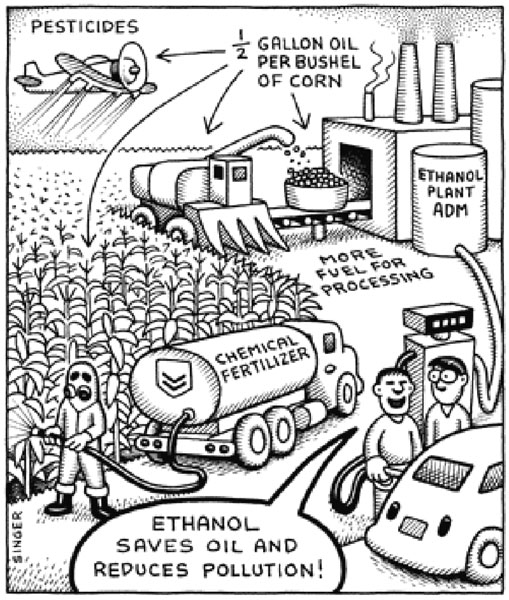
But even if we could all use E85 right now, there's another more serious problem. Using corn ethanol does not actually reduce our consumption of fossil fuels. Rather, many scientists argue, using ethanol actually increases fossil-fuel reliance. According to the calculations of Cornell environmental-engineer David Pimentel, 29% more fossil fuels are needed to grow corn and produce corn ethanol than are saved by using ethanol as a fuel. In a "best case" scenario, says Pimentel, the trade-off is even.

How can growing and processing corn use so much fuel? Corn is fertilizer-intensive; fossil fuels are used in the manufacture of nitrogen fertilizer. Farm machinery used to till, plant, harvest, shuck, etc., burn fossil fuels. The trucks that haul fertilizers, seeds, pesticides, harvested corn, etc., burn diesel fuel. And so on.

cartoon courtesy of Peaceworks Monitor, peaceworks.missouri.org

Corn ethanol has yet more problems. In order to replace the 1.6 million barrels of oil a day we're currently getting from the Persian Gulf, half of our country's farmland would have to be planted in corn destined for ethanol factories. Since 56% of our corn already goes into livestock feed....so that would be difficult. An economic forecaster cited in the NY Times predicts "a food fight between the livestock industry and this bio-fuels or ethanol industry" by mid-2007, over a limited corn supply.

I'm glad we're pursuing ethanol, but ethanol from corn is not the solution. Brazil is currently the world's leading producer of ethanol - from sugar cane - for a cost that's 30% less. But I don't know that sugar cane uses less land or less fossil fuels than corn, per gallon of ethanol produced. The real answer is cellulosic ethanol, produced ideally from waste plant matter, from farm waste.

At present we don't have the enzymes needed to produce cost-effective ethanol from cellulose. Cellulose is a structural molecule whose function is to hold plants upright, so it's a rigid and complex molecule, and it's tough to break down into the components of ethanol. Corn on the other hand is largely starch to feed the embryonic plant. It's soft and easily broken down.

Research continues for the purpose of developing new enzymes to break down cellulose, and we'll get there. Meanwhile, the Energy Policy Act of 2005 calls for the use of at least 7.5 billion gallons of ethanol in 2012. Although corn ethanol is not the ultimate solution, at least using corn ethanol now is creating an infrastructure for ethanol production and delivery, so that when the difficulties with cellulosic ethanol are unraveled, we can get it on line fast. Hopefully. Biodiesel and straight veg are great options for diesel cars, although only 3% of U.S. cars can use diesel.

In the mean time, I'm tapping my foot for 2008. Please, oh please, let us have an election where the person who actually gets the most votes can take the helm and guide us with some sense through treacherous waters. Imagine a president who would take responsibility for our role in creating the world's greenhouse gases, and lead the world in turning things around.

Friday, June 30, 2006

Review of the Documentary "Kilowatt Ours" by Jeff Barrie

image courtesy of www.peaceproject.com


"Kilowatt Ours" knocked my socks off. It's a testament to the power of documentaries to get our attention fast. In this simple but extremely effective film, Jeff Barrie documents how coal-mining power companies are exploiting the Southeast, with dangerous health and environmental consequences. And more appalling, he shows how we consumers are blithely supporting the power companies' clandestine activities with our gluttonous, if ignorant, energy consumption.

Jeff Barrie was smart, he started with the most violent scenes - mountaintops exploding into the air, reduced to river-clogging rubble. For every ton of coal removed from the mountains of West Virginia, the 6 million tons of earth and forest above the coal must first be pulverized and dumped into the valleys below. Barrie uses poignant interviews with locals impacted by the disappearing mountains and ravaged landscapes to document the damage.

Coal-fired power plants are bad news all the way around. The Southeast uses more power than any other part of the country. The average Southeast home uses 1100 kilowatt-hours per month; the national average is 850. In the Southeast, 61% of our power is from coal! According to the Department of Energy , the combustion of 1 ton of coal releases more than 5,000 pounds of planet-warming carbon dioxide into the atmosphere.

And in the Southeast, powering one average household requires a ton of coal every 8 weeks!! Seems unreal. But it is real.

Burning coal also releases sulphate particulates into the air, a major air pollutant. As a result, asthma is now the most prevalent chronic illness in children, the #1 cause of school absences. Barrie has several sad and tender scenes of children displaying the arsenal of drugs and inhalers they need to aid their breathing.

"These are some of the drugs I need to help me," says one somber little boy, gesturing to a counter-top covered with medicine bottles.

Another interesting scene in the movie shows Dick Cheney saying that our energy use in the U.S. is so high (and our population is growing so fast) that we will need one new power plant every week for the next 20 years to keep up.

That is a sobering thought.

Then Barrie gets to the solutions. I love this part. He profiles schools, homes, businesses that are cutting back on their energy use with simple measures. Jeff and his wife Heather live in a basement apartment in Nashville. Simply by replacing all their incandescent bulbs with compact fluorescent bulbs, and buying a used energy-efficient frig for $200, they cut their power usage in half. Then he explains how most or many power companies offer a green-power option. By checking a box on your power bill and paying a small extra amount, you can specify that you want all your power to be drawn from green sources, such as wind and solar. This gives the power company incentive to develop more green sources. I know we have that option in North Carolina. You can learn more about it at NC Green Power. Barrie demonstrates that if we all adopted simple energy saving measures to make our homes more energy efficient, and opted for green power on our power bills, we could get rid of coal-fired power plants altogether. He's pretty convincing. After watching it, we replaced the last of our incandescent bulbs with compact fluorescent from Home Depot. They cost more, but they're supposed to last 6 or 7 years. And use only 10% of the energy of incandescent. The light is the same warm glow as incandescent.

Barrie did a great job. His film makes me want to study how he pulled it off - so simple and powerful a statement of problem and easy solution. It's personal, it's factual, and it's absolutely convincing.

Prisoners at the pump

With the current price of gas, I sure am glad I live on a farm and don't have to drive anywhere most days. As far as cars go, there's just nowhere to go, 'cept maybe the swimming hole - and we get a government subsidy on the diesel for our tractors. Still, on the days when we do have to make the 45-mile trek into town, I remember the good old days, when gas was $0.89 a gallon, with a nostalgic sigh. Oh, 2001... it seems like a dream to me now.

The rest of the time, however, I secretly support the high gas prices. Could financial alarm force environmentally-blind Americans to reconsider the casualness with which we hop behind the wheel? Maybe people who don't care about the environment do care about their own pocketbooks. In researching our next book, I've found out that in just one year, the average driver emits about 10,000 pounds of carbon dioxide into the atmosphere, as well as 300 pounds of carbon monoxide, and close to 10 pounds each of hydrocarbons and NOx. That’s some heavy junk floating around in our air and our lungs! To find out how much your vehicle emits, enter your stats into the EPA’s Tailpipe Talley at www.environmentaldefense.org/TailpipeTally/.

If you didn’t like the results of that test, fortunately there are a number of approaches to changing those stats, even while driving on gasoline. Don’t get me wrong – gas is dirty, no matter how you drive. But a few small changes in your driving habits, from how you drive to when, can have great cumulative effect. If just 10% people used public transportation for their work commute only, it would save 135 million gallons of gas a year – not to mention lots of pennies at the pump. And even in your private car, how you drive makes a huge difference in your environmental impact. A few steps you can take include:

· Don’t warm up your engine before driving. The engine emits the most pollutants when cold, and it heats up faster when driving than idling.

· Combine outings. Even if you have to turn the car on and off at each parking lot, using the car for many errands at once reduces the number of cold starts.

· Drive steadily. The most fuel efficient speed is between 35 and 45 mph. It’s much more efficient to chug along steadily at 45 mph than to race to a stoplight only to slow down, idle, and accelerate again.

· Don’t idle. Leaving the car running for thirty seconds uses just as much gas as it would to restart the engine.

· Maintain your car. A faulty or poorly serviced engine can release up to 10 times the emissions of a well-maintained one. This includes all parts of the car; old tires, for example, impede the car’s movement and decrease its fuel efficiency.

· Share rides. It costs you about 25 cents a mile to drive your car, figuring in all the operating costs as well as fuel. By ridesharing on the daily commute to work, you can save as much as $3,000 a year on gas, insurance, parking, and car maintenance.

· Drive at non-peak times. This is the best way to avoid idling, stop-and-go traffic, and non-fuel-efficient speeds on the road.

If you think all this is insignificant, think again. The amount of gasoline and money wasted by inefficient driving is tremendous, adding up to 753 million gallons of gas per year, or $1,194 per driver in wasted fuel and time. Just think of the catalytic converters you could buy with all that money!

-Sara Kate

Wednesday, June 28, 2006

Three Gorges Dam

Earlier this month the cofferdams designed to temporarily hold back the rising waters of the Yangtse River were removed and China's greatest engineering feat, Three Gorges Dam, cut the heart of the dragon. When completely filled in 2008, the reservoir formed by Three Gorges will stretch 412 miles to Chongqing, creating a long, deep, wide and slow moving river that will enable safe, reliable navigation along China's most important waterway, as well as an important hydroelectric resource for the Chinese economy.

Three Gorges Dam, became a reality after nearly 100 years of planning. In 1919 Chinese Premier Sun Yat-sen speculated about the benefits of constructing a modern hydroelectric project on the Yangtze River. By the end of WW II, the first director of the TVA (Tennessee Vally Authority,) David Lilienthal wrote a book, TVA: Democracy on the March later published in China, which is widely considered to be the inspiration for the Yangtse project.

Three Gorges Dam was envisioned to harness the great river or long river, as the Chinese call it, which winds its way 3,900 miles to the East China Sea. The river coils like a mythical dragon through an area that is home to nearly 400 million people. Three Gorges Dam spans the point where the last of three narrows called gorges funnel the annual runoff from the 20,000-foot high Tibetan plateau. Annual floods have, over the last century, caused billions in damage and the loss of hundreds of thousands of lives. Flooding in 1911 killed unknown thousands and again in 1931, took the lives of another 145,000 people, inundating an area the size of New York State, and submerged more than 3 million hectares of farmland, destroying 108 million houses. In the flood of 1935, 142,000 people were killed. As recently as 1998, flooding along the gorges led to 3,656 fatalities, and affected the lives of 290 million people. In that flood, there were more than 5 million houses destroyed and 21.8 million hectares of farmland submerged. The total economic cost of the flood that year was for $30 billion.
When first proposed, the construction was touted by government officials as reminiscent of last century's development of the Tennessee Valley Authority to control flooding in the United States. Three Gorges Dam, which has 26 generators, will produce 85 billion kilowatts of electricity per year, nearly one-ninth of China's present power needs. The control storage of the Three Gorges Dam reservoir is 22.15 billion cubic meters; the flood causeway is 483 meters, with the maximum discharging capacity at 102,500 meters per second, also a record. The two-way, five-step lock is also the most advanced in the world.

When Chinese authorities announced in 1992 that China would begin construction, at last, of Three Gorges Dam they faced considerable resistance from environmental and humanitarian interests around the world. Entire towns were to be displaced by the rising water, thousands of lives uprooted and moved, ancestral ground submerged forever. As recently as the last Presidential elections in the United States, environmentalists voiced caution that the project would result in increased industrialization along the banks of the Yantgse resulting in elevated levels of pollution across one of the world’s most densely populated regions. Recent spectrographic analysis provided by Envisat orbited by the European Space Agency reveal a trend toward increasing levels of nitrogen dioxide, a compound suspected of being a major contributor to global warming. The potential for accelerated NO2 increases is not without concern for environmentalists.

While it would seem that flood mitigation, with its consequent reduction in the loss of life and property, would be a worthwhile commitment, environmentalists point out that such control projects are unlikely to overcome a 100-year event. During the intervening control cycle, populations increase and the memory of past events fades to the point of dangerous disregard and that in such an event more lives could be lost than in all previous floods combined.

Silt accumulation is another disadvantage of large damming construction, the slowing of the river allows greater amounts of silt to settle out of the stream. The Yangtse is one of the world’s most turbulent rivers pouring 960 billion cubic meters of water into the East China Sea annually. The subsequent silt bloom is visible from space and scientists are uncertain what effect the discontinuance of this sedimentary deposit into the East China Sea will have in the long term.

The Three Gorges Dam, while providing great economic and cultural benefit to a growing Chinese economy, at the same time seems to reprise the doubtful contribution of similar undertakings over the last half century of dam building in the United States. Damming projects here have largely failed to provide long-term solutions to soil erosion, flood control or power supply even while they promoted industrial growth and economic gain. Perhaps, in the end, manipulating nature for short-term advantage may prove to be a double-edged sword afterall and not a true dragon slayer.

by Harlan Weikle
Greener Magazine

Wednesday, June 21, 2006

Al Gore's An Inconvenient Truth Is the Most Important Movie I've Ever Seen


I was blown away by Al Gore's new movie, An Inconvenient Truth. It's the most important movie I've ever seen. Forget Hillary or John Edwards - if Al Gore runs for president, he's got my vote.

But it's not a political movie. I'm only saying that because Gore truly "gets it." He understands that if we don't stop what we're doing within the next generation, we'll reach a point of no return - the beginning of an inexorable slide into the destruction of our own civilization and all the other species that share the planet with us. There is no other issue that even comes close in importance.

Gore is brilliant. The movie was a perfectly crafted script and performance, the optimum blend of personal journey and science, of frightening predictions and empowerment.

I just hope it's not all preaching to the choir - I hope the Bush supporters (if there are any left) will go see it. I hope those who still say global warming is a "theory" will see it. Most of what he said, I already knew more or less, as a biologist and a science writer - but it still floored me. The movie was by far the most powerful articulation of any issue that I have ever seen.

Gore pointed out many facts that I know to be true. One of those, a fact that my husband Ken tells his biology classes, is about the unwavering conviction of the scientific community. Of 928 published articles in scientific peer-reviewed journals on the subject of global warming, all 928 agreed that global warming is a fact, and is a result of greenhouse gases from our burning of fossil fuels.

But as the result of a propaganda campaign, the popular media are far from such a consensus. Only 43% of popular media stories fully support that global warming is a fact. They have been swayed by an all-out effort from the oil industry to "reposition global warming as a debate." As Gore points out, these are the same tactics perpetrated by the tobacco industry. Both of my own parents died of smoking-related cancer. My mother smoked three packs a day for five decades, and my dad and brothers and I breathed the secondhand smoke day in and day out. Everyone knows now that the tobacco industry suppressed information and deceived the public as long as possible, just as the fossil fuel industries are doing now. Only now the stakes are higher - we are literally talking about eventual extinction of a planet.


Some of the facts that I managed to scribble on the back of my ticket stub (after leaving my note pad in the car):

The ten hottest years in recorded history have all been within the last 14 years. The hottest of all was 2005.

One reason our production of greenhouse gases is increasing so fast is the increase in world population. "It took 10,000 generations for the world's population to reach two billion, and in a 95-year period, it is expected to go from two to nine billion," Gore said. An undisputed fact. See the International Data Base and Population Connection for more on that topic.

Gore pointed out that we in the US are responsible for a huge proportion of the world's troubles with global warming. Of the worldwide emissions that contribute to global warming, 30.3% are generated by the United States - although we have only 5% of the world's population. There are only two industrialized nations in the world that have not ratified the Kyoto treaty to limit greenhouse gas emissions - the United States and Australia. We guzzle fossil fuels because we're wealthy in relation to the rest of the world, and we can afford to. Wealthy, yet oblivious to the consequences of our consumption. We're oblivious because of the conspiracy by the fossil fuel industries and the Bush pro-oil and pro-industry administration to keep us guzzling and ignorant. (This is my point more than Gore's. He said almost nothing about Bush. As I said, it was not a political movie. He was careful to keep it scientific rather than political.)


The most conservative projections are that worldwide temps will increase (on the average) 5 degrees in the next few decades. But that's not evenly distributed around the globe. During that period, the equator will gain one degree, while the poles will heat up by 12 degrees. One reason for that is the loss of ice. Ice reflects 90% of solar radiation back into space. When ice caps melt, the water in their place absorbs 90% of solar radiation that strikes it, heating up accordingly. The polar ice caps are already melting, as are glaciers around the world. The film had footage of dozens of disappearing glaciers - before and after meltoff. If or when half of Greenland melts, and certain pieces of Arctic ice melt that are already well on their way, then sea levels worldwide will rise 20 feet, inundating coastal cities worldwide. For the first time, scientists are finding significant numbers of polar bears who have drowned, unable to find solid ice to stand on.

Yet, it's not hopeless by any means. We still have the power to reduce those emissions with only minor lifestyle choices. It's not like giving up cigarettes altogether. More like cutting back from three packs to one or two packs a day. Can we do it, so we can send our kids into a future that has some promise?

Here are Gore's tips on what we can do to take action and bring about change.

The recommendations are simple, such as using compact fluorescent bulbs in your light fixtures, and turning off TVs etc when not in use. See the movie's web site at www.climatecrisis.net for more information. The Union of Concerned Scientists and Natural Resources Defense Council and Environmental Defense have useful web sites on the topic too. The World Wildlife Fund has great suggestions about things we can do at home that make a big difference.

We're going to Home Depot tonight to change out the rest of our bulbs. We can still turn this thing around. But we may be the last generation to have that option.

Friday, June 16, 2006

How to Convert a Lawn to a Native Meadow or Woodland


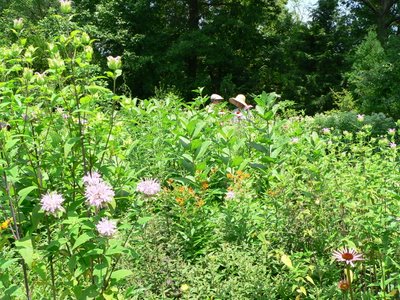
An All-Native Meadow of Wildlife-Friendly Plants in North Carolina

photo by Sally Kneidel

Before yesterday, I'm not sure I'd ever seen a meadow of all native plants anywhere east of the Mississipppi. But I have now, and it was stunning! I interviewed Beth Henry and Mollie Brugh yesterday, about their conversion of a schoolyard to a native meadow and a native woodland in North Carolina. They've gained some local fame with their successful and lovely landscape restoration projects. I'd like to follow their example in my own bedraggled yard, which is neither lawn nor meadow, but a pathetic mixture of trampled invasives, sparse dehydrated grasses, and bare spots.

We took a tour of the schoolgrounds and Beth's property around her own house, which she also converted from lawn to native meadow and woodland. At both sites, home and school, most plants were selected for the seeds or fruit or nectar they provide for wildlife. Although the schoolyard is impressive, Beth's property at home is even more so, since she was able to follow her own whims entirely, and she has full sun for half of it. So I'm going to focus on that.

I was astonished at how beautiful Beth's meadow is. I expected it to be parched, because NC is hot and dry in summer. But it was lush and green. Being all native plants, they're adapted to this climate and need no watering, no fertilizing, no tending whatsoever. So many flowers! Purple coneflowers, lantana, pagoda dogwood, and many many more. She had passion flowers for frittilary butterflies, native grasses for skippers - she knew which plants are hosts for which caterpillars, which plants provide the best nectar, seeds, and fruit.

Beth has had her home meadow and woodland for 4 years now. She got a lot of her ideas from two books by Sara Stein - Noah's Garden and Planting Noah's Garden - which she said were a tremendous inspiration.

Replacing Lawn with Native Meadow
The first thing to do in converting a lawn, Beth said, is to lay down a thick layer of newspapers all over the lawn, and cover the layer heavily with mulch. She ordered two dumptrucks of mulch for her own yard, but she has a couple of acres. Beth said to leave the mulch-covered newspaper down all summer to kill the grass.

After she removed all the dead grass on her own property, Beth was ready to plant. No tilling or fertilizing needed for native plants. She put in plugs of small already-sprouted seedlings. Very young plants. She said there are a lot of good sources of native seedlings that have been propogated by growers rather than wild-dug. Avoid wild-dug plants, obviously. In North Carolina, she uses these sources: North Carolina Native Plants Society, Meadowbrook Nursery in Marion NC, Northcreek Nursery, Carolina Greenery, Winghaven. By googling "native plants" and then your state name, you should be able to find a native plant society in your own state or a nearby state. By asking around, you may find a seed-swapping group that meets periodically in your area to trade seeds. Your state's native plant society may have a list-serve to help find such a group.

To plant a plug of soil holding a young plant, Beth took a narrow shovel, plunged it into the soil and pushed it forward, creating a slit just wide enought to put in the plug. Then she tamped the soil around it with her foot. She put the plugs about a foot apart, watering them only until they were established. She mixed the species up overall. She started both meadows, at the school and her home, with 6 species of native grasses and 17 species of native wildflowers, planting 3 or so plants of one type together, but not all the plants of one type in the same spot. So her meadow looks like a heterogeneous mixture - a small group of coneflowers here, and another small group of coneflowers over there, with several other types of plants in between.

Planting the Woodland
Beth already had a woodland with native trees at her home, but the ground was covered with English ivy and Japanese honeysuckle - both invasive introduced species that spread aggressively. She had to pull all that out by hand first. Then she just started buying shade-loving native wildflowers and shrubs, and planting them, a few at a time, under the canopy of trees. Now they form a substantial underbrush of native plants with seeds that are edible for wildlife, such as "hearts a'bustin," which has gorgeous hot pink and orange seed pods. And delicate little "rue anemone" and "spring beauty."

Beth said that replacing lawn with woodland is more difficult, although it certainly can be done. The trees will self-establish as "volunteers" - from acorns buried by squirrels or maple seeds blown in on the wind. If you're willing to wait. Or if not, you can buy wildlife-friendly native trees from a local nursery, such as persimmon, dogwood, mulberry, blackgum.

The good thing about an already established woodland is that the weeds are suppressed by the ground cover of dead leaves. When you're making a woodland from lawn, there is no leaf cover, and the weeds, Beth said, are "outrageous." Why not just let the weeds go? Because many of them will be invasive "exotics." In this sense, "exotic" means not native, or introduced from another country.

The National Wildlife Federation has state-by-state listings of native plants that are beneficial to wildlife. Click on the red flower that says "Native Gardening." The Cornell Laboratory of Ornithology has lists of bird-friendly trees although they don't appear to all be native trees. By googling "native trees" or "native plants" and your state, you can probably find other lists of native plants and trees that are beneficial to local wildlife.

Ken and I were walking last night, imagining our whole street converted to native meadows and woodlands instead of lawns. Every street a wildlife habitat! Instead of the pointless green lawn after chemically-sustained green lawn....such a pointless and energy-intensive use of space. Could it happen? We can make it happen. Every converted yard sets a precedent, making it easier for others to follow. Seeing Beth's yard was a revelation to me.

For more info about beneficial native landscaping, see my June 12 post, "Lawns Are 5th Largest "Crop" in Terms of Land Use."

Monday, June 12, 2006

Lawns Are 5th Largest "Crop" in Terms of Land Use

photo courtesy of www.summerwindlawn.com

The Southeast is already baking in the summer heat. The grass in our yard is crispy from the heat and lack of rain. Not that I care about our "grass." It's not grass anyway, it's mostly other plants - plantain, wild violets, oxalis, clover, chickweed - mowed to simulate grass. Upon close inspection, the yard also turns out to be a minefield of chipmunk holes. One area has so many holes that the ground is actually starting to sink, which is fine with me. Maybe if we're lucky, some big and interesting wildlife will move into the hole. But not likely, since I saw Animal Control trolling the neighborhood last week for raccoons and possums to tote away.

I would like to get rid of the grass altogether. I learned just last week that grass is the 5th largest "crop" in the United States, after corn, wheat, soybeans, and hay - in terms of land use. I was surprised to learn that the use of pesticides is 20 times greater per acre in residential yards than on farms!! For what purpose? Most yards don't grow a single thing we use for food or clothing or fiber - they're purely ornamental. The practice of covering our yards with a monoculture of grass and manicured non-native shrubs and flowers is chemical-intensive and energy-intensive and high-maintenance. All the trimmings and clippings and mowings required to keep these non-native plants looking tidy generates 20% of our landfill waste, in spite of recent effort to mulch and recycle yard waste. I was surprised at that. So much yet to learn...

I called Scott's lawn service a couple of weeks ago to find out what they would recommend for our yard - just out of curiousity. The lad who came out was quite nice. Said the standard prescription is herbicides to kill all the non-grass plants, such as those named above, the application of 4 lbs of chemical fertilizer per 1000 sq ft of lawn, insecticides to kill "turf-damaging insects," and GrubEx as needed to kill grubs, which are food for moles. This is per visit. The contract includes 5 or 7 visits per year, depending on whether you get the regular or deluxe version. The latter also includes aeration and seeding.

I thanked him for his visit but declined the services.

I would like to just let our yard go to succession - let it just grow untended for a few years and see what happens. One of my neighbors did that. His lawn is about 6 feet tall now, looks heterogeneous and interesting. But....I realize now that that's not necessarily a good idea, because a lot of the plants that colonize our lawns on their own are not native species. When people plant ornamentals, some of them spread aggressively, and wind up in my yard too. Non-native plants that spread aggressively, whether by seed dispersal or vegetatively, are called "invasive species." The county conservation office told me last week that the plant life in one of our urban nature preserves in Charlotte is 30% introduced or non-native species. None of which were planted there intentionally. Some were dumped there as trash before the area became a nature preserve. But a lot of them were started by seeds dispersed by way of wind or animal droppings.

To landscape a yard in a way that's really eco-friendly, I need to choose native plants, and ideally plants that will also feed local wildlife. Wildlife are adapted to survive on the food and shelter provided by the plants they evolved with. These plants could include native holly, mulberry, persimmon, sunflower, dogwood....

Sara Kate learned in a edible plants workshop she attended that the pre-Columbus indigenous people of this area subsisted mainly on mulberry, persimmon, chestnuts, and walnuts, with lesser amounts of wild greens. Supplemented with some meat on occasion, I suppose. Or not. I don't really know about that.

I'm thinking about planting some native wildflowers. But where can I get native wildflowers without digging them up and removing them from their native habitat? Don't want to do that. Maybe I could collect a few seeds from native flowers, after the flowers have gone to seed. That wouldn't hurt the plants. I could leave some seeds behind. Gonna look into that....

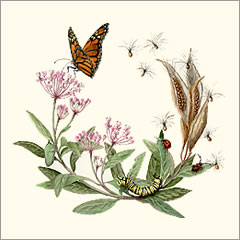
drawing courtesy of NC Botanical Garden at UNC Chapel Hill

Actually just found a good web site about "Landscaping with Native Plants" by googling native plants North Carolina. It lists some nurseries that sell seeds for native plants. I wonder where the seeds come from. I hope they're from propagated plants, so that wild stock are not being depleted of their seeds. One of the nurseries listed is nearby, so I'm gonna check it out....

Sunday, June 11, 2006

Working on an Organic Farm; Book Coming Together

photo courtesy of www.foodsubs.com

The pub date for our next book, about green consumer choices that really matter, has been pushed back to fall of 2007. So suddenly we have more time, which is very nice, as I've been driving myself insane working 14 hours a day. Sara Kate has been working hard on the book too - as her jobs allow - on a unit about the fishing industry. She interviewed a PhD who works for a fish sticks company, who dropped one of the many little gems Sara has discovered about the fisheries world. The scientist told Sara Kate that the workers at her company often pee in the vat where fish sticks are being mixed. Just for the hell of it, because they can.

Sara Kate is working on a unit now about soy products and dairy products. I eat a hell of a lot of soy....but I wish it was local. It's not. I do try to get organic soy products, so I'm not funding companies like Monsanto and Archer Daniels Midland who have already genetically modified most of our soy, corn and cotton crops, and are gearing up to tinker with the rest of our vegetable seed stock. Organic certification is our strongest weapon right now against genetic modification of our food supply.

Sara Kate and Matt are working on an organic farm in the mts of NC - Mountain Harvest Organics. The farm workers are Carl and Julie, the owners, and Mandy and Trapper, the other two hired workers. The farm has 35 clients who get a box of organic veggies and fruits every week, so it's a CSA. (A CSA - for Community Supported Agriculture - is a farm that signs up clients for a yr at a time, for an annual fee. The clients take whatever organic produce the farm has available for any given week.) The farm also sells organic produce at the North Asheville Farmers Market every week, and at the Waynesville Farmers Market.

Alan has done some pieces for the book too. He's written about the longleaf pine community, which used to dominate the Southeastern coastal plain, but has been almost completely replaced by loblolly pine plantations. E.O. Wilson, Harvard biologist and Pulitzer Prize winner, told me in an email last week that at least 90% of the biodiversity in a native forest is lost when the forest is replaced by a pine plantation. Alan did a piece about train travel and bus travel too, for the new book's section on green travel options. Bus travel, as it turns out, is the form of travel least costly in terms of energy use and overall environmental impact. Alan is getting ready to write something for the book about stream restoration - his job at present.

We are still looking for contributors on other topics - anything to do with green travel options, green housing, and eco-friendly diets. If you're interested in writing something for the book, email us at twogreenpencils@hotmail.com with your idea. You don't have to be an expert. We're interested in ordinary struggles of people trying to make sustainable choices.

"Some of them were dreamers....who were making plans and thinking of the future."
Jackson Browne, After the Deluge