Showing posts with label southeast Asia. Show all posts

Monday, December 06, 2010

Hunting may threaten orangutans even more than habitat loss

Wild adult male orangutan on Sumatra. Photo: Sally Kneidel

[See bottom of this page for list of my previous posts about orangutans.]
Most people are surprised to learn that unlawful traffic in wildlife and wildlife parts is the third biggest criminal activity in the world, after drugs and arms. The illegal hunting of great apes is so pervasive that it may threaten their survival even more than habitat loss does. Habitat loss is rampant these days, due to human population growth....so I wouldn't have believed that hunting could be an even bigger threat until reading a recent paper by Vincent Nijman (and 5 other scientists). Nijman is a scientist at Oxford Brookes University, a consultant to TRAFFIC, and has published numerous research papers on orangutan conservation.  He and the other authors of this particular paper collected convincing data that suggest orangutan populations have been reduced more by hunting than anything else.
 Wild male orangutan resting, Sumatra. Photo: Sally Kneidel

I crisscrossed Indonesia and Malaysia looking for orangutans

I was on the islands Borneo and Sumatra a few months ago, searching high and low for wild orangutans. That was my main reason for going to Southeast Asia.  I had researched sites carefully in advance and I chose my destinations accordingly; consequently, I was lucky enough to see a number of wild orangutans in undisturbed forests. But as Dr. Nijman writes, "Bornean orangutans currently occur at low densities and seeing a wild one is a rare event." In contrast, historic collectors like Alfred Russel Wallace in the 1800s saw many orangutans daily and "were able to shoot continuously over weeks or even months."  Clearly, orangutans are much rarer today than they were in the past. That's true not only of orangutans, but also for the other great apes.

Chimpanzees and gorillas are hunted for meat

I saw on the "Planet Green" network on November 24 a one-hour documentary about an investigation into the hunting of chimpanzees and gorillas for bushmeat in Cameroon. The investigator, Steve Galster, said these two apes are popular meat because they're so big and fleshy relative to other remaining wildlife. The primary reasons they're shot or trapped is to eat them, to sell their meat to neighbors, or to transport the meat by train or car to city markets. But when baby animals are captured after shooting the mother, the babies can be shipped abroad to be sold as pets. So killing a mother ape is doubly profitable.
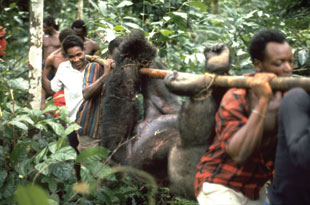
Gorilla carried out of the forest. Photo courtesy of United Nations' Food and Agriculture Organization

A pet chimp brings social status

I was impressed with the diligence of the filmmakers for this Planet Green show, which featured an undercover sleuth (a local woman) equipped with a tiny concealed camera visiting a local man who was trying to sell a baby chimp. The chimp was eventually confiscated and sent to a sanctuary. Even at the sanctuary, though, young chimps are vulnerable to theft in order to sell them. The demand for them is huge.

 Baby chimp, Wikimedia Commons 

Having a baby chimp is a social asset, the narrator said - something to show off no matter where you live. I can imagine that. There aren't many things in life more interesting than a living baby ape. In this Planet Green documentary, the poachers and smugglers who were caught on film all wound up going free, through "negotiations" (bribery) or police who failed to show up in court, or officials who took pity on impoverished poachers and their children.

Strong evidence that hunting has hurt orangutans more than habitat loss

The research of Vincent Nijman (and 5 colleagues) into the hunting of orangutans on Borneo was published in the online journal PLoS ONE in August, 2010. The researchers used "encounter rates" to measure the density of orangutans over the last 150 years in a variety of different habitats on Borneo. Their data came from hunting accounts, museum collections, and field studies. By the researchers' calculations, the number of Bornean orangutans has declined about 6-fold since the mid-1800s. The convincing aspect of their data is this: If large-scale deforestation and forest degradation caused the decline, then we would expect to see a sudden decline after the 1960s and 1970s, "coincident with major intensification of [deforestation] during this period." However, encounter rates declined steadily for at least 120 years before major deforestation began. Furthermore, say Nijman et al., although orangutan numbers do generally decrease following habitat disturbance, they manage to survive in high densities in some areas that have been heavily disturbed or even clear-cut and planted with monoculture plantations. Nijman et al. also noted that local orangutan extinctions or historical declines have occurred in the same areas where we know orangutans have been heavily hunted.

 Mother and infant orangutan in forest on Borneo.  Photo: Sally Kneidel

Orangutans now extinct in upland Borneo, where hunting was heavy historically

Mother and infant orangutan on Borneo.  Photo: Sally KneidelFor example, orangutans have long been extinct in upland areas of Borneo where poor soil prevents farming - areas that were historically populated by nomadic humans forced to rely on hunting. In contrast, freshwater and peat swamp environments were mostly not inhabited by people until the 19th century, but were densely populated by orangutans. The PLoS ONE paper sites many other examples of hunting-related distribution patterns of orangutans. In eastern Sabah (a state in Borneo), roving bands of head-hunters provided a refuge for orangutans and other wildlife, because other humans were afraid to enter the area. That refuge ended when head-hunting was banned.

Nijman et al. conclude that hunting has been underestimated as a key causal factor of orantugan density and distribution, and that orangutan population declines have been more severe than previously estimated based on habitat loss only.

Why do people still hunt orangutans?

The red apes, among our closest relatives, are still hunted for food or traditional medicines, as agricultural pests, for trophies, and more recently, for the pet trade. When I was in Southeast Asia in June and July, I visited the wildlife markets of Jakarta, where vendors openly flaunt wildlife-protection laws that are seldom enforced. There I was offered pet orangutans, along with many other supposedly protected primates, protected birds, and even a baby jaguar. Many told me they were carrying on a family business that had been handed down by their fathers. For more about my time in the Jakarta markets, see this post.

Trapping, shooting, eating, and selling wildlife are long-held traditions in forest cultures. Solutions must involve enforcement of local laws protecting forests and wildlife, and enforcement of penalties. That's something that's not happening right now in developing countries. But it must if orangutans, gorillas, chimpanzees, tigers, and thousands of other species are to survive this century. Many organizations are busy, on site, trying to make it happen. In Southeast Asia, TRAFFIC and Greenpeace are working hard to turn things around.

What can you do?

Support some of the NGOs who are making the most progress in protecting orangutans from illegal hunting and trade and who are fighting to protect Southeast Asia's remaining forests from destruction.

These are some of the best:

Greenpeace International
TRAFFIC: the wildlife trade monitoring network
ProFauna (an Indonesian NGO that helped me in Jakarta by providing a local guide to go with me to the markets)
World Wildlife
ForestEthics
Rainforest Action Network
Earth Pulp and Paper

My previous posts on conservation in Southeast Asia:

Some of my previous posts on wildlife smuggling around the world:

Monkeys and parrots pouring from the jungle. September, 2008
The U.S. imports 20,000 primates per year. February, 2010
The great apes are losing ground. March, 2010

Some of my previous posts about deforestation:

Orangutans dwindle as Borneo, Sumatra converted to palm-oil plantations August 3, 2010
Wild tigers are in trouble October 4, 2010
Plush toilet paper flushes old forests. September 26, 2009

Keywords: orangutans hunting habitat loss bushmeat Planet Green gorillas chimpanzees Southeast Asia Africa TRAFFIC Greenpeace ProFauna wildlife trade wildlife smuggling

Saturday, August 28, 2010

Tiny new frog discovered on Borneo - can it survive deforestation and the illegal wildlife trade?


Photo by scientist Indraneil Das of newly-discovered frog species

A new pea-sized frog species has been discovered on Borneo!  Scientists from the University of Malaysia Sarawak found the tiny frogs living in and around tubular carnivorous plants called pitcher plants. The tadpoles grow in the water inside the plants. Although the water contains enzymes that kill and digest insects, the frogs and tadpoles are not harmed.

Frogs discovered by odd call
The scientists happened upon the frogs in plants near a road, in the mountains if Kubah National Park in the Malaysian state of Sarawak (on the island of Borneo). Because the frogs are so small (a half inch or less), the workers located them not by sight, but by the strange call coming from the carnivorous plants. They described the call as "harsh rasping notes." The species has been named Microhyla nepenthicola, after the pitcher plant where they were found.

Microhyla nepenthicola on its pitcher-plant home. Photo by scientist Indraneil Das, courtesy of NewScientist
 
Borneo's wildlife threatened by habitat loss and illegal pet trade
Borneo is a tropical Southeast Asian island, one of the world's richest biodiversity hotspots, so it's not surprising that a new species would be discovered there.  Unfortunately, Borneo is rapidly being deforested and converted to palm-oil plantations; as a result, many of its fauna and flora are threatened or endangered by habitat loss.
Once forested land in Borneo, now covered with palm-oil plantations. Photo by Sally Kneidel

In addition, illegal trade in wildlife is rampant in Southeast Asia . Animals are traded for pets, for traditional medicines, zoos, wildlife collections, biomedical research, and so on. Although laws are in place to protect rare and threatened wildlife, enforcement is lax and trade flourishes with little restriction, even the sale of critically endangered orangutans. Rare species command a higher price in the wildlife markets, and so are targeted by trappers. This fact is not good news for the new frog species.

New frog's location may offer them some protection
In spite of these threats, a couple of factors may help Microhyla nepenthicola survive. One is their location.  The frogs were found on a mountain, and forests on slopes are more difficult to harvest. Also, they were in a national park, which will offer some protection from deforestation, although illegal harvesting of trees, plants and animals continues in Borneo's national parks because wildlife protection laws are not enforced.  However, the clear-cutting required to establish a palm-oil plantation is unlikely to occur in a national park.

In addition, the frogs may be dependent upon the pitcher plant and unable to survive elsewhere - especially in the wildlife markets, where conditions are dirty, and care provided to animals is minimal.
Birds at Pramuka, a major Indonesian wildlife market in Jakarta. Photo by Sally Kneidel

In the four wildlife markets I visited in Indonesia and Singapore, I did not see a single amphibian. They may be there, but I didn't see them.

We'll see what happens down the road for M. nepenthicola.  I wish them good luck.

For more information about wildlife on the islands of Borneo and Sumatra, read my three previous posts about my visits there, and see the links to websites and publications below.

My previous posts about the wildlife of Borneo, Indonesia, and Malaysia:

Orangutans dwindle as Borneo, Sumatra converted to palm-oil plantations August 3, 2010

My search for a wild orangutan in Borneo and Sumatra August 16, 2010

Laws flaunted: flourishing pet trade threatens orangutans' survival August 23, 2010

Publications with more information on wildlife conservation in Indonesia and Malaysia (including Borneo and Sumatra):

David Adam. 2010. Monkeys, butterflies, turtles...how the pet trade's greed is emptying south-east Asia's forests. www.traffic.org

Vincent Nijman. 2009. New study highlights scale of international wildlife trade in Southeast Asia. www.traffic.org

Chris R. Shepherd. The bird trade in Medan, north Sumatra: an overview. www.traffic.org

Chris R. Shepherd. 2010. Illegal primate trade in Indonesa exemplified by surveys carried out over a decade in North Sumatra. www.traffic.org

Vincent Nijman. 2009. An Assessment of Trade in Gibbons and Orang-utans in Sumatra, Indonesia. A TRAFFIC Southeast Asia report.

Vincent Nijman. 2005a. Hanging in the Balance: An Assessment of Trade in Orang-utans and Gibbons
on Kalimantan, Indonesia. A TRAFFIC Southeast Asia report.

Vincent Nijman. June 2005b. In Full Swing: An Assessment of Trade in Orangutans and Gibbons on Java and Bali. A TRAFFIC Southeast Asia report.

Serge A. Wich et al. 2008. Distribution and conservation status of the orang-utan (Pongo spp.) on Borneo and Sumatra: how many remain? Fauna and Flora International. Oryx 42(3):329-339.

Eric Meijaard et al. August 11, 2010. Hunting a key factor in Orangutan's decline. TRAFFIC home page.

Web sites for more information:

Traffic: the wildlife trade monitoring network

ProFauna Indonesia

Greenpeace Southeast Asia

Sumatran Orangutan Society

Orangutan Outreach

Save the Orangutan

Key words: Southeast Asia new frog discovered Microhyla nepenthicola Borneo Malaysia endangered threatened habitat loss pet trade TRAFFIC wildlife markets deforestation palm oil plantations

Tuesday, August 03, 2010

Orangutans dwindle as Borneo, Sumatra converted to palm-oil plantations

Text and all photos by Sally Kneidel, PhD.   

 A mother orangutan cradles her baby tenderly, at a forest refuge in Borneo. Photo by Sally Kneidel.

I've wanted to visit Indonesia for years - it has more tropical rain forest than almost any other country. Only Brazil has more. Indonesia is a nation of more than 13,000 islands, including Borneo, Bali, Sumatra, and Java. Although crowded and impoverished, Indonesia is a biodiversity hotspot, home to tigers, sunbears, elephants, rhinos, and best of all, orangutans. The biggest draw for me are the orangutans.

Orangutans were common on Borneo and Sumatra at one time, but their populations are shrinking fast due to massive deforestation. Even in areas where they still survive, orangs are elusive and hard to spot. So when I finally made that trip to southeast Asia a couple of months ago, my hopes of seeing orangutans weren't high.  I had to give it a try, though, before the red-haired apes are all extinct.  I also wanted to understand the challenges to their survival - the forces driving deforestation, and the illegal wildlife trade that's rampant in s.e. Asia.

Poverty and overpopulation are major causes of habitat loss and wildlife poaching in Indonesia - around half the population lives on $2 a day or less. When jobs are scarce, a hungry family can make good money selling timber or trapping wildlife illegally for the pet trade, food, traditional medicines, and research labs. According to Interpol, the trade in wildlife and wildlife parts is the 3rd most lucrative blackmarket in the world, just behind drugs and arms.

I saw plenty of poverty in Indonesia and in Malaysian Borneo (the northern part of the island of Borneo is Malaysia, the southern part is Indonesia).
 
Above, Indonesian children begging for money in the street.  Photo by Sally Kneidel.

Above, a woman fixing dinner for her children in a coastal town in Borneo. The beached boat is their home. Photo by Sally Kneidel.

Indonesia surprised me
Indonesia surprised me in a lot of ways.  I was stunned at the paucity of wild birds in the jungles of Borneo and Sumatra...until I visited the bird and wildlife markets in Jakarta (the capital of Indonesia). Nearly every town in Indonesia has a wildlife market. A shocking number of species are for sale in these markets, both legally and illegally.  Most of the birds for sale, crowded into small cages often without food or clean water, are wild-caught ordinary songbirds, comparable to bluebirds, robins, or chickadees in the U.S.  They aren't birds like zebra finches and parakeets that will breed in captivity. Most vendors in the wildlife markets have a stall or kiosk, but I saw lots of men without stalls just wandering around the markets with a freshly-trapped bird in a small paper bag, or a monkey in their hands, trying desperately to find a buyer. Trying to get me to buy their captive, so they could buy dinner for their families or pay their rent or whatever. It was heartbreaking.
 A baby macaque for sale at Barito wildlife market in Jakarta. Photo by Sally Kneidel.

Orangutan conservation is complicated
I was surprised too at the variety of efforts to both protect and make money off of orangutans.  Often those two efforts conflict.  Ecotourism is definitely a good thing, because if communities can make money catering to tourists who want to trek through the jungle or look at wildlife, then the locals have a financial incentive to preserve the forest and wildlife rather than sell the timber and animals or convert the forest to palm-oil plantations. The conflict stems from the fact that tourists want to see orangutans up close, so they can take pictures. But orangutans and other primates don't normally come close to people unless they expect to be fed.  The problem with feeding is that orangutans, being closely related to humans, can and do easily pick up our diseases, and can transmit those diseases to their entire forest population.  I visited the full range of orangutan-viewing opportunities, from totally wild and never fed, to places where some visitors were able to hold orangutans on their laps.

The palm-oil nightmare
Yet another surprise, for me, was the palm-oil industry. I knew that most of Borneo's forests have been converted to palm-oil plantations. But it didn't really sink in until I flew over the forests of Sumatra, Borneo, and Java and saw that at least 70% of the ground below was palm plantations. Those areas don't support wildlife. And the rain forest that remains is in small fragments, most of which are too small to support breeding  populations of any vertebrates other than rodents and lizards.

Palm-oil plantations stretch to the horizon, as seen from an airplane over Indonesia. Photo by Sally Kneidel.

 An emerging market...is that good?
Indonesia is a big country, almost as broad as the United States. Globally, it ranks 4th in human population, behind China, India, and the U.S.  Not surprisingly, Indonesia has recently been listed as an "emerging market" by Dow Jones and various other financial institutions. Other "emerging markets" include India, China,  Malaysia, Brazil, Peru, South Korea, South Africa, and many others. The fact that Indonesia has been categorized as an emerging market means that it will be attracting even more international investors.  That could be a good thing. But in the case of Indonesia, I imagine it means more extraction industries - international corporations that harvest/destroy the country's national resources and send the profits to international shareholders.  I fear it means that even more of the country's forests will be converted to the lucrative palm-oil plantations.  That scares me to death.  A large number of "charismatic megafauna" species will inch even closer to extinction - the orangs and various other primates, the elephants, rhinos, tigers, sunbears, etc.

Women on the island of Bali, Indonesia, carried back-breaking loads of soil to a construction site for 12 hours a day. Photo by Sally Kneidel.

What's the solution?
In several posts to follow, I'll explore these issues in more detail. I'll tell you everywhere I stayed on my trip, with contact info, and all the orangutan sanctuaries and forests I visited. I'll show you my clandestine pics of the wildlife markets of Jakarta, pics of wild orangs and other primates, as well as the landscapes, the cities, and the beautiful people of Indonesia. And I'll tell you what I learned about orangutan conservation - what's working, what isn't, and what you can do (from home, or as a visitor to Indonesia). I'll review the conservation organizations I learned more about, such as ProFauna Indonesia, BOS (Borneo Orangutan Survival), Traffic, and (SOS) Sumatran Orangutan Society. What does it mean to live on $2 a day? The issues are complex. The future seems challenging for Indonesia's people and daunting for their tropical forests and wildlife....but not hopeless.

Key words:  Asia Borneo orangutans Indonesia palm oil plantations deforestation southeast Asia Sumatra Malaysia ProFauna Pramuka Jakarta $2 a day poverty Bali ecotourism rainforests wildlife trade traditional medicine

Wednesday, March 10, 2010

Great apes losing ground

This post now on Google News on BasilandSpice, a syndicated website

Text and photos (except gibbon photo) by Sally Kneidel

  Myself (Sally Kneidel) with a young orang in grad school at OU, while a student of Roger Fouts'

Southeast Asia a center for illegal wildlife trade
I'm going to Indonesia soon, to write about the current plight of orangutans who are losing their habitat. And to learn more about the illegal trade in wildlife, especially endangered primates.

If you regularly read the website of "Traffic: The Wildlife Trade Monitoring Network, you know that southeast Asia is the epicenter of the illegal trade in protected wildlife. The Chatuchak weekend market in Bangkok is said to be the single largest market on the planet where wildlife is traded illegally. That's one place I'm going.

New study finds endangered gibbons threatened by pet trade
I do read Traffic regularly and spotted on their website this morning a link to a recent article from the journal  Endangered Species Research, a study of the trade in seven species of gibbons native to Indonesia. All seven of these gibbon species are listed as Endangered by the IUCN, meaning that all are at very high risk of going extinct in the wild. All are protected by Indonesian law and can't legally be kept as pets.

Gibbons, courtesy of commons.wikimedia.org
The researchers for the ESR article I mentioned above reported on 600 gibbons found in 22 zoos and 9 wildlife rescue centers and reintroduction centers from 2003 to 2008. About 2/3 of these animals had been confiscated by Indonesian authorities from persons keeping or trading them illegally. About 1/3 were animals donated by pet owners who grew tired of the gibbons as they aged and were no longer cute pets. The article reported that prosecution of offenders is rare, and so the trade in gibbons and other endangered primates such as orangutans remains rampant.
 
Traffic published an excellent overview of the ESR gibbon article on Dec 7, 2010, on the Traffic website.

Both gibbons and orangutans (also highly endangered) are Great Apes, the animals most closely related to humans. (Other Great Apes include chimpanzees and gorillas.) What animals could be more deserving of our protection, or more interesting?

The illegal pet trade grows more significant as species dwindle
The main threats to most primates are loss of habitat and hunting, but as their numbers decline, the illegal trade in primates is having an increasing impact on the surviving populations. This trade is driven not only by pet owners, but also by demand from biomedical companies and zoos. I recently wrote a post in which I reported that the country importing the most primates is the United States, largely for medical, pharmaceutical, and other research. Many or most of these are wild-caught primates, because wild-caught are much cheaper than those bred and raised in captivity. And most research is paid for by grants, so researchers shop frugally for their experimental subjects.

But the primate pet trade is thriving in the United States too.  If you doubt it, take out a subscription to Animal Finders' Guide, or attend one of the many exotic animal auctions held across the U.S. every year, such as the infamous "Woods and Waters." Animal Finders' Guide advertises these auctions, but the weekly publication is mostly pages of ads selling wildlife, from lions to camels to primates, including chimpanzees. Selling them to anyone who'll pay. Stunned when I read my first copy, I called a man selling a young chimp from his "backyard compound" in Texas. He assured me I needed no papers, offered to drive the chimp halfway to deliver it to me. I don't remember exactly how much he was asking, but I think it was $25,000.

Many of the animals for sale in the United States arrive the same way drugs do: by boat, by private plane, in the trunks of cars. I went to an animal market in Peru that offered baby tamarins, marmosets, night saki monkeys, sloths, baby spider monkeys for sale to anyone who would buy.

A baby spider monkey for sale illegally in a market along the Amazon, photo by Sally Kneidel


An indifferent policeman plays with a baby sloth for sale illegally, photo by Sally Kneidel

The price of these endangered and threatened wildlife in that market by the Amazon?  The equivalent of $2 each. Many were sold as pets; keeping primates as companion animals is still quite popular in the villages of remote Amazonia. Some families had a baby marmoset for every child in the family, as well as turtles and iguanas that they dragged around on rope leashes.

A teenage girl in an Amazonian village with a pet marmoset, photo by Sally Kneidel

Check out my previous post about the Amazonian wildlife market, and my previous post about the popularity of wildlife and primates as pets in Amazonia - both posts with lots of pics.

What can you do?
Support organizations such as the Borneo Orangutan Survival Foundation (BOS), which manages a 1 million acre reserve that is home to 3500 wild orangutans. BOS is committed to rescuing orangutans displaced by the ongoing destruction of their remaining habitat for palm oil plantations.
Support Orangutan Land Trust, an organization affiliated with BOS. I know the people who manage BOS and OLT, and I know they're making a difference.

Support  SOS, the Sumatran Orangutan Society, an organization working to protect the Sumatran Orangutan.

Support TRAFFIC, an organization committed to informing the public about all species threatened by loss of habitat, hunting, and illegal trade. TRAFFIC has been around for a long time, and is associated with WWF.

I don't know much about Kalaweit, but just looking at their website, they appear to be an organization working to protect and rescue gibbons in Indonesia.

Sources:
Vincent Nijman et al. October 13, 2009. "Saved from trade: donated and confiscated gibbons in zoos and rescue centers in Indonesia." Endangered Species Research (http://www.int-res.com/journals/esr/esr-home/)

See also:
Traffic. "Study highlights gibbon trade in Indonesia" Kuala Lampur, Malaysia.  12/7/2009.

David Adam. "Monkeys, butterflies, turtles... how the pet trade's greed is emptying south-east Asia's forests."
guardian.co.uk The Observer Feb 21, 2010.

Some of my previous posts on these topics:
Monkeys and parrots pouring from the jungle..

U.S. imports 20,000 primates per year

From the Amazon to the Andes, Peru knocked me silly

Keywords: gibbons orangutans red apes Orangutan Outreach endangered animals southeast Asia BOS Borneo great apes