Wednesday, October 27, 2010

Guest post from Berkeley duo growing mushrooms on coffee grounds

Readers, this is a guest post from Nikhil Arora and Alex Velez, co-founders of Back to the Roots, an interesting new business. The two are growing gourmet pearl-oyster mushrooms on coffee grounds, and are selling kits to allow consumers to do the same. I love the idea of growing food on what would otherwise be waste, so invited them to tell us how they got started.
Alex and Nikhil, co-founders of a sustainable mushroom venture

From the Grounds Up: Our Sustainable Story of Coffee to Mushrooms

It was Spring ’09 and we were fourth years at UC Berkeley. Both of us had offers in corporate America. Investment banking and consulting seemed to be the futures waiting for us after graduation. All that changed one day after listening to a lecture in one of our business ethics courses when we first heard about the idea that gourmet mushrooms can be grown on recycled coffee grounds. 

Seven million tons of coffee per year - most winds up as waste

We could really do something with this idea: we discussed the possibilities. America is absolutely addicted to coffee. The world production of coffee is nearly 7 million tons a year. Only 1% ends up in the cup, while 99% ends up in landfills. The possibility of diverting this waste stream into something of value, gourmet mushrooms, was something we just couldn't let go. As the weeks went by, we really dove into first seeing if we could actually grow mushrooms from coffee grounds, and then seeing if this idea could work as the basis of a full scale social venture.

We won our initial funding in a UC Berkeley competition

The first plan of action was definitely an interesting experience. We went around to local coffee shops collecting used coffee grounds. Out of the 10 buckets of the mushrooms we planted, only one grew. In that one bucket though, we saw potential. We took that batch to the local Berkeley Whole Foods, and the team members we showed it to took a real interest. We created a plan and submitted our business proposal to "Bears Breaking Boundaries," an entrepreneurial competition sponsored by the UC Berkeley Chancellor to provide $5,000 in initial funding for a ground breaking project. And that's really the story of how we got started, giving up the corporate titles to carry a new one: "The Mushroom Guys."
Pearl-oyster mushrooms growing from the do-it-yourself kit

We donate our used soil to urban farms and nurseries

After graduating, we then started Back to the Roots, a name symbolizing sustainability, innovation and social responsibility. What is so unique about Back to the Roots is its completely closed loop system. We first utilized a large waste stream to produce something of value: gourmet oyster mushrooms. The mushrooms were harvested and sold across NorCal Whole Foods Markets. The leftover coffee grounds, enriched by the mushroom growth, turned into premium soil amendment that was then donated to local nurseries and urban farms, giving back to the community from which we gather the coffee grounds from.

Since we launched in 2009, we have diverted and transformed over 50,000 pounds of coffee grounds into a rich soil for local, healthy food and have grown 7,500 pounds of delicious gourmet mushrooms. Starting off as purely an urban mushroom farm, Back to the Roots has recently transformed into an organization dedicated to letting everyone grow their own fresh food right at home…as local as it gets! Our vision is to serve as a standard bearer for innovation and responsibility in our community and inspire others to work towards a more sustainable future. We’re doing this first through our Easy-to-Grow Mushroom Garden.

Eco-friendly packaging

These mushroom-growing kits that we sell on our website are packaged in post-consumer cardboard and printed with soy ink, an environmentally better alternative. The kits arrive in the mail ready to grow: we wanted to create a sustainable product that is easy and simple, so everyone can enjoy growing and eating fresh mushrooms (including kids…who love watching them grow so fast!). The Easy-to-Grow Mushroom Gardens yield multiple crops, and you get up to one pound of delicious pearl-oyster mushrooms in as little as 10 days from your first crop. The soil inside is safe and sustainable too – 100% recycled coffee grounds! And while you may be worrying that the mushrooms taste like coffee, plenty of chefs, like Alice Waters of Chez Panisse, can attest to their authentic nutty flavor.
The mushrooms grow right out of the box that comes in the mail

We donate 5% of sales to breast cancer research

We’re also currently donating 5% of all sales to support local breast cancer awareness organizations - supporting a cause that is close to our hearts (our co-founder, Alex, fought through cancer in high school) and educating the community on the great health benefits that oyster mushrooms have.

Through our mushroom gardens, we hope to encourage people to go "Back to the Roots" of sustainability. If you want to try growing your own delicious mushrooms, use the special discount we’re giving just to Veggie Revolution readers for a limited time: just type in veggierev20 on the checkout page of our website and get 20% off! You can grow up to 1 pound of gourmet mushrooms in as little as 10 days and support breast cancer awareness!

Happy Harvesting!

Nikhil and Alex
Back to the Roots, Co-founders

key words: sustainable business sustainable farming gardens gardening pearl oyster mushrooms Easy to Grow Mushroom Garden Back to the Roots Nikhil Arora

Sunday, October 24, 2010

New studies: cancer linked to milk consumption

My mom was a meat, eggs, and milk gal. To her way of thinking, animal protein was the key to good health. Breakfast was bacon, eggs, and milk, period. If my brothers and I were running late for school, she made us gulp down a blend of raw eggs and milk. I loathed that "yellow milk."

Things have changed since then. My parents both died of cancer and my own children are in their twenties. When my two kids were teenagers, we gave up meat as a family and later gave up eggs and cartons of dairy milk - for environmental, humane, and health considerations.

Cheese was harder

For a while I continued to rationalize eating cheese and ice cream. I told myself it was okay because the cows weren't killed, they were just milked. But while researching and writing our book Veggie Revolution, my daughter Sadie and I learned the truth about dairy cows. It's not a pretty picture - in terms of the planet, the cows, or our health.
A dairy cow at a milking machine. Photo: Sally Kneidel

Humane considerations: "A cow is just a milk factory" he said with a smirk

A dairy scientist we interviewed at N.C. State University told us, "A dairy cow is just a milk factory.  There's not much quality of life." He's right. Modern dairy cows are among the most exploited of all factory-farmed livestock. In order to offer milk at competitive prices in supermarkets, dairymen today push the cows to their physiological limits to produce as much milk as their bovine bodies possibly can. Whereas cows 100 years ago could produce milk for a farmer's family for 10 to 12 years, the typical dairy cow nowadays burns out after only 3 years of milking. She wears out for four reasons: 1) she's pregnant for nine months every year, 2) she's milked for 10 months every year, in spite of being pregnant, 3) most dairy cows are given injections of the hormone BST (also called BGH) to maximize milk production, and 4) her leg joints give out from standing on concrete while she's heavy with pregnancy and a full udder.

So when she loses her ability to walk, or fails to become pregnant, or her milk production drops too low, she's "culled from the herd" and slaughtered. Her meat is sold for low-quality packaged beef products such as potted meat or beef hot-dogs.About 30% of the herd at a conventional dairy is "culled" every year.

Veal is the male calves of dairy cows

Eating dairy products is not more humane than eating beef. Beef cattle spend 5 or 6 comfortable months with their mothers at pasture before heading to the factory-like feedlot to be fattened for slaughter.  Whereas, male calves of dairy cows are often kept tethered and immobile beginning 24 hours from birth, to be sold in a few months as veal. (Veal is muscles that have had no exercise whatsoever; the meat is pale and tender as a result.) The female calves of dairy cows become impregnated at about 1.5 years of age and go "on the milk string" by their 2nd birthday. Calves of both genders are separated from their mothers after 24 hours so the mother's milk can be sold to humans.
 
Dairy cows waiting to be milked. Photo: Sally Kneidel

Environmental issues: Dairy cows win the poop contest

Dairy cows make a lot of waste. One beef steer makes 50-60 lbs of waste per day, but each dairy cow makes about 120 lbs per day, because they're older and bigger. (Beef cattle are slaughtered before or near their first birthday.) Some dairies these days have as many as 1000 dairy cows.Their waste is flushed into open-air lagoons, which can be 25 feet deep and as large as several football fields.These lagoons can spill over during storms, can crack and leak into groundwater. Nitrate contamination of ground and surface waters (and wells) near  livestock-waste lagoons is commonplace and is even legally allowed up to certain limits, although nitrates are toxic for human consumption.  Nitrates and phosphates also cause eutrophication of streams and lakes downhill from the lagoons, which means the nutrients fuel algal blooms that subsequently suck all the oxygen out of the water, suffocating fish and aquatic invertebrates.

51% of greenhouse gases are from livestock

In addition to the waste issue is the fact that the livestock sector worldwide generates 51% of all greenhouse gases - that includes methane from manure, CO2 from the burning of forests to raise livestock feed or to graze the animals, CO2 from the transport of feed or refrigerated animal products, etc. (That figure is from a recent analysis by World Bank scientists, "Livestock and Climate Change," published by Worldwatch institute.)

Milk consumption linked to cancer

The link between cancer and dietary hormones, especially estrogen, is a major source of concern among scientists. According to Harvard scientist Ganmaa Davaasambuu, a number of studies have correlated the consumption of milk and cheese with higher rates of hormone-dependent cancers (breast, testicular, prostate). Milk from a pregnant cow contains up to 33 times more estrogen and 10 times more progesterone than milk from a non-pregnant cow.  In nomadic societies like Mongolia, where cows are milked only 5-6 months per year, the hormone content of milk is relatively low. The Western practice of keeping cows confined in large numbers and milking them 10 months per year is relatively recent.
Science News article on milk, hormones, and cancer.
Photo: Sally Kneidel

Male hormones (androgens) in cows' milk are cause for concern too. In a recent report in Science News, physician F. W. Danby from Dartmouth Medical School said that certain androgens in cows' milk have the capacity for increasing the number of estrogen receptors in the human body. Extra receptors allow more estrogen - including any from milk - to affect cellular machinery that can turn tumor growth on.  Hormones in cows' milk "are being poured into a system that didn't anticipate them," said Danby, and can't eliminate them effectively.

The same Science News report goes on to say, "One of the most provocative aspects of the milk story is its impact on insulinlike growth factor 1. Many studies have linked elevated concentrations of IGF-1 with cancer risk. Not only is milk a rich source of the substance, but people who drink milk also end up with more IGF-1 in their blood."  Incidentally, I read in another article today that cows injected with BST have more IGF-1 in their milk. Since the year 2000, BST has been banned in Canada, the European Union, Australia, and New Zealand. But it's still legal and widely used here in the US.  National Dairy Council lobbyists can be thanked for that.

Do we need cows' milk for good health?

The Science News article concludes with a comment on milk from oncologist Michael Pollak of McGill University:  "Because the body of knowledge about this beverage’s human bioactivity is still in its infancy, people may just have to employ the precautionary principle. In the absence of definitive [safety] data—or the presence of an adverse effect which may be small—you have to decide: Is there anything good about milk? And other than developing children and malnourished adults, people probably don’t need milk."

No indeed. Calcium and protein are both easily available from plenty of plant-based sources.
Great-tasting nutritious alternatives to dairy products at our house. Photo: Sally Kneidel

Alternatives to dairy products

And, yes, we've given up dairy cheese. We found some good plant-based cheese we like at Trader Joe's. There's really no excuse anymore for me. Six years ago, a woman who works for PETA said to me, on the subject of going vegan: "It's not that hard."  What she said was so simple, but it stuck with me. No, it really isn't that hard. And as a person who loves animals, who frets endlessly about our planet, and who wants to stay alive as long as possible....it's one of those small things that I can do, that anyone can do, and if everyone did it, the impact would be huge.

Key words: dairy cancer factory farms livestock and climate change dairy cows dairy waste veal calves vegan

Sources:

Janet Raloff. "Scientists find a soup of suspects while probing milk's link to cancer".  Science News. 2009.

Robert Goodland and Jeff Anhang. " Livestock and Climate Change."  Worldwatch Magazine. Nov-Dec 2009.

Corydon Ireland. "Hormones in milk can be dangerous." Harvard University Gazette.

Monday, October 18, 2010

Review of new food film: "What's on YOUR Plate?"

This post now on Google News and on the syndicated BasilandSpice.com


Two young girls lead the way

I was asked to review the new DVD, "What's on YOUR Plate? The Film about Kids and Food Politics". The stars of the movie are two 11-year-old multiracial girls in NYC, Sadie Hope-Gund and Safiyah Riddle. The film documents the girls' quest to learn why American diets are often so unhealthy, and why our food travels an average of 1500 miles from farm to fork. Sadie and Safiyah were fantastic in their roles as curious young consumers. They were bright, confident, and completely natural in front of the camera. Great role models for other young girls, who will feel empowered by watching the two in action.
Sadie and Safiyah interviewed a variety of relevant experts: NYC school food executives, an MD specializing in cholesterol management, food author and activist Anna Lappé, a food-conscious diabetic, and Manhattan Borough President Scott Stringer. That was just for starters.

After investigating school lunches laden with with fat and empty calories, and the corporate origins of processed foods that fill our supermarkets, Sadie and Safiyah turned their focus to healthy alternatives.

I loved the diversity of local food providers in the film

For me, the exploration of solutions was the most interesting aspect of the movie. I admired the filmmakers' selection of people to represent the local-foods movement in NYC. Three who stood out for me were Maritza Owens of Harvest Home Farmers Markets in Harlem, a Spanish-speaking family of farmers (the Angels) in Goshen, NY, and the founders of Stanton Street CSA (Kevin Walter and Sasha Schulman). A CSA is an agreement that allows consumers to prepay a local farmer for an annual share of his or her produce. All of these people were involved in getting locally-grown produce directly to consumers in NYC. At least some of the produce was organic; it wasn't clear to me whether all of it was.
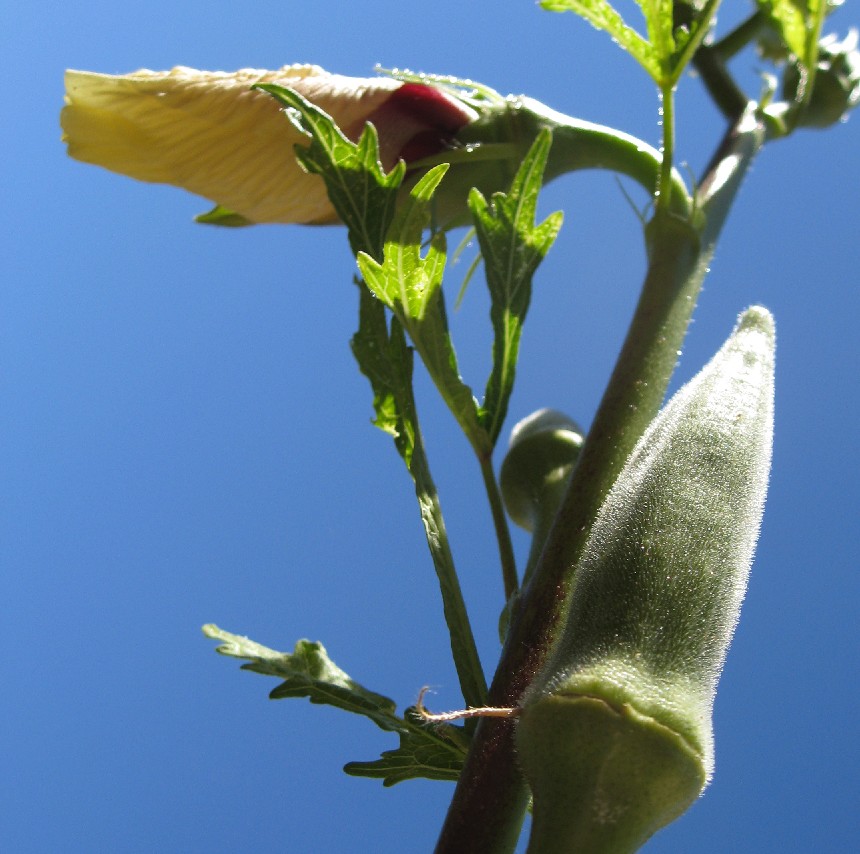
Organic okra in October. Photo: Sally Kneidel

Ninety percent of farmers need second jobs to support their families

So the movie in a very visceral way illustrated how to seek out and support local farmers and local vendors who provide healthy fresh vegetables. Most such people are barely making ends meet and desperately need community support, so the movie is valuable if it accomplishes nothing more than encouraging support of local farmers. I also appreciated the variety of cultures represented in the film, and the discussions about neighborhoods and demographic groups with little access to fresh produce. The girls' interview with the Manhattan Borough President addressed that problem specifically.

An excellent resource for families and educators

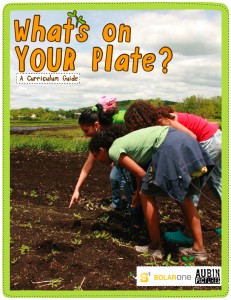
I was impressed with the movie and I applaud the efforts of everyone involved. I highly recommend it for families with children and as a tool for educators, especially educators of young people. In fact, the website of the film's distributor offers a 64-page curriculum and 3 study modules that go along with the DVD, entitled School Food, Health and Access, and Local Food.

Although I liked it, I wouldn't necessarily advise an adult foodie who's already knowledgeable about farmers markets and CSAs to seek out the film. And it's not a movie I would have chosen to watch purely for my own enjoyment or for information about food. However, as a food writer with fantasies about making a documentary, I might watch it again as an example of an extremely well-executed film about food. Sadie's mother, Catherine Gund, produced the movie and her expertise as a professional filmmaker was evident. There was not a dull moment, and I can easily imagine a class of 8th graders or 11th graders riveted to the screen during the entire film.

Wish it had mentioned the ominous impacts of livestock

As long as we're examining "what's on our plates", I was a tad disappointed that the documentary didn't address the merits of organic food more forcefully, and didn't mention the fact that Americans eat much more meat per capita than any other country. Our over-consumption of animal products has implications far beyond our health. The livestock sector has a huge impact on global warming - a fact well-documented by scientists worldwide. A recent paper published by Worldwatch Institute attributes more than 50% of greenhouse gases to the livestock sector. Although the film didn't get into environmental issues much, it could easily have incorporated both these issues in relation to health - especially given that both girls are vegetarians.

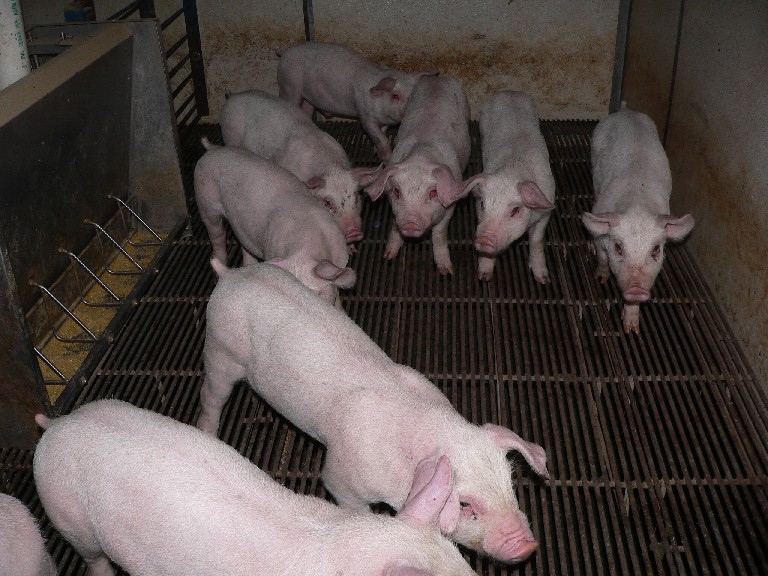
Hogs for a popular sausage brand, raised on a N.C. factory farm. Photo: Sally Kneidel

Despite omissions, the film is a powerful tool

There are advantages though to covering a few topics well rather than touching on everything. No question that Sadie and Safiyah covered a few topics with pizzazz and aplomb. "What's on YOUR Plate?" invites young viewers to boldly seek answers about their own school food and demand access to healthy produce. We all deserve fresh, local, and wholesome food.

Our books about how our food choices affect our health and the environment:

Sally and Sadie Kneidel. 2005. Veggie Revolution: Smart Choices for a Healthy Body and a Healthy Planet. Fulcrum Publishing.

Sally and Sadie Kneidel. 2008. Going Green: A Wise Consumer's Guide to a Shrinking Planet. Fulcrum Publishing.

Some of my previous posts about the effect of diet on health and the environment:

"Livestock account for 51% of annual worldwide greenhouse gas emissions"

"New study: meat impacts climate more than buying local"

"Less meat....smaller footprint"

"Is local food the greenest choice? New study says no"

"Earth Day: 3 things you can do"

"An apple? Bran muffin? or cold cereal? Top ten sources of easy fiber"

"10 hot tips for a green and energy-efficient holiday."

"Obama to fight consolidation of farms: good news for small farms and consumers"

"Smithfield blamed for swine flu by Mexican press"

"The virus is a swine flu and has its roots in North Carolina, the land of Smithfield"

"Tyson and Smithfield drooling over untapped profits abroad"

"Working in a turkey insemination factory"

"A tasty vegan meat substitute: Tofurkey kielbasa"

Key words: DVD documentary movie film review What's on your Plate Sadie Safiyah CSA farmers markets local food NYC Maritza Owens Stanton Street CSA Catherine Gund organic livestock sector Worldwatch

Monday, October 11, 2010

Why use toilet paper? No need to flush our forests

This post now on the syndicated BasilandSpice and on Google News.
Toilet in Malaysia with personal sprayer instead of toilet paper. Photo by Sally Kneidel

We're facing mass wildlife extinctions this century. One big reason: the human population explosion and resulting habitat loss.

You might be surprised to learn how our personal hygiene choices affect wildlife-habitat loss. I was.

Americans flush 54 million trees per year. We're #1!
According to the WWF, almost 270,000 trees are either dumped in landfills or flushed every single day.  About 10% of that total is toilet paper.  Since Americans lead the pack in resource consumption, it's no surprise that we also use more toilet paper than anyone else.  In 2005, North American consumption of toilet paper was 23 kg per capita - 6 times more than the world average of 3.8 kg per capita. Africa had the lowest use in 2005, at 0.4 kg per capita.
Trees on their way to pulp mills or sawmills. Photo by Sally Kneidel

Trees of the Amazon, Southeast Asia, the Pacific Northwest and the southeastern US have been targeted by the pulp and timber industry for decades, but now the boreal forests of Russia, Alaska, Canada, and Scandinavia face the growing threat of chainsaws. According to an online magazine World Science, these boreal forests are 1/3 of the world's remaining forested area and 1/3 of the world's stored carbon. Yet the NGO Forest Ethics reports that Canada's old-growth and intact forests are being logged at a rate of 5 acres/minute, 24/7.

China plans to drape itself in tree plantations for paper
North America's rate of toilet paper consumption is stable, but the rate is increasing almost everywhere else, as developing countries aspire to Western ways. Between 1990 and 2003, China's consumption of toilet paper grew by 11%.  China is projected to become the fastest-growing consumer of all paper products, including toilet paper, and will soon lead the world in paper production as well.  Unfortunately most of China's future paper will come from tree plantations. I say unfortunately because tree plantations are generally non-native monocultures, managed with pesticides and consequently devoid of other plants and wildlife. They are biodiversity deserts. China's "Great Green Wall" initiative aims to blanket the country with tree plantations, covering 42% of China's landmass by the year 2050 with tree species that will produce usable fibers.  Many of those trees will be planted in semi-desert areas where they will deplete already-dwindling water supplies.
Great choice for toilet paper, 90% post-consumer-recycled. Photo by Sally Kneidel

Solution #1: Post-consumer recycled paper
Toilet paper can easily be made from at least 90% post-consumer recycled paper. Most companies just don't bother to do it, apparently. Kimberley-Clark is the largest tissue manufacturer in the world. Their products are sold in 150 countries and their tissue is used by almost 20% of the world's population every day.  With so large a market, KC could save a great many forest habitats by making their products with recycled paper. Yet, according to Noelle Robbins' excellent research for Worldwatch, Kimberley-Clark claims there is no advantage to using recycled paper. And so their tissue is made from virgin wood fibers. KC is not alone. There's little effort among toilet paper companies to change consumer preferences to more forest-friendly products.

Still, consumers can buy toilet paper made from recycled paper.Marcal makes tissue from recycled office paper, magazines and paper from residential recycle bins.  Tim Spring, CEO of Marcal, says "Sixty percent of all paper ends up in landfills....We throw away enough paper to make toilet paper for a lifetime."  According to Marcal's website, the company has saved 22 million trees since 2000 by using recycled paper.

My local supermarket does not carry Marcal.  They do however carry toilet tissue called "Green Forest" manufactured by Planet Inc., in Victoria, B.C., Canada.  The package says that it is "Minimum 90% post-consumer recycled content."   If you're looking for recycled, the words "post-consumer" are important.  Because manufacturers can and do claim "recycled" when all they've done is trim the uneven ends off their newly manufactured paper and throw the ends back into the vat of wood pulp to be stirred up and rolled flat again. Whereas "post-consumer recycled" (PCR) means that the paper was previously used by a consumer, as office paper or newspaper or whatever.(Toilet paper is the only paper that cannot be recycled, after use, into new paper.)

Great online guide to forest-friendly toilet paper
The Natural Resources Defense Council has a great Shopper's Guide to Home Tissue Products that lists the percent post-consumer-recycled content of 10 to 19 brands in each category of home tissues (toilet paper, paper towels, napkins, facial tissues) and recommends which brands to avoid altogether (Charmin, Cottonelle, Kleenex, Puffs, Bounty, Viva).  Very useful. I was interested to see that Green Forest is actually the best.  The next-best brands of toilet paper listed are 80% PCR.

Solution #2: We learned in Asia that water works better than paper!
During the time I spent recently in two predominately Muslim countries, I was intrigued by the use of water instead of toilet paper throughout these countries. My husband and I were perplexed at first when we found that almost every bathroom we encountered in Malaysia and Indonesia had a bucket of water with a scoop floating on the water. I'm still not sure exactly what that was for, except that it had to do with the hygiene requirements of Islam. We didn't use the buckets, as we're not Muslim.
Bucket and scoop under faucet, bathroom on Indonesian island of Sumatra.  Photo by Sally Kneidel

But most bathrooms also had a hose coming out of the wall next to the toilet, even if the toilet was the kind where you have to squat over a porcelain hole in the floor.
 
 Toilet with personal sprayer, no paper, at a Singapore restaurant. Photo by Sally Kneidel

Sometimes the hose had a simple nozzle or a nozzle with a squeeze handle, similar to those many Americans have at the kitchen sink. (Photo at top of post shows nozzle with squeeze handle.)
Toilet with hose and simple nozzle in Malaysia. Photo by Sally Kneidel

Bathrooms with hoses generally did not have toilet paper.  It's customary to use the hose and sprayer instead. After a few weeks, we came to prefer the sprayer to paper.  Later, in Tokyo, we saw the ultimate technology in the use of water for personal cleaning - the "Washlet." The toilet itself squirts a stream of aerated clean water on the user (from the underside of the toilet seat at the back) and has a blow-drying system as well!
Sign indicating a Washlet, on a Tokyo bathroom door. Photo by Sally Kneidel

If only the whole world would use water...
Ecologically, using water is a great solution. According to a quotation in the Worldwatch document cited below, the production of each roll of toilet paper uses 37 gallons (140 liters) of water. The average American uses 57 sheets of toilet paper per day, which requires 3.7 gallons of water just for the manufacturing process. Compare this to 0.03 gallons (0.01 liter) per use of the Japanese Washlet. Various hand-held squirt devices are estimated to use from 0.2 to 0.5 liters per toilet visit.

But even if, hypothetically, the squirting-water methods used the same amount of water as the manufacturing of toilet paper, they don't require the harvesting of trees. And the harvesting of trees at a non-renewable rate is the big problem with our reliance on toilet paper. The overharvesting of trees, or deforestation, is destroying wildlife habitats at an unprecedented rate. We've got to stop it within just the next couple of decades, before it's too late for tigers and orangutans and all the other wild and wonderful critters on this planet.

Squirting devices are hygienic too
Personal washing devices are not only more forest-friendly, they're also promoted as hygienic improvements over the rags, leaves, corn cobs, newspapers, and other items used in many developing countries - methods that often contribute to diarrhea and other health problems associated with poor sanitation. The Worldwatch article cited below describes several water-squirters for bathroom hygiene that can be used in areas without plumbing, such as the Tjebbi - a portable plastic bottle.  It's produced by Tjebok Health Care.

Nozzles please
We're having some plumbing work done on a very old house we bought last spring. We plan to install in both bathrooms a hose and nozzle like the ones so prevalent in Southeast Asia. Maybe we'll stop consumption of home tissues (toilet paper, paper towels, paper napkins, facial tissues) altogether. I like that idea.

To learn how you can encourage sustainable forestry practices and protect forest wildlife, check out these NGOs:
Worldwatch Institute

Earth Pulp and Paper

ForestEthics

Natural Resources Defense Council

Greenpeace International

Rainforest Action Network

Dogwood Alliance

TRAFFIC: the wildlife trade monitoring network

A major source for this post:
Noelle Robbins. "Flushing forests." Worldwatch Institute. June 2010.

Some of my previous posts about deforestation:
Orangutans dwindle as Borneo, Sumatra converted to palm-oil plantations
Wild tigers are in trouble
Plush toilet paper flushes old forests.

Key words: toilet paper Worldwatch Institute World Watch Institute deforestation Southeast Asia forest products Noelle Robbins Flushing Forests

Monday, October 04, 2010

Experts avoid nonorganic potatoes

Photos and text by Sally Kneidel


On my weekly shopping jaunt yesterday, I was irked to find the grocery store was out of organic baking potatoes. Frustrating. I was planning to have them for supper last night, and I already had the vegan chili beans for a topping.

I thought about it for a minute - how could a vegetable that's underground be sprayed directly with pesticides? The nonorganic potatoes must not be that bad, I thought. So I bought them instead.

After I got home, I remembered an article my daughter had e-mailed me entitled, "The 7 foods experts won't eat." I pulled the article out of my file and....dang, sure enough, #4 was "Nonorganic potatoes."

I was dead wrong
I was definitely mistaken about underground veggies being relatively safe from pesticides.  As it turns out, root vegetables absorb herbicides, fungicides, and pesticides that have washed into the soil. So these chemicals are not just on the vegetable's surface, they're absorbed into its flesh. Washing and peeling can't get rid of them.

Because potatoes are the nation's most popular vegetable and demand is so high, potato plants are sprayed at every opportunity to keep the spuds blemish-free. During the growing season, the potato plants are sprayed with fungicides... which wash and seep into the soil.  At harvesting time, the vines are obliterated with herbicides to get them out of the way. More seepage down to the taters.  After the potatoes are harvested, they're sprayed directly with a chemical to keep them from sprouting. And they usually won't sprout, even if you try to get them to. (Although I have sprouted a few conventional potatoes.)

Potato farmers won't eat them!
Said Jeffrey Moyer as chair of the National Organic Standards Board, "I've talked with potato growers who say point-blank they would never eat the potatoes they sell. They have separate plots where they grow potatoes for themselves without all the chemicals."

The only solution is buying organic potatoes, or growing your own. If you're desperate, peeling may help somewhat....at least with the sprout-inhibiting chemical.

Buying organic protects wildlife too
Remember - when you buy organic, you're protecting not only your own health, but the health of the wildlife and ecosystems adjacent to and downhill from those farm fields. When crops are sprayed, so are the soil insects and worms, which are eaten by frogs and birds and lizards....the toxic sprays move right along the food chain, poisoning the whole system. And that includes the streams and lakes and rivers downhill from the cropfields. Rains flow across the sprayed fields and into these surface waters...as well as ground and well water.

So looks like I'll be taking those icky taters back to the store.  Now, we did have some organic sweet potatoes on hand last night. I wondered briefly how those would taste with chili beans.  Quickly nixed that idea.

Instead we decided to saute some portabellos in a little olive oil with some fresh rosemary, a sprinkle of toasted sesame oil, and a  splash of tamari.  We put each portabello on a big slice of rosemary-olive oil bread with melted soy mozzarella on top. Had a salad on the side. Now that was tasty.

Portabellos with rosemary for dinner

For further reading:

For more information:
For more vegetarian/vegan recipes and information about organic, local, and sustainably-grown foods, check out our books on Amazon: Veggie Revolution and Going Green

Keywords: organic nonorganic potatoes 7 foods to avoid pesticides herbicides fungicides Jeffrey Moyer portabellos 7 foods experts won't eat

Tuesday, September 28, 2010

The tiger in the suitcase - an isolated incident?

This post now on Google News 


The airport cub, still in the suitcase. Photo credit: "Wildlife Checkpoint, Suvarnabhumi Airport." Used with permission.

 This past August 22, a hot story popped up in headlines around the world. A 2-month-old tiger cub was spotted by x-ray in a suitcase at a Bangkok airport. The tiger was drugged but alive, crammed among tiger toys and blue jeans in the suitcase. A 31-year-old Thai woman was arrested.

The drugged cub, awake but dopey, soon after removal from the suitcase. Photo credit: "TRAFFIC the wildlife trade monitoring network"  Used with permission.

The story was riveting - would the cub die, impaired from the lack of oxygen or the drugs?

The revived cub. Photo credit: TRAFFIC the wildlife trade monitoring network. Used with permission.

A couple of days later, the baby tiger was photographed looking alert and healthy. Apparently no permanent damage, other than loss of its mother and freedom.

But few of the articles I saw about the concealed tiger cub addressed the bigger picture. The smuggling of tigers or tiger body parts is not an isolated incident, or even a rare event. In fact, it happens daily on a massive scale. These operations are largely undercover. On September 15 in Ha Noi,Viet Nam, police uncovered a wildlife-bone trade network operated by a couple at their home. Nearly 900 kg (1,984 lbs) of animal bones from four different locations were confiscated.  

The haul included 6 complete tiger skeletons and 6 skulls, 32 kg of additional tiger bones - even though it's estimated that only 30 wild tigers remain in all of Viet Nam.

The confiscated bones in Ha Noi also included 3 clouded leopard skulls and 1 skeleton, 6 bear skulls and one stuffed bear head, in addition to 730 kg of other wildlife bones and dried wildlife body parts. What are all these bones for?

Very pricey "tiger-bone glue" is thought (erroneously) to improve virility
Tiger bones and other wildlife bones are boiled down by wildlife dealers to make "bone glue," a popular traditional medicine, and one of the most expensive. According to traditional medicine guides, pure tiger bone glue is taken as a tonic to enhance masculinity, although in reality it has no medically demonstrable effect.

Wildlife and body parts altered to pass for more expensive species
Before a sale, various animal bones are often made to look like tiger bones by carving or grinding them. Even living leopards may be made to seem like tigers before sale. Their bodies may be pumped full of water and agar (doubling their weight) and they may be painted with black stripes. I would find it hard to believe that such a scheme could work, had I not seen, myself, primates painted different colors to resemble more expensive species, in the wildlife markets of Jakarta.

Tigers are on the brink
In 1900, the world had more than 100,000 tigers. Since then, humans have reduced that number to around 3200 in the wild. Some estimates are as low as 1500.  But even those numbers seem higher than they effectively are.  The 6 remaining tiger subspecies survive in numerous small populations - a population defined as individuals living in close enough proximity to interbreed.  These pockets are scattered over 13 countries. Altogether, the actual land space occupied by today's wild tigers is only about 7% of the area they once covered.

It's been estimated that none of the isolated wild tiger populations has more than 250 mature breeding individuals. A population that small can be negatively affected by inbreeding, or heavily impacted by a new disease vector or a change in local prey or habitat. When a population gets too small, it loses its resilience and can just collapse for any or all of these reasons. Who knows what that number is for tigers?  At 250, they're no doubt approaching it.

What are the human threats to tigers?
As tiger numbers have plummeted 97% over the last 110 years, the Javan, Bali, and Caspian tiger subspecies have gone extinct. During the same period (1900-2010), the human population has skyrocketed from 1.7 billion to 6.87 billion today. Humans are responsible for the drop in tiger numbers and the extinctions, by a variety of insults. The primary threats to tiger survival are habitat loss, habitat fragmentation, poaching, scarcity of prey, and retributive killing.  

Habitat loss includes clearing of forests for timber, palm oil plantations, agriculture, livestock grazing, human settlements, as well as habitat fragmentation by roads and rapid development. Prey are scarce for the same reasons - loss of habitat and fragmentation of habitat, and poaching (for food or trade). Tigers are sometimes hunted and killed by frustrated farmers and livestock herders when the predators are blamed for livestock deaths. That's retributive killing.

Poaching is a major source of tiger mortality
Tigers are shot, trapped, snared for lots of reasons: to be sold as prestigious skins for the homes of the rich and powerful, for the pet trade (especially as cubs), and largely to supply the illegal trade in tiger parts used for Chinese traditional medicines, such as the above-mentioned "bone glue."  But bone glue is only one of many products containing tiger ingredients.  This is a huge problem in Asian countries where many people believe they can acquire the characteristics of the animals they eat. The BBC's Andrew Harding reported on a "penis emporium" in Beijing where a dish of "tiger penis hotpot" costs  $5,700 (USD). Supposedly, men order it to improve their virility, although Harding's waitress at the emporium admitted to Harding that eating tiger penis has no effect on virility. Said the waitress, "People just like to order tiger to show off how much money they have." When consumers will pay such prices for tiger parts, you can imagine the money that tiger poachers or dealers can make. Some poachers or dealers store their tiger corpses or tiger parts to sell in later years, when the animals have become even more rare and prices will be even higher. That sounds familiar. I heard the same thing about the endangered blue-fin tuna which is still overharvested - that some fish dealers are stockpiling the blue-fin in freezer vaults, for the day when the species is extinct, and prices will go through the roof. (See the documentary End of the Line for more info about this.) Along the same theme, several conservationists in Southeast Asia told me during my recent stay there that the rarest birds and primates are the most targeted by poachers, because the rarest are the most prestigious possessions, are thus most coveted, and will command the highest price in the markets. Some trappers focus on an endangered species as the price escalates, until the animals are extinct or so rare it's impossible to find them, then the poachers switch their attention to another rare species. In Southeast Asia, many local people will trap whatever they can catch, because they know that whatever it is, they can sell it at a nearby wildlife market - as food, a pet, a skin, medicine ingredient, etc.

Tigers as pets
In a poll by Animal Planet, tigers were voted the world's most popular animal, followed (in order) by dogs, dolphins, horses, lions, snakes, elephants, chimpanzees, orangutans, and whales.Is this a factor in Asians' willingness to pay exorbitant prices to eat tiger parts? Probably. It's definitely a factor in a  bit of news I found shocking: the Association of Zoos and Aquariums estimates that up to 12,000 tigers are being kept as private pets in the United States, significantly more than the world's entire wild population; 4,000 are believed to be in captivity in Texas alone. Part of the reason for America's enormous tiger population relates to legislation. Only nineteen states have banned private ownership of tigers, fifteen require only a license, and sixteen states have no regulations at all. Ouch! That's another can of worms, which I won't explore here, although I have prior posts on the widespread sale of exotic (foreign) wildlife within the U.S., and the extensive smuggling of monkeys, parrots, snakes, lizards, even chimpanzees across borders into the U.S. (See list below.)

Tigers need help!
Tigers are critically endangered, predicted by many to be extinct in the wild within 20 years, and protected by the CITES international treaty as well as by various federal regulations of the countries where they live and where their body parts are shipped to. But with international crime syndicates now involved in the highly profitable wildlife trade, and source countries' wildlife departments sorely understaffed, tigers are freely poached from preserves where they are supposed to be entirely protected. Some tiger preserves have been completely drained of tigers by poachers. Tigers and tiger parts are shipped through airports where security personnel can often be paid off - I was told this myself repeatedly by wildlife dealers in Indonesia. Tigers and tiger parts are smuggled the same way drugs are: in the trunks of cars, in boats, in planes, in suitcases. When the Thai woman was caught with a tiger in her suitcase in August, we all thought, "What a nut! Who would try something so stupid?!" The fact is, anybody and everybody would, everyday. They would and they do. That's why we have 3200 wild tigers left today, at the end of a century that began with more than 100,000.

What's being done?
In this year, the Chinese Year of the Tiger, the first ever Global Tiger Summit will be held in St. Petersburg, Russia, from Nov. 21-24. At the Summit, Russia will host ministers and heads of state from the 13 countries that still have tiger populations to sign a declaration on joint cooperation for tiger conservation, and to initiate a global tiger recovery program which seeks to double the number of tigers by the year 2022, the next Chinese Year of the Tiger. That means increasing tiger numbers to 6,400 from the current historic low of 3,200.

What you can do
Stopping the deforestation and the poaching are two essential ingredients to helping these beloved animals rebound. Ways to help with that include:
  • support organizations that are working hard on the scene to stop deforestation in the countries where tigers live (such as Greenpeace)
  • support the organizations that are seeking enforcement of anti-poaching laws in Southeast Asia, and are seeking to have violators prosecuted (such as TRAFFIC: the wildlife trade monitoring network)
  • avoid buying products that contain palm oil
  • write your own legislators and ask them to do the same
See World Wildlife Fund's page about the upcoming tiger summit for suggestions about what you personally can do to help protect the remaining wild tigers. One piece of good news is that tigers are prolific breeders, and given the needed resources, could actually rebound quickly.

A postscript
The 6 surviving tiger subspecies, in descending numbers, are the Bengal tiger, Indochinese tiger, Malayan tiger, Sumatran tiger, Siberian tiger, and South China tiger (not seen in the wild since 1987)

The 13 countries that still have wild tigers are all Asian: India (with the most), Bangladesh, Cambodia, China, Laos, Myanmar, Thailand, Vietnam, Malaysia, Indonesia, Russia, Nepal, and Bhutan.

My previous posts on Southeast Asia:
Wildlife trade rivals drug trade in profits September 20, 2010

Some of my previous posts on exotic wildlife in the U.S. and animal smuggling:
Monkeys and parrots pouring from the jungle. September, 2008.
The U.S. imports 20,000 primates per year. February, 2010
The great apes are losing ground. March, 2010

Keywords: tigers extinction Global Tiger Summit Russia tiger bones Ha Noi Viet Nam penis emporium wildlife trade tiger glue wildlife body parts pet trade wildlife markets most popular animal TRAFFIC the wildlife trade monitoring network Greenpeace ProFauna Southeast Asia

Monday, September 20, 2010

Wildlife trade rivals drug trade in profits

I recently wrote a post about Indonesia's illegal trade in wildlife, focusing on orangutans. As one of our closest relatives, orangutans act and look a lot like humans, especially the babies. People world-over seem to share a fascination for the red-haired apes; they're featured in movies, commercials, and as "poster children" for conservation organizations. Unfortunately, their high visibility has done little to protect orangutans from impending extinction. In fact, their human-like antics contribute to their demise by making them extremely popular as pets - one of the major threats to their survival.

While orangutans are as widely available as ever for pet-seekers, dealers no longer display them openly in the marketplace. With all the media attention on the apes' endangered and protected status, dealers and police as well find it difficult to pretend that orangutan sales are legit. Orangs are more likely now to be sold in the same clandestine ways drugs are sold - at prearranged meetings, or in homes or other private locations.

Greater slow loris at Jatinegara market in Jakarta. Photo by Sally Kneidel

What about the less celebrated primates of Southeast Asia? 
Southeast Asia has 70 species of primates, with 39 species in Indonesia alone. That's an astonishing number; in my experience, it's unrivaled by anywhere else in the world. During my recent visits to three wildlife markets in Jakarta (Indonesia's capital), I saw plenty of primates openly exhibited for sale, although there were many more species for sale that I didn't see.

"The shy one"
At all three Jakarta markets, I saw the greater slow loris for sale, an internationally protected primate  species that's listed in CITES Appendix I and on the IUCN Red List of Threatened Species. The greater slow loris is totally protected by Indonesian legislation as well. Yet these animals were paraded brazenly, were even hawked aggressively to me and my companion as highly desirable and cuddly purchases. They were called "kuskus" by the dealers, “kukang” or “malu-malu” (the shy one) by local people outside the markets.  A consultant for TRAFFIC told me about seeing lorises in markets dyed black and dressed  in clown outfits – selling for higher prices. Mortality is high in pet lorises, from infections after having their teeth pulled out with pliers, and from stress and inappropriate food. But lorises are relatively inexpensive and considered easily replaceable in Indonesia. Which means their capture rate must be quite high to maintain a steady flow into the markets.

Greater slow loris at Barito market, Jakarta. Photo by Sally Kneidel

Greater slow loris at Barito market in Jakarta. Photo by Sally Kneidel

I saw dozens of long-tailed macaques for sale in all the markets. Many looked so young as to be barely weaned. They all seemed bedraggled and frightened. Many appeared hungry and sick. One was dyed orange to look like a more expensive baby silvered-leaf monkey.
Baby macaque at Barito market, Jakarta. Photo by Sally Kneidel

Infant macaques at Pramuka market. Photo by Sally Kneidel
Frightened young macaque at Jatinegara market. Photo by Sally Kneidel

I kick myself for not stopping in Medan
I seriously regret not going to the animal markets in the city of Medan, on Indonesia's island of Sumatra. I went through Medan twice, but didn't realize what I might have learned about the illicit animal trade if I'd stopped and snooped around. As it turns out, a lot of the primates for sale in Jakarta were caught on Sumatra, a less populated and more forested island than the island of Java, where Jakarta is.  So Javan dealers acquire wildlife from Medan (or from Borneo) to supply the huge markets of Jakarta, markets like Pramuka.

Indonesia's biggest wildlife market: Pramuka, in Jakarta. Photo by Sally Kneidel

A great bit of sleuthing
The diligent Chris Shepherd of TRAFFIC surveyed the wildlife markets of Medan sixty-six times between 1997 and 2008. During that period, Shepherd observed 1,953 primates of 10 species for sale, most of which are recognized as threatened to varying degrees by the IUCN Red List of Threatened Species.  Those 10 species were the greater slow loris, long-tailed macaque, pig-tailed macaque, silvered leaf monkey, ebony leaf monkey, Thomas's leaf monkey, Sumatran leaf monkey, Siamang, agile gibbon, and white-handed gibbon.
 Thomas's leaf monkey in a Sumatran national park, a species openly for sale in Medan. Photo by Sally Kneidel

White-handed gibbons in the treetops of Sumatra. This species was also seen in a Medan market by Chris Shepherd. Photo by Sally Kneidel

Shepherd made the effort to cultivate relationships with Medan dealers so they would talk to him about trends and sources. The dealers told him that high-profile species such as orangutans drew the attention of law-enforcement officers, but other totally protected species such as the loris rarely did. The macaques and other most common species were completely ignored by enforcement agencies, although according to Indonesian law, no primates may be legally harvested for commercial purposes.  Given the absence of enforcement, it's not surprising that the dealers expressed to Chris little fear of prosecution.  The dealers also felt no need to get the permits that are legally required to sell wildlife of any kind in Indonesia.  According to the Medan dealers Shepherd interviewed, primates are in demand and sell very quickly. Customers pay more for rare species, thus increasing the incentive for trappers to target the rare and threatened.

What's going on with the legal protection of these animals?
Indonesia is a lovely and deeply exciting country, but it does have a reputation for government corruption, bribery, and generally ineffective law enforcement. I was told several times that if I got a traffic ticket, I should just pay the policeman and that would be the end of it. Many wildlife dealers told me that animals purchased at the markets could be smuggled through airports by paying the security screeners, if they happened to say anything. I didn't test either of these assertions, but heard these comments so many times, I concluded there must be some truth to them. Since returning home, I've learned that academic studies confirm the weak enforcement of laws in Indonesia.  Given the lack of financial resources in the country, it's not that surprising.

Recommendations from an expert
Chris Shepherd closed his 2010 paper on the illegal primate trade in Indonesia with recommendations to address the problem of illegal sales of protected primates.He says that Indonesia has adequate laws and regulations to protect primates from over-exploitation. He recommends that the Natural Resources Conservation Agency in North Sumatra should be encouraged to monitor wildlife markets frequently and to take action against individuals involved in capturing and selling primates illegally. Persons illegally keeping or trading primates should be prosecuted and given maximum sentences, and as a deterrent to others, the prosecutions and punishments should be widely publicized. Furthermore, markets where illegal trade in wildlife occurs should be closed down by appropriate authorities. I agree with that, for sure.

Can promotion of eco-tourism help too?
Most humans consider animals to exist for our exploitation: as food, beasts of burden, companions, or commodities for profit.  But eco-tourism provides a new category. Animals, protected and nurtured in their own habitats, can become a livelihood - a livelihood that can be especially valuable in impoverished countries like Indonesia. True, a little delayed gratification might be required to cultivate a family livelihood that can sustain generations, as opposed to a handful of cash today.

It may be working in Bukit Lawang
I stayed in the small village of Bukit Lawang, a Sumatran town next to Gunung Leuser National Park. Bukit Lawang is a good example of an entire village cashing in on the tourists who come to see wildlife in the park, mainly primates. Some families run guesthouses, some hire out as forest guides, some work in restaurants, or operate kiosks that sell drinks and snacks.  Poaching of animals and plants is still rampant in Gunung Leuser National Park. But since poverty and unemployment are cited as major drivers of poaching, I'm guessing that villagers employed in eco-tourism are less enthusiastic about poaching than they might have been at one time. It would be an interesting study, I think - do people making a living in eco-tourism change their attitudes about illegally capturing or selling wildlife? Does anyone know the answer to that?

Another piece of the solution
For anyone who wants to help, consider making a donation or offering volunteer work to TRAFFIC, a great organization working hard to combat the illegal trade in wildlife. TRAFFIC has some fantastic reports, many by Chris Shepherd or Vincent Nijman, available for free download on their website. Or contribute to the efforts of Greenpeace, an NGO working to protect the forests and wildlife habitats of Southeast Asia.  Another option is Indonesia's own ProFauna, an NGO working on behalf of Indonesian wildlife.

Paper referenced above:
Chris R. Shepherd. 2010. "Illegal primate trade in Indonesia exemplified by surveys carried out over a decade in North Sumatra."Endangered Species Research 11:201-205. Available on TRAFFIC website.

My previous posts on Southeast Asia:
Orangutans dwindle as Borneo, Sumatra converted to palm-oil plantations August 3, 2010
My search for a wild orangutan in Borneo and Sumatra August 16, 2010
Laws flaunted: flourishing pet trade threatens orangutans' survival August 23, 2010

Resources to help you take action:
Keywords: illegal wildlife trade primate trade Southeast Asia TRAFFIC Greenpeace ProFauna wildlife Indonesia bird markets Indonesia animal markets Pramuka Barito Jatinegara Jakarta wildlife markets orangutan white-handed gibbon greater slow loris langur leaf monkey macaque primate protection primate conservation primate exploitation primate sales black market corruption

Saturday, September 18, 2010

Grocery Variety and Sustainability Go Hand-in-Hand

By Dan Grifen, a guest blogger for Veggie Revolution

"In other environmental issues we tell people to stop something, reduce their impact, reduce their damage," - U.S. Ecologist Gary Nabhan

Since the beginning of the green movement, there has been a rise in the number of organizations and businesses that are doing their part in the promotion of sustainability through conservation. As human beings, we're told to reduce our carbon footprint, consume less unhealthy foods, and spend less time in the shower! But let's take a minute to step back and look at this from a different perspective; one that Gary Nabhan strongly suggests.

Gary Paul Nabhan, PhD, is an Arab-American writer/conservationist whose extensive farming work in the U.S./Mexico borderlands region has made him world renowned. Specifically speaking, Nabhan is known for his work in biodiversity as an ethnobotanist. His uplifting messages and attitude towards life and culture have granted us access to multiple beneficial theories including his latest of eat what you conserve.

According to The United Nations' Food and Agriculture Organization, about three quarters of the genetic diversity of crops has been vanishing over the last century; a dozen species now provide 90% of the animal protein eaten globally. In accordance, just 4 crop species supply half of plant based calories in the human diet.

Nabhan claims that by eating the fruits and vegetables that we are attempting to conserve/save, we're promoting the dissemination and conservation of these same plant species. But this goes beyond what we typically buy in supermarkets, particularly because of price and abundance. We must remember to try new things and immerse ourselves in the very concept of diversity. Keep in mind - the benefits of splurging for that costly fruit/vegetable supremely outweigh the cons. Not only are you promoting biodiversity and further eliminating the needs of farmers to remove rare, less purchased crops off their agenda, but you're also effectively encouraging healthier lifestyles.

Agriculturist Marco Contiero mentioned, "Biodiversity is an essential characteristic of any sustainable agricultural system, especially in the context of climate change." With sustainable crop efforts being lead by the CGI (Clinton Global Initiative) and the IRRI (International Rice Research Institute) the duo plans to provide a more sustainable crop that can withstand natural disasters, avoiding food shortages like Haiti is experiencing. Contiero goes on to state "We need to ensure this is the basis for the future…" – This is exactly what Doug Band, the CGI, and the IRRI are doing by engaging in sustainability efforts.

So remember, next time you're in the supermarket picking out a common varietal of navel oranges or strawberries, turn your attention to something that's a bit more exotic in nature. The same goes for salads/salad ingredients; shop outside the norm, picking spices and vegetables that you wouldn't normally incorporate into your everyday diet. During such economic downtime it isn't always easy to maintain the same level of grocery shopping intrigue, but we must also not forget that in this sundry of foods we can find fun!

Written by Dan Grifen – Supporter of all things green and progressive

Dan Grifen blogs at http://everythingleft.wordpress.com and is a guest blogger for Veggie Revolution and SallyKneidel.com

Key words: sustainable food conservation Gary Nabhan Dan Grifen Everything Left everythingleft  sustainable farming biodiversity seed diversity crop diversity shopping sustainably FAO genetic diversity of crops

Tuesday, September 07, 2010

My review of the documentary "Dirt! The Movie"

 This post is now on Google News and the syndicated BasilandSpice

Garden soil, composted from vegetable and yard waste. Photo by Sally Kneidel

I was asked to write a review of "Dirt! The Movie," a documentary about our worldwide destruction of soil versus our absolute dependence on soil for our survival. The movie is an inspiring blend of interviews with scientists, farmers, and activists, as well as footage from around the world of the traditional uses and modern abuses of soil.

The first third of the movie explores the origins and contents of healthy soil, followed by testimonials from an impressive array of experts about the value and utility of soil. The filmmakers interviewed workers building with soil; one-third of the world still lives in earthen homes. Winemakers talked about the relationship between soil and subtleties of taste. Biologists dug up worms and fungi with their hands; they and others spoke passionately about the vast array of organisms essential to soil health.

A scary diagnosis
The next third of the film documented how humans are destroying the limited amount of soil we have. Little of this was new to me, yet I felt compelled to write down almost every word of it. The vivid images and words were motivating to me in the way a scary medical diagnosis can be motivating; I wanted to remember everything. To make their point about soil destruction, the filmmakers covered mountaintop removal for mining, agribusiness methods that erode soils and poison ecosystems, desertification that starves African and Indian families, and deforestation of the Amazon "for expansion of soil."  Said biologist Janine Benyus, "We've lost 1/3 of our topsoil in the last 100 years."

Benyus and other scientists denounced the agribiz practice of planting monocultures, which are more vulnerable to weather extremes and pests, leading to the use of pesticides that destroy vital soil organisms. Unhealthy soils lead to the widespread use of nitrogen fertilizer, most of which winds up in surface waters downhill from crop fields. Nitrogen pollution is responsible for the infamous dead zone in the Gulf of Mexico, where little survives but jellyfish. Nitrogen fertilizer also forms nitrous oxides that contribute to global warming. Remarked Vandana Shiva, a physicist, farmer, and activist in India, "25% of greenhouse gas emissions are coming from agriculture that has become a war against soil."

Majora Carter is featured
The last third or so of the film was devoted to solutions, spotlighting individuals who are engaged in projects to nurture soil or to help underserved populations connect with gardening. The most impressive of those to me was Majora Carter, founder of Sustainable South Bronx, who extolled the virtues of roof gardens. I gathered that the filmmaker's objective in this portion of the film was to illustrate what each of us might do as individuals, to encourage viewers to take action, however small.

While I agree that "a journey of a thousand miles begins with one step," we don't have time to piddle around.  As Wes Jackson of "The Land Institute" pointed out in the movie, "we have a hundred year window in which to find ourselves. We have come to the end of the extraction economy and we have got to figure out how to live within our means."  Jackson is being generous. We have maybe 20 years to turn things around, before reaching the point of no return environmentally. With that in mind, I would've liked to see the film focus on bigger solutions, like pressing the governments of Brazil and Southeast Asia to protect their remaining trees.  Or suggesting ways to address desertification in Africa.. As the richest country in the world, we are not powerless.

Why is the impact of livestock omitted?
In spite of the movie's merits, I was disappointed that it never mentioned the livestock sector as a major cause of soil loss worldwide. The desertification in Africa is a direct result of overgrazing of livestock. When hoofed animals graze land with too few plants to sustain them, they pull up plants by the roots. They also compact the soil with their hoofs, which keeps rain from permeating the soil.  The result is rootless, dry soil that blows away in the wind - that's desertification.  Nor did the film mention that Brazilian rainforests are cut primarily to raise feed for livestock or to graze livestock.  If we ate plant-based foods only and skipped the livestock, we'd need only a small fraction of the agricultural land we need to support livestock. In which case, forests could be spared. Is that not relevant to soil conservation? What's more relevant than that?

I was also surprised that, during the discussion of seed diversity and the importance of saving and exchanging seeds with other farmers, no mention was made of corporations such as Monsanto that are acquiring ownership and controlling the use of our crop seeds, and genetically altering many of them. (For more about Monsanto, see the Center for Food Safety website or their publication "Monsanto vs. U.S. Farmers".)

Valuable for educators
But overall "Dirt! The Movie" is a film with a crucial message, and well worth watching.It's an excellent movie for a teacher or professor to use for any age student, as an introduction to an ecology unit, or to open any variety of topics involving life on the planet. It's not a gripping documentary, like "Darwin's Nightmare." But valuable.If everyone on the planet were aware of the issues covered in this film, we might stand a chance of actually turning things around before we exhaust our planet's resources...none of which are more necessary than dirt.

Key words: Dirt the movie film review movie review desertification soil topsoil nitrogen pollution dead zone Gulf of Mexico monocultures deforestation erosion agriculture gardening roof gardens Majora Carter Sustainable South Bronx Monsanto

Thursday, September 02, 2010

How food affects your brain: 10 facts we now know

 Walnuts and olive oil, two of the healthful choices for your brain. Photo by Sally Kneidel

Readers -
I just received an email from Cindy Cullen at the Culinary Arts College, asking if I'd like to post a link to their article
How Food Affects Your Brain: 10 Facts We Now Know.

Some interesting information in the post, so I'm passing it along.

I need to add a couple of things in relation to their list of foods. If you eat fish, please choose fish and seafood responsibly.  Our oceans are being emptied of fish by over-harvesting, and many species once common are on the verge of extinction. In addition, many fish species contain dangerous levels of mercury and other pollutants.

Use these guides to choose seafood wisely:
Seafood Selector from Environmental Defense Fund
Sustainable Seafood Guide from the Natural Resources Defense Council
Health Alerts Seafood Guide from EDF
Seafood Recommendations from the Monterey Bay Aquarium

Choose organic
In regard to the fruits and vegetables on the Culinary Arts College list, please choose organic. Strawberries are on the list, and 54 different pesticide residues have been found on non-organic strawberries by the USDA Pesticide Data Program (according to the Pesticide Action Network). Buying organic not only protects the future health of you and your children, it also protects ecosystems and wildlife.Pesticides sprayed on crop fields are washed into nearby streams, rivers and lakes. They're also ingested by birds and other animals feeding near croplands.

A few of my previous posts on the importance of choosing organic products:
Did your shopping list kill a songbird?
Organic cotton: it's worth every penny
Top 10 eco-friendly diet choices
Bird-protecting chocolate and coffee

A few of my previous posts on over-harvesting of fish and on pollutants in fish:
Number of imperiled fish almost doubles in 20 years
Tuna is the biggest source of mercury from fish: is it safe to eat fish? 
Review of the documentary: "End of the Line: where have all the fish gone?"
Top 10 ways to help wildlife
New book about how overfishing is changing the world
Farmed salmon vs. wild salmon
Lice from fish farms attack wild salmon 

Key words: organic overharvesting of fish salmon depletion of fish mercury overharvesting of ocean fish disappearing fish imperiled fish threatened fish endangered strawberries pesticides