Tuesday, August 31, 2010

New studies: fast-food "kids meals" loaded with calories and fat


Photo by Sally Kneidel

 Happy meal helps kids, says the fast-food box. Is that so? Not according to recent medical studies. Kids who live near a fast-food restaurant are more likely to be obese, according to a 2010 study in the International Journal of Pediatric Obesity. Not surprising, given that most kids' meals marketed by national fast-food chains are high in calories, saturated fat, and sodium. Some contain as much saturated fat as the daily maximum recommended for children. In addition, these meals often fail to meet the nutritional standards for children published this year by the Institute for Medicine.

In a study published this month (August 2010), The Physicians' Committee for Responsible Medicine analyzed the nutritional content of a children's meal from five national fast-food chains: McDonald's, Wendy's, KFC, A&W, and Burger King. PCRM ranked the meals from worst to least bad.

Worst was McDonald's Mighty Kids Meal (double cheeseburger, fries, chocolate milk) with 840 calories and 37 grams of fat. This meal had more than double the recommended limit on saturated fat and sodium for one meal.

Second worst was Wendy's Kids Meal of chicken sandwich, fries, and chocolate Frosty, containing 770 calories, 34 grams of fat.

KFC Kids Meal was 3rd worst, with popcorn chicken, potato wedges, string cheese, and soft drink: 780 calories; 1800 mg of sodium.

Fourth worst was A&W Kids Meal, consisting of a cheeseburger, fries and soft drink, with 780 calories and 9 grams of saturated fat.

And  fifth worst was Burger King's BK Kids, a breakfast muffin sandwich meal with egg and cheese. It had 95 mg of cholesterol and exceeded the recommended sodium limit for a child's breakfast.

Misleading marketing
Kids' meals at fast-food restaurants are marketed directly to children, with brightly-colored boxes and often a small toy inside. They are also marketed to parents, with statements such as this: [the BK Breakfast Kids Meal] "joins the brand's roster of meals that meet stringent nutrition criteria" - although this BK meal exceeds the recommended cholesterol intake for one meal.

Health risks
What are the consequences of too many calories and too much dietary fat?  Obesity, for one thing. According to a study in the Journal of the American Medical Association, 32% of Americans between the ages of 2 and 19 are overweight; 17% are obese. Obesity is associated with a number of health risks, including type 2 diabetes. Another study in JAMA reports that 1/3 of children born in the year 2000 will develop diabetes at some time in their lives. This number is projected to increase as the prevalence of childhood obesity increases. Other health risks of obesity include cardiovascular disease and certain types of cancer (see CDC website).

Another concern with fast-food kids' meals is that many contain red and processed meats, including hot dogs, hamburgers, bacon and deli meats. Consumption of these is a key risk factor for colorectal cancer, according to the American Institute for Cancer Research. Red and processed meats have been linked to other cancers too. As a result of a high intake of saturated fat and cholesterol, one in five teens in the U.S. has an abnormal cholesterol level, a contributor to cardiovascular disease - the leading cause of death in the U.S.

 Poster of Batman toy and a doll in the window of McDonald's near my house. Photo by Sally Kneidel

What to do?
Limit your child or teen's trips to fast-food restaurants. Make sure your child is informed about the health risks associated with fast-food. Help kids see the bigger picture, too, and become conscious consumers. Visiting a McDonald's together is a good opportunity to educate your child or teen about the influence of marketing. The one in my neighborhood has posters of toys inside and outside the building, and huge decals of happy messages for kids stuck to table surfaces. The purpose of corporate marketing is to increase sales and make more money for shareholders, not necessarily to impart accurate information to consumers. One likes to think that federal regulations put limits on false or misleading marketing (such as "this product is a healthy choice") but that's not always the case.

Remember Joe Camel?
You might tell your child or teen the story of "Joe Camel," a cartoon figure that apparently was used to market Camel cigarettes to minors. After years of effectively doing just that, R.J. Reynolds ended the "Joe Camel" campaign in 1997, under pressure from the American Medical Association, Congress, various public-interest groups, and a lawsuit. But only after Joe Camel had increased the teenage-sales of Camel cigarettes from $6 million in 1988 to $476 million in 1992. 

For more information about corporate goals and ethics, watch the documentary film, "The Corporation." A great family conversation piece.  Help your child be an educated consumer.

Primary source:
Physicians Committee for Responsible Medicine. August 2010. "The five most unhealthful fast-food kids meals." http://www.pcrm.org/health/reports/worst_fast-food_kids_meals.html

Other references:
International Journal for Pediatric Obesity. April 2010. "Child body mass index, obesity, and proximity to fast food restaurants".

Sally Kneidel, PhD, and Sadie Kneidel. 2005. Veggie Revolution: Smart Choices for a Healthy Body and a Healthy Planet. Fulcrum Publishing.

Journal of the American Medical Association. "Prevalence of high body mass index in US children and adolescents".

Journal of the American Medical Association. "Lifetime risk for diabetes mellitus in the United States".

Links to some of my previous posts about health effects of meat and environmental impacts of the livestock industry:
Livestock account for 51% of annual worldwide greenhouse gas emissions

Ground beef: a risky choice for families and the planet

Less meat...smaller footprint

A review of Jonathan Safron Foer's book: Eating Animals

Key words: kids meal fast food red meat processed meat health risks obesity diabetes cardiovascular disease heart disease McDonald's KFC Burger King Wendy's Mighty Kids

Saturday, August 28, 2010

Tiny new frog discovered on Borneo - can it survive deforestation and the illegal wildlife trade?


Photo by scientist Indraneil Das of newly-discovered frog species

A new pea-sized frog species has been discovered on Borneo!  Scientists from the University of Malaysia Sarawak found the tiny frogs living in and around tubular carnivorous plants called pitcher plants. The tadpoles grow in the water inside the plants. Although the water contains enzymes that kill and digest insects, the frogs and tadpoles are not harmed.

Frogs discovered by odd call
The scientists happened upon the frogs in plants near a road, in the mountains if Kubah National Park in the Malaysian state of Sarawak (on the island of Borneo). Because the frogs are so small (a half inch or less), the workers located them not by sight, but by the strange call coming from the carnivorous plants. They described the call as "harsh rasping notes." The species has been named Microhyla nepenthicola, after the pitcher plant where they were found.

Microhyla nepenthicola on its pitcher-plant home. Photo by scientist Indraneil Das, courtesy of NewScientist
 
Borneo's wildlife threatened by habitat loss and illegal pet trade
Borneo is a tropical Southeast Asian island, one of the world's richest biodiversity hotspots, so it's not surprising that a new species would be discovered there.  Unfortunately, Borneo is rapidly being deforested and converted to palm-oil plantations; as a result, many of its fauna and flora are threatened or endangered by habitat loss.
Once forested land in Borneo, now covered with palm-oil plantations. Photo by Sally Kneidel

In addition, illegal trade in wildlife is rampant in Southeast Asia . Animals are traded for pets, for traditional medicines, zoos, wildlife collections, biomedical research, and so on. Although laws are in place to protect rare and threatened wildlife, enforcement is lax and trade flourishes with little restriction, even the sale of critically endangered orangutans. Rare species command a higher price in the wildlife markets, and so are targeted by trappers. This fact is not good news for the new frog species.

New frog's location may offer them some protection
In spite of these threats, a couple of factors may help Microhyla nepenthicola survive. One is their location.  The frogs were found on a mountain, and forests on slopes are more difficult to harvest. Also, they were in a national park, which will offer some protection from deforestation, although illegal harvesting of trees, plants and animals continues in Borneo's national parks because wildlife protection laws are not enforced.  However, the clear-cutting required to establish a palm-oil plantation is unlikely to occur in a national park.

In addition, the frogs may be dependent upon the pitcher plant and unable to survive elsewhere - especially in the wildlife markets, where conditions are dirty, and care provided to animals is minimal.
Birds at Pramuka, a major Indonesian wildlife market in Jakarta. Photo by Sally Kneidel

In the four wildlife markets I visited in Indonesia and Singapore, I did not see a single amphibian. They may be there, but I didn't see them.

We'll see what happens down the road for M. nepenthicola.  I wish them good luck.

For more information about wildlife on the islands of Borneo and Sumatra, read my three previous posts about my visits there, and see the links to websites and publications below.

My previous posts about the wildlife of Borneo, Indonesia, and Malaysia:

Orangutans dwindle as Borneo, Sumatra converted to palm-oil plantations August 3, 2010

My search for a wild orangutan in Borneo and Sumatra August 16, 2010

Laws flaunted: flourishing pet trade threatens orangutans' survival August 23, 2010

Publications with more information on wildlife conservation in Indonesia and Malaysia (including Borneo and Sumatra):

David Adam. 2010. Monkeys, butterflies, turtles...how the pet trade's greed is emptying south-east Asia's forests. www.traffic.org

Vincent Nijman. 2009. New study highlights scale of international wildlife trade in Southeast Asia. www.traffic.org

Chris R. Shepherd. The bird trade in Medan, north Sumatra: an overview. www.traffic.org

Chris R. Shepherd. 2010. Illegal primate trade in Indonesa exemplified by surveys carried out over a decade in North Sumatra. www.traffic.org

Vincent Nijman. 2009. An Assessment of Trade in Gibbons and Orang-utans in Sumatra, Indonesia. A TRAFFIC Southeast Asia report.

Vincent Nijman. 2005a. Hanging in the Balance: An Assessment of Trade in Orang-utans and Gibbons
on Kalimantan, Indonesia. A TRAFFIC Southeast Asia report.

Vincent Nijman. June 2005b. In Full Swing: An Assessment of Trade in Orangutans and Gibbons on Java and Bali. A TRAFFIC Southeast Asia report.

Serge A. Wich et al. 2008. Distribution and conservation status of the orang-utan (Pongo spp.) on Borneo and Sumatra: how many remain? Fauna and Flora International. Oryx 42(3):329-339.

Eric Meijaard et al. August 11, 2010. Hunting a key factor in Orangutan's decline. TRAFFIC home page.

Web sites for more information:

Traffic: the wildlife trade monitoring network

ProFauna Indonesia

Greenpeace Southeast Asia

Sumatran Orangutan Society

Orangutan Outreach

Save the Orangutan

Key words: Southeast Asia new frog discovered Microhyla nepenthicola Borneo Malaysia endangered threatened habitat loss pet trade TRAFFIC wildlife markets deforestation palm oil plantations

Monday, August 23, 2010

Laws flaunted: Flourishing pet trade threatens orangutans' survival

A baby orangutan living as a pet. Photo by Chris Shepherd (TRAFFIC Southeast Asia); used with permission. Originally printed in TRAFFIC publication "In Full Swing..." listed below.

Pet trade threatens orangutan survival
"Having a pet orangutan is a status symbol," I was told by my Indonesian friend Ria, who lives and works in Jakarta, Indonesia's capital. Doesn't matter if the animal lives in a small, dirty cage behind the house, which most do; it's still a social asset to have one.

A baby pet orangutan, chained to its cage in the backyard. Photo courtesy of Orangutan Foundation

That's too bad, because the local, national, and international demand for young orangutans as pets is a major threat to the survival of both species: the Bornean orangutan and Sumatran orangutan.  Since both are endangered, they are theoretically protected by law from commercial trade.  However, in Indonesia, these laws are mostly ignored.

Habitat loss remains the single biggest threat to orangutans, but as it turns out, the pet trade and deforestation are closely linked.

At the market, I was offered an orangutan and a leopard
Almost every Indonesian city has a bird or wildlife market, where legal and illegal species are sold by independent vendors to anyone who can pay. I went to 4 of these markets during my Asian travels, including Indonesia's biggest market - Pramuka, in downtown Jakarta. I hired an Indonesian from "ProFauna Indonesia" (a wildlife conservation NGO in Jakarta) to go with me as my guide and translator.

Below, a frightened baby macaque for sale at Pramuka. Photo by Sally Kneidel


A greater slow loris (a primate) thrust in my face by a market vendor. Photo by Sally Kneidel

We saw plenty of wild-caught primates, birds, reptiles, and small mammals at Pramuka. But we didn't see any orangutans. We were, however, offered a baby orangutan for the price of 20-25 million IDR ($2200-2800) and an adult orangutan for 30 million IDR ($3300). Pramuka is famous for its network of homes behind the market (referred to as "in the back") where especially valuable or illegal animals are kept safely out of sight until a sale is made.

A baby orangutan for sale. Photo by Chris Shepherd (TRAFFIC Southeast Asia); used with permission

Vendors often keep photos of their illegal (endangered and thus protected) animals on their cell phones, to show interested buyers. For example, we were shown a photo of an available baby leopard that the vendor said was "in the back." The leopard was offered to us for 80 million IDRs ($8800), although the vendor called it a "Javan tiger" to justify the price. [Javan tigers are actually extinct, although many potential buyers may not know that.]

The baby leopard that was offered to us at Pramuka.

The majority of vendors would not talk to us about orangutans they might or might not have, because I was not in one of the demographic groups that typically buy animals (Chinese and Koreans are likely to buy, they said. Australians, Europeans, and Americans just look.) But this one vendor did talk to us about orangs - the one who quoted us prices. He said that he didn't have an orangutan on the spot, but "could bring it directly," if we had the money. Since we didn't slap down the money, we didn't get to see it.

For forest-dwellers, orangutans are valuable trade commodities
Although orangutan sales in the past may have been concentrated at wildlife markets, nowadays sales often occur at other locations. Pet orangutans may be moved from the interior of the country to  more developed coastal towns, or professional traders may travel to a remote area and buy or order young orangutans to transport to populated areas. According to TRAFFIC's Vincent Nijman, most forest-dwelling people in Indonesia know the commercial value of an infant orangutan. Given the absence of effective law enforcement, few will resist the opportunity to obtain an infant to sell  In a country where more than half the population survives on $2/day or less, young orangutans are regarded as valuable trade commodities.

Unchecked timber industry yields orangutans for market
The hunting and capturing of orangutans for the pet trade is, in a way, a by-product of the timber trade and the conversion of forests to palm-oil plantations. As roads are created to provide access to not-yet plundered forests, these arboreal red apes become more accessible to humans with guns. Newly exposed mothers are often shot to obtain their infants. As trees are felled, orangutans may be killed or they may become stranded and vulnerable to capture.

Up to 15 orangutans die to get one live infant to market
TRAFFIC published a number of estimates of the "loss rate" - the number of orangutans killed in order to get one live orang to a village or city where it can be sold. Quite often both mother and infant are killed if the mother is shot from a tree and falls, so another mother is shot to try again. That's a loss rate of 3. And in shipping the infants, 5 may be packed in one crate in hopes that one animal will arrive alive. If 4 die, that pushes the loss rate to 7. Some researchers estimate average loss rates as high as 15! (See the 2009 paper listed below for more about loss rate assessments.)

 A young orangutan smuggled for the pet trade, dead on arrival. Photo courtesy of Sav-Erth.com

The situation is frustrating, and even incomprehensible in some ways. What is the Indonesian government doing to stop this "harvesting" of orangutans like they were ears of corn?

Indonesia a trade center due to lax enforcement of wildlife laws
Here's a fact that surprises most Americans: the illegal trade in animals and animal parts is the 3rd biggest blackmarket in the world, behind drugs and arms.

Indonesia is an epicenter of this illegal trade, because of the country's rich tropical biodiversity and because of the laissez-faire attitude of the Indonesian government. Although the country has enacted a range of laws and regulations to protect species and limit deforestation, the government fails to enforce these laws effectively. Indonesia is also a Party to the Convention on International Trade in Endangered Species (CITES), and both orangutan species are listed in Appendix I, which prohibits all international commercial trade of these species among contracting Parties. Yet this treaty, like the local legislation, is generally ignored. I was told by several Indonesian conservation workers that if an Indonesian is found to possess a pet orangutan, the chances of having the animal confiscated or of facing prosecution are extremely low. Rather, the pet owner can, upon discovery of his pet, probably obtain a permit from the government that will allow him to legally keep the orangutan.

TRAFFIC researcher Vincent Nijman found that, in spite of existing laws and treaties, the number of confiscated orangutans being delivered to rescue centers and the number of new arrivals at local zoos has remained more or less steady over the last 15 years, suggesting that the brisk trade in orangutans is not decreasing.

What should be done?
"TRAFFIC: the wildlife trade monitoring network" is very active in Southeast Asia and has studied the situation closely and made several recommendations that seem to hit the nail on the head. Their published papers are excellent sources of information. (See "Sources" below.) When I got home from my journey, I sent TRAFFIC copies of all my wildlife-market photos and videos, in case they might be helpful. They're working hard; I want to help!

TRAFFIC's recommendations for reducing the trade in orangutans are as follows (I've condensed and abbreviated):

1. Better protection of the remaining forest is needed - through the Indonesian government, land concession holders (timber and palm-oil companies), and landowners.
2.Wildlife protection laws need to be enforced more effectively.
3. Handing out registration letters to make pets "legal" needs to be stopped immediately. Persons whose protected wildlife is confiscated should face legal charges as a deterrent to others.
4. The relationship between poaching of orangutans and illegal logging should be more thoroughly assessed.
5. The major ports of Indonesia should be monitored more stringently to curb international sales of orangutans.
6. Co-operation between the government and NGOs that work to protect orangutans and rehabilitate confiscated orphans should be increased.
7. Bold and innovative approaches are needed to educate the public with regard to buying, selling, and keeping protected wildlife as pets.
(See the 2005b paper listed below for more about these recommendations.)

Photo by Sally Kneidel

Coming up
In my next posts about s.e. Asia, I'll explore the causes of deforestation on Borneo and Sumatra, and why it continues unabated in spite of the considerable efforts of NGOs to stop or slow it.  I'll also post the pictures we took of wild-caught and protected birds in the bird markets of Jakarta and Singapore. Why are wild birds so popular as pets in tropical Asia?  I'll tell you what we learned.

My previous posts on orangutans in s.e. Asia: 
 
Orangutans dwindle as Borneo, Sumatra converted to palm-oil plantations  August 3, 2010

My search for a wild orangutan in Borneo and Sumatra  August 16, 2010

Published sources for this post and for additional information:

Vincent Nijman. 2005a. Hanging in the Balance: An Assessment of Trade in Orang-utans and Gibbons
on Kalimantan, Indonesia. A TRAFFIC Southeast Asia report.

Vincent Nijman. 2009. An Assessment of Trade in Gibbons and Orang-utans in Sumatra, Indonesia. A TRAFFIC Southeast Asia report.

Vincent Nijman. June 2005b. In Full Swing: An Assessment of Trade in Orangutans and Gibbons on Java and Bali. A TRAFFIC Southeast Asia report.

Serge A. Wich et al. 2008. Distribution and conservation status of the orang-utan (Pongo spp.) on Borneo and Sumatra: how many remain? Fauna and Flora International. Oryx 42(3):329-339.

Eric Meijaard et al. August 11, 2010. Hunting a key factor in Orangutan's decline. TRAFFIC home page.

Web sites for more information:

Traffic: the wildlife trade monitoring network

ProFauna Indonesia

Greenpeace Southeast Asia

Sumatran Orangutan Society

Orangutan Outreach

Save the Orangutan

Key words: orangutan, orangutans, Southeast Asia, primates, great apes, endangered, threatened, habitat loss, pet trade, TRAFFIC, wildlife markets, Pramuka, deforestation, timber industry, palm oil plantations

Monday, August 16, 2010

My search for a wild orangutan in Borneo and Sumatra

  Adult male Sumatran orangutan. Photo by Sally Kneidel

On my Asian quest to see wild and semi-wild orangutans (with my husband Ken), I wasn't sure I'd find a single one of the red apes roaming free in a forest. Orangutans used to be widespread in Southeast Asia, but now survive only on the islands of Borneo and Sumatra. Orangutans on both islands are in serious trouble. Only 6500 Sumatran orangutans (Pongo abelii) survive in the wild. The World Conservation Union lists the Sumatran species as "critically endangered" on their IUCN Red List. Sumatran orangutans are considered one of the world's 25 most endangered primates.

The Bornean orangutan (Pongo pygmaeus), with around 45,000 individuals left in the wild, is also on the IUCN Red List, as "endangered." The IUCN predicts that both orangutan species will be extinct in 10 to 30 years if no progress is made in overcoming the threats to their survival. The biggest threat is habitat loss, due to the conversion of forests to palm oil plantations. Road networks often fragment the forests that are left standing. These two factors are responsible for the loss of more than 80% of orangutan habitat in the last 20 years, and the rate of loss is not slowing. Poaching is another major threat to orangutan survival - mostly for the pet trade. According to SOS, there's a huge local, national, and international demand for infant orangutans to be kept as pets. To capture an infant, poachers usually kill the mother.

Logging trucks roar past as we enter the reserve
Since I was determined to spot some orangutans, hopefully wild ones, I  chose my Asian destinations accordingly and arranged everything myself.  No group tour, no package trip. I chose Danum Valley Conservation Area in northern Borneo because it's one of the largest and best-protected lowland rainforests remaining in southeast Asia. The 438 sq km reserve is said to be one of the best places in the world to see truly wild orangutans in their natural habitat. An expensive option for staying in Danum Valley is Borneo Rainforest Lodge. The other choice is the more spartan Danum Valley Field Centre, which is cheaper but gives preference to researchers (which I was not). DVFC is promoted as the leading rainforest research center in the Old World tropics. Tourists can stay at DVFC in limited numbers, but there are no guides. So you're on your own on the forest trails. I know from experience that having a wildlife guide can make a world of difference in what I see while forest trekking.

The first wild orangutan I saw, at DanumValley Field Centre (Borneo). You can see the small green fruit she was eating, still on the twigs in front of her right arm, and a tiny piece in her mouth. Photo by Sally Kneidel.

In spite of not having a guide, I saw my first wild orangutan at DVFC. She was busy eating nut-like fruits in a tree overhead, dropping the inedible pieces like rain all around me. I was thrilled, and riveted, my head tilted back so far that my neck ached. But I couldn't look away from her. I was surprised at how red she was, how long her hair was, and that she seemed unconcerned about my presence.  I saw her on several different days in the same tree. I was lucky to see 4 or 5 other orangutans at DVFC too, but those were just fleeting glimpses through dense foliage. I would have seen more with a guide, no doubt, but that was okay. With hours of trekking on the trails, I also came upon lots of  long-tailed macaques, pig-tailed macaques, a "flying lemur," and a troop of gorgeous red leaf monkeys (maroon langurs). And a Borneo pygmy elephant! ...just as its rear end disappeared into the undergrowth. Danum Valley was definitely worth my 5-day stay. I'd go back there in a flash.
A "flying lemur" clinging to a tree at DVFC. They are unrelated to the true lemurs of Madagascar. Photo by Sally Kneidel.

                  Long-tailed macaque. Photo by Sally Kneidel                 

Although the Danum Valley Conservation Area is rich in wildlife, it is unfortunately bordered on every side by 3-100 km of commercial forests that are rapidly being logged, and beyond those are palm-oil plantations. The road to DVFC is a forestry road; we passed 10 to 12 trucks loaded with huge tree trunks on the way to the Field Centre. That was depressing.

One of the dozen logging trucks we passed on our way into Danum Valley Conservation Area. Photo by Sally Kneidel.
 
My next stop, Sepilok: workers lax about protecting orangutans
Before I left home, I booked a room near Sepilok Orangutan "Rehabilitation" Center because it was the one place I felt assured of seeing an orangutan, if all else failed. Sepilok is the second most visited tourist attraction in Malaysian Borneo, just after Mount Kinabalu. Its appeal is an orangutan feeding platform in a forest setting, where a worker sets out fruit and a pan of milk twice a day for the few orangs that live there.
A pan of milk on the feeding platform at Sepilok. Photo by Sally Kneidel

 The viewing platform at Sepilok. Photo by Sally Kneidel

Tourists can watch from a viewing platform about 50-75 feet away, as 1 to 4 orangutans show up for the snacks. The center claims to be rehabilitating orangutan orphans and releasing them into the "surrounding wild population," although the center has only 40-43 sq km of forest so there can't be much of a population. The center also claims to guard against physical contact between orangs and humans, who can infect the orangs with human viruses like hepatitis, herpes, and influenza. But I watched 4 different feeding sessions, and the workers ignored the ban on physical contact. They handed fruits to the orangs and patted them like pets, both of which were totally unnecessary.

 Above, a worker at Sepilok strokes a young orangutan on the feeding platform. Photo by Sally Kneidel
Above, a Sepilok worker hand-feeds a young orang on the feeding platform. Photo by Sally Kneidel
Another Sepilok worker hand-feeds an orang on the feeding platform. Photo by Sally Kneidel

I also saw a tourist at the center with an orangutan in her lap, cheek to cheek, while her friend snapped photos. No one who worked there paid any attention. The one Sepilok orangutan that I saw fairly close, on the boardwalk to the viewing platform, had a serious eye problem that appeared to be a bad infection - the eye was swollen shut. Contracted from a cheek-to-cheek encounter with a tourist? Could have been.  Had I known in advance that I would see orangutans elsewhere, I would have skipped Sepilok. Although I have to admit the spectacle of 100+ chattering tourists packed onto the sweltering viewing platform was interesting in itself. One person collapsed with heat stroke while I was there, losing control of her bowels. She lay prostrate for a half-hour, then was slowly escorted out, still woozy. I noticed the next day that no one had cleaned off the boardwalk, and the excrement was still there. Not exactly careful health protocol, for barefoot visitors or the macaques and orangs that use the boardwalk when the crowds are gone.

At Sepilok, I watched an orangutan snatch a tourist's backpack and bolt into the forest, then empty the bag and drink the woman's bottle of water. Whatever germs the woman had, the orangutan now has them too. Photo by Sally Kneidel
 
Next, a painful boat ride to a swamp hut  
After reading on Lonely Planet's "Thorn Tree travel forum" about orangutans along Borneo's Kinabatangan River, I booked a 3-day stay at Uncle Tan's Jungle Camp on the river. Getting there requires an hour-long van ride followed by a 2-hour boat ride. The boats are small, open motor boats with backless metal benches - not the most comfortable. Especially if you're prone to lower-back pain like I am.
 Uncle Tan's boats on the Kinabatangan River. Photo by Sally Kneidel

The schedule includes hours of boat rides every day, looking for wildlife. I did see one orangutan, and 3 other primates that were all new to me: proboscis monkeys, Bornean gibbons (gray gibbons), and a silvered leaf monkey. Nice, but all were too far away to photograph. From the boat, we also saw crocodiles, long-tailed macaques, Oriental pied hornbills, a black hornbill, a "leopard cat," a common palm civet, a flying fox (a huge bat), a buffy fish-owl, etc. The night walk with our excellent guide Remy was great; he pointed out colorful birds sleeping on low branches right beside the trail, such as a rufous-backed kingfisher, scarlet-rumped trogon, and a little pied flycatcher.
Rufous-backed kingfisher at Uncle Tan's. Photo by Sally Kneidel

 River water for ablutions at Uncle Tan's. Photo by Sally Kneidel
 
Our doorless hut with mosquito nets at Uncle Tan's. Photo by Sally Kneidel

I've heard the accommodations at Uncle Tan's described as "substandard." I guess I agree with that. The doorless open-air huts were on stilts in a swamp, furnished only with mattresses on the floor and mosquito netting. No pillows...but the sheets were clean. The only water available for ablutions was river water that the guests had to ladle out of a barrel, next to the pit toilets. When I read about this in advance, it sounded rustic and adventurous. In reality, it wasn't that pleasant. The frequent and long boat rides, while they did give me new primate sightings, grew wearisome. I hate to be a wimp, but I wouldn't go back there and probably wouldn't recommend Uncle Tan's except for the hardiest of travelers. Not for naturalists interested in photography. The brightest star of my stay was Remy the guide, who gave me a lot of information about deforestation in the area when I asked. He said 70% of the Kinabatangan River is bordered by palm-oil plantations that come right up to the river, and he showed me a map to prove it. That was distressing news, but didn't surprise me.
 Remy, our great guide at Uncle Tan's. Photo by Sally Kneidel

I let out an expletive of shocked delight
I hit the wildlife jackpot on the island of Sumatra, with a fantastic orangutan experience in Gunung Leuser National Park. GLNP is one of the most famous parks in Asia for travelers and scientists. The park has been recognized internationally as a Biosphere Reserve, a World Heritage Site, and an ASEAN Heritage Park. It's a huge park, with 10,946 sq km of mountainous and lowland forests, swamps, and mangroves, and is home to four big Asian mammals: Sumatran orangutans, Sumatran tigers, Sumatran elephants, and Sumatran rhinos, plus a number of other primates. The jungle village of Bukit Lawang is right across the Bohorok River from the entry to the park so I bunked in the village, while trekking during the day on the park's steep jungle trails. Helen with the Sumatran Orangutan Society suggested my husband and I call Expedition Jungle to find lodging in Bukit Lawang. We did. Expedition Jungle booked us at Sam's Bungalows, provided transport to and from the airport in Medan, and provided a guide for our jungle forays.
Sam and wife Ipat in their guesthouse, Sam's Bungalows. They were a joy, and their restaurant had the best food I had anywhere on the trip. Photo by Sally Kneidel

Jungle Inn, the guesthouse next to Sam's. Photo by Sally Kneidel

 The Sumatran jungle village of Bukit Lawang. Photo by Sally Kneidel
On the first day trekking, my husband and I and our local guide had been going straight uphill for some time on a jungle trail in Gunung Leuser National Park, when all of sudden we came upon a mother and baby Thomas's leaf monkey in a tree right next to the trail. The youngster fled, but the mother sat and watched us for several exciting minutes.
Thomas's leaf monkey. Photo by Sally Kneidel

An hour later, we were still farther up the mountain when I heard my husband, up ahead of me, calling my name quietly but urgently. I ran up the trail over a little hill and right in front of me, 30 feet from the trail, was a gigantic adult male orangutan gazing my way, perched between two saplings. I had not seen an adult male before in the wild and I was stunned by his size, his huge volume of shaggy red hair, the breadth of his face, the size of his huge hands and feet - the whole scene was mind-boggling.

 The male at Gunung Leuser. Photo by Sally Kneidel

I let out an expletive of shocked delight and began groping for my camera, unable to take my eyes off of him. Was he the best thing I've ever seen? Maybe. Except for the first time I laid eyes on my own children.

Which was best?
If I had to recommend one place to look for orangutans, it might be Gunung Leuser National Park (we also saw several white-handed gibbons there). Bukit Lawang is a fascinating town to use as a base (more about that in a later post), but it's not the only village with access to the park. Berastagi is another one.

I know some guide books recommend Tanjung Puting National Park in southern Borneo as the best place for orangutan-viewing. And it might be - I don't know. I didn't go there because it was too hard to make arrangements by email (I tried), and the prospect of living on a tiny boat (a klotok) for several days didn't really appeal to me. Linda Spalding wrote a great memoir (A Dark Place in the Jungle) about her klotok trip up the Sekonyer River in Tanjung Puting.

I'll be writing more about all these places, and about the challenges to orangutan survival. After seeing our furry red relatives in their natural habitat, I feel more intrigued than ever to learn what can be done to protect them. Stay tuned.

Sources other than the links within the post:
Tamara Thiessen. 2008. Borneo: Sabah, Brunei, Sarawak. Bradt Travel Guides, UK. 
Myers, Susan. 2009. Birds of Borneo. Princeton Field Guides.
Rowthorn, Chris. 2008. Borneo. Lonely Planet.
Williams, China et al. 2008. Southeast Asia on a Shoestring. Lonely Planet.

Great sources of information about orangutan conservation:
Sumatran Orangutan Society
Orangutan Outreach
Save the Orangutan
ProFauna Indonesia
TRAFFIC: the wildlife trade monitoring network
Greenpeace International

Key words: orangutan Borneo Sumatra deforestation palm oil plantations  Indonesia Malaysia primates habitat loss pet trade Danum Valley Sepilok Uncle Tan Gunung Leuser Bukit Lawang

Tuesday, August 03, 2010

Orangutans dwindle as Borneo, Sumatra converted to palm-oil plantations

Text and all photos by Sally Kneidel, PhD.   

 A mother orangutan cradles her baby tenderly, at a forest refuge in Borneo. Photo by Sally Kneidel.

I've wanted to visit Indonesia for years - it has more tropical rain forest than almost any other country. Only Brazil has more. Indonesia is a nation of more than 13,000 islands, including Borneo, Bali, Sumatra, and Java. Although crowded and impoverished, Indonesia is a biodiversity hotspot, home to tigers, sunbears, elephants, rhinos, and best of all, orangutans. The biggest draw for me are the orangutans.

Orangutans were common on Borneo and Sumatra at one time, but their populations are shrinking fast due to massive deforestation. Even in areas where they still survive, orangs are elusive and hard to spot. So when I finally made that trip to southeast Asia a couple of months ago, my hopes of seeing orangutans weren't high.  I had to give it a try, though, before the red-haired apes are all extinct.  I also wanted to understand the challenges to their survival - the forces driving deforestation, and the illegal wildlife trade that's rampant in s.e. Asia.

Poverty and overpopulation are major causes of habitat loss and wildlife poaching in Indonesia - around half the population lives on $2 a day or less. When jobs are scarce, a hungry family can make good money selling timber or trapping wildlife illegally for the pet trade, food, traditional medicines, and research labs. According to Interpol, the trade in wildlife and wildlife parts is the 3rd most lucrative blackmarket in the world, just behind drugs and arms.

I saw plenty of poverty in Indonesia and in Malaysian Borneo (the northern part of the island of Borneo is Malaysia, the southern part is Indonesia).
 
Above, Indonesian children begging for money in the street.  Photo by Sally Kneidel.

Above, a woman fixing dinner for her children in a coastal town in Borneo. The beached boat is their home. Photo by Sally Kneidel.

Indonesia surprised me
Indonesia surprised me in a lot of ways.  I was stunned at the paucity of wild birds in the jungles of Borneo and Sumatra...until I visited the bird and wildlife markets in Jakarta (the capital of Indonesia). Nearly every town in Indonesia has a wildlife market. A shocking number of species are for sale in these markets, both legally and illegally.  Most of the birds for sale, crowded into small cages often without food or clean water, are wild-caught ordinary songbirds, comparable to bluebirds, robins, or chickadees in the U.S.  They aren't birds like zebra finches and parakeets that will breed in captivity. Most vendors in the wildlife markets have a stall or kiosk, but I saw lots of men without stalls just wandering around the markets with a freshly-trapped bird in a small paper bag, or a monkey in their hands, trying desperately to find a buyer. Trying to get me to buy their captive, so they could buy dinner for their families or pay their rent or whatever. It was heartbreaking.
 A baby macaque for sale at Barito wildlife market in Jakarta. Photo by Sally Kneidel.

Orangutan conservation is complicated
I was surprised too at the variety of efforts to both protect and make money off of orangutans.  Often those two efforts conflict.  Ecotourism is definitely a good thing, because if communities can make money catering to tourists who want to trek through the jungle or look at wildlife, then the locals have a financial incentive to preserve the forest and wildlife rather than sell the timber and animals or convert the forest to palm-oil plantations. The conflict stems from the fact that tourists want to see orangutans up close, so they can take pictures. But orangutans and other primates don't normally come close to people unless they expect to be fed.  The problem with feeding is that orangutans, being closely related to humans, can and do easily pick up our diseases, and can transmit those diseases to their entire forest population.  I visited the full range of orangutan-viewing opportunities, from totally wild and never fed, to places where some visitors were able to hold orangutans on their laps.

The palm-oil nightmare
Yet another surprise, for me, was the palm-oil industry. I knew that most of Borneo's forests have been converted to palm-oil plantations. But it didn't really sink in until I flew over the forests of Sumatra, Borneo, and Java and saw that at least 70% of the ground below was palm plantations. Those areas don't support wildlife. And the rain forest that remains is in small fragments, most of which are too small to support breeding  populations of any vertebrates other than rodents and lizards.

Palm-oil plantations stretch to the horizon, as seen from an airplane over Indonesia. Photo by Sally Kneidel.

 An emerging market...is that good?
Indonesia is a big country, almost as broad as the United States. Globally, it ranks 4th in human population, behind China, India, and the U.S.  Not surprisingly, Indonesia has recently been listed as an "emerging market" by Dow Jones and various other financial institutions. Other "emerging markets" include India, China,  Malaysia, Brazil, Peru, South Korea, South Africa, and many others. The fact that Indonesia has been categorized as an emerging market means that it will be attracting even more international investors.  That could be a good thing. But in the case of Indonesia, I imagine it means more extraction industries - international corporations that harvest/destroy the country's national resources and send the profits to international shareholders.  I fear it means that even more of the country's forests will be converted to the lucrative palm-oil plantations.  That scares me to death.  A large number of "charismatic megafauna" species will inch even closer to extinction - the orangs and various other primates, the elephants, rhinos, tigers, sunbears, etc.

Women on the island of Bali, Indonesia, carried back-breaking loads of soil to a construction site for 12 hours a day. Photo by Sally Kneidel.

What's the solution?
In several posts to follow, I'll explore these issues in more detail. I'll tell you everywhere I stayed on my trip, with contact info, and all the orangutan sanctuaries and forests I visited. I'll show you my clandestine pics of the wildlife markets of Jakarta, pics of wild orangs and other primates, as well as the landscapes, the cities, and the beautiful people of Indonesia. And I'll tell you what I learned about orangutan conservation - what's working, what isn't, and what you can do (from home, or as a visitor to Indonesia). I'll review the conservation organizations I learned more about, such as ProFauna Indonesia, BOS (Borneo Orangutan Survival), Traffic, and (SOS) Sumatran Orangutan Society. What does it mean to live on $2 a day? The issues are complex. The future seems challenging for Indonesia's people and daunting for their tropical forests and wildlife....but not hopeless.

Key words:  Asia Borneo orangutans Indonesia palm oil plantations deforestation southeast Asia Sumatra Malaysia ProFauna Pramuka Jakarta $2 a day poverty Bali ecotourism rainforests wildlife trade traditional medicine

Monday, July 12, 2010

Innovative oral history project makes human rights crises personal

In a small office in San Francisco, a team of authors, scholars, professors, and staff are focused on an Asian nation most Americans can't even pinpoint on a map. Burma. Before this it was Sudan. And before that, New Orleans. In every case, a non-profit organization called Voice of Witness is tracking down, affirming and publicizing the stories of survivors of the world's greatest tragedies.

Voice of Witness is a book series that collects first-hand oral accounts of human rights crises and transforms them into books used by educators, lawmakers, and activists. These intimate histories make current events come alive even for disinterested high school students and uninformed policy makers. "Voice of Witness does a better job than I've seen anybody do with having people tell their stories in a way that really engages you," says MSNBC's Rachel Maddow.

While Development & Communications associate Juliana Sloane networks around the Bay Area to raise awareness and funding for the organization, at least part of her mind is 8000 miles away... in Burma. Voice of Witness's latest project, Nowhere to Be Home: Narratives from Survivors of Burma's Military Regime, coincides with the Southeast Asian nation's upcoming election - the first in twenty years. In 1990, Nobel Peace Prize winner Aung San Suu Kyi led the National League for Democracy Party to a landslide victory. However, she spent the next two decades under house arrest, rather than in office. Whether the 2010 elections will be as hollow is yet to be determined.

Regardless of the outcome, Voice of Witness will be observing, documenting: bearing witness, giving voice. For more on their upcoming projects - including Congo, Zimbabwe, and women in prison - as well as ways to help, visit www.voiceofwitness.org.

by Sadie Kneidel

Thursday, June 24, 2010

Prescient or Pessimistic? Scientists debate possible oil spill tsunamis

Might the Gulf have its own way of wrapping up the BP oil spill? According to the Huffington Post, geologists speculate that this man-made disaster could result in a natural catastrophe far worse than what we've seen so far.

Until now, the methane gas leaking from BP's damaged oil well has been overshadowed by the more overtly damaging oil leak. However, every barrel of oil that leaks is accompanied by close to 3000 cubic feet of natural gas, which is 75-90% methane. Methane is already a notorious gas. Whiel it is highly useful for heating homes and powering the occasional school bus, it is also a potent greenhouse gas. When released into the atmosphere, it is 20 times more detrimental to the ozone layer than carbon dioxide.

When released into water, it's not much better. As the oil-gas mixture spews into the waters of the Gulf, ocean microbes gobble it up. However, as they feast, they also consume massive amounts of oxygen - like ketchup on their hotdogs. In the areas tainted by the BP oil spill, this feeding frenzy is using up all the available oxygen, resulting in dead zones of water. These lifeless expanses, where no sea life can grow and no further oil can be broken down, could persist for years to come.

While methane is inevitably released during oil drilling, it is typically released in controlled "kicks," or spurts. Apparently, more than a year ago geologists advised BP executives against the location of its ill-fated Macondo well. Seismic data from that area indicated a massive methane deposit in that area. Perhaps, then, the uncontrolled methane kick that sank the Deepwater Horizon platform on April 20 was not entirely unexpected.

But that's just the beginning of the potential disasters. The Huffington Post reports that new fissures or cracks in the ocean floor would be the first sign that methane trapped below the surface might be leaking. And indeed, as mitigation efforts continue, BP robotic submarines and live video feeds report new plumes, fissures, and cracks in the area surrounding the damaged rig.

If the gas did erupt, the disaster thus far would like like a day in the park in comparison. A gigantic bubble of flammable gas under rocketing skyward under massive pressure could cause an impressive array of disasters. Tsunamis could wreak havoc from Texas to Georgia, due to the force of the eruption or the subsequent vaporization of ocean water flooding the recently vacated cavity. Ships and other oil rigs could also sink, due to the loss of buoyancy.

Will this happen? It's hard to say whether such predictions are realistic or over the top. If I lived on the Gulf shores, though, I'd have my suitcase packed.

- Sadie Kneidel

Tuesday, June 15, 2010

Internal documents reveal a lack of foresight that may cost BP millions

Could a touch of foresight have prevented the BP oil spill? Recently released internal BP documents suggest that a little discretion could have staved off what has been described as the largest environmental disaster in history.

The House Energy and Commerce Committee made public a series of BP emails and documents from the months preceding the April 20 catastrophe, revealing that the company's disastrous oil spill in the Gulf was no surprise. Or at least, it shouldn't have been.

The dozens of documents divulge a series of money-saving decisions that compromised the safety of the rig. In the six weeks preceding the disaster, BP had spent at least $22 million on the rig, which was overdue to move to its next location. To minimize this hemorrhage of $500,000 per day, BP made a series of money-saving decisions. The company saved $7 million to $10 million by selecting a riskier design model for the well. In addition, they chose to use only six of the 21 recommended centralizers, or devices that assure that the well casing stays centered. Finally, the company decided against a test of the cement's integrity, called a cement bond log.

Would a safer design, more centralizers, or sturdier cement have prevented the rig from exploding? Had the delayed rig not been delayed and losing money, would BP have made these compromises? It's hard to say, and bitter to contemplate. On his fourth and latest trip to the Gulf, Obama vowed that the area would one day return to normal - or better than normal. However, the American public has its doubts. A recent USA Today/Gallup poll revealed that more than half of Americans expect the catastrophe to impact the Gulf for at least a decade to come. Eighty percent expect an indefinite impact on the economy, food and gas prices, and half of those surveyed predict that the coastal ecosystem will never fully recover. The Gulf is now paying a higher price for that infamous rig than BP ever did.

In another poll, 59% of Americans said that they want BP to "pay for all financial losses resulting from the Gulf Coast oil spill, including wages of workers put out of work, even if those payments ultimately drive the company out of business," according to gallup.com. Ironically, even a fraction of that price will surely surpass the money BP saved by cutting corners in the first place.

by Sadie Kneidel

Saturday, May 29, 2010

Still in Puerto Rico: the natural treasures of Guanica and its mangrove forests

Photos and text by Sally Kneidel, PhD

This is the fifth and last post about a birdwatching and hiking trip to Puerto Rico in March of 2010.

In search of a great beach...and tropical nature
After we left the town of Jayuya in the central mountains of Puerto Rico, we drove to El Bosque Estatal de Guanica, a 10,000-acre subtropical forest on the s.w. coast. We took a short hike on the southern side of the reserve, which is dry scrub forest with sun-bleached rocky soil and stunted, twisted trees. The dry forest gets only 35 inches of rain/year, compared to 15 feet of rain/yr in Puerto Rico's mountainous rain forests. 

The dry forest of Guanica
The dry forest of Guanica has been declared a United Nations Biosphere Reserve, with the highest bird diversity on the island - twice as many bird species as El Yunque rain forest. Guanica's birds include the Mangrove Cuckoo, Antillean Mango, Puerto Rican Tody, Greater Antillean Grackle, Puerto Rican Flycatcher, Puerto Rican Vireo, and lots more. The dry forest also has hundreds of interesting dry-adapted plant species, including cacti and spiny bushes and trees.   
A Pearly-eyed Thrasher in a short, stunted tree of Guanica's dry forest.

Mongooses and non-native mammals in Puerto Rico
The only mammal we saw on the hike was a mongoose. Mongooses from India were introduced to Puerto Rico to control rats, which were also introduced and are abundant. Rats are a big problem for sugar plantations on Puerto Rico, as well as native wildlife.  But rats are nocturnal and mongooses are active only during the day, so the effort failed (like most introductions of nonnative species). Now mongooses are out of control, with no natural predators on the island.  The  mongooses not only prey on native species, such as Puerto Rican parrot nestlings, but are major carriers of rabies.

Other introduced mammals in Puerto Rico include a population of rhesus macaques. The macaques cause problems for native birds by preying on their eggs. A population of free-ranging squirrel monkeys was also introduced when a research station was vandalized in the 1970s.

Alan's research base in the town of Playa Santa
After our short hike (very hot), we left El Bosque Estatal de Guanica for the small coastal town of Playa Santa, where my son Alan was living and working with a bird research team.

Alan, Ken, Matt, and Sadie in Alan's house in Playa Santa

After a quick tour of the house where the whole research team lives and plans their data-collecting forays, we went to the beach of Playa Santa. 

The best beach yet: Playa Santa
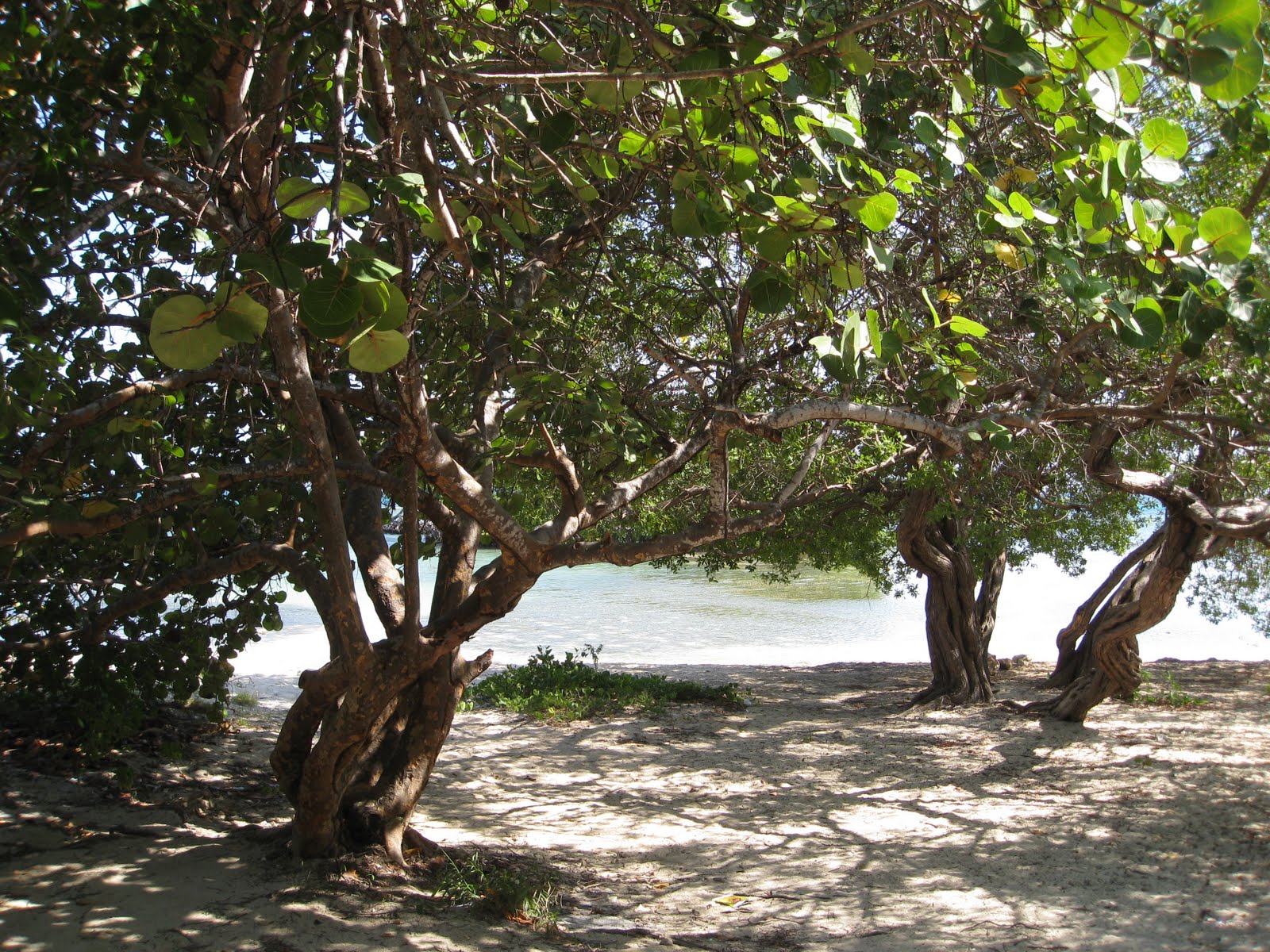
Playa Santa is a truly exquisite beach. The beach is forested in places (below).

Most of the trees on the beach had dark-brown termite tunnels running up their trunks and their largest branches (photo below).
There were picnic tables under a few of the trees, where we parked our stuff.
Matt, Ken, Alan, and Sadie

Mangroves grow in the shallow tidal waters of Playa Santa

The mangroves in Playa Santa's intertidal zone

Mangroves
Mangroves are trees that grow only in intertidal zones.  There are around 70 species of mangroves around the world.  With their roots partially submerged and partially in the air, mangrove trees provide habitat and food for hundreds of thousands of animal species, from birds to monkeys to crustaceans. The nooks and crannies of the submerged roots make excellent nurseries for vulnerable fish hatchlings.  At one time, most coastlines of the tropical world supported mangrove forests. With their intricate root systems, these forests encourage the deposition of sediment by slowing the flow of water; they also protect coastlines from erosion, storm surge, and tsunamis.  But in the past few decades, 35% of the world's mangrove forests have been destroyed. For information about protecting mangroves, see the website of the Mangrove Action Project.
The spatially-heterogeneous roots of these mangroves (at Playa Santa) provide unique habitat for wildlife.

The water at Playa Santa was turquoise and so shallow that we could wade out a hundred feet from shore. There were no waves at all.
 Matt, Alan, Ken, and Sadie wading

Intertidal life
While my family waded farther out, I looked for creatures in the foot-deep water.
I saw this Little Blue Heron foraging for fish, and saw her catch one.

I saw this thing, about 5 inches across.  I have no idea what this was, but it looked alive.

The thing above looked like the lining of a burrow, secreted by a marine worm. A lot of marine worms that burrow in abrasive sand secrete soft linings to their burrows. This lining (or "casing") might have worked its way to the surface, if the worm had died. I don't know!  I'm just guessing. If any of you readers know what it is, tell me!

This little mushroom-like thing was interesting, on the ocean floor in about 10 inches of water. I feel like I should know what it is, being a biologist. But I don't. Do you?  It was 2 or 3 inches tall. The stuff around it was seaweed of various species.

We found several sea cucumbers in the intertidal zone. They are echinoderms, related to sea stars (starfish) and sea urchins and sand dollars. They were all alive, and amazing.  I'd never seen one alive before. 
A sea cucumber in Playa Santa's intertidal zone.


Ken holding a sea cucumber

A bigger living sea cucumber, in my own hand

Sea cucumbers are not very active and are almost completely limp out of water. But most species can move slowly across the ocean floor on tiny "tube feet," scavenging for planktonand dead organic matter. In some parts of the world, they're extremely abundant. In China and s.e. Asia, sea cucumbers are popular as human food.

Leaving Playa Santa for San Juan.....and Roberto Clemente
So that was Playa Santa.We left in late afternoon, dropped Alan off at his home, and the rest of us drove back to San Juan to fly home.  In San Juan we stopped by the park that honors the famous baseball player for the Pittsburgh Pirates, Roberto Clemente. Clemente grew up in Puerto Rico.  He died in a plane crash on a humanitarian trip to provide supplies to earthquake victims in Nicaragua, in 1972. Ken has always been a huge fan of Roberto Clemente.
Ken with one of his heroes
Puerto Rico overall
I loved Puerto Rico because it was new, it was tropical, and I was with my family - we would have had fun anywhere. Do I recommend it as a travel destination?  I do, if you want a tropical island with both mountains and beaches.  It was easy to get to, easy to book, easy to navigate because most of the residents speak English, and many of them speak it very well.  Calls from the U.S. are not international, and P.R. uses U.S. dollars. Yet, it still feels like Latin America or the Caribbean because Spanish is the first language, and the culture is not the same as the continental U.S. For me, the culture was very different from home - the music, styles of dress, the food. That was great, I don't want to go somewhere just like home. So Puerto Rico was easy and comfortable, but different enough to feel that we weren't "in Kansas anymore."

We saw a lot of great birds in Puerto Rico. But if wildlife is your first priority, I'm not sure Puerto Rico would be my first recommendation.. The only native mammals living there now are bats. Islands in general have less wildlife than mainlands - at least that's true for smaller islands.

I guess I'm spoiled by the prolific wildlife of Costa Rica: white-faced capuchins, spider monkeys, howler monkeys, native squirrel monkeys, sloths, ant-eaters, coatimundis, agoutis, tayras, red-eyed tree frogs, poison-dart frogs, and some of the world's most impressive venomous vipers. If you're looking for spectacular tropical wildlife not far from the U.S., Costa Rica will provide more.

Just depends on what you're after.

Anyway, we had a great time in Puerto Rico.  If you're going, I do recommend all the places we stayed, which I've mentioned in my Puerto Rican posts listed below. In San Juan, we spent 2 nights at Coral by the Sea hotel, which was right on the beach, comfy and clean, an easy walk from restaurants, cheaper than its competitors, and 5 minutes from the airport. Its contact number is 787.791.6868.

Tropical nature! For me, there's nothing better.

My previous posts about our March 2010 trip to Puerto Rico:

Old San Juan: Steep, tropical, colorful

Exploring the tropical rainforest in Puerto Rico: El Yunque Caribbean National Forest

Puerto Rican beach pleasures, and the Jayuya Uprising

In Puerto Rico: Jayuya and the Toro Negro State Forest

See also Alan Kneidel's posts about Puerto Rico at http://goodbykneidel.blogspot.com

Keywords: Puerto Rico wildlife marine life mangroves introduced mammals rhesus macaques tropical islands Costa Rica