Showing posts with label meat industry. Show all posts

Thursday, May 14, 2009

Is local food the greenest choice? New study says no

Dairy cows' rear-ends: bad news for our climate.
Photo by Sally Kneidel

"Local" is the mantra in sustainable food these days. But should it be? Is eating locally-produced food the most powerful thing we can do to reduce our ecological "foodprint?"

A new study from Worldwatch Institute says no indeed. I love Worldwatch. They crank out study after study with lots of hard data, evaluating the environmental impact of various consumer choices. So useful! So fun to quote!

Don't get me wrong - I'm all in favor of local food. We definitely should support small-scale farmers in our own communities who are growing food organically and sustainably. For years now, I've been writing and speaking in support of them, on this blog and in our books and at various conferences.

There's no question that, all other things being equal, buying food grown nearby is better than buying food that's been trucked for long distances. Less transported food means fewer emissions and a smaller carbon footprint. But as Sarah DeWeerdt points out in this new Worldwatch article, we need to look at the whole production picture - not just how far food was transported from producer to market.

As it turns out, when we look at life-cycle analysis, a "cradle-to-grave perspective" on food products, food miles are "a relatively small slice of the greenhouse-gas pie," says DeWeerdt. In fact, according to a comprehensive analysis last year by Christopher Weber and H. Scott Matthews of Carnegie Mellon University, final delivery from the producer or processor to the retailer accounts for only 4% of the U.S. food system's greenhouse-gas emissions! Materials required for cultivation and processing must be transported too; this transport is considered part of the "upstream" miles and emissions. Such materials include fertilizer, pesticides, animal feed, etc. But the transport of these items, together with transport to market, still accounts for only 11% of the food system's emissions.

What's the source of all the other greenhouse gases associated with agriculture? Production. Primarily, production of livestock. Weber and Matthews from Carnegie Mellon found that a whopping 83% of food-related emissions occur before the food leaves the farm. Tara Garnett, in a recent analysis of a U.K. food system reached similar conclusions.

What you eat may matter more than where it came from

Numerous studies reviewed by DeWeerdt have found that livestock production generates a much higher volume of greenhouse gases than does plant production. Beef and dairy cattle are the worst culprits; DeWeerdt calls them "agriculture's overwhelming 'hotspots' " in terms of greenhouse-gas emissions. A group of Swedish researchers has calculated that meat and dairy account for 58% of that country's total food emissions. In Garnett's study, meat and dairy accounted for half of the U.K. food system's greenhouse gases. Garnett writes, "Broadly speaking, eating fewer meat and dairy products and consuming more plant foods in their place is probably the single most helpful behavioral shift one can make" to reduce food-related greenhouse gases. Weber and Matthews reached a similar conclusion: "No matter how it is measured, on average red meat is more GHG-intensive than all other forms of food. " The dairy industry, in their study, was the second-biggest contributor to greenhouse-gas emissions.

A large proportion of emissions associated with beef cattle and dairy cows are the greenhouse gases methane and nitrous oxide. Methane is 23 times more potent at trapping solar heat than is carbon dioxide; nitrous oxide is 296 times more potent (molecule per molecule). Methane comes from the rear-ends of ruminants such as cows. Both methane and nitrous oxide come from manure, especially the vast, open "waste lagoons" associated with factory farms.

Well then, just how much does food contribute to the planet's overall carbon footprint? I reported on that in a previous post. In 2006, the United Nations Food and Agriculture Organization published a live-wire of a paper entitled "Livestock's Long Shadow." According to that research document, livestock account for 18 percent of all greenhouse gas emissions. And here's the kicker - that's more than all forms of transportation combined! You can easily google that document for yourself. Just read the 3-page Executive Summary in Part I, which summarizes the the whole 400 page report.

After concluding that red meat and dairy are emissions hot-spots, DeWeerdt does go on to review the merits of buying local food. One clear advantage, which Sadie and I talk about in our presentations, is that local food is in general grown by small-scale farmers who are openly accountable for their treatment of the environment and their livestock. The farmers I know who sell food to their own communities welcome visitors to inspect their methods. This is a far cry from industrial producers who keep their exploitive and often abusive operations shielded from public view.

So buy local. But, if you want to contribute to a liveable planet for your grandchildren, eat low on the food chain too. And join me in a tip of the hat to Worldwatch for another fine study.

by Sally Kneidel, PhD

Sources:
Sarah DeWeerdt. Is Local Food Better? Worldwatch Institute. Accessed May 15, 2009.

Livestock's Long Shadow. United Nations Food and Agriculture Organization. Rome, 2006.

To see my primary post about Livestock's Long Shadow and about Weber & Matthews' research, click here

To see all my, Ken's, and Sadie's posts that mention Livestock's Long Shadow, click here

To see my favorite Worldwatch Institute document, Happier Meals: Rethinking the Global Meat Industry by Danielle Nierenberg, click here

Key words:: Worldwatch Livestock's Long Shadow meat industry local food red meat cattle dairy livestock greenhouse gases carbon emissions food carbon footprint foodprint Sarah DeWeerdt Weber and Matthews Matthews and Weber Carnegie Mellon

Saturday, February 09, 2008

China's growing appetite for meat will strain world water supplies


China's rapid industrialization and increasing population, along with a growing preference for meat on the dinner table, are creating water shortages that will have world repercussions. In coming decades, China will have to rely on food imports to meet demand.

China is home to 21% of the world's population. Its economy has grown at the fastest rate in recent world history, about 8% per year over the last two decades, says Junguo Liu, an environmental scientist in Switzerland.

During this period of unprecedented growth, the consumption of grains in China has remained steady, even dropping a little. But the consumption of meat in China has more than quadrupled since 1980. The production of meat requires much more water per serving than any other kind of food. Even though meat and other animal products made up only 16% of the typical Chinese diet in 2003, those foods accounted for more than one-half of the country's food-related water consumption, report Liu and colleague Hubert Savenije of Delft University in an upcoming Hydrology and Earth System Sciences.

How does the Chinese diet compare to the American diet?

Food-related water consumption per capita in the United States is about 3,074 cubic meters per year, almost four times the Chinese figure. The water needed to produce the typical U.S. citizen's consumption of meat alone far exceeds that required to produce the average Chinese citizen's entire diet.

Why is that? According to Danielle Nierenberg of Worldwatch Institute, Americans eat 248 lbs of meat per person per year, far more per capita than any other country in the world.

The world of the future will not be able to support a growing population eating more and more meat. Already more than 1/3 of the world's population live in regions where water is considered scarce.

Keywords :: China, water shortage, meat industry, American meat consumption, population growth

Sources:
Sid Perkins. "A thirst for meat." Science News. January 19, 2008.
http://www.sciencenews.org/articles/20080119/fob4.asp

Danielle Nierenberg. "Happier meals: rethinking the global meat industry." Worldwatch Institute. 2005. http://www.worldwatch.org/node/819

Friday, January 26, 2007

Weiners & Burgers Heating the Planet More than Cars

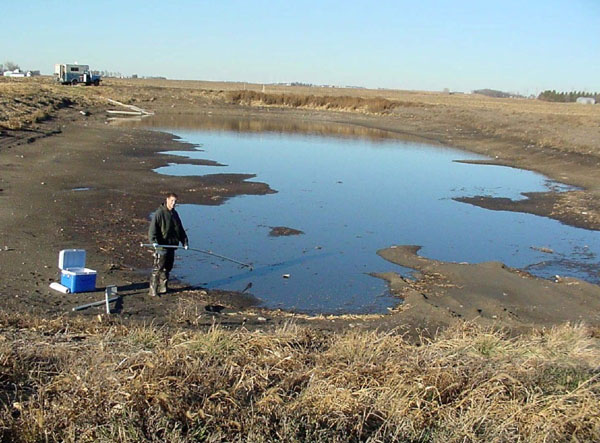
A scientist collecting waste samples from a swine manure holding pond in Iowa

Animal farming is a bigger contributor of greenhouse gases and global warming than transportation is. So says a new report from the United Nations FAO or Food and Agricultural Organization.

Raising livestock accounts for 18% of all green-house gas emissions worldwide, including 9% of all carbon dioxide produced by human activities. Most of that CO2 is from the burning of forests for livestock pastures or to grow feed for farmed animals.

In addition, 37% of all methane due to humans is from livestock. Methane is 23 times more potent as a greenhouse gas, molecule for molecule, than CO2 is.

Farmed animals, says the FAO report, now comprise 20% of all land animals. The proliferation of animals we keep for meat, eggs, and milk is displacing and endangering wildlife species. The report says that 30% of land which is now occupied by livestock was at one time prime wildlife habitat. [It seems to me this figure should be closer to 100%.]

The FAO proposes, as a partial solution, that the true environmental costs inherent in animal agriculture should be passed along to livestock farmers. This would include the cost of attempting to restore habitats damaged by livestock, including the cleaning of rivers polluted by the liquid effluent from waste lagoons. The farmers then would be forced to pass those costs along to retailers and on to consumers. Sounds good to me.

But some costs can't be recouped. There is no technology to remove CO2 from the air, for example. I know this because my community has just had a couple of public hearings to consider our local power company's request to build more coal-fired power plants. That point was brought up again and again as I and others protested the construction: there is no technology to remove CO2 from the air. So the real solution to animal farming will have to be consuming fewer animal products. There is no other true fix.

Science News, January 13, 2007

Keywords:: GREENHOUSE GASES GLOBAL WARMING CLIMATE CHANGE ANIMAL AGRICULTURE FACTORY FARMING ANIMAL PRODUCTS FARMED ANIMALS TRANSPORTATION SUVS CARS TRUCKS EMISSIONS CARBON DIOXIDE BURNING FORESTS BURNING WOODLANDS PASTURES LIVESTOCK FEED ENVIRONMENTAL COSTS CONSUMER LIVESTOCK FARMER TRUE COSTS

Friday, September 08, 2006

Mass Extinctions of Wildlife Related to Our Diet Choices

Mass Extinction Underway...
A mass extinction is a catastrophic, widespread, or global event that wipes out 25 to 75 percent of existing species. Most of the mass extinctions that occurred prehistorically — before humans evolved — resulted from global climate changes that killed thousands of species and left behind those able to adapt to the new conditions.

According to a recent survey, 70 percent of biologists believe we are in the midst of a new mass extinction. Although the Earth has experienced other mass extinctions before humans evolved, biologists point out two important differences between the current mass extinction, and those of the past:

1) This mass extinction is taking place in a very short period of time, during a few decades, rather than over thousands or millions of years.

2) We are eliminating or fouling many environments, such as tropical forests, coral reefs, and wetlands, that in the past fostered the evolution of new species during the 5 to 10 million years after a mass extinction.

What’s Going On?
The destruction of habitats by humans is responsible for about 75 percent of the current extinctions. Another major cause is unregulated hunting and fishing. The introduction of nonnative species such as wild boars, Gypsy moths, and European starlings is another leading cause of extinctions.

How Are Extinctions Related to Meat Consumption?
The production of meat requires much more land than producing an equally nutritious amount of plant protein. Because most Americans eat animal products two or three times a day, we devote a hefty portion of our land to either grazing livestock or raising grain or hay to feed livestock. About 40 percent of all land area in the United States is used for grazing livestock for our dinner tables.

Consider this. In the United States, we feed 66 percent of our grain to livestock. But the rest of the world feeds only 3 percent of their grain to livestock. If we weren’t eating so much meat and dairy and eggs, think of all the agricultural land that could be restored to its natural state as forests, prairies, and wetlands. We could also slow the conversion of natural lands to agricultural lands. Our population here in the U.S. is still growing rapidly and our food production will have to increase. This year we reached 300,000. By the year 2025, just 18 years away, we'll add another 50,000 people to the United States population! See www.census.gov, or International Data Base, for more information about that.

The adoption of a vegetarian, or better yet, a vegan diet would vastly improve the outlook on the future for both humankind and wildlife.

Is Our Diet Making Us Healthy and Happy?
About 65 percent of Americans are overweight or obese. We also have high rates of heart disease, high blood pressure, colon cancer, and other ailments related to a diet high in meat, eggs, and milk fat. We’re not healthier.

But are we happier? No. Although our consumption of resources has doubled since 1957, the proportion of Americans who report they are “very happy” has remained the same.

But Wait…
Raising livestock doesn’t have to take so much land and cause so much pollution, if done on a smaller scale. Only a few decades ago, manure naturally fertilized crops and enriched the soil, rather than winding up in “waste lagoons” that leak and spill into rivers. Livestock consumed crop waste and kitchen waste. Animals and people maintained a balance. It’s only since the production of meat, milk, and eggs has become industrial in scale that it has begun to damage the Earth so severely. The damage includes ocean habitats and fish populations as well as land ecosystems.

The average American eats 248 pounds of meat a year, far more per person than any other country. It’s not possible for everyone on the planet to have that much meat. We would need four more Earths to raise enough livestock and fish, if everyone on our planet ate as much meat as Americans do.

The Union of Concerned Scientists says that our American diet is second only to our transportation as our most environmentally damaging consumer activity. We can make better diet choices for a sustainable future.

The loss of countless plant and animal species is at stake.

See our post of September 9 for an example of a wildlife population that's threatened by our consumer demand for animal protein.