Showing posts with label Andes. Show all posts

Friday, August 01, 2008

Guinea pig was the main dish at Lake Llanganuco in Peru

Juan Albino, our taxi driver from Huaraz to Llanganuco in the Andes. (The previous post is about our family's stay in Huaraz.)

"How much farther is it?" someone whimpered. Our rear ends were aching, jammed into another Peruvian taxi - older cars that have lost most of their seat padding and shock absorbers. But the views out the window soon distracted us from our discomfort. Our jaunt through the Andes in the taxi, from Huaraz to Llanganuco Lodge, was so scenic I was soon beside myself. I exclaimed on and on about the sights like I'd had way too much coffee - sometimes to the annoyance of my fellow passengers. The taxi bounced across luscious green and brown slopes, past occasional adobe homes with plots of potatoes or corn, past sheer rock cliffs. Quechua women in brilliant clothing sauntered along the narrow curving road, or worked the vegetable gardens with their husbands. Beyond the slopes were snowy peaks, among the world's highest. I tried to memorize the whole thing: the landscape and the thrill, for me, of being in Peru instead of behind my desk at work. It was worth 10 months of slogging at the job for a couple of weeks of this. Compared to Europe or the U.S., Peru is a pretty economical destination. Our travel agent in Iquitos, Rosa Vasquez Zanetti, turned us on to some great Peruvian places with great Peruvian prices.


Andean peaks: Huandoy (above) and Huascarán (right) loomed ahead as we hurtled up the mountain in Juan's taxi. Huascarán is the world's highest tropical peak, at 22,205 feet. (These two photos by Alan Kneidel.)


We passed through the market in the Andean town of Yungay

As we jostled along in the taxi, we were intrigued to find that our driver Juan's first language was Quechua. We begged him to teach us some words and he complied. Hello is yameyocko, he said. Yes is ohmee. No is mana. Mother is mama, oddly. At least I'll remember that one. Juan even told us how to say "Can I take your picture?" - Oto hotootah tomarishkekee - one of my necessary phrases in Peru.

Our driver Juan with my family - Ken, Alan and Sadie - at a quick stop to look at a gold mine

After two and half hours, we pulled into Llanganuco Lodge at the end of Huandoy Valley. Charlie Good, the British owner of the lodge, welcomed us with his beloved pooch, Shackleton. The rooms were nice - hot water from a tankless gas heater, and duvets on each bed. At 11,500 feet, the nights are chilly. Charlie is a young economist from London who gave up the rat race to pursue his dream, and he's doing a good job of it. He offers gear for climbing and rappelling, and he's created a bunch of hiking trails around the lodge, one to a glacier, and some that provide views of soaring Andean Condors (click here to see on youtube). We saw a lot of birds at Llanganuco, including the Giant Conebill, Giant Hummingbird, Great Thrush, Puna Ibis, and Andean Goose. I'll give more details about birding near Charlie's Llanganuco Lodge in a later post. Charlie is also involved in the challenges facing the local Quechua farmers. He wrote a great piece about the threats to the Quechuan rural culture that appeared in a Huaraz magazine. I'll reprint that piece in a later post too.

The two pics below: Llanganuco Lodge, and our room's view of Huascarán


Pic below: a small lake we hiked around, right next to the lodge


Birding near the lodge: l to r, Charlie (lodge owner) with Alan and Sadie

Higher and higher:
Huascarán National Park

and Lake Llanganuco

We'd started taking Diamox the day before we left Lima for the Andes. It's the most popular medicine for treating and preventing altitude sickness. It works by making you breathe faster, which compensates for the reduced oxygen in the higher air. My brothers had used it on hikes in Colorado and they said it worked. The day after we arrived at Llanganuco Lodge, we called a taxi from Yungay to come get us and take us to Lake Llanganuco, a very big lake in Huascarán National Park. It was a walkable distance from the lodge to the lake, but involved a 1000 ft rise in altitude - too much exertion for the first day at 12,500 feet, even with the Diamox. We planned to walk back from the lake to the lodge instead, which would be all downhill.

The day at Lake Llanganuco was one of the happiest days of my entire life. I know I said something similar about Huaraz, but here it is again. This day was even better. On the way up to the lake, in the taxi, we had to stop at the park office to pay an entry fee, and we spotted a Quechuan family who had a food-stand outside the office. They were selling whole baked potatoes and baked corn from their garden. We bought a couple of hot potatoes to munch on, and they let me take their pictures.

Below: dad and mom, then daughter and mom - selling baked potatoes & corn at the park office


We soon arrived at charming Lake Llanganuco (below), surrounded by snowy peaks. The rock face on the right side of the photo was covered with bromeliads of the genus Puya, which grow only under harsh conditions such as high altitudes or deserts. Photo of lake by Alan Kneidel. (If you click on any picture, the picture enlarges.)


But even more interesting than the lake, to me, were two groups of local Quechuan women who had set up shop under the two shelters in the picnic area next to the lake. Yay!! I was so excited. Now was my chance to get to really talk to some Andean people and take some pics, if they'd let me. And if they spoke Spanish. They did. The first group was cooking lunch to sell to hikers and lake visitors. The selection: roasted or fried guinea pig, crunchy corn kernels cooked in oil, similar to corn nuts but a lot better, potatoes, corn on the cob, greens, tomatoes, and fried unleavened bread that was so good it made me giddy.

Below: guinea pig cooking over the fire, and guinea pig on the plate ("cuy picante," a traditional Peruvian dish)


One of several women sharing a fire to cook guinea pig, etc.


I did my best to engage the guinea-pig-roasters in conversation, but they were busy cooking and tending a small child who was unhappy with the smoke in his eyes. I tried to amuse the child so the women could work, but he was afraid of me with my light hair and freckled face. So I gave up on that. I decided to try my luck with the second group of women, who were selling woven hats and scarves and gloves. They too had a fire going, but it was only to heat water for the mate de coca tea they were selling, made of brewed coca leaves - a tradition in the Andes since Inca days. They weren't nearly as busy as the women who were cooking, and they had no children to distract them. I was in luck. I made friends right away with Maria, a jovial Quechua woman who tried to get me to buy a hat, and modeled an assortment of hats to win me over.


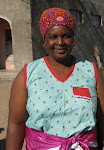
First hat above, second hat right. Maria looked lovely in both. I only wish I had her address to send her prints.


After the hat modeling, I had to buy a cup of hot tea from the gals, and a bag of leaves for later tea-making. (I was interested to learn that coca leaves alone have no excitatory or intoxicating properties. But they do have a lot of medicinal properties.) I then proposed some general photo-taking of whoever was interested. All six of the women selling hats jumped up, peeled off their fleeces and comfy clothes, and put on their Quechuan finery. About that time Sadie wandered up from her trek around the lake, and joined in the fun. She too had to have a cup of tea, and procure a bag of tea leaves for later. Sadie was a good addition to such a gathering because her Spanish is flawless and her social skills are better than mine too. We were hummin' along.

Photo below: Tucking in the finery for a pose.


When Sadie ambled away to prepare for our upcoming hike, the women waved goodbye like old friends (below).
We ate some lunch (yes, some of our family tried the guinea pig) then took off down the trail through Huascarán National Park back to Llanganuco Lodge. We hiked through a forest of red Polylepis trees, which are endemic to high altitudes in the Andes. Polylepis forests are disappearing, we learned, because of population growth and increasing demands on the land.

Below, four photos of the Polylepis forest by Alan Kneidel. In the second photo, a Giant Conebill forages on the tree trunk.


In this picture, Puya bromeliads are visible on the Polylepis trees.


The trail followed the stream that ran through the forest between these cliffs.


Hiking through the red trees between monstrous cliffs was fun, but I'm not sure we were quite ready for the altitude factor. The trail was covered with rocks in places and was hard to walk on. As I discovered later, one symptom of altitude sickness is "loss of coordination" and I may have had that affliction, because I had to go at a snail's pace to keep from breaking my leg. Another symptom is fatigue, and I was definitely experiencing that. By the time we made it back down to the park office where I'd photographed the food vendors, I was completely exhausted. But we pressed on. We met some boys on a dirt road with their llama, and that seemed to revive me.
Just before dark, we made it back to Llanganuco Lodge. I popped another Diamox and got ready for our gourmet dinner, cooked by Tito, a friendly local guy who whipped up the meals at the lodge. I was ready that night for our free shot of pisco. However, one of us who hadn't taken any Diamox that day missed dinner and instead spent the evening hours hugging the toilet bowl. Luckily Llanganuco Lodge has great toilets. Was it altitude sickness? I don't know...nausea is one of the first symptoms. Or maybe it was the guinea pig, which wasn't really entirely cooked. At any rate, it wasn't our first date with johnny on the trip. In the Amazon, we'd had several days of erupting from either end, or both.

No matter, after a couple more days of hiking and birding around the picturesque Llanganuco Lodge area, we were telling Charlie goodbye and heading back to Lima for the final leg of our Peru blast...the desert coast along the Pacific. Specifically, we were off to bird the Reserva Nacional de Paracas and Islas Ballestas.

Photos and text by Sally Kneidel, except nine photos by Alan Kneidel as noted above

Click here for great photos of a birding trip to Huascarán National Park by Jeff Pippen of Duke University (not related to our trip, other than the destination, and the fact that we're all from N.C.)

Keywords:: Peru cuy picante Alan Kneidel Huascaran Huandoy Llanganuco Lodge Lake Llanganuco Andes Quechua guinea pig Andean Condor birding in the Andes Polylepis Puya pisco Diamox altitude sickness Giant Conebill Sally Kneidel adventure travel birding trip

Thursday, July 24, 2008

Taking Rosa's good advice, we veered up the road into Huaraz and the Peruvian Andes


Rosa looked concerned. "Why are you going to Huancayo?" she asked, brow furrowed. Rosa Vasquez Zanetti runs a travel agency out of her family's inn where we were staying, on the Amazon River in Iquitos Peru. Rosa had been so helpful already, I'd asked her to look over our plans for the Andes.

"We picked Huancayo at random - because it's a small mountain town with no Americans, and not too far from Lima by bus," I answered.

"But...that's not the best plan," Rosa continued, in her soft-spoken way. "For birding and trekking, you should go to Huaraz in the Cordillera Blanca. And you should ride the Cruz del Sur bus from Lima. It travels during the day and makes no stops so it's safer." Night buses that make frequent stops are vulnerable to occasional muggings, as we heard from more than one source.

a view of Huaraz from Zarela's hostel

"Stay at Zarela's hostel in Huaraz for a couple of days to get acclimated," Rosa told us. "Then from there, you can go up to Llanganuco Lodge and Llanganuco Lake. You'll like that better than Huancayo."

Rosa arranged it all. As it turns out, the Cruz del Sur bus does make pit stops on request (the onboard bathroom is for liquids only, the driver announced). But no scheduled stops. And it didn't freak me out like I feared it would, swooping around mountain curves with no guard rails. I just didn't look out the window.

kids of a Huaraz street vendor

We loved Huaraz - at 10,200 feet, the highest place we'd ever spent the night. (Click for map.) We loved La Casa de Zarela too, a first-class backpackers' hostel with hot water, great views, and helpful staff, especially spunky owner Zarela Zamora (online reviews and contact info). Most of the guests staying there left early in the morning on treks or climbs arranged by one of the local trekking companies. Huaraz (and Zarela's) are featured in Outside Magazine as the mecca for mountain adventurers in the northern Peruvian Andes. Nestled between the Cordillera Negra (brown peaks) and the Cordillera Blanca (frosted peaks), Huaraz is within spitting distance of some of the world's highest summits. The Cordillera Blanca has more than 50 peaks of 5700 m (18,700 feet) or higher. North America has only three; Europe none. (Click here for a Huaraz trekker's online journal entry.)

Much of the adobe town was leveled by an earthquake in 1970 that killed 20,000 people in Huaraz alone - half the population. The town has been rebuilt, this time with rebar reinforcement in every wall. In fact, a good proportion of the homes and buildings still have rebar poking out the top. But the funky construction and the steep cobbled streets just add to the town's personality - a blend of local enterprise and Andean indigenous culture, along with the trekkers, birders, and wanderers like ourselves.

a Huaraz weaver and her alpaca

I spent our time in Huaraz skulking around the town, trying to get pics of Andean street scenes and the beautiful Quechua women who were everywhere, with their long thick braids and brilliantly colored hand-woven clothes and baby-slings. In the afternoons and evenings, indigenous women from outlying farms and villages set up stands or spread blankets on the sidewalk to sell produce or woven items. They all wore traditional fedora-style hats, often with an arrangement of feathers lying flat against the felt. Most of the women didn't want their picture taken, even when I asked politely. But a few acquiesced, a couple of them even asked me to mail them prints. It was a blissful day for me, I can't say why exactly - one of those few days where the world seems a lovely place; I felt grateful to be alive and well.


After just one day of acclimating in Huaraz, and scampering about annoying people with my camera, we hired a taxi driver from Yungay to take us to Llanganuco Lodge at 11,500 feet, and later Llanganuco Lake (12,500 feet) in Huascarán National Park. The lodge is right smack at the base of snow-covered peaks Huascarán and Huandoy. At 22,200 feet, Huascarán is the highest tropical peak in the world. I'll tell you about the National Park and the lodge - and altitude sickness - in my next post. Between our amoeba issues along the Amazon and altitude sickness in the Andes, we had a few sick days. But that's all forgotten now. I said in my previous post that I'd move to Iquitos in a heartbeat; I'll have to include Huaraz as well. If a job opened in either place, I'd be gone in a flash.


Huascarán by Alan Kneidel

All other photos, and text, by Sally Kneidel

Keywords:: Huaraz, Andes, trekking, trek, climbing, Huascaran, Llanganuco, Pascana Amazon Services, Rosa Vasquez, Quechua, La Pascana, Zarela, Zarela's, alpaca, Kneidel, Sally Kneidel, Alan Kneidel

Monday, July 14, 2008

From the Amazon to the Andes, Peru knocked me silly

Be sure to ride the moto-taxis in Iquitos, and hold on tight

If you're interested in adventure travel, as in someplace really different from home and not too expensive, consider Peru. If you want a ground-level view of what's really going down in the tropical world, Peru will show you that.

We're just back from 24 days in Peru, a trip that included the Amazon, the Andes, and the desert along the Pacific Coast. Peru is one of the most varied and stunning countries I've seen. It has the highest biodiversity of any country on the planet - a big bonus for us. We also found opportunities to interact with indigenous people in villages along the Amazon and in the Andes. One of our goals was to spend as much time as possible in places where other Americans don't go - remote villages and nature reserves. We accomplished that, partly by avoiding Machu Picchu and the Sacred Valley.

My trip included husband Ken, son Alan, and daughter Sadie. Sadie and Alan are both in their twenties.

A whole lotta birds
We saw 301 species of birds in Peru - not bad. Compared to 314 species in Costa Rica (over a period of 12 weeks), 220 in Kenya, and 141 in South Africa. [The Kenya trip was only Alan.] Birds we saw in Peru included the Humboldt penguin, Inca tern, Peruvian booby, Peruvian pelican, blue and yellow macaw, vermillion flycatcher, white-throated toucan, wattled jacana, Andean flicker, white-winged parakeet, burrowing owl, etc. I can post a list if anyone is interested. Leave a comment on the blog and tell me.

A street vendor in Iquitos

Wild and woolly Iquitos

We spent 4 or 5 days in Iquitos, the world's largest city that's not accessible by road but only by river or air. It's a friendly, hyper, and funky little town on the Amazon River. And cheap. Our lodging cost us $9 per person per day, on a quiet dead-end street that ends at the river. The roads of Iquitos are traversed by "moto-taxis" instead of cars, like 3-wheeled motorcycles with go-cart engines (see picture at top of post). For half a dollar, a mototaxi will take you anywhere, darting through town at break-neck speed. A first-class thrill, better than any carnival ride. I love Iquitos. I would move there next week if I had a job there and I'm not kidding.

Biological station on stilts
After a few days in charming Iquitos, we took a boat to a very remote biological station about 90 river-miles from Iquitos. We went east on the Amazon and south on its tributary, the Orosa River. The biological station, Madre Selva, is operated by Project Amazonas, a conservation and humanitarian non-profit. The station provides "rustic" lodging for biologists studying Amazonian plants and animals. Project Amazonas also offers some medical aid to remote families and under-served villages on the rivers. At the biological station, we slept in tents on raised wooden platforms under a thatched roof. Thatched homes with open sides are traditional in Amazonia. Every single house you pass on the river is built that way, and on stilts, which protect against flooding - because Peru has a rainy season and a dry season and water levels fluctuate dramatically. Summer in the U.S. is Peru's dry season, good for travel. Especially July and August.


Photos: Our housing at Madre Selva, outside and inside. Our house had screen walls, but most homes don't.


We had the station to ourselves, with our Peruvian helpers

The biological station is open to anyone who wants to go. The director of Project Amazonas, Dr. Devon Graham, is affiliated with Florida International University (in Miami) and frequently takes student groups to the station to study the use of forest resources by local people, all of whom are indigenous. He also takes groups of tourists, but none were there when we were. We had the station all to ourselves, along with our cook, boatman, and our naturalist guide - all native Peruvians whom Devon engaged for us.Photo: Our boat is visible behind Raul Viena our cook, Edwin Ruiz our boatman, and Cesar Peña our naturalist guide

The wildlife delivery crew
We loved the local indigenous children who paddled over to the station every day in their dugout canoes. When their mothers came too, they brought stuff to trade: woven baskets, bags, fans, carved jewelry. The moms welcomed what we offered: lotion, mosquito netting, toothpaste, socks, shirts, anything. Sometimes the children brought their "pets" to show us: lizards, turtles, and even monkeys! This was not at our request, and we were uncomfortable seeing wildlife as pets, especially the primates. But as we learned, people living in remote places along the Amazon do keep wildlife as pets. We saw plenty of wildlife for sale as meat too, back in Iquitos, which made us equally uncomfortable.

But we were grateful to have the chance to talk with the families around the biological station.


Above photo: A group of sisters brought us a little frog in a baggie (which Sadie released into the forest). Right: Another family brought their two pet monkeys to visit with us, just to be neighborly.
The monkey pictured is a monk saki monkey.

Belen market: teeming with life and death
Captive wildlife often winds up in Iquitos. Part of Iquitos is a floating shantytown of huts built on rafts that rise and fall with the river. The floating area of the city, called Belen, has an extensive and colorful open-air market on the shore, which offers every imaginable jungle resource. It's an exotic sensory deluge, crammed with foods and spices and jungle products I've never seen before. It reminded me of Diagon Alley in the Harry Potter books for some reason, maybe because of all the traditional medicines for sale, made of plant and animal parts. (The use of animal parts to treat ailments and impotence worldwide is based almost entirely on superstition, folklore and tradition. I don't know of any animal parts that have been demonstrated to be effective medicine.) The part of the Belen market that offered traditional medicines was troubling, and fascinating. As I've written elsewhere, the trade in wildlife and wildlife parts worldwide is the third most lucrative blackmarket commodity in the world, after drugs and arms (according to Interpol).
Photo above: In the Belen market, plant and animal parts were sold as medicine (see "Medicina Natural" sign above. "La Selvita" means "The Little Jungle.")

I saw traditional medicines made of animal parts while visiting a medicine man in a remote village in South Africa last year. He had a few animal tails and skulls, and some unidentified animal parts in jars, but his collection of animal parts was meager compared to the array on display in the Belen market.

We also saw baby monkeys for sale in the Belen market, for 5 soles, about $2 each. I was stunned at that. These were saddle-backed tamarins, spider monkeys, pygmy marmosets, animals whose habitats and population numbers are declining, and who should be protected. There were more than monkeys for sale....living anteaters, parrots, and sloths, too. It was distressing, yes, but if it's happening, I want to know about it. I was grateful for the opportunity to see it for myself, and grateful to our guide Cesar Pena for taking me there. Cesar has been a nature guide on the Amazon for Project Amazonas for 12 years. He works independently too. If you're interested in hiring him as a guide on the Peruvian Amazon, contact him directly at cesars99@hotmail.com. His phone number in Iquitos is 965-658361. To call him from the U.S., dial 011.51.65.965658361.

Rosa was a life-saver in planning our trip. Maybe literally.
Before this post gets too long, I want to recommend an excellent resource for anyone considering a trip to Peru. Rosa Vasquez Zanetti. Her family owns and operates the modest little inn where we stayed in Iquitos, the Hospedaje La Pascana. Rosa is also an excellent travel agent, through her own Pascana Amazon Services. Not only did she make a number of our bookings before we arrived in Peru, she also helped me change some of our Andes plans at the last minute while we were in Iquitos. She recommended some safer means of bus travel into the mountains for us, and booked the tickets. She also recommended safer and more interesting mountain towns and Andean peaks for our hiking plans, and she booked those too, while we were in Iquitos. She was a fantastic resource and speaks very good English. You can contact Rosa directly at reservas@pascana.com or call her in Iquitos. From the U.S., her number is 011.51.65.233466. I'll write another post about what we did in the Andes.

I recommend Miguel Quevedo
I want to recommend too a Peruvian driver that we hired to drive us from Lima to the Reservas de Paracas, a mind-blowing desert nature reserve 4 hours south of Lima. Devon Graham of Project Amazonas recommended both Miguel and Rosa to us. Miguel stayed with us the entire 56 hours or so (two nights) that we spent in the area of Paracas. When we left the car to go birding, he stayed with the car to guard our things. His name is Miguel Quevedo. He's smart, responsible, trustworthy, fun. On many occasions, he acted as our advocate - straightening out misunderstandings with vendors, etc. Miguel can be reached through Rosa Vasquez Zanetti (she will call him for you if you email her at reservas@pascana.com.) Or you can call him directly, but he speaks little English. His phone number in Lima is (511) 99664-1254. If calling from the U.S., it's 011 511 996641254.

Miguel and Sadie at supper, at Paracas on the Pacific coast

More later on Peru, and why I long to get back there.
Photos and text by Sally Kneidel

Keywords::Peru travel, adventure travel, Amazon, Andes, Paracas, Iquitos, South America, tropics