Monday, August 16, 2010

My search for a wild orangutan in Borneo and Sumatra

  Adult male Sumatran orangutan. Photo by Sally Kneidel

On my Asian quest to see wild and semi-wild orangutans (with my husband Ken), I wasn't sure I'd find a single one of the red apes roaming free in a forest. Orangutans used to be widespread in Southeast Asia, but now survive only on the islands of Borneo and Sumatra. Orangutans on both islands are in serious trouble. Only 6500 Sumatran orangutans (Pongo abelii) survive in the wild. The World Conservation Union lists the Sumatran species as "critically endangered" on their IUCN Red List. Sumatran orangutans are considered one of the world's 25 most endangered primates.

The Bornean orangutan (Pongo pygmaeus), with around 45,000 individuals left in the wild, is also on the IUCN Red List, as "endangered." The IUCN predicts that both orangutan species will be extinct in 10 to 30 years if no progress is made in overcoming the threats to their survival. The biggest threat is habitat loss, due to the conversion of forests to palm oil plantations. Road networks often fragment the forests that are left standing. These two factors are responsible for the loss of more than 80% of orangutan habitat in the last 20 years, and the rate of loss is not slowing. Poaching is another major threat to orangutan survival - mostly for the pet trade. According to SOS, there's a huge local, national, and international demand for infant orangutans to be kept as pets. To capture an infant, poachers usually kill the mother.

Logging trucks roar past as we enter the reserve
Since I was determined to spot some orangutans, hopefully wild ones, I  chose my Asian destinations accordingly and arranged everything myself.  No group tour, no package trip. I chose Danum Valley Conservation Area in northern Borneo because it's one of the largest and best-protected lowland rainforests remaining in southeast Asia. The 438 sq km reserve is said to be one of the best places in the world to see truly wild orangutans in their natural habitat. An expensive option for staying in Danum Valley is Borneo Rainforest Lodge. The other choice is the more spartan Danum Valley Field Centre, which is cheaper but gives preference to researchers (which I was not). DVFC is promoted as the leading rainforest research center in the Old World tropics. Tourists can stay at DVFC in limited numbers, but there are no guides. So you're on your own on the forest trails. I know from experience that having a wildlife guide can make a world of difference in what I see while forest trekking.

The first wild orangutan I saw, at DanumValley Field Centre (Borneo). You can see the small green fruit she was eating, still on the twigs in front of her right arm, and a tiny piece in her mouth. Photo by Sally Kneidel.

In spite of not having a guide, I saw my first wild orangutan at DVFC. She was busy eating nut-like fruits in a tree overhead, dropping the inedible pieces like rain all around me. I was thrilled, and riveted, my head tilted back so far that my neck ached. But I couldn't look away from her. I was surprised at how red she was, how long her hair was, and that she seemed unconcerned about my presence.  I saw her on several different days in the same tree. I was lucky to see 4 or 5 other orangutans at DVFC too, but those were just fleeting glimpses through dense foliage. I would have seen more with a guide, no doubt, but that was okay. With hours of trekking on the trails, I also came upon lots of  long-tailed macaques, pig-tailed macaques, a "flying lemur," and a troop of gorgeous red leaf monkeys (maroon langurs). And a Borneo pygmy elephant! ...just as its rear end disappeared into the undergrowth. Danum Valley was definitely worth my 5-day stay. I'd go back there in a flash.
A "flying lemur" clinging to a tree at DVFC. They are unrelated to the true lemurs of Madagascar. Photo by Sally Kneidel.

                  Long-tailed macaque. Photo by Sally Kneidel                 

Although the Danum Valley Conservation Area is rich in wildlife, it is unfortunately bordered on every side by 3-100 km of commercial forests that are rapidly being logged, and beyond those are palm-oil plantations. The road to DVFC is a forestry road; we passed 10 to 12 trucks loaded with huge tree trunks on the way to the Field Centre. That was depressing.

One of the dozen logging trucks we passed on our way into Danum Valley Conservation Area. Photo by Sally Kneidel.
 
My next stop, Sepilok: workers lax about protecting orangutans
Before I left home, I booked a room near Sepilok Orangutan "Rehabilitation" Center because it was the one place I felt assured of seeing an orangutan, if all else failed. Sepilok is the second most visited tourist attraction in Malaysian Borneo, just after Mount Kinabalu. Its appeal is an orangutan feeding platform in a forest setting, where a worker sets out fruit and a pan of milk twice a day for the few orangs that live there.
A pan of milk on the feeding platform at Sepilok. Photo by Sally Kneidel

 The viewing platform at Sepilok. Photo by Sally Kneidel

Tourists can watch from a viewing platform about 50-75 feet away, as 1 to 4 orangutans show up for the snacks. The center claims to be rehabilitating orangutan orphans and releasing them into the "surrounding wild population," although the center has only 40-43 sq km of forest so there can't be much of a population. The center also claims to guard against physical contact between orangs and humans, who can infect the orangs with human viruses like hepatitis, herpes, and influenza. But I watched 4 different feeding sessions, and the workers ignored the ban on physical contact. They handed fruits to the orangs and patted them like pets, both of which were totally unnecessary.

 Above, a worker at Sepilok strokes a young orangutan on the feeding platform. Photo by Sally Kneidel
Above, a Sepilok worker hand-feeds a young orang on the feeding platform. Photo by Sally Kneidel
Another Sepilok worker hand-feeds an orang on the feeding platform. Photo by Sally Kneidel

I also saw a tourist at the center with an orangutan in her lap, cheek to cheek, while her friend snapped photos. No one who worked there paid any attention. The one Sepilok orangutan that I saw fairly close, on the boardwalk to the viewing platform, had a serious eye problem that appeared to be a bad infection - the eye was swollen shut. Contracted from a cheek-to-cheek encounter with a tourist? Could have been.  Had I known in advance that I would see orangutans elsewhere, I would have skipped Sepilok. Although I have to admit the spectacle of 100+ chattering tourists packed onto the sweltering viewing platform was interesting in itself. One person collapsed with heat stroke while I was there, losing control of her bowels. She lay prostrate for a half-hour, then was slowly escorted out, still woozy. I noticed the next day that no one had cleaned off the boardwalk, and the excrement was still there. Not exactly careful health protocol, for barefoot visitors or the macaques and orangs that use the boardwalk when the crowds are gone.

At Sepilok, I watched an orangutan snatch a tourist's backpack and bolt into the forest, then empty the bag and drink the woman's bottle of water. Whatever germs the woman had, the orangutan now has them too. Photo by Sally Kneidel
 
Next, a painful boat ride to a swamp hut  
After reading on Lonely Planet's "Thorn Tree travel forum" about orangutans along Borneo's Kinabatangan River, I booked a 3-day stay at Uncle Tan's Jungle Camp on the river. Getting there requires an hour-long van ride followed by a 2-hour boat ride. The boats are small, open motor boats with backless metal benches - not the most comfortable. Especially if you're prone to lower-back pain like I am.
 Uncle Tan's boats on the Kinabatangan River. Photo by Sally Kneidel

The schedule includes hours of boat rides every day, looking for wildlife. I did see one orangutan, and 3 other primates that were all new to me: proboscis monkeys, Bornean gibbons (gray gibbons), and a silvered leaf monkey. Nice, but all were too far away to photograph. From the boat, we also saw crocodiles, long-tailed macaques, Oriental pied hornbills, a black hornbill, a "leopard cat," a common palm civet, a flying fox (a huge bat), a buffy fish-owl, etc. The night walk with our excellent guide Remy was great; he pointed out colorful birds sleeping on low branches right beside the trail, such as a rufous-backed kingfisher, scarlet-rumped trogon, and a little pied flycatcher.
Rufous-backed kingfisher at Uncle Tan's. Photo by Sally Kneidel

 River water for ablutions at Uncle Tan's. Photo by Sally Kneidel
 
Our doorless hut with mosquito nets at Uncle Tan's. Photo by Sally Kneidel

I've heard the accommodations at Uncle Tan's described as "substandard." I guess I agree with that. The doorless open-air huts were on stilts in a swamp, furnished only with mattresses on the floor and mosquito netting. No pillows...but the sheets were clean. The only water available for ablutions was river water that the guests had to ladle out of a barrel, next to the pit toilets. When I read about this in advance, it sounded rustic and adventurous. In reality, it wasn't that pleasant. The frequent and long boat rides, while they did give me new primate sightings, grew wearisome. I hate to be a wimp, but I wouldn't go back there and probably wouldn't recommend Uncle Tan's except for the hardiest of travelers. Not for naturalists interested in photography. The brightest star of my stay was Remy the guide, who gave me a lot of information about deforestation in the area when I asked. He said 70% of the Kinabatangan River is bordered by palm-oil plantations that come right up to the river, and he showed me a map to prove it. That was distressing news, but didn't surprise me.
 Remy, our great guide at Uncle Tan's. Photo by Sally Kneidel

I let out an expletive of shocked delight
I hit the wildlife jackpot on the island of Sumatra, with a fantastic orangutan experience in Gunung Leuser National Park. GLNP is one of the most famous parks in Asia for travelers and scientists. The park has been recognized internationally as a Biosphere Reserve, a World Heritage Site, and an ASEAN Heritage Park. It's a huge park, with 10,946 sq km of mountainous and lowland forests, swamps, and mangroves, and is home to four big Asian mammals: Sumatran orangutans, Sumatran tigers, Sumatran elephants, and Sumatran rhinos, plus a number of other primates. The jungle village of Bukit Lawang is right across the Bohorok River from the entry to the park so I bunked in the village, while trekking during the day on the park's steep jungle trails. Helen with the Sumatran Orangutan Society suggested my husband and I call Expedition Jungle to find lodging in Bukit Lawang. We did. Expedition Jungle booked us at Sam's Bungalows, provided transport to and from the airport in Medan, and provided a guide for our jungle forays.
Sam and wife Ipat in their guesthouse, Sam's Bungalows. They were a joy, and their restaurant had the best food I had anywhere on the trip. Photo by Sally Kneidel

Jungle Inn, the guesthouse next to Sam's. Photo by Sally Kneidel

 The Sumatran jungle village of Bukit Lawang. Photo by Sally Kneidel
On the first day trekking, my husband and I and our local guide had been going straight uphill for some time on a jungle trail in Gunung Leuser National Park, when all of sudden we came upon a mother and baby Thomas's leaf monkey in a tree right next to the trail. The youngster fled, but the mother sat and watched us for several exciting minutes.
Thomas's leaf monkey. Photo by Sally Kneidel

An hour later, we were still farther up the mountain when I heard my husband, up ahead of me, calling my name quietly but urgently. I ran up the trail over a little hill and right in front of me, 30 feet from the trail, was a gigantic adult male orangutan gazing my way, perched between two saplings. I had not seen an adult male before in the wild and I was stunned by his size, his huge volume of shaggy red hair, the breadth of his face, the size of his huge hands and feet - the whole scene was mind-boggling.

 The male at Gunung Leuser. Photo by Sally Kneidel

I let out an expletive of shocked delight and began groping for my camera, unable to take my eyes off of him. Was he the best thing I've ever seen? Maybe. Except for the first time I laid eyes on my own children.

Which was best?
If I had to recommend one place to look for orangutans, it might be Gunung Leuser National Park (we also saw several white-handed gibbons there). Bukit Lawang is a fascinating town to use as a base (more about that in a later post), but it's not the only village with access to the park. Berastagi is another one.

I know some guide books recommend Tanjung Puting National Park in southern Borneo as the best place for orangutan-viewing. And it might be - I don't know. I didn't go there because it was too hard to make arrangements by email (I tried), and the prospect of living on a tiny boat (a klotok) for several days didn't really appeal to me. Linda Spalding wrote a great memoir (A Dark Place in the Jungle) about her klotok trip up the Sekonyer River in Tanjung Puting.

I'll be writing more about all these places, and about the challenges to orangutan survival. After seeing our furry red relatives in their natural habitat, I feel more intrigued than ever to learn what can be done to protect them. Stay tuned.

Sources other than the links within the post:
Tamara Thiessen. 2008. Borneo: Sabah, Brunei, Sarawak. Bradt Travel Guides, UK. 
Myers, Susan. 2009. Birds of Borneo. Princeton Field Guides.
Rowthorn, Chris. 2008. Borneo. Lonely Planet.
Williams, China et al. 2008. Southeast Asia on a Shoestring. Lonely Planet.

Great sources of information about orangutan conservation:
Sumatran Orangutan Society
Orangutan Outreach
Save the Orangutan
ProFauna Indonesia
TRAFFIC: the wildlife trade monitoring network
Greenpeace International

Key words: orangutan Borneo Sumatra deforestation palm oil plantations  Indonesia Malaysia primates habitat loss pet trade Danum Valley Sepilok Uncle Tan Gunung Leuser Bukit Lawang

Tuesday, August 03, 2010

Orangutans dwindle as Borneo, Sumatra converted to palm-oil plantations

Text and all photos by Sally Kneidel, PhD.   

 A mother orangutan cradles her baby tenderly, at a forest refuge in Borneo. Photo by Sally Kneidel.

I've wanted to visit Indonesia for years - it has more tropical rain forest than almost any other country. Only Brazil has more. Indonesia is a nation of more than 13,000 islands, including Borneo, Bali, Sumatra, and Java. Although crowded and impoverished, Indonesia is a biodiversity hotspot, home to tigers, sunbears, elephants, rhinos, and best of all, orangutans. The biggest draw for me are the orangutans.

Orangutans were common on Borneo and Sumatra at one time, but their populations are shrinking fast due to massive deforestation. Even in areas where they still survive, orangs are elusive and hard to spot. So when I finally made that trip to southeast Asia a couple of months ago, my hopes of seeing orangutans weren't high.  I had to give it a try, though, before the red-haired apes are all extinct.  I also wanted to understand the challenges to their survival - the forces driving deforestation, and the illegal wildlife trade that's rampant in s.e. Asia.

Poverty and overpopulation are major causes of habitat loss and wildlife poaching in Indonesia - around half the population lives on $2 a day or less. When jobs are scarce, a hungry family can make good money selling timber or trapping wildlife illegally for the pet trade, food, traditional medicines, and research labs. According to Interpol, the trade in wildlife and wildlife parts is the 3rd most lucrative blackmarket in the world, just behind drugs and arms.

I saw plenty of poverty in Indonesia and in Malaysian Borneo (the northern part of the island of Borneo is Malaysia, the southern part is Indonesia).
 
Above, Indonesian children begging for money in the street.  Photo by Sally Kneidel.

Above, a woman fixing dinner for her children in a coastal town in Borneo. The beached boat is their home. Photo by Sally Kneidel.

Indonesia surprised me
Indonesia surprised me in a lot of ways.  I was stunned at the paucity of wild birds in the jungles of Borneo and Sumatra...until I visited the bird and wildlife markets in Jakarta (the capital of Indonesia). Nearly every town in Indonesia has a wildlife market. A shocking number of species are for sale in these markets, both legally and illegally.  Most of the birds for sale, crowded into small cages often without food or clean water, are wild-caught ordinary songbirds, comparable to bluebirds, robins, or chickadees in the U.S.  They aren't birds like zebra finches and parakeets that will breed in captivity. Most vendors in the wildlife markets have a stall or kiosk, but I saw lots of men without stalls just wandering around the markets with a freshly-trapped bird in a small paper bag, or a monkey in their hands, trying desperately to find a buyer. Trying to get me to buy their captive, so they could buy dinner for their families or pay their rent or whatever. It was heartbreaking.
 A baby macaque for sale at Barito wildlife market in Jakarta. Photo by Sally Kneidel.

Orangutan conservation is complicated
I was surprised too at the variety of efforts to both protect and make money off of orangutans.  Often those two efforts conflict.  Ecotourism is definitely a good thing, because if communities can make money catering to tourists who want to trek through the jungle or look at wildlife, then the locals have a financial incentive to preserve the forest and wildlife rather than sell the timber and animals or convert the forest to palm-oil plantations. The conflict stems from the fact that tourists want to see orangutans up close, so they can take pictures. But orangutans and other primates don't normally come close to people unless they expect to be fed.  The problem with feeding is that orangutans, being closely related to humans, can and do easily pick up our diseases, and can transmit those diseases to their entire forest population.  I visited the full range of orangutan-viewing opportunities, from totally wild and never fed, to places where some visitors were able to hold orangutans on their laps.

The palm-oil nightmare
Yet another surprise, for me, was the palm-oil industry. I knew that most of Borneo's forests have been converted to palm-oil plantations. But it didn't really sink in until I flew over the forests of Sumatra, Borneo, and Java and saw that at least 70% of the ground below was palm plantations. Those areas don't support wildlife. And the rain forest that remains is in small fragments, most of which are too small to support breeding  populations of any vertebrates other than rodents and lizards.

Palm-oil plantations stretch to the horizon, as seen from an airplane over Indonesia. Photo by Sally Kneidel.

 An emerging market...is that good?
Indonesia is a big country, almost as broad as the United States. Globally, it ranks 4th in human population, behind China, India, and the U.S.  Not surprisingly, Indonesia has recently been listed as an "emerging market" by Dow Jones and various other financial institutions. Other "emerging markets" include India, China,  Malaysia, Brazil, Peru, South Korea, South Africa, and many others. The fact that Indonesia has been categorized as an emerging market means that it will be attracting even more international investors.  That could be a good thing. But in the case of Indonesia, I imagine it means more extraction industries - international corporations that harvest/destroy the country's national resources and send the profits to international shareholders.  I fear it means that even more of the country's forests will be converted to the lucrative palm-oil plantations.  That scares me to death.  A large number of "charismatic megafauna" species will inch even closer to extinction - the orangs and various other primates, the elephants, rhinos, tigers, sunbears, etc.

Women on the island of Bali, Indonesia, carried back-breaking loads of soil to a construction site for 12 hours a day. Photo by Sally Kneidel.

What's the solution?
In several posts to follow, I'll explore these issues in more detail. I'll tell you everywhere I stayed on my trip, with contact info, and all the orangutan sanctuaries and forests I visited. I'll show you my clandestine pics of the wildlife markets of Jakarta, pics of wild orangs and other primates, as well as the landscapes, the cities, and the beautiful people of Indonesia. And I'll tell you what I learned about orangutan conservation - what's working, what isn't, and what you can do (from home, or as a visitor to Indonesia). I'll review the conservation organizations I learned more about, such as ProFauna Indonesia, BOS (Borneo Orangutan Survival), Traffic, and (SOS) Sumatran Orangutan Society. What does it mean to live on $2 a day? The issues are complex. The future seems challenging for Indonesia's people and daunting for their tropical forests and wildlife....but not hopeless.

Key words:  Asia Borneo orangutans Indonesia palm oil plantations deforestation southeast Asia Sumatra Malaysia ProFauna Pramuka Jakarta $2 a day poverty Bali ecotourism rainforests wildlife trade traditional medicine

Monday, July 12, 2010

Innovative oral history project makes human rights crises personal

In a small office in San Francisco, a team of authors, scholars, professors, and staff are focused on an Asian nation most Americans can't even pinpoint on a map. Burma. Before this it was Sudan. And before that, New Orleans. In every case, a non-profit organization called Voice of Witness is tracking down, affirming and publicizing the stories of survivors of the world's greatest tragedies.

Voice of Witness is a book series that collects first-hand oral accounts of human rights crises and transforms them into books used by educators, lawmakers, and activists. These intimate histories make current events come alive even for disinterested high school students and uninformed policy makers. "Voice of Witness does a better job than I've seen anybody do with having people tell their stories in a way that really engages you," says MSNBC's Rachel Maddow.

While Development & Communications associate Juliana Sloane networks around the Bay Area to raise awareness and funding for the organization, at least part of her mind is 8000 miles away... in Burma. Voice of Witness's latest project, Nowhere to Be Home: Narratives from Survivors of Burma's Military Regime, coincides with the Southeast Asian nation's upcoming election - the first in twenty years. In 1990, Nobel Peace Prize winner Aung San Suu Kyi led the National League for Democracy Party to a landslide victory. However, she spent the next two decades under house arrest, rather than in office. Whether the 2010 elections will be as hollow is yet to be determined.

Regardless of the outcome, Voice of Witness will be observing, documenting: bearing witness, giving voice. For more on their upcoming projects - including Congo, Zimbabwe, and women in prison - as well as ways to help, visit www.voiceofwitness.org.

by Sadie Kneidel

Thursday, June 24, 2010

Prescient or Pessimistic? Scientists debate possible oil spill tsunamis

Might the Gulf have its own way of wrapping up the BP oil spill? According to the Huffington Post, geologists speculate that this man-made disaster could result in a natural catastrophe far worse than what we've seen so far.

Until now, the methane gas leaking from BP's damaged oil well has been overshadowed by the more overtly damaging oil leak. However, every barrel of oil that leaks is accompanied by close to 3000 cubic feet of natural gas, which is 75-90% methane. Methane is already a notorious gas. Whiel it is highly useful for heating homes and powering the occasional school bus, it is also a potent greenhouse gas. When released into the atmosphere, it is 20 times more detrimental to the ozone layer than carbon dioxide.

When released into water, it's not much better. As the oil-gas mixture spews into the waters of the Gulf, ocean microbes gobble it up. However, as they feast, they also consume massive amounts of oxygen - like ketchup on their hotdogs. In the areas tainted by the BP oil spill, this feeding frenzy is using up all the available oxygen, resulting in dead zones of water. These lifeless expanses, where no sea life can grow and no further oil can be broken down, could persist for years to come.

While methane is inevitably released during oil drilling, it is typically released in controlled "kicks," or spurts. Apparently, more than a year ago geologists advised BP executives against the location of its ill-fated Macondo well. Seismic data from that area indicated a massive methane deposit in that area. Perhaps, then, the uncontrolled methane kick that sank the Deepwater Horizon platform on April 20 was not entirely unexpected.

But that's just the beginning of the potential disasters. The Huffington Post reports that new fissures or cracks in the ocean floor would be the first sign that methane trapped below the surface might be leaking. And indeed, as mitigation efforts continue, BP robotic submarines and live video feeds report new plumes, fissures, and cracks in the area surrounding the damaged rig.

If the gas did erupt, the disaster thus far would like like a day in the park in comparison. A gigantic bubble of flammable gas under rocketing skyward under massive pressure could cause an impressive array of disasters. Tsunamis could wreak havoc from Texas to Georgia, due to the force of the eruption or the subsequent vaporization of ocean water flooding the recently vacated cavity. Ships and other oil rigs could also sink, due to the loss of buoyancy.

Will this happen? It's hard to say whether such predictions are realistic or over the top. If I lived on the Gulf shores, though, I'd have my suitcase packed.

- Sadie Kneidel

Tuesday, June 15, 2010

Internal documents reveal a lack of foresight that may cost BP millions

Could a touch of foresight have prevented the BP oil spill? Recently released internal BP documents suggest that a little discretion could have staved off what has been described as the largest environmental disaster in history.

The House Energy and Commerce Committee made public a series of BP emails and documents from the months preceding the April 20 catastrophe, revealing that the company's disastrous oil spill in the Gulf was no surprise. Or at least, it shouldn't have been.

The dozens of documents divulge a series of money-saving decisions that compromised the safety of the rig. In the six weeks preceding the disaster, BP had spent at least $22 million on the rig, which was overdue to move to its next location. To minimize this hemorrhage of $500,000 per day, BP made a series of money-saving decisions. The company saved $7 million to $10 million by selecting a riskier design model for the well. In addition, they chose to use only six of the 21 recommended centralizers, or devices that assure that the well casing stays centered. Finally, the company decided against a test of the cement's integrity, called a cement bond log.

Would a safer design, more centralizers, or sturdier cement have prevented the rig from exploding? Had the delayed rig not been delayed and losing money, would BP have made these compromises? It's hard to say, and bitter to contemplate. On his fourth and latest trip to the Gulf, Obama vowed that the area would one day return to normal - or better than normal. However, the American public has its doubts. A recent USA Today/Gallup poll revealed that more than half of Americans expect the catastrophe to impact the Gulf for at least a decade to come. Eighty percent expect an indefinite impact on the economy, food and gas prices, and half of those surveyed predict that the coastal ecosystem will never fully recover. The Gulf is now paying a higher price for that infamous rig than BP ever did.

In another poll, 59% of Americans said that they want BP to "pay for all financial losses resulting from the Gulf Coast oil spill, including wages of workers put out of work, even if those payments ultimately drive the company out of business," according to gallup.com. Ironically, even a fraction of that price will surely surpass the money BP saved by cutting corners in the first place.

by Sadie Kneidel

Saturday, May 29, 2010

Still in Puerto Rico: the natural treasures of Guanica and its mangrove forests

Photos and text by Sally Kneidel, PhD

This is the fifth and last post about a birdwatching and hiking trip to Puerto Rico in March of 2010.

In search of a great beach...and tropical nature
After we left the town of Jayuya in the central mountains of Puerto Rico, we drove to El Bosque Estatal de Guanica, a 10,000-acre subtropical forest on the s.w. coast. We took a short hike on the southern side of the reserve, which is dry scrub forest with sun-bleached rocky soil and stunted, twisted trees. The dry forest gets only 35 inches of rain/year, compared to 15 feet of rain/yr in Puerto Rico's mountainous rain forests. 

The dry forest of Guanica
The dry forest of Guanica has been declared a United Nations Biosphere Reserve, with the highest bird diversity on the island - twice as many bird species as El Yunque rain forest. Guanica's birds include the Mangrove Cuckoo, Antillean Mango, Puerto Rican Tody, Greater Antillean Grackle, Puerto Rican Flycatcher, Puerto Rican Vireo, and lots more. The dry forest also has hundreds of interesting dry-adapted plant species, including cacti and spiny bushes and trees.   
A Pearly-eyed Thrasher in a short, stunted tree of Guanica's dry forest.

Mongooses and non-native mammals in Puerto Rico
The only mammal we saw on the hike was a mongoose. Mongooses from India were introduced to Puerto Rico to control rats, which were also introduced and are abundant. Rats are a big problem for sugar plantations on Puerto Rico, as well as native wildlife.  But rats are nocturnal and mongooses are active only during the day, so the effort failed (like most introductions of nonnative species). Now mongooses are out of control, with no natural predators on the island.  The  mongooses not only prey on native species, such as Puerto Rican parrot nestlings, but are major carriers of rabies.

Other introduced mammals in Puerto Rico include a population of rhesus macaques. The macaques cause problems for native birds by preying on their eggs. A population of free-ranging squirrel monkeys was also introduced when a research station was vandalized in the 1970s.

Alan's research base in the town of Playa Santa
After our short hike (very hot), we left El Bosque Estatal de Guanica for the small coastal town of Playa Santa, where my son Alan was living and working with a bird research team.

Alan, Ken, Matt, and Sadie in Alan's house in Playa Santa

After a quick tour of the house where the whole research team lives and plans their data-collecting forays, we went to the beach of Playa Santa. 

The best beach yet: Playa Santa
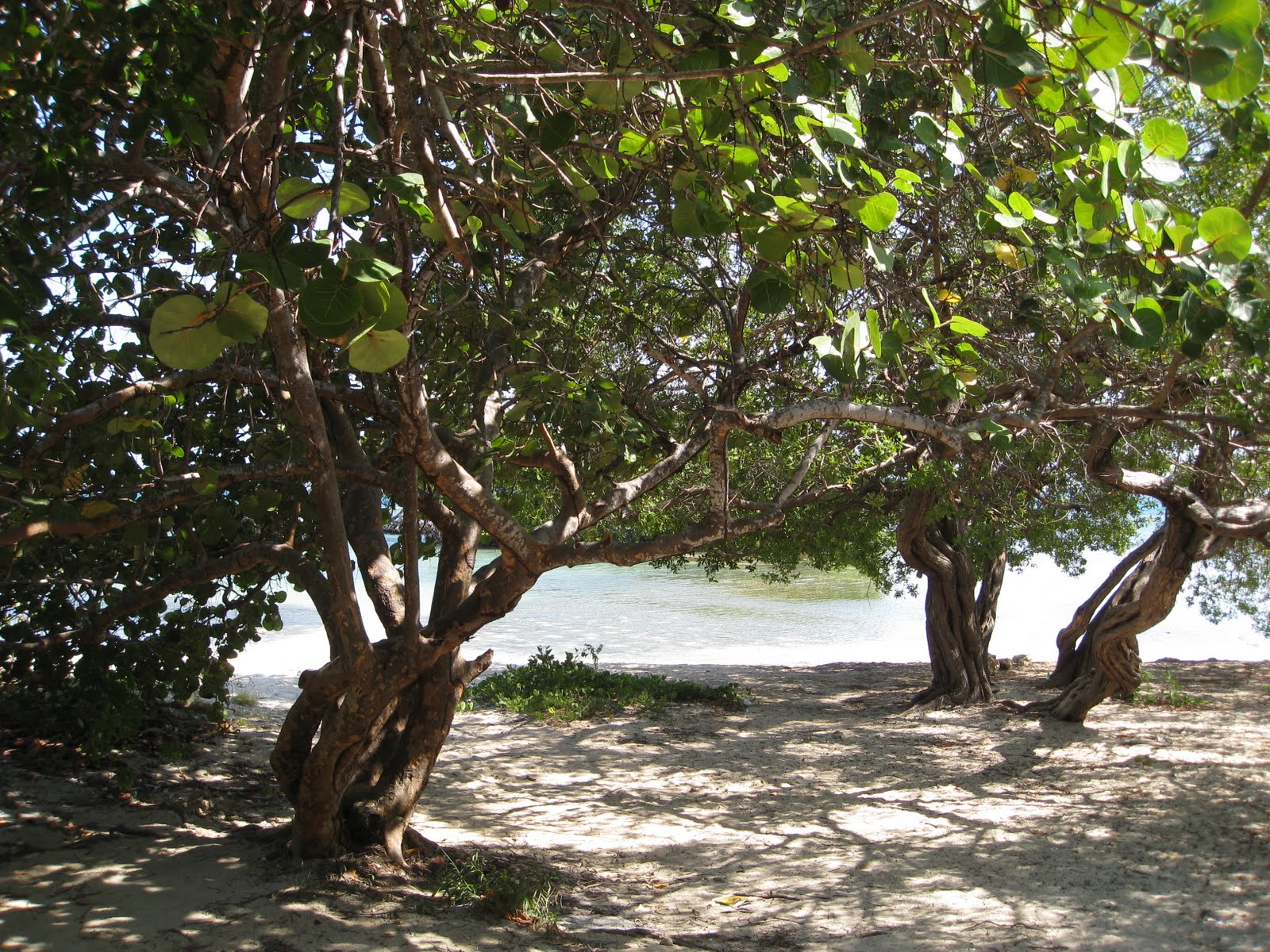
Playa Santa is a truly exquisite beach. The beach is forested in places (below).

Most of the trees on the beach had dark-brown termite tunnels running up their trunks and their largest branches (photo below).
There were picnic tables under a few of the trees, where we parked our stuff.
Matt, Ken, Alan, and Sadie

Mangroves grow in the shallow tidal waters of Playa Santa

The mangroves in Playa Santa's intertidal zone

Mangroves
Mangroves are trees that grow only in intertidal zones.  There are around 70 species of mangroves around the world.  With their roots partially submerged and partially in the air, mangrove trees provide habitat and food for hundreds of thousands of animal species, from birds to monkeys to crustaceans. The nooks and crannies of the submerged roots make excellent nurseries for vulnerable fish hatchlings.  At one time, most coastlines of the tropical world supported mangrove forests. With their intricate root systems, these forests encourage the deposition of sediment by slowing the flow of water; they also protect coastlines from erosion, storm surge, and tsunamis.  But in the past few decades, 35% of the world's mangrove forests have been destroyed. For information about protecting mangroves, see the website of the Mangrove Action Project.
The spatially-heterogeneous roots of these mangroves (at Playa Santa) provide unique habitat for wildlife.

The water at Playa Santa was turquoise and so shallow that we could wade out a hundred feet from shore. There were no waves at all.
 Matt, Alan, Ken, and Sadie wading

Intertidal life
While my family waded farther out, I looked for creatures in the foot-deep water.
I saw this Little Blue Heron foraging for fish, and saw her catch one.

I saw this thing, about 5 inches across.  I have no idea what this was, but it looked alive.

The thing above looked like the lining of a burrow, secreted by a marine worm. A lot of marine worms that burrow in abrasive sand secrete soft linings to their burrows. This lining (or "casing") might have worked its way to the surface, if the worm had died. I don't know!  I'm just guessing. If any of you readers know what it is, tell me!

This little mushroom-like thing was interesting, on the ocean floor in about 10 inches of water. I feel like I should know what it is, being a biologist. But I don't. Do you?  It was 2 or 3 inches tall. The stuff around it was seaweed of various species.

We found several sea cucumbers in the intertidal zone. They are echinoderms, related to sea stars (starfish) and sea urchins and sand dollars. They were all alive, and amazing.  I'd never seen one alive before. 
A sea cucumber in Playa Santa's intertidal zone.


Ken holding a sea cucumber

A bigger living sea cucumber, in my own hand

Sea cucumbers are not very active and are almost completely limp out of water. But most species can move slowly across the ocean floor on tiny "tube feet," scavenging for planktonand dead organic matter. In some parts of the world, they're extremely abundant. In China and s.e. Asia, sea cucumbers are popular as human food.

Leaving Playa Santa for San Juan.....and Roberto Clemente
So that was Playa Santa.We left in late afternoon, dropped Alan off at his home, and the rest of us drove back to San Juan to fly home.  In San Juan we stopped by the park that honors the famous baseball player for the Pittsburgh Pirates, Roberto Clemente. Clemente grew up in Puerto Rico.  He died in a plane crash on a humanitarian trip to provide supplies to earthquake victims in Nicaragua, in 1972. Ken has always been a huge fan of Roberto Clemente.
Ken with one of his heroes
Puerto Rico overall
I loved Puerto Rico because it was new, it was tropical, and I was with my family - we would have had fun anywhere. Do I recommend it as a travel destination?  I do, if you want a tropical island with both mountains and beaches.  It was easy to get to, easy to book, easy to navigate because most of the residents speak English, and many of them speak it very well.  Calls from the U.S. are not international, and P.R. uses U.S. dollars. Yet, it still feels like Latin America or the Caribbean because Spanish is the first language, and the culture is not the same as the continental U.S. For me, the culture was very different from home - the music, styles of dress, the food. That was great, I don't want to go somewhere just like home. So Puerto Rico was easy and comfortable, but different enough to feel that we weren't "in Kansas anymore."

We saw a lot of great birds in Puerto Rico. But if wildlife is your first priority, I'm not sure Puerto Rico would be my first recommendation.. The only native mammals living there now are bats. Islands in general have less wildlife than mainlands - at least that's true for smaller islands.

I guess I'm spoiled by the prolific wildlife of Costa Rica: white-faced capuchins, spider monkeys, howler monkeys, native squirrel monkeys, sloths, ant-eaters, coatimundis, agoutis, tayras, red-eyed tree frogs, poison-dart frogs, and some of the world's most impressive venomous vipers. If you're looking for spectacular tropical wildlife not far from the U.S., Costa Rica will provide more.

Just depends on what you're after.

Anyway, we had a great time in Puerto Rico.  If you're going, I do recommend all the places we stayed, which I've mentioned in my Puerto Rican posts listed below. In San Juan, we spent 2 nights at Coral by the Sea hotel, which was right on the beach, comfy and clean, an easy walk from restaurants, cheaper than its competitors, and 5 minutes from the airport. Its contact number is 787.791.6868.

Tropical nature! For me, there's nothing better.

My previous posts about our March 2010 trip to Puerto Rico:

Old San Juan: Steep, tropical, colorful

Exploring the tropical rainforest in Puerto Rico: El Yunque Caribbean National Forest

Puerto Rican beach pleasures, and the Jayuya Uprising

In Puerto Rico: Jayuya and the Toro Negro State Forest

See also Alan Kneidel's posts about Puerto Rico at http://goodbykneidel.blogspot.com

Keywords: Puerto Rico wildlife marine life mangroves introduced mammals rhesus macaques tropical islands Costa Rica

Monday, May 24, 2010

Gulf Oil Spill 2010: Drilling for Dollars, Not Oil

by Ken Kneidel, PhD

We’re discovering a lot of money, not a lot of oil
The oil under the Gulf is not being extracted to extend our ability to live in an oil-driven economy, nor to provide energy independence from the Middle East. BP is drilling in the Gulf solely because the corporation can make a lot of money in doing so. In terms of the world’s supply, the volume of oil in BP’s spewing oil field in the Gulf of Mexico is a piddling amount, roughly 3 billion barrels. That might seem like a lot, but currently the world is using 31 billion barrels of oil per year. Dividing 31 by 3 tells us that at our current rate of usage, the oil in this particular oil pocket could supply the world for just of a year…35 days. When converted to dollars, however, this small volume of oil becomes an enormous pile of change for BP. With crude oil currently selling at $70 a barrel, the value of the field (if all were extracted) would be $210 billion dollars. Simply put, this oil is being drilled for monetary profit; all other rationales lag far behind.

Our oil reserves are waning
Secondly, the fact that BP is drilling in such a hard-to-access location tells us that the supply of oil on this planet is running dangerously low. We’ve already depleted all the easy-to-reach pockets of oil. BP’s well lies under one mile of ocean and 30,000 feet of the Earth’s crust. The list of other recent “major” discoveries is similar – trivial amounts in difficult places. Chevron announced in 2006 the discovery of a similar field in the Gulf (3 to 15 billion barrels, six miles under the ocean surface – a 35 to 177 day world supply). The “new” oil fields under melting Arctic ice have been estimated to contain roughly 90 billion barrels (a 2.9 year world supply). According to the website www.worldometers.info, we have 15,536 days until we run out of oil, consuming at our current rate. That’s 42.6 years. James Howard Kunstler, in this book, The Long Emergency, calculates a 37-year supply. I’ve found internet sites with dates all over the place; the U.S. Department of Energy gives an estimate of 100 years. But for those who latch on to the 100-year date as a means for supporting lack of concern, remember that these estimates are based on current world usage rates. With development in India and China increasing (the two are selling 1.2 million new cars per month), all of the dates could shrink significantly. Also, don’t forget to factor in population growth, which many omit in their calculations. How do we cut the absolute amount of oil that we consume with the world’s population of 6.8 billion projected to swell to 9 billion in 50 years? In addition, it’s not just oil that’s in short supply According to the US Geological Survey, our reserves of lead, tin, copper, iron, and bauxite are projected to last 17, 19, 25, 54, and 68 years respectively.

 Future environmental catastrophes 
are certain
If we are unwilling to curb our energy usage (the total consumption has held steady over the past 10 years), environmental disasters like this will occur again. We can blame the spill on lack of oversight or short-cuts in safety technology. And maybe the US will enact changes to make drilling safer in years down the road, but look at other locations on Earth. In a recent NY Times editorial, Lisa Margonelli stated that a coastal spill as large as that of Exxon-Valdez has occurred every year since 1969 in environmentally-lax Nigeria, which supplies the US 10% of its oil.Will action be taken by the corporate world, or the government of Nigeria, to put an end to these environmental disasters? Do Americans care about ecosystems off the coast of Nigeria? The non-human organisms on our planet interact without regard to political boundaries. In our desperation, we continue to look at the oil fields in the Arctic National Wildlife Refuge. Its 10 billion barrels offers the world a 118 day supply, and for the US just 1.3 years at our current usage rate of 7.6 million barrels a year. How long before we drill that too?

The consequences are severe for everyone
We are destined to suffer dramatically from dragging our feet in weaning ourselves from dependence on oil. I’m reminded of the story where the farmer, when setting out to town by riding his donkey, begins by belting the donkey on the head with a two-by-four. When asked by a bystander why he hit the donkey so brutally before even starting his journey, he replied “Well, first I have to get his attention!” This Gulf oil spill is a similar wake-up call. It’s urgent that we come to our senses and address larger issues that lie ahead over the next 100 years. Just consider the economic and social implications of running out of oil as our primary energy supply. Without jet fuel, what would happen if air transport came to a halt in just a few decades? Can anyone envision an airplane fueled by solar power, a fuel-cell, a windmill, or natural gas? What about our diesel-powered rail and trucking systems? How can we collect and distribute the food we grow on huge corporate farms, or the cotton we grow, or the polyester we manufacture for clothing? How will we get people to work without gasoline? How will we build the windmills or the solar power cells without the plastics produced from oil? How will we support the 2.5 billion people worldwide who live in cities? Over 3.4 billion people live within 120 miles of coastlines. If sea levels rise just a meter, there will be refugees from cities well beyond New Orleans. Add Miami, New York, Tokyo, Mumbai, Shanghai, and Jakarta for a start.

Why “crying wolf” is the right thing to do
I’m afraid that by now many readers are steaming, some writing this off as insane left-wing liberal tree-hugging alarmism. But the BP oil spill is a wake-up call that we all must take seriously. In his book Collapse, Jared Diamond addresses the wisdom of being conservative when setting criteria for raising environmental alarm. Let me borrow from him and illustrate with the smoke alarm in my kitchen. I note, often with irritation, that it sometimes goes off with the slightest hint of fire – a piece of over-cooked toast will get it wailing, sometimes just turning on a cook-top burner that has an oily smudge on it will trigger the alarm. The piercing whistle is annoying when it goes off, but after I settle down and realize that all is well, my rational self notes that I want my smoke alarm to work that way. If the alarm goes off when my house is already on fire, it would do me no good, my loved ones and valuable possessions could be gone. Similarly, we need to put our environmental warning systems on a low setting. We can turn our backs on the BP oil spill and write it off as a mistake in technology. But I implore you to look at the big picture. Ignoring warnings like this carries us ever closer to the point where our wake-up call will come too late. We’ve been hit between the eyes with a two-by-four. Time to stop the arguing and denial, and take serious steps toward preparing for the inevitable day when the oil is gone. We need to take what oil’s left and direct it towards supporting a massive investment in the manufacture and research of sustainable energy sources. The enormity of what’s at stake demands our immediate attention.

Key words: BP oil spill remaining oil James Howard Kunstler The Long Emergency Jared Diamond Collapse how much oil is left Lisa Margonelli

Monday, May 10, 2010

We're importing oil from poor countries with far more spills

A just-hatched sea turtle making its way to the water. Photo courtesy of nps.gov.

This post now on BasilandSpice.com.

After my post a few days ago about the oil spill and its consequences to wildlife, I got a few interesting messages from friends and acquaintances.

My friend Sonia, the director of a land conservancy in the Southwest U.S., sent me this note on Facebook:

"This whole situation is just heartbreaking...and infuriating. A FB friend is sharing photos from a friend of hers who found three dead sea turtles in coastal AL yesterday. She said she has lived there 16 years and never found one dead - then three in a day."

Jane, another close friend in my hometown of Charlotte, sent me this message via FB:

"I have been listening all day to ramifications of the spill. The only solution is to get to the root cause: too much demand for gasoline. I feel very guilty as one who uses petroleum as much as anyone."

Jane hit the nail on the head - we all should be concerned about our persistent and unyielding consumption. During the past decade, even with all the publicity about climate change and carbon footprints and our country's disproportionate consumption of oil, the United States has not reduced its consumption of oil at all; it's roughly the same as it was in 2000.

The brilliant Lisa Margonelli changed my thinking

I heard Lisa Margonelli on NPR last week, in a startling (to me) discussion of our oil consumption. She really enlightened me on one subject. Like most environmentalists, I've always been firmly opposed to offshore drilling, especially off the coast of my state (NC), but also opposed to drilling in the Arctic or the Gulf or any place where drilling might threaten already-stressed and declining wildlife populations.

But Lisa Margonelli had a different perspective on that, in her May 1 Op-Ed piece in the NY Times and her remarks on NPR. Lisa directs the Energy Productivity Initiative at the New America Foundation. Her book, Oil On the Brain: Petroleum's Long, Strange Trip to Your Tank, describes the culture and economy of the oil-supply chain.

As Lisa pointed out, none of us want oil wells on our own coastline. She guesses that the likely outcome of the recent BP spill will be a moratorium on offshore drilling. Yay! We'd all like to see birds and sea turtles win out for a change over big oil corporations. Lisa says that, emotionally, she would enjoy the moratorium too.

But....the problem is that the U.S. is not reducing its overall oil consumption. Therefore, the oil that isn't produced domestically must be imported. Lisa had some interesting info about the ramifications of importing oil. It doesn't come from rich countries like Saudi Arabia, which is what I guess we all thought. No, it comes from places that are so poor they have no environmental safeguards and no financial resources to enforce laws or to clean up spills. Places like Kazakhstan, Angola and Nigeria.

Said Lisa, "Kazakhstan, for one, had no comprehensive environmental laws until 2007, and Nigeria has suffered spills equivalent to that of the Exxon Valdez every year since 1969. As of last year, Nigeria had 2,000 active spills."

Ouch!!!

Reminds me of the other environmentally-exploitive products we import, like beef from the Amazon and palm-oil from Indonesia.

What's to be done?

The internet is full of proposals for solutions, most of them sensible.

Said John Fitzpatrick , PhD, Director of the Cornell Laboratory of Ornithology, whom I respect enormously: " We must never again forget the fundamental lessons of this disaster. The unthinkable is possible, and must be planned for in advance. As we assess risks versus rewards, as we fully audit the true costs of energy exploration and extraction, we need to incorporate and properly mitigate the enormous risks and costs of disasters like [this oil spill]."

Yes that sounds good. If we're going to drill offshore, or anywhere, we need to be ready to plug the spew quickly when the machinery fails.

More importantly, we need to reduce our oil consumption! As my friend Jane said...we're all responsible for the consequences of oil drilling. We're all responsible for the dead sea turtles Sonia's friend sees washing up on the Alabama shore. We're all responsible for the unimaginable oil mess in Nigeria.

Can Obama help us reduce our oil consumption? Who is going to lead us on this? Will we maintain our addiction to oil until we finally run out in about 43 years? I wish it was 3 years and not 43, because I frankly can't imagine that Americans will stop the gluttony until the the last drop is gone.

Sources:

John W. Fitzpatrick, PhD, Director of Cornell Laboratory of Ornithology. "How bad is the oil spill? Ask the pelicans. " FoxNews.com. May 4, 2010.

Lisa Margonelli. "A spill of our own." New York Times. Op-Ed Page. May 1, 2010.

Shashank Bengali. "Gulf spill's lesson: The era of 'easy oil' is over." The Charlotte Observer. May 9, 2010.

Some of my previous posts on the oil spill and other coastal environmental issues: 
Oil spill 2010: Danger to wildlife considered "terrifying"

10% of Louisiana underwater by 2100, says recent study

North Carolina's vital coastal breeding grounds vulnerable to rising seas

Copenhagen data confirm: 10% of Florida underwater by end of the century

10,000 pythons breeding in Florida, says new USGS report

More info:
American Bird Conservancy

Key words:

Lisa Margonelli importing oil sea turtles reducing consumption oil spill Nigeria Kazakhstan Angola foreign spills Louisiana Alabama

Monday, May 03, 2010

Oil Spill 2010: Danger to Wildlife Considered "Terrifying"

Louisiana marsh, photo from USGS

This post is now on Google News. Also on Basilandspice.com which is partnered with Newstex, TOPIX, EIN McClatchy-Tribune News Service and other media outlets.

On Thursday April 29, the slick from the oil gushing into the Gulf of Mexico covered about 1,150 miles. By the end of the next day, the size of the oil slick had more than tripled to 3,850 miles. Said Hans Graber of the University of Miami, this rapid rate of expansion suggests that the oil is now spurting from the ocean floor much more quickly than it was.

The broken oil well that's spewing more than 200,000 gallons per day is a mile underwater, making efforts to shut it off extremely difficult. Crews are using at least 6 remotely operated vehicles to try to stem the flow, but so far have been unsuccessful. It may be weeks or even months before the gush is stopped.

Long term consequences to coastal ecosystems and fish

What are the long term repercussions of such an unprecedented volume of oil hitting our Gulf Coast, and perhaps the coasts of Florida, Georgia, North and South Carolina as well? The Gulf spill is at the top of "the Loop Current," a part of the Gulf Stream that sends water around Florida and as far north as Cape Hatteras, NC.

Many people are focused on the impact to the fishing industry, which will indeed be hit hard. "Louisiana, after Alaska, is the second-largest seafood producing state," said Dr. Ralph Portier of Louisana State University. The wetlands of the Mississippi Delta are essential to much of that sea life. Many oceanic fish lay their eggs in protected estuaries and marshes, where the hatchlings are safer from predators and food may be more accessible. Crabs, shrimp, and oysters are also completely dependent on coastal wetlands. "Every crevice, creek, bayou, bay, where water flows in and out of coastal grasses - that's the habitat for all these coastal nurseries. If we lose it or it's impacted, we have a real long-term effect," said Dr. Portier of LSU.

Marsh grasses are naturally resilient, but the coastal ecosystem of Louisiana has already experienced a number of serious insults. According to the U.S. Geological Survey, the hurricanes of 2005 turned about 217 square miles of marsh into water. If nature had been left alone, that marshland would be replenished by sediment flowing down the Mississippi River. But levees holding back the Mississippi River prevent the natural deposition of sediment. The marshes are chopped up by navigation channels and pipeline canals, too, which allow saltwater into freshwater marshes, slowly killing the marshes.

"Hanging by a fingernail"

"The trouble with our marshes is they're already stressed, they're already hanging by a fingernail," said Dr. Denise Reed of the University of New Orleans.

And yet it now seems possible that the influx of oil from the still-gushing well in the Gulf could deliver the killing blow to the whole coastal ecosystem. The volume of oil that now seems likely to wash up on the Louisiana coast could overwhelm the coastal grasses' ability to recover. If the roots die, the plants die and the ground underneath turns to mud and disappears into the sea within a year, said Dr. Irving Mendelssohn of Louisiana State University.

Even if the volume of oil does not increase dramatically, it is still likely to move through channels into the saltwater marshes. Then, even a minor tropical storm could send it farther inland to the freshwater marshes, which are more fragile and almost impossible to clean, said Mendelssohn.

Especially valued fish likely to be heavily impacted include the Atlantic tarpon and the overfished Atlantic bluefin tuna.

What about other wildlife?

The Gulf has four species of sea turtles and all of them are endangered. Turtles and marine mammals don't try to avoid oil slicks, said Jackie Savitz of the conservation group Oceana. Consequently they wind up eating the oil; it also blocks their airways.

Not only coastal birds, but migratory songbirds will feel the effects

Of course, thousands of shore birds and marsh birds breed in the coastal marshes of the Gulf Coast. That includes species such as white ibises, anhingas, purple gallinules, common gallinules, pied-billed grebes, wood ducks, king rails, clapper rails, black-necked stilts, killdeer, Louisana herons, black-crowned and yellow-crowned night herons, green herons, little blue herons, snowy egrets, great egrets, black skimmers, American coots, mottled ducks, and so on. But it's not just the shore birds and marsh birds that will be impacted by a heavy or steady influx of oil on the coast. Millions of North American songbirds migrate in spring from their wintering grounds in southern Mexico and the Yucatan Peninsula to the Gulf shores, before flying on to their breeding grounds in the eastern U.S. and Canada. This phenomenon is called by birders the "Gulf Express." It includes tiny ruby-throated hummingbirds, many species of warblers, kingbirds, thrushes, orioles, cuckoos, and more - at least 55 species in all. The flight covers 500 or 600 miles of open water for birds that may weigh no more than two 25-cent coins. Even in good years, many of them don't make it. It all depends on good weather, physical conditioning, and luck. Thousands of birdwatchers converge on the Gulf coast and its barrier islands to witness the migratory spectacle each spring.

"If anything goes sour, the birds die"

In a very good year, the birds may arrive at the coast with enough energy to fly past the marshes, landing in forests 30 miles inland. But if the weather is unsettled, or the winds are from the north, the birds pile up along the coast. They're hungry, thirsty, and tired. As author and birder Scott Weidensaul said about this migration, "If anything goes sour, the birds die."

As of right now, many of the birds have already made the spring crossing, but not all. For those who haven't yet, this may be a spring when something "goes sour". And what about next fall, when they do the flight in reverse? And next spring - what if the marshes are all coated in oil, or the coastal grasses are all dead? Many of these bird species are already in serious trouble from habitat loss in Latin America and in the U.S.

Prospects are "terrifying"

None of us know right now the true long-term impacts of the rapidly expanding mass of toxic goo that's floating in the Gulf of Mexico. I'm not sure anyone has even calculated yet the potential damage to coastal estuaries and marshes of the Southeastern states. But as NY Times writers Leslie Kaufman and Campbell Robertson said, the prospects for coastal land, livelihoods, and wildlife are "terrifying everyone."

Sources:

Leslie Kaufman and Campbell Robertson. "Spill puts wetlands in peril." NY Times. Reprinted in Charlotte Observer. May 2, 2010.

Kirsten Valle. "Some fear oil from Gulf spill could reach N.C." Charlotte Observer. May 1, 2010.

Renee Schoof and Karen Nelson. "Oil spill is endangering a vast array of wildlife." Charlotte Observer. April 30, 2010.

Cain Burdeau and Holbrook Mohr. "Document: BP didn't plan for a major spill." Charlotte Observer. May 1, 2010.

Scott Weidensaul. Living on the Wind: Across the Hemisphere with Migratory Birds. North Point Press. New York. 1999.  Key words: Gulf oil spill BP oil spill fisheries coastal ecosystems shore birds migratory birds sea turtles

Some of my previous posts on coastal environmental issues:

10% of Louisiana underwater by 2100, says recent study

North Carolina's vital coastal breeding grounds vulnerable to rising seas

Copenhagen data confirm: 10% of Florida underwater by end of the century

10,000 pythons breeding in Florida, says new USGS report 

Key words: Gulf oil spill BP oil spill fisheries coastal ecosystems shore birds migratory birds sea turtles