Showing posts with label Puerto Rico. Show all posts

Saturday, May 29, 2010

Still in Puerto Rico: the natural treasures of Guanica and its mangrove forests

Photos and text by Sally Kneidel, PhD

This is the fifth and last post about a birdwatching and hiking trip to Puerto Rico in March of 2010.

In search of a great beach...and tropical nature
After we left the town of Jayuya in the central mountains of Puerto Rico, we drove to El Bosque Estatal de Guanica, a 10,000-acre subtropical forest on the s.w. coast. We took a short hike on the southern side of the reserve, which is dry scrub forest with sun-bleached rocky soil and stunted, twisted trees. The dry forest gets only 35 inches of rain/year, compared to 15 feet of rain/yr in Puerto Rico's mountainous rain forests. 

The dry forest of Guanica
The dry forest of Guanica has been declared a United Nations Biosphere Reserve, with the highest bird diversity on the island - twice as many bird species as El Yunque rain forest. Guanica's birds include the Mangrove Cuckoo, Antillean Mango, Puerto Rican Tody, Greater Antillean Grackle, Puerto Rican Flycatcher, Puerto Rican Vireo, and lots more. The dry forest also has hundreds of interesting dry-adapted plant species, including cacti and spiny bushes and trees.   
A Pearly-eyed Thrasher in a short, stunted tree of Guanica's dry forest.

Mongooses and non-native mammals in Puerto Rico
The only mammal we saw on the hike was a mongoose. Mongooses from India were introduced to Puerto Rico to control rats, which were also introduced and are abundant. Rats are a big problem for sugar plantations on Puerto Rico, as well as native wildlife.  But rats are nocturnal and mongooses are active only during the day, so the effort failed (like most introductions of nonnative species). Now mongooses are out of control, with no natural predators on the island.  The  mongooses not only prey on native species, such as Puerto Rican parrot nestlings, but are major carriers of rabies.

Other introduced mammals in Puerto Rico include a population of rhesus macaques. The macaques cause problems for native birds by preying on their eggs. A population of free-ranging squirrel monkeys was also introduced when a research station was vandalized in the 1970s.

Alan's research base in the town of Playa Santa
After our short hike (very hot), we left El Bosque Estatal de Guanica for the small coastal town of Playa Santa, where my son Alan was living and working with a bird research team.

Alan, Ken, Matt, and Sadie in Alan's house in Playa Santa

After a quick tour of the house where the whole research team lives and plans their data-collecting forays, we went to the beach of Playa Santa. 

The best beach yet: Playa Santa
Playa Santa is a truly exquisite beach. The beach is forested in places (below).
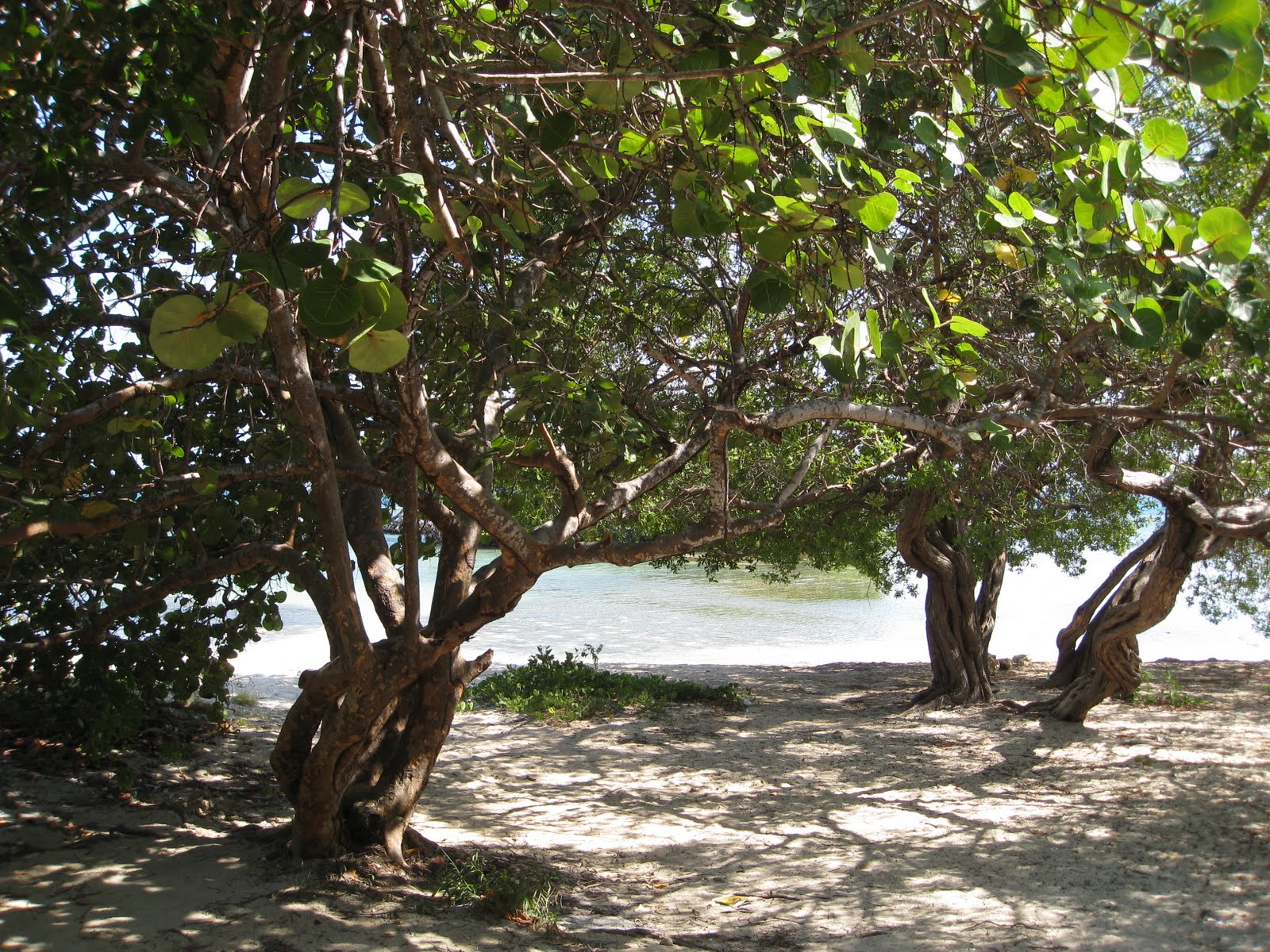
Most of the trees on the beach had dark-brown termite tunnels running up their trunks and their largest branches (photo below).
There were picnic tables under a few of the trees, where we parked our stuff.
Matt, Ken, Alan, and Sadie

Mangroves grow in the shallow tidal waters of Playa Santa

The mangroves in Playa Santa's intertidal zone

Mangroves
Mangroves are trees that grow only in intertidal zones.  There are around 70 species of mangroves around the world.  With their roots partially submerged and partially in the air, mangrove trees provide habitat and food for hundreds of thousands of animal species, from birds to monkeys to crustaceans. The nooks and crannies of the submerged roots make excellent nurseries for vulnerable fish hatchlings.  At one time, most coastlines of the tropical world supported mangrove forests. With their intricate root systems, these forests encourage the deposition of sediment by slowing the flow of water; they also protect coastlines from erosion, storm surge, and tsunamis.  But in the past few decades, 35% of the world's mangrove forests have been destroyed. For information about protecting mangroves, see the website of the Mangrove Action Project.
The spatially-heterogeneous roots of these mangroves (at Playa Santa) provide unique habitat for wildlife.

The water at Playa Santa was turquoise and so shallow that we could wade out a hundred feet from shore. There were no waves at all.
 Matt, Alan, Ken, and Sadie wading

Intertidal life
While my family waded farther out, I looked for creatures in the foot-deep water.
I saw this Little Blue Heron foraging for fish, and saw her catch one.

I saw this thing, about 5 inches across.  I have no idea what this was, but it looked alive.

The thing above looked like the lining of a burrow, secreted by a marine worm. A lot of marine worms that burrow in abrasive sand secrete soft linings to their burrows. This lining (or "casing") might have worked its way to the surface, if the worm had died. I don't know!  I'm just guessing. If any of you readers know what it is, tell me!

This little mushroom-like thing was interesting, on the ocean floor in about 10 inches of water. I feel like I should know what it is, being a biologist. But I don't. Do you?  It was 2 or 3 inches tall. The stuff around it was seaweed of various species.

We found several sea cucumbers in the intertidal zone. They are echinoderms, related to sea stars (starfish) and sea urchins and sand dollars. They were all alive, and amazing.  I'd never seen one alive before. 
A sea cucumber in Playa Santa's intertidal zone.


Ken holding a sea cucumber

A bigger living sea cucumber, in my own hand

Sea cucumbers are not very active and are almost completely limp out of water. But most species can move slowly across the ocean floor on tiny "tube feet," scavenging for planktonand dead organic matter. In some parts of the world, they're extremely abundant. In China and s.e. Asia, sea cucumbers are popular as human food.

Leaving Playa Santa for San Juan.....and Roberto Clemente
So that was Playa Santa.We left in late afternoon, dropped Alan off at his home, and the rest of us drove back to San Juan to fly home.  In San Juan we stopped by the park that honors the famous baseball player for the Pittsburgh Pirates, Roberto Clemente. Clemente grew up in Puerto Rico.  He died in a plane crash on a humanitarian trip to provide supplies to earthquake victims in Nicaragua, in 1972. Ken has always been a huge fan of Roberto Clemente.
Ken with one of his heroes
Puerto Rico overall
I loved Puerto Rico because it was new, it was tropical, and I was with my family - we would have had fun anywhere. Do I recommend it as a travel destination?  I do, if you want a tropical island with both mountains and beaches.  It was easy to get to, easy to book, easy to navigate because most of the residents speak English, and many of them speak it very well.  Calls from the U.S. are not international, and P.R. uses U.S. dollars. Yet, it still feels like Latin America or the Caribbean because Spanish is the first language, and the culture is not the same as the continental U.S. For me, the culture was very different from home - the music, styles of dress, the food. That was great, I don't want to go somewhere just like home. So Puerto Rico was easy and comfortable, but different enough to feel that we weren't "in Kansas anymore."

We saw a lot of great birds in Puerto Rico. But if wildlife is your first priority, I'm not sure Puerto Rico would be my first recommendation.. The only native mammals living there now are bats. Islands in general have less wildlife than mainlands - at least that's true for smaller islands.

I guess I'm spoiled by the prolific wildlife of Costa Rica: white-faced capuchins, spider monkeys, howler monkeys, native squirrel monkeys, sloths, ant-eaters, coatimundis, agoutis, tayras, red-eyed tree frogs, poison-dart frogs, and some of the world's most impressive venomous vipers. If you're looking for spectacular tropical wildlife not far from the U.S., Costa Rica will provide more.

Just depends on what you're after.

Anyway, we had a great time in Puerto Rico.  If you're going, I do recommend all the places we stayed, which I've mentioned in my Puerto Rican posts listed below. In San Juan, we spent 2 nights at Coral by the Sea hotel, which was right on the beach, comfy and clean, an easy walk from restaurants, cheaper than its competitors, and 5 minutes from the airport. Its contact number is 787.791.6868.

Tropical nature! For me, there's nothing better.

My previous posts about our March 2010 trip to Puerto Rico:

Old San Juan: Steep, tropical, colorful

Exploring the tropical rainforest in Puerto Rico: El Yunque Caribbean National Forest

Puerto Rican beach pleasures, and the Jayuya Uprising

In Puerto Rico: Jayuya and the Toro Negro State Forest

See also Alan Kneidel's posts about Puerto Rico at http://goodbykneidel.blogspot.com

Keywords: Puerto Rico wildlife marine life mangroves introduced mammals rhesus macaques tropical islands Costa Rica

Saturday, May 01, 2010

In Puerto Rico: Jayuya and the Toro Negro State Forest

Photos and text by Sally Kneidel, PhD

Driving from the coast to the town of Jayuya in La Cordillera Central is not easy. Although the mountain roads of Puerto Rico are paved, most are extremely narrow and curvy.

On our drive from Playa Lucia, we arrived in Jayuya after dark, and tooled around the town looking for something to eat. Although the town has several restaurants, they were all closed. Open only on Thursday, Friday, and Saturday.  We were forced to resort to the grocery store and a pizza kiosk on wheels.

But dinner was fun anyway. We made pina coladas and ate the tasty pizza on the balcony of our hotel, Posada Jayuya (787.828.7250; calls from the U.S. to Puerto Rico are not international calls).

La Piedra Escrita, an ancient Taino site
The next day, we went first to La Piedra Escrita on the outskirts of Jayuya. La Piedra Escrita is one of Puerto Rico's most honored remainders of the indigenous Taino culture.  It's a boulder 32 ft high and 13 ft wide, in the middle of a river - Rio Saliente.
La Piedra Escrita

On the rock are 52 petroglyphs carved by indigenous groups between 600 and 1200 A.D. The boulder creates a natural pool in the river.  Alan and Matt jumped off the boulder and swam.

 The long  boardwalk down to La Piedra Escrita in el Rio Saliente

Sadie and Matt groovin' on the boardwalk.

Toro Negro State Forest
The next day we took off for a major hike in El Bosque Estatal de Toro Negro (Toro Negro State Forest ), one of the highest and most extensive forests on the island, in the Central Mountains (La Cordillera Central). We drove about an hour south of Jayuya to get there, along La Ruta Panamerica. When we arrived, we took a simple map from the ranger station but it wasn't a lot of help.

 Matt and Sadie hiking (above)

The first part of the hike was fantastic - we walked along Quebrada Dona Juana (a mountain stream).

Sadie and Matt in the stream

Following the trail along the stream, we came to great swimming hole along a little trail called Charco La Confesora, and the guys had to stop to jump in. Matt was very pleased.

As was Alan (below). 
Alan takes to the swimming hole,
above and below.
After the swim, we followed Trail 5 uphill for hours, immersed in a thick tropical jungle of banana trees, sierra palms, tree ferns, flamboyan trees, and elephant ears, on a muddy, steep, and scantily-marked trail. Visibility was minimal through the dense foliage. Toro Negro Forest is the real thing.

Finally, we realized we'd missed our turn onto Trail 9. And we seemed to be lost. Dismay began to set in. Having a fresh head cold, I was already exhausted.

The wildlife
We saw lots of birds: Black-throated Blue Warblers, Northern Parulas, Green Mangos, Cape May Warblers, Belted Kingfishers, and more. And several other interesting creatures along the way...like this lizard Alan photographed. Was it a dwarf gecko? Not sure.
the lizard Alan found in Toro Negro
I spotted the eggs of a Coqui Frog, in the photo below.  They'd been deposited on a leaf on the ground

Alan found a giant predatory centipede, Scolopendra. (Photo of Puerto Rican Scolopendra species by Alan Kneidel)

Would we ever get out?
Just after we decided we really were lost, we stumbled upon a paved road! We walked downhill on the road for about 5 miles, and found the spot where we'd left our car.

Our forest hike had been beautiful, if somewhat daunting.

Jayuya again
Back we went to Jayuya, once again to find no restaurants open. We ate pizza on the balcony of the hotel again, and then took a swim in the hotel pool, decorated with this mermaid, below.


Jayuya was a friendly place after all
Except for the restaurant factor, Jayuya was a friendly enough place. No one was rude or hostile except for a couple of older folks who had been around during the 1950 Jayuya Uprising against the U.S.  Most folks were warm and helpful.

On to dry forest and mangroves ....Alan's research home
The next morning we took off for our last stop - Alan's hometown of Playa Santa in the dry forest, with its coastal mangroves  - and what turned out to be the most beautiful beach of all.

My previous posts about this trip to Puerto Rico:

Old San Juan: steep, tropical, colorful

Exploring the tropical rainforest in Puerto Rico: El Yunque Caribbean National Forest

Puerto Rican beach pleasures, and the Jayuya Uprising

Alan's blogs:
http://goodbykneidel.blogspot.com
http://beerandtrees.com

Helpful resource:
Suzanne Van Atten. Puerto Rico. Moon Handbooks. 2nd Edition, 2009.


Key words: Puerto Rico Jayuya Toro Negro Ruta Panamerica Posada Jayuya Kneidel

Saturday, April 24, 2010

Puerto Rican beach pleasures, and the Jayuya Uprising

All photos and text by Sally Kneidel, PhD

The variety in Puerto Rico surprised us. We started off in  Old San Juan with its pink buildings, steep and narrow blue-cobblestoned roads, and historic elegance.

We drove from there to our dream destination: El Yunque Caribbean National Forest, which didn't disappoint. We spent a couple of days in the luscious rainforest that was teeming with tropical birds, lizards, coqui frogs, tree ferns, and other delectables. We loved every second. See our pics and read about our stay there in this post.

Yearning for a tropical beach
Then the 5 of us crammed once again into our rental Nissan Altima, and ambled very carefully over the mountain roads toward the southeast coast. Our immediate goal was to find a beach where we could swim. Our ultimate plan was to cover the whole island more or less in just a few days.

As we made our way to the coast in search of a beach, Ken said about the very cramped drive, "This is fun, but could quickly become torture." We tried to divert attention from aching butts and precipitous roadside cliffs by singing loudly along with Sadie's Ipod - amusing songs like "Timber" by Sons of the San Joaquin. Which is actually a good cowboy song, but grows ludicrous as it's played over and over.

Soon we arrived at Punta Tuna Lighthouse on the s.e. coast, which had a beautiful beach. But swimming was not allowed.
The coastal dry forest at Punta Tuna Lighthouse

Alan and Matt eating tortillas made with canned beans at Punta Tuna

 A Puerto Rican home next to our picnic spot at Punta Tuna

We did find the perfect beach...with coconuts
We left the disappointing Punta Tuna and moved on in our quest for a place to swim on the s.e.coast, stopping to check out Playa Lucia, near Yabucoa. It was exactly what we wanted.
Behind the wide sandy beach, all the trees were coconut trees.
Coconuts were falling from the trees - we had to try to open one. Sadie persistently threw a whole coconut against the sidewalk. Alan went after another one with a knife, then slammed the inner part against the pavement.

Success!  It was good!
Meanwhile, the sea and the waves beckoned, and so we plunged into the aqua blue ocean of Playa Lucia.
 We were surprised to find several living sand dollars in the shallow surf.

Living sand dollars
I've never seen a live sand dollar in the U.S.  These creatures are echinoderms, related to sea stars and sea urchins. The ones you find in beach-novelty stores are just the skeletons of dead ones. [See this piece Alan wrote about shops in the U.S. that sell over-harvested sea animals as "cute" knick-knacks.] The photo above is the underside of a living sand dollar we found, showing the hundreds of little moving spines that they use to either burrow or creep along the ocean floor. We put it back where we found it promptly of course, so as not to injure it.

Seeking Jayuya: forested peaks, indigenous people, rebellious history 
After our beach-craving was satisfied, we were ready to head off to Jayuya, a town in the Cordillera Central that Alan had selected. The area has some of the island's highest peaks and an interesting history.  Jayuya is rich in Taino culture, the indigenous group of people who ruled the island when Christopher Columbus arrived. It was also the site of the "Jayuya Uprising," a 1950 revolt against the U.S. government by Puerto Rico's Nationalist Party. During the uprising, the U.S. declared martial law in Puerto Rico, and attacked the town of Jayuya with U.S. bomber planes and artillery. Part of the town was destroyed, although news of the action was kept out of the U.S. media somehow.  Alan's been living in Puerto Rico for several months and had heard that many of the people of Jayuya are still a bit hostile toward the U.S. We were curious. So off we went. See my next post.

Key words: Puerto Rico Playa Lucia Punta Tuna sand dollar coconuts Jayuya uprising Taino

Saturday, April 17, 2010

Exploring the tropical rainforest in Puerto Rico: El Yunque Caribbean National Forest

Text and photos by Sally Kneidel, PhD

We visited our son Alan in Puerto Rico in March. He's working there temporarily, collecting data on the island's bird populations for a project based at NC State.

I wrote on April 5 more about Alan's job. I also wrote about the day we spent in historic Old San Juan, with its steep cobblestone streets, old Spanish forts, and occasional interesting critters.

Tearin' outta town to the rainforest
After seeing Old San Juan, we blasted eagerly on to El Yunque Caribbean National Forest,  the crown jewel of Puerto Rico's remaining wild areas. El Yunque is perched high in the mountains of the island's interior, the only tropical forest in the U.S. National Forest system. Almost half of El Yunque's 28,000 acres are still virgin forest, and virgin forests are rare anywhere these days. Puerto Rico used to be completely forested, before Columbus set foot there in 1493.  But, with agriculture, the timber industry, and development, the forests are mostly gone.

Puerto Rico is a relatively small island - only 110 miles E to W; 40 miles N to S.  So El Junque is only an hour or so from San Juan. It could be an even faster trip, but the roads in the mountains are narrow and curvy.

Casa Cubuy Ecolodge
We stayed in the only lodging we could find that is actually in El Yunque, which was Casa Cubuy Ecolodge.
Photo by Sally Kneidel

It was a bit expensive, but we were only there two nights. All 5 of us stayed in one room, to economize.

Ken, Alan, and Matt in our room, below (photo by Sally Kneidel)

Below: the tropical breakfasts were included in the room cost (photo by Sally Kneidel)

Below, Ken and Alan search for birds from the breakfast balcony. We had a clear shot of Scaly-Naped Pigeons and several raptors flying over the treetops. (Photo by Sally Kneidel)


Dinnertime was a blast, on a different balcony (below). We ate traditional Puerto Rican "mofongo" both nights (made vegetarian just for us), drank wine, played pool, acted silly, and listened to the night sounds of the forest critters. Pictured: Alan, Sadie, Matt (Photo by Sally Kneidel)


Hiking in the El Yunque
During the day, we hiked in the rainforest. We walked along a narrow curvy road that had been closed by a mudslide several years before (photo below). There was no one else on the road, not one soul. Photo by Sally Kneidel
Above, my family: Sadie, Ken, Alan, and Matt (photo by Sally Kneidel).
Matt's creative headgear kept bugs and sun off. Mosquitos love Matt, but their affection for him is unrequited.

Tree ferns and flowers
We saw lots of tree ferns, which really are ferns that are tall trees. El Yunque has 240 species of trees, 23 of which are endemic to El Yunque. This forest also has 150 species of ferns and 50 types of wild orchids, I've read. We saw flowers everywhere, many of them familiar species that decorate yards in the States - like  impatiens, which grows wild in El Yunque as a native plant. Bromiliads, Heliconia, and Hibiscus flowers are common tropical flowers in El Yunque too.

Below, the tiny flowers of Heliconia are inside the yellow bracts (photo by Sally Kneidel)

Hibiscus flowers (above) are common there too, an ingredient of familiar herbal teas like Red Zinger (photo by Sally Kneidel)

 Alan shows Sadie and Matt his pic of the tiny red flower resting on Sadie's thumbnail (photo by Sally Kneidel)

Coquí frogs are the sound of the forest
We heard the  lovely chirping of the coquí frogs constantly, whether inside or out,  with their cricket-like "ko-KEE, ko-KEE". According to the US Forest Service website, "Coquí frogs are plentiful and considered a national treasure in the forest. There are currently 13 species of coquís. These tree frogs are endemic in Puerto Rico." Still, as common as they are, they're hard to spot. Below is the only picture I took of one, and it is, admittedly, pretty bad.

Above, this coquí frog was outside our room at Casa Cubuy Ecolodge in El Yunque Caribbean National Forest (photo by Sally Kneidel)

 A much better coquí frog photo from the US Forest Service website

Not a lot of mammals...
I've read that bats are the only remaining native mammals in Puerto Rico. We didn't see any bats though. Didn't see any mammals at all except a lot of feral cats and dogs and an introduced mongoose - but not in El Yunque. Mongooses were introduced to control rats (which were also introduced). The mongooses have wrought havoc on wildlife in some areas, but have had no effect on the rats.

The rainforest birds were abundant
We did see a bunch of beautiful birds in El Yunque. Those included the Puerto Rican Woodpecker, the Puerto Rican Tody, the Greater Antillean Oriole, lots of Bananaquits, and the Puerto Rican Emerald (a hummingbird). Seems like a lot of the birds there have names that start with the words "Puerto Rican."

Loved them lizards
The animals we saw most often were lizards, and they were so much fun, like this one on Alan's shoulder (below). They looked like the genus Anolis, but I'm not sure. The lizards were literally everywhere - in buildings, on the road, on every tree. Why are they so common there? Are their natural predators all gone?

Photos above and below by Sally Kneidel.

Alan and a lizard that's contemplating biting him (below)

Below, the lizard poses for Alan (photo by Sally Kneidel)

A  lovely assortment of snails
As much as I like the lizards, the snails were really cool too. And abundant.  El Yunque has 34 different species of land snails, some of them startlingly beautiful.
 The snail species above, Caracolus caracolla, was the most conspicuous snail on our hikes in El Junque. From the side, they look disc-like, having a sharpish edge like a frisbee (photo by Sally Kneidel)

Below, two of the same native snails mating in El Yunque. Note the sharp edges on both (photo by Sally Kneidel)

Below, another shot of Caracolus caracolla. Photo by Sally Kneidel.
 
  
Walking sticks, on shirt and hair
We were lucky to see a walking stick, an herbivorous insect that hides from predators by resembling a twig. 

Below, the walking stick on Alan's shirt. Photo by Sally Kneidel.

And on my head. (Photo by some Kneidel).
 

Every stream had its swimming holes
We found a great swimming hole in the river below Casa Cubuy Lodge. We stopped at almost every opportunity for a swim. 
Above, Matt's usually the first one in.
Below, Alan and Ken dry off on the sunny rocks (photos by Sally Kneidel)

Below, Ken and Sadie at the same swimming hole below our lodge (photo by Sally Kneidel)

We wondered what we'd find on our next stop
Wish we could've stayed longer in El Yunque. But after only two nights we jammed in our rental car and headed down to the coast for a swim, before climbing back into the mountains - this time to the high peaks of the Cordillera Central.  Descriptions of the beaches and the Cordillera Central to come in my next two posts.

Key words: Puerto Rico El Junque Casa Cubuy Ecolodge

Sources:
Suzanne Van Atten. Puerto Rico. Moon Handbook. September 2009.
Goodbye, me (website of Alan Kneidel)