Showing posts with label H1N1. Show all posts

Saturday, January 09, 2010

H1N1 weekly deaths increase, but spread of virus decreases

This post now a Google News Link and on www.basilandspice.com.

Wonder what's going on with the H1N1 virus?  If there's going to be a third wave of the epidemic this flu season, we should know soon.  But the CDC is still not sure what lies in store for the rest of this winter.

The Centers for Disease Control closely monitor and analyze all data on H1N1, and do their best to make predictions. On their very thorough website, they posted their most recent H1N1 reports on January 4. As you can see, the report has mixed indicators of future trends for H1N1.  It also has a lot of information about what you can do to protect yourself.

Number of deaths has increased
The Jan 4 report says that, for the most recent week analyzed (Dec 20-26), the number of flu deaths increased over the preceding week. The number of deaths is now back above the "epidemic" threshold, after dipping below it for the first time in 11 weeks. Almost all of the influenza viruses identified this winter in the U.S. continue to be 2009 H1N1 influenza A virus, which is susceptible to the H1N1 vaccine now being widely offered to the public.

Doctor visits up; hospitalization rates steady
For the week Dec 20-26, visits to doctors for flu-like symptoms increased over the previous week. Overall hospitalization rates for flu and its most dangerous complication (pneumonia) were unchanged from the previous week.

Antivirals still effective
For persons very sick with H1N1 and pneumonia, the currently circulating H1N1 virus remains susceptible to the antiviral drugs oseltamivir and zanamivir "with rare exception."

Is the virus in decline?
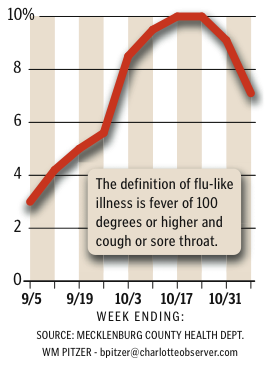
The number of states reporting widespread influenza activity decreased for the last week analyzed (Dec 20-26).  In addition, the number of pediatric deaths has decreased, even though the total number of deaths increased.

Get the shot!
The CDC continues to urge the public to get inoculated against H1N1. The shot or mist is offered widely at county health departments and doctors' offices. When I went to get a shot at my local county health department, the vaccine was free. There was a $15 administration fee, which is covered by insurance. The CDC has said repeatedly that widespread vaccination of the public can be a major factor in preventing a third wave of the disease. The vaccine will continue to be widely available through January.

Vulnerable groups
On January 2, Science News ran an online story saying sickle-cell increases vulnerability to H1N1 in children, although I didn't see that on the CDC website.

According to the CDC, the persons most vulnerable to complications from H1N1 are:
People 65 and older
Children under 5
Pregnant women
African Americans
People with these health conditions:
HIV/AIDS, severe immunosuppresssion, diabetes, disabilities, cardiovascular disease, asthma, arthritis, cancer patients and survivors, chronic pulmonary obstructive disease.

People who interact a lot with the public in their jobs may be more likely to contract H1N1 than others.

See Source #4. below for more info about vulnerable groups.

Symptoms
According to the CDC, you may have the flu if you have some or all of these symptoms:
fever (may or may not be present)
cough
sore throat
runny or stuffy nose
body aches
headache
chills
fatigue
sometimes diarrhea and vomiting

Prevention
To prevent infection in yourself and your children: get the vaccine, wash your hands frequently with soap or alcohol gel, avoid contact with those who are ill, avoid touching your eyes, nose, and mouth when out in public.  And if you have flu-like symptoms, call or see your health care provider. Stay home at least 24 hours after your fever is gone.  

Sources:
1. Centers for Disease Control. 2009 H1N1 Flu: Situation Update January 4, 2009
2. CDC. 2009 H1N1 Flu: Situation Update - Key Flu Indicators January 4, 2009
3. CDC. General Information about 2009 H1N1 Vaccines (and where to find a vaccine)
4. CDC. People at High Risk of Developing Flu-Related Complications. November 10, 2009
5. CDC. Flu View. (a map of state-by-state influenza activity). For week ending Dec 26, 2009
6. Nathan Seppa.  "H1N1 Hits Sickle Cell Kids Hard". Science News. January 2, 2009

My previous posts about H1N1:
H1N1 shot made my son vomit, but GO GET THAT SHOT  12/24/2009

H1N1 widespread but declining. Experts disagree about a third wave of H1N1 this winter. 12/02/2009

Second wave of H1N1 declining in numbers but not severity. Third wave may be the worst 11/18/09

The most dangerous cases of H1N1  11/12/2009

My daughter says elderberry got rid of her H1N1 10/22/2009

Why is swine flu likely to return in winter? It's not because we're cooped up together in winter 5/8/2009

H1N1 is a swine flu and has its roots NC, the land of Smithfield 5/2/2009

Smithfield blamed for swine flu by Mexican press   4/29/2009

Keywords: CDC H1N1 vaccine influenza swine flu vulnerable groups epidemic

Thursday, December 24, 2009

H1N1 shot made my son vomit, but GO GET THAT SHOT


This post now a Google News Link and posted on www.basilandspice.com

Photo by Sally Kneidel, PhD

Poor lad
Yesterday, my son and I went to get H1N1 shots at our local health department.  We didn't have to wait more than five minutes, and the shot didn't hurt more than just the needle stick. But as we walked out to the car, my son (in his early 20s) said he felt sick.  We got in the car, and before we were even out of the parking lot, he told me to pull over.  He jumped out and vomited two or three times on the grass.

When we got home he vomited again, went to bed and slept for 4 hours. When he got up he still felt sick and had a bad headache.  But the sheet we'd been given at the health department said that both "nausea" and "headache" were "mild problems" that might occur after the injection.  More serious reactions would be wheezing, hives, rapid pulse, paleness, difficulty breathing - symptoms that indicate an allergic reaction.  He had none of those.  About 7 p.m. he got off the sofa, took two Tylenol, and then took a long hot shower. After that, he felt fine.  Today he's fine, and I'm fine too.

Get that shot
I'm not writing this to discourage anyone from getting a shot.  I'm glad we got our shots, and my son is too.  My point in writing this post is actually to urge everyone to get H1N1 shots now, because the CDC continues to say that the more vaccinations are given to the public, the lower the chance we will have a dangerous third wave of H1N1 later this winter.

The latest news on H1N1 from the CDC
Yesterday, Dec 22, the Centers for Disease Control gave another of their weekly press conferences on the status of H1N1.  I studied all 8 pages; below I've summarized the main points.

In the U.S., the good news about H1N1 is two-fold:
  • Less virus is circulating.
  • The vaccine is more readily available than it has been. But, the current map provided by the CDC shows that the virus is still widespread in 11 states and regionally widespread in 20 more states.
About 60 million of the 307 million people in the U.S.have been vaccinated for H1N1 thus far.  Of those, two-thirds have been children.  About half the unvaccinated people in the U.S. who have been recently polled indicate that they want to be vaccinated.  Just a month ago, interest in vaccination was higher, at 60%.  Interest in vaccination is waning because the number of cases in the current wave of infection has been declining.

The waning interest is unfortunate, say the doctors at the CDC.  Dr. Anne Schuchat of the CDC led Tuesday's press conference, and she urged against public complaisance.  She said whether or not the U.S. experiences a third and perhaps more virulent wave of the H1N1 flu after December depends in part on how many people get vaccinated in the next few weeks. "Getting vaccinated will reduce the chance of your getting sick and reduce the chance of the country going through a third wave," said Dr. Schuchat.

Who is most vulnerable to hospitalization with H1N1?
Schuchat was asked during the press conference, what pre-existing health conditions make patients more vulnerable to serious illness with H1N1? The most serious cases are generally those that develop into pneumonia.

She answered that H1N1 patients are more likely to be hospitalized if they have these pre-existing conditions:
  • asthma
  • chronic lung disease
  • diabetes
  • cancer
  • chronic heart disease
  • pregnancy
She said any pregnant woman who has respiratory symptoms should be seen by a doctor and treated.

Virtually all the cases of flu in the U.S. at this time are H1N1, said Schuchat.  "Everything we're seeing in terms of the flu strains is the H1N1 virus and so it's not gone at all. None of us know what the weeks and months ahead will bring in terms of influenza activity."

How to find the vaccines for H1N1 and seasonal influenzas
For those who are interested in the seasonal flu vaccine, Schuchat said, "there's a little bit of seasonal flu vaccine around.  It will be spotty place to place....the vast majority has already been used."  She recommended checking with your doctor or pharmacy.

As for locating the vaccine for H1N1, Schuchat said about 2/3 of the states have carried out school vaccination programs.  As of Dec 22, 111 million doses of H1N1 vaccine have become available for order by states. This vaccine is available through doctors' offices, hospitals, and health departments.

Schuchat said emphatically that children under the age of 10 need two doses of the H1N1 shot, a month apart. Five or six weeks apart is okay, she said.

Pets
Dr. Schuchat said it's true that some household pets - cats and dogs - have contracted H1N1. But she said "the rare occurrances of this virus in other species is not a general problem."

My own comments about H1N1 in animals
It's my understanding that hogs having the virus is a potential problem, because a single hog can simultaneously have two or more types of viruses that also infect people. If a particular hog has more than one type of virus, the different viruses can exchange genetic material within the hog's cells, and make recombinant forms of virus which may be more virulent (more infective, more dangerous) than either of the contributing viruses.  This is why hogs are sometimes called "mixing vessels" in discussions of avian and swine flu viruses. It's believed that hogs have been an essential component in the development of avian and swine flus that have or may in the future cause widespread infections.  Birds are called "trojan horses" in virology, carrying viruses far afield, and as I said, hogs are called "mixing vessels."

So if your hogs get H1N1....well, I don't know what to tell you.  Let's hope they don't.

Sources:
Centers for Disease Control and Prevention

Wenjun Ma et al. "The hog as a mixing vessel for influenza viruses: human and veterinary implications." J. Mol. Genet. Med. 2009.

My previous posts about Smithfield and the swine flu:
H1N1 is a swine flu and has its roots NC, the land of Smithfield  May 2, 2009

Smithfield blamed for swine flu by Mexican press   April 29, 2009

My previous posts about H1N1:
H1N1 widespread but declining. Experts disagree about a third wave of H1N1 this winter.  12/02/2009

Second wave of H1N1 declining in numbers but not severity. Third wave may be the worst  11/18/09

The most dangerous cases of H1N1  11/12/2009

My daughter says elderberry got rid of her H1N1  10/22/2009

Why is swine flu likely to return in winter? It's not because we're cooped up together in winter  5/8/2009

Keywords:: H1N1 swine flu hogs mixing vessels trojan horses avian flu vaccinations

Wednesday, December 02, 2009

H1N1 widespread but declining. Experts disagree about a 3rd wave of infection this winter.

I read some new information today about H1N1, directly from our country’s primary source. The director of the Centers for Disease Control, which is monitoring the H1N1 pandemic, gave a weekly briefing to the press on Tuesday December 1. A transcript of Dr. Frieden's comments is available on the CDC website.

Following is a condensation of his main points, where he talks about the decline in H1N1 cases over the last 4 weeks, and the uncertainty over whether we will see a third wave during the coming winter. In his remarks, he stresses repeatedly that right now is a good time to try again to get vaccinated against the H1N1 virus.  Widespread vaccination could prevent the occurrence of a third wave of H1N1 infections.  In trying to make predictions, Dr. Frieden compares the H1N1 pandemic to the flu pandemic of1957-58.   I found those remarks particularly interesting.  See what he has to say!  There is no better expert on the subject in the United States than the director of the CDC. Following are the words of Dr. Frieden during his December 1 press briefing, edited for brevity:

"We are in a window of opportunity.  We're going from a time where there was lots of disease and not enough vaccines to a time where disease is gradually decreasing and we're having a steady increase in the amount of vaccine available.  That leaves a window of opportunity for people to be protected by getting the vaccine.  The flu virus is unpredictable.  We can't be sure of what will happen in the future.  There's been a decline in activity, but there's still lots of flu.  Flu is widespread in 32 states.  Although flu is going down, it’s far from gone.  And flu season lasts until May.  Only time will tell what the rest of the season will bring.  There are still lots of kids who are sick and lots of people who are at risk of getting influenza and end up getting severely ill from it.

"One question that all of us naturally have is, will we have another wave, or another large number of cases in the months to come, between now and May?  We took an informal poll of about a dozen of some of the world's leading experts in influenza.  About half of them said, yes, we think it's likely that we'll have another surge in cases.  About half said, no, we think it's not likely.  And one said, flip a coin.  We don't know what the future will hold.  What we can do is track it very closely so that as the cases develop or don't develop, we can determine where they're occurring and what their characteristics are.

"It's important to remember that in the last pandemic that behaved this way, 1957-1958, more than 50 years ago, there was a large surge in cases at the beginning of the school year, then a waning of cases, and then in December, January, February, there was a big increase in the number of people who were severely ill or who died.  We don't know if that will happen this year.  We do know that the vaccine is the best way to protect yourself.  

"With the increasing amounts of vaccine available it is a window of opportunity for protection.  There are now nearly 70 million vaccine doses available.  And we're seeing that more people are getting vaccinated. And as that happens, it's harder for the virus to spread.  Increasing supply should lead to the ease of getting vaccinated in many places, but we know it's still far too frustrating.  We know there are lots of people who wanted to get vaccinated but who haven’t been able to get vaccinated yet.  We know from polls that 9 out of 10 people who wanted to get vaccinated and didn’t receive the vaccine, said they would try again.  Now, it's a good time to try again because vaccine is increasingly available.  We're seeing variability. Some states are getting school kids vaccinated and holding back some of the vaccine from doctors' offices.  Other places are mostly working with doctors' offices and not so much with schools.  So there are differences.

"We continue to have not as much vaccine as we would like to at this point.  About a quarter of all of the vaccine that we have available is in the form of nasal spray which is available for people in the age of 2 to 49 who don't have underlying health conditions.  We heard about reluctance on the part of health-care workers and others to get the nasal spray.  There's really no reason to be any less confident in the nasal flu vaccine.

"In summary, we don't know what the future will bring.  We do know that we have more vaccine now.  It is a real window of opportunity to get vaccinated in the coming weeks and months.  And vaccination remains our best protection against the flu and for people who are sick.  It's important still to get prompt treatment.  When you're sick with flu-like symptoms, it may or not be flu, but if you're sick, see a doctor.  Or if you have an underlying health condition like diabetes, it's particularly important to see your doctor.  Thank you."  

So. What do you think? Have you tried to get vaccinated and been unable to?  I would love to hear your comments on my website at sallykneidel.com or here at veggierevolution.blogspot.com.

Source:
Press Briefing Transcripts
Weekly 2009 H1N1 Flu Media Briefing
December 1, 2009 1:00 p.m.
 http://www.cdc.gov/media/transcripts/2009/t091201.htm

Keywords:: H1N1 vaccine swine flu CDC pandemic

Wednesday, November 18, 2009

Second wave of H1N1 declining in numbers but not severity; third wave may be worst


Text by Sally Kneidel, PhD
November 18, 2009
See this post now on the front page of www.basilandspice.com


I talked with a knowledgeable nurse friend yesterday, a woman who takes care of the health needs of hundreds of teenagers.  She sees patients all day long every day, many of whom have flu.  She told me yesterday that H1N1 is waning at present.  But it's expected to peak again in another month or two. In the next wave, she predicted, much or most of the U.S. population who haven't had H1N1 will get it - at least, those who haven't been vaccinated.  She said successive outbreaks of a pandemic flu within one year tend to be worse with each successive wave.

Her comments jibe with articles I read today in the Charlotte Observer and on the CDC web site. The CDC says that visits to doctors for flu-like illnesses have decreased nationally for the last two weeks, after climbing for the previous four weeks.  But, says the CDC, "Total influenza hospitalization rates for laboratory-confirmed flu continue to climb and remain higher than expected for this time of year. Hospitalization rates continue to be highest in younger populations, with the highest hospitalization rate reported in children 0-4 years old. The proportion of deaths attributed to pneumonia and influenza....continues to increase and has been higher than what is expected for six weeks now.....Almost all of the influenza viruses identified so far [this fall] continue to be 2009 H1N1 influenza A viruses." [As I reported in an earlier post, pneumonia is the usual cause of death in fatal H1N1 cases.]

So, apparently, the total number of cases has been dropping nationally for the last couple of weeks, but is the H1N1 virus becoming more virulent?  More dangerous?  What else would lead to higher hospitalization and death rates, in spite of dropping numbers of people infected?

Which leads one to wonder about the vaccine.  The limited supplies are supposed to be going to pregnant women, children 6 months and older, young adults up to 24, anyone with a chronic medical condition, health-care workers, and emergency responders.  Yet, that's not always happening.  I went over to my local County Health Department a week ago to get a shingles shot (at least 6 people close to me have had shingles in the last year!), and while I was there, the staff asked me if I wanted to get an H1N1 shot.  I said no, because I'm not in a high-risk group. Corroborating my experience, there are numerous reports in the newspaper of lower-risk people being offered shots.  No one's too upset about that right now. But that could change. I would like to get the vaccine for myself and my family before the January wave hits. Wouldn't we all?  I looked on the CDC web site under "2009 H1N1 Influenza Vaccine Supply Status" dated 11/17/2009.  Unfortunately, it's remarkably not helpful, almost as if they intended to make it indecipherable. I just want to know, when will the vaccine be available for everyone who wants it?  Will it get here before the next wave, which will likely have higher mortality rates?

What's taking so long?

Sources:
Centers for Disease Control and Prevention. "2009 H1N1 Flu: Situation Update." 11/13/2009.  

Lisa Rosetta. "Second wave of H1N1 flu cases starting to wane."  11/16/2009.  Salt Lake Tribune.

Dharm Makwana. "H1N1 second wave ends." 11/18/2009.  24 Hours Vancouver.

Karen Garloch. "Swine flu numbers ease off:  Levels still surpass peak of a regular flu season, and officials predict new surge then."  11/14/2009. Charlotte Observer.

Karen Garloch. "H1N1 vaccine given to low-risk patients."  11/17/2009. Charlotte Observer.

My previous posts about H1N1:

The most dangerous cases of H1N1  11/12/2009

My daughter says elderberry got rid of her H1N1  10/22/2009

Why is swine flu likely to return in winter? It's not because we're cooped up together in winter  5/8/2009

This virus IS a swine flu and has its roots in North Carolina, the land of Smithfield   5/2/2009

Smithfield blamed for swine flu by Mexican press  4/29/2009

Keywords:: H1N1 vaccine swine flu successive waves low-risk patients

Thursday, November 12, 2009

The most dangerous cases of H1N1

by Sally Kneidel, PhD

As I wrote about a couple of weeks ago, my daughter and her boyfriend both had H1N1 recently. They both had fever, headache, severe muscle aches, fatigue, a sore throat and dry cough. They were both pretty miserable for a few days, but then made a very speedy recovery.  Neither one of them ever went to a doctor, because by the time we figured out what they had, it was too late for Tamiflu to have any effect.  A nurse told me that Tamiflu is effective only if taken in the first day or two of a viral illness, because all it does is shorten the duration and severity of the illness.  My daughter and her boyfriend did take elderberry extract capsules (800 mg, 3 times a day) which they felt hastened their recovery.

The same nurse friend I mentioned above also told me that, of all the people she sees in her job, those with H1N1 are in general not as sick as those with the seasonal flu. The population she treats is mostly teens.

When H1N1 Can Be Fatal
But soon after my daughter and her boyfriend recovered, the college-age son of a friend became ill with H1N1. He went to the college infirmary, and was soon in the hospital.  I'm not sure exactly what symptoms he had at first, except that they included a cough, sore throat, and runny nose.  Then, within just a couple of days, I got the word that he was in critical condition, in the ICU with pneumonia!!  There was a day or two after that where no one was sure whether he would live or die.  It was very frightening. He was able to breathe, but due to fluid in his lungs he was not getting enough oxygen, which can lead to organ failure and death.  So he was put on a respirator, which forces air into the lungs. The respirator was put on a high setting, meaning that a lot of air was being forced into his lungs. He was teetering on the brink of life for a couple of days, then I heard that the respirator had been turned down a notch, which was good.  After another day or two, a tracheotomy was performed and the respirator was attached to that instead of being stuck in his mouth.  I'm not sure what the purpose of that procedure was, except that it was a considered a step toward healing, and he was more comfortable having the respirator out of his mouth.  He started writing notes to the nurses, texting his friends, and generally coming around.  Next thing I heard, the respirator was removed, the tracheotomy was closed up and he was going home!  Seems like as soon as he began to get better, the recovery was remarkably fast.

Studies say my friend's experience was typical of serious cases of H1N1
I just recently read articles in the Journal of the American Medical Association (JAMA) and in Science News that detailed a typical scenario in the most serious cases of H1N1. They described cases remarkably similar to that of my friend's son. The articles said that young adults are the most vulnerable.  The most critical patients are those who get pneumonia. The article said inflammation in the lungs leads to fluid build-up in the airways and the lungs.  Says Dr.Robert Fowler of the University of Toronto, "Most patients are still able to take breaths, but those breaths are ineffective."  In a Canadian study reported in JAMA, 168 patients critically ill with H1N1 (average age 32) received intensive treatment, including antivirals such as Tamiflu and ventilators, but 17% of them died.  In another study, patients in Australia and New Zealand with an average age of 34 who were critically ill with H1N1 had a mortality rate of 21%.  In a third study, this time in Mexico, critically ill patients with H1N1 had a mortality rate of 41%, although these patients too were treated with ventilators and antivirals such as Tamiflu or Relenza. In one final study, in California, 11% of patients who became critically ill with H1N1 died - the most common cause of death was "viral pneumonia and acute respiratory distress syndrome."  Note that these percentages are percentages of people who were already critically ill with H1N1, not just percentages of all people with H1N1 flu.

The most important factor seems to be pneumonia. I am not sure what steps can be taken to keep H1N1 from turning into pneumonia, but if I had H1N1, I would see a doctor as fast as possible to get a prescription for an antiviral, and I would stay home and rest, drink lots of fluids, and do whatever the doctor said to help keep my lungs clear. 


The CDC and other sources recommend these steps for keeping well and keeping others well:
Wash hands frequently.
Don't touch eyes, nose, mouth.
Leave the room if someone else is coughing, because inhaling airborne droplets can lead to infection, and that factor is more likely in cold weather. (See my previous post below on why that's true.) 
If you are sick, cover your mouth or nose with a tissue when you cough and throw it away, or with the inside of your elbow, not with your hands.
Stay home if you're sick until you've had no fever for at least 24 hours.
Try to avoid touching doorknobs or things that other people touch constantly when out in public or at work.  Use your own pen to sign receipts.

See the CDC's website for more information on staying well.

Sources: 
Anand Kumar, MD, et al.  "Critically Ill Patients with 2009 Influenza A(H1N1) Infection in Canada". 2009.  Journal of the American Medical Association 302(17):1872-1879. Published online October 12, 2009  

Janice K. Louie, MD, et al. "Factors Asssociated with Death or Hospitalization Due to Pandemic 2009 Influenza A(H1N1) Infection in California". 2009.  Journal of the American Medical Association 302(17):1896-1902.

Nathan Seppa. "Reviewing H1NI flu's worst cases: Antivirals, ventilators help, but fatalities show lungs hit hard."  Nov 7, 2009. Science News. 

My previous posts on H1N1: 

Why is swine flu likely to return in winter?  It's not because we're cooped up together in winter

 
My daughter says elderberry got rid of her H1N1 flu 

Keywords:: H1N1 flu swine flu worst cases pneumonia ventilator how to protect yourself from H1N1 CDC JAMA

Thursday, October 22, 2009

My daughter says elderberry got rid of her H1N1 virus


Sadie with little Henry

Written by Sally Kneidel, PhD, of sallykneidel.com. This post is now on www.basilandspice.com and is a Google News link.

My daughter Sadie, in her 20s, got sick a few days ago with a flu-like illness.  We didn't figure out for a couple of days, after talking to a nurse, that her affliction was almost certainly swine flu.  Fever of 102 degrees, headache, severe body aches, fatigue, sore throat and cough, slight sniffles. On Monday she was too sick to go to work. One of her housemates came home with some elderberry capsules from a natural-foods store.  Sadie (my daughter) took 800 mg capsules, 3 times a day, on Monday and Tuesday. I talked to her on Wednesday and she said she was 100% recovered with no symptoms whatsoever. Maybe the flu had just run its course and she would have felt fine even without the elderberry.  But I was curious enough to look it up on the internet, and was astonished at the volume of credible articles I found about black elderberry as a treatment for the flu. My daughter's whole household is taking elderberry now, to avoid getting what Sadie had, including elderberry in syrup form for the baby.

Now, I'm not a health professional, and I am not recommending a particular flu treatment to anyone. Flu can be dangerous. But I am saying these articles on the internet are interesting.  Have a look for yourself. A few of them are listed below. You can find many more by googling "elderberry flu" or "elderberry H1N1."

Tamiflu, an antiviral commonly prescribed for flu, is very expensive. It only shortens the duration and may reduce the severity of the flu. It also has common side effects that can include vomiting and headache. Of course, there are flu cases where reducing the severity even a little can be life-saving, so I'm not knocking Tamiflu.


Articles about elderberry and flu:
Paul Fassa.  "Elderberry Trumps Tamiflu for Flu Remedy". Natural News.com, May 30, 2009 

Cathy Wong. "Flu remedies."  About.com: Alternative Medicine. Dec 4, 2007.

Chris Bolwig. "Flu cure found in the elderberry."  Ice News - Daily News. Nov 12, 2007.

Elderberry extract prevents H1N1 infection in vitro.   The Medical News. September 11,. 2009.

Teresa Koby.  Elderberry flavonoids bind to and prevent H1N1 infection in vitro. Herb News, Herb Research Foundation. August 28, 2009.

Nicky Blackburn. "Study shows Israeli elderberry extract effective against avian flu."  Israeli21c: Innovative News Service. January 29, 2006.

Key words:: alternative medicine elderberry flu H1N1 herbal medicine herbal remedies swine flu