Thursday, July 24, 2008

Taking Rosa's good advice, we veered up the road into Huaraz and the Peruvian Andes


Rosa looked concerned. "Why are you going to Huancayo?" she asked, brow furrowed. Rosa Vasquez Zanetti runs a travel agency out of her family's inn where we were staying, on the Amazon River in Iquitos Peru. Rosa had been so helpful already, I'd asked her to look over our plans for the Andes.

"We picked Huancayo at random - because it's a small mountain town with no Americans, and not too far from Lima by bus," I answered.

"But...that's not the best plan," Rosa continued, in her soft-spoken way. "For birding and trekking, you should go to Huaraz in the Cordillera Blanca. And you should ride the Cruz del Sur bus from Lima. It travels during the day and makes no stops so it's safer." Night buses that make frequent stops are vulnerable to occasional muggings, as we heard from more than one source.

a view of Huaraz from Zarela's hostel

"Stay at Zarela's hostel in Huaraz for a couple of days to get acclimated," Rosa told us. "Then from there, you can go up to Llanganuco Lodge and Llanganuco Lake. You'll like that better than Huancayo."

Rosa arranged it all. As it turns out, the Cruz del Sur bus does make pit stops on request (the onboard bathroom is for liquids only, the driver announced). But no scheduled stops. And it didn't freak me out like I feared it would, swooping around mountain curves with no guard rails. I just didn't look out the window.

kids of a Huaraz street vendor

We loved Huaraz - at 10,200 feet, the highest place we'd ever spent the night. (Click for map.) We loved La Casa de Zarela too, a first-class backpackers' hostel with hot water, great views, and helpful staff, especially spunky owner Zarela Zamora (online reviews and contact info). Most of the guests staying there left early in the morning on treks or climbs arranged by one of the local trekking companies. Huaraz (and Zarela's) are featured in Outside Magazine as the mecca for mountain adventurers in the northern Peruvian Andes. Nestled between the Cordillera Negra (brown peaks) and the Cordillera Blanca (frosted peaks), Huaraz is within spitting distance of some of the world's highest summits. The Cordillera Blanca has more than 50 peaks of 5700 m (18,700 feet) or higher. North America has only three; Europe none. (Click here for a Huaraz trekker's online journal entry.)

Much of the adobe town was leveled by an earthquake in 1970 that killed 20,000 people in Huaraz alone - half the population. The town has been rebuilt, this time with rebar reinforcement in every wall. In fact, a good proportion of the homes and buildings still have rebar poking out the top. But the funky construction and the steep cobbled streets just add to the town's personality - a blend of local enterprise and Andean indigenous culture, along with the trekkers, birders, and wanderers like ourselves.

a Huaraz weaver and her alpaca

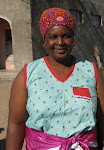
I spent our time in Huaraz skulking around the town, trying to get pics of Andean street scenes and the beautiful Quechua women who were everywhere, with their long thick braids and brilliantly colored hand-woven clothes and baby-slings. In the afternoons and evenings, indigenous women from outlying farms and villages set up stands or spread blankets on the sidewalk to sell produce or woven items. They all wore traditional fedora-style hats, often with an arrangement of feathers lying flat against the felt. Most of the women didn't want their picture taken, even when I asked politely. But a few acquiesced, a couple of them even asked me to mail them prints. It was a blissful day for me, I can't say why exactly - one of those few days where the world seems a lovely place; I felt grateful to be alive and well.


After just one day of acclimating in Huaraz, and scampering about annoying people with my camera, we hired a taxi driver from Yungay to take us to Llanganuco Lodge at 11,500 feet, and later Llanganuco Lake (12,500 feet) in Huascarán National Park. The lodge is right smack at the base of snow-covered peaks Huascarán and Huandoy. At 22,200 feet, Huascarán is the highest tropical peak in the world. I'll tell you about the National Park and the lodge - and altitude sickness - in my next post. Between our amoeba issues along the Amazon and altitude sickness in the Andes, we had a few sick days. But that's all forgotten now. I said in my previous post that I'd move to Iquitos in a heartbeat; I'll have to include Huaraz as well. If a job opened in either place, I'd be gone in a flash.


Huascarán by Alan Kneidel

All other photos, and text, by Sally Kneidel

Keywords:: Huaraz, Andes, trekking, trek, climbing, Huascaran, Llanganuco, Pascana Amazon Services, Rosa Vasquez, Quechua, La Pascana, Zarela, Zarela's, alpaca, Kneidel, Sally Kneidel, Alan Kneidel

Monday, July 14, 2008

From the Amazon to the Andes, Peru knocked me silly

Be sure to ride the moto-taxis in Iquitos, and hold on tight

If you're interested in adventure travel, as in someplace really different from home and not too expensive, consider Peru. If you want a ground-level view of what's really going down in the tropical world, Peru will show you that.

We're just back from 24 days in Peru, a trip that included the Amazon, the Andes, and the desert along the Pacific Coast. Peru is one of the most varied and stunning countries I've seen. It has the highest biodiversity of any country on the planet - a big bonus for us. We also found opportunities to interact with indigenous people in villages along the Amazon and in the Andes. One of our goals was to spend as much time as possible in places where other Americans don't go - remote villages and nature reserves. We accomplished that, partly by avoiding Machu Picchu and the Sacred Valley.

My trip included husband Ken, son Alan, and daughter Sadie. Sadie and Alan are both in their twenties.

A whole lotta birds
We saw 301 species of birds in Peru - not bad. Compared to 314 species in Costa Rica (over a period of 12 weeks), 220 in Kenya, and 141 in South Africa. [The Kenya trip was only Alan.] Birds we saw in Peru included the Humboldt penguin, Inca tern, Peruvian booby, Peruvian pelican, blue and yellow macaw, vermillion flycatcher, white-throated toucan, wattled jacana, Andean flicker, white-winged parakeet, burrowing owl, etc. I can post a list if anyone is interested. Leave a comment on the blog and tell me.

A street vendor in Iquitos

Wild and woolly Iquitos

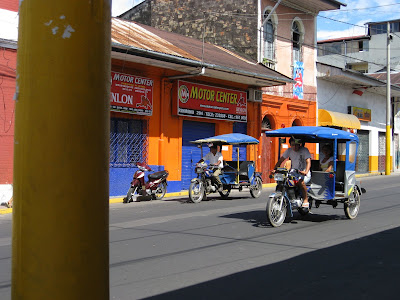
We spent 4 or 5 days in Iquitos, the world's largest city that's not accessible by road but only by river or air. It's a friendly, hyper, and funky little town on the Amazon River. And cheap. Our lodging cost us $9 per person per day, on a quiet dead-end street that ends at the river. The roads of Iquitos are traversed by "moto-taxis" instead of cars, like 3-wheeled motorcycles with go-cart engines (see picture at top of post). For half a dollar, a mototaxi will take you anywhere, darting through town at break-neck speed. A first-class thrill, better than any carnival ride. I love Iquitos. I would move there next week if I had a job there and I'm not kidding.

Biological station on stilts
After a few days in charming Iquitos, we took a boat to a very remote biological station about 90 river-miles from Iquitos. We went east on the Amazon and south on its tributary, the Orosa River. The biological station, Madre Selva, is operated by Project Amazonas, a conservation and humanitarian non-profit. The station provides "rustic" lodging for biologists studying Amazonian plants and animals. Project Amazonas also offers some medical aid to remote families and under-served villages on the rivers. At the biological station, we slept in tents on raised wooden platforms under a thatched roof. Thatched homes with open sides are traditional in Amazonia. Every single house you pass on the river is built that way, and on stilts, which protect against flooding - because Peru has a rainy season and a dry season and water levels fluctuate dramatically. Summer in the U.S. is Peru's dry season, good for travel. Especially July and August.


Photos: Our housing at Madre Selva, outside and inside. Our house had screen walls, but most homes don't.


We had the station to ourselves, with our Peruvian helpers

The biological station is open to anyone who wants to go. The director of Project Amazonas, Dr. Devon Graham, is affiliated with Florida International University (in Miami) and frequently takes student groups to the station to study the use of forest resources by local people, all of whom are indigenous. He also takes groups of tourists, but none were there when we were. We had the station all to ourselves, along with our cook, boatman, and our naturalist guide - all native Peruvians whom Devon engaged for us.Photo: Our boat is visible behind Raul Viena our cook, Edwin Ruiz our boatman, and Cesar Peña our naturalist guide

The wildlife delivery crew
We loved the local indigenous children who paddled over to the station every day in their dugout canoes. When their mothers came too, they brought stuff to trade: woven baskets, bags, fans, carved jewelry. The moms welcomed what we offered: lotion, mosquito netting, toothpaste, socks, shirts, anything. Sometimes the children brought their "pets" to show us: lizards, turtles, and even monkeys! This was not at our request, and we were uncomfortable seeing wildlife as pets, especially the primates. But as we learned, people living in remote places along the Amazon do keep wildlife as pets. We saw plenty of wildlife for sale as meat too, back in Iquitos, which made us equally uncomfortable.

But we were grateful to have the chance to talk with the families around the biological station.


Above photo: A group of sisters brought us a little frog in a baggie (which Sadie released into the forest). Right: Another family brought their two pet monkeys to visit with us, just to be neighborly.
The monkey pictured is a monk saki monkey.

Belen market: teeming with life and death
Captive wildlife often winds up in Iquitos. Part of Iquitos is a floating shantytown of huts built on rafts that rise and fall with the river. The floating area of the city, called Belen, has an extensive and colorful open-air market on the shore, which offers every imaginable jungle resource. It's an exotic sensory deluge, crammed with foods and spices and jungle products I've never seen before. It reminded me of Diagon Alley in the Harry Potter books for some reason, maybe because of all the traditional medicines for sale, made of plant and animal parts. (The use of animal parts to treat ailments and impotence worldwide is based almost entirely on superstition, folklore and tradition. I don't know of any animal parts that have been demonstrated to be effective medicine.) The part of the Belen market that offered traditional medicines was troubling, and fascinating. As I've written elsewhere, the trade in wildlife and wildlife parts worldwide is the third most lucrative blackmarket commodity in the world, after drugs and arms (according to Interpol).
Photo above: In the Belen market, plant and animal parts were sold as medicine (see "Medicina Natural" sign above. "La Selvita" means "The Little Jungle.")

I saw traditional medicines made of animal parts while visiting a medicine man in a remote village in South Africa last year. He had a few animal tails and skulls, and some unidentified animal parts in jars, but his collection of animal parts was meager compared to the array on display in the Belen market.

We also saw baby monkeys for sale in the Belen market, for 5 soles, about $2 each. I was stunned at that. These were saddle-backed tamarins, spider monkeys, pygmy marmosets, animals whose habitats and population numbers are declining, and who should be protected. There were more than monkeys for sale....living anteaters, parrots, and sloths, too. It was distressing, yes, but if it's happening, I want to know about it. I was grateful for the opportunity to see it for myself, and grateful to our guide Cesar Pena for taking me there. Cesar has been a nature guide on the Amazon for Project Amazonas for 12 years. He works independently too. If you're interested in hiring him as a guide on the Peruvian Amazon, contact him directly at cesars99@hotmail.com. His phone number in Iquitos is 965-658361. To call him from the U.S., dial 011.51.65.965658361.

Rosa was a life-saver in planning our trip. Maybe literally.
Before this post gets too long, I want to recommend an excellent resource for anyone considering a trip to Peru. Rosa Vasquez Zanetti. Her family owns and operates the modest little inn where we stayed in Iquitos, the Hospedaje La Pascana. Rosa is also an excellent travel agent, through her own Pascana Amazon Services. Not only did she make a number of our bookings before we arrived in Peru, she also helped me change some of our Andes plans at the last minute while we were in Iquitos. She recommended some safer means of bus travel into the mountains for us, and booked the tickets. She also recommended safer and more interesting mountain towns and Andean peaks for our hiking plans, and she booked those too, while we were in Iquitos. She was a fantastic resource and speaks very good English. You can contact Rosa directly at reservas@pascana.com or call her in Iquitos. From the U.S., her number is 011.51.65.233466. I'll write another post about what we did in the Andes.

I recommend Miguel Quevedo
I want to recommend too a Peruvian driver that we hired to drive us from Lima to the Reservas de Paracas, a mind-blowing desert nature reserve 4 hours south of Lima. Devon Graham of Project Amazonas recommended both Miguel and Rosa to us. Miguel stayed with us the entire 56 hours or so (two nights) that we spent in the area of Paracas. When we left the car to go birding, he stayed with the car to guard our things. His name is Miguel Quevedo. He's smart, responsible, trustworthy, fun. On many occasions, he acted as our advocate - straightening out misunderstandings with vendors, etc. Miguel can be reached through Rosa Vasquez Zanetti (she will call him for you if you email her at reservas@pascana.com.) Or you can call him directly, but he speaks little English. His phone number in Lima is (511) 99664-1254. If calling from the U.S., it's 011 511 996641254.

Miguel and Sadie at supper, at Paracas on the Pacific coast

More later on Peru, and why I long to get back there.
Photos and text by Sally Kneidel

Keywords::Peru travel, adventure travel, Amazon, Andes, Paracas, Iquitos, South America, tropics

Sunday, July 13, 2008

Vegetarian/Vegan Club of Charlotte

Readers, I am passing along this message from Ileana:

Are you a vegetarian or vegan in the Charlotte community and surrounding area that would like to get to know others in the area? Would you like to learn more about which local restaurants have food we can eat? Would you be interested in monthly dine-arounds? Are you thinking of becoming a vegetarian or vegan and need a support group?

If so, email me at charlotteveggies@gmail.com to join the Vegetarian/Vegan Club of Charlotte.

Tuesday, July 01, 2008

Energy-efficient and Water-saving Clothes Washing Machines


Our avocado-colored washing machine is 20 or 30 years old; we inherited it years ago and it was old even then. We've been expecting it to break down for a long time, but it keeps plodding on dutifully. Still, we feel like we should replace it with a more energy-efficient and water-conserving model. Although we'll plunk down some change up front, a new washing machine will save us money on electricity and water bills But how can we tell which new ones are the best in terms of energy efficiency? Tons of products make "green" marketing claims that I've learned not to trust.

You might know about the EPA and Department of Energy's Energy Star program. The program identifies appliances that meet federal energy-efficiency standards. According to the Energy Star website, appliances with the Energy Star logo can reduce household energy consumption and greenhouse-gas emissions by 33%! The Energy Star website says this efficiency saved consumers $12 million in electricity bills in 2005 alone. That same year, the use of Energy Star products reduced the USA's greenhouse-gas emissions by an amount equivalent to 23 million cars – the same as if one car in ten were retired. Sounds pretty good.

A lot of major brands have models that qualify for the blue Energy Star logo. The Energy Star website has search engines for different products and stores that carry them.


So what about washing machines in particular?

According to these green building guidelines from California, Energy Star washing machines use 50% less energy and 45 to 60% less water, but perform as well as conventional washers. For maximum efficiency, these guidelines recommend models with a water-factor rating of 6.0 or less. Most Energy Star washing machines are front loaders. They not only wash and rinse with less water but most models have a high-speed spin cycle that removes more water than conventional models, thus saving energy on drying.

The websites listed below are helpful sources of information. For the present, before we choose a new washer, I'll keep trying to reduce our energy use by washing only full loads and by washing in cold water. And even after I get the new washer, I'll keep hanging the clothes on the line to dry. Yeah, they get bird poop on them now and then, but what the heck. The little gobs flake right off when they're dry. The trick is to bring in the clothes as soon as they're dry. The longer they stay out, the greater the chance they'll get bombarded.

See our new book, Going Green, for more information on energy-saving appliances and other environmentally-friendly consumer choices.

by Sally Kneidel, PhD

Sources and more info:
1. Going Green: A Wise Consumer's Guide to a Shrinking Planet
Sally Kneidel, PhD, and Sadie Kneidel

2.
Energy Star
http://www.energystar.gov

3. Green Building Guidelines. G. Appliances http://www.co.contra-costa.ca.us/depart/cd/recycle/gbg/Grnbldg-NewConstruction-9Chap4-2.pdf

4.Consortium for Energy Efficiency
http://www.cee1.org/resid/seha/refrig-main.php3
http://www.cee1.org/

Keywords: clothes washer clothes washing machine energy-efficiency energy-efficient appliances Energy Star energy-efficient clothes washer water-conserving clothes washer front loading


Wednesday, June 25, 2008

Most Earth-friendly Mass Transit?


What kind of mass transit is the most eco-friendly?

Intercity buses. Yup. Most of us don't travel much on intercity buses, and we have reasons for that. Bus routes between cities in the U.S. can be unreasonably long - I think Charlotte to Birmingham takes 1 or 2 days one-way, as I recall from our friend Carra. But other bus routes make a lot of sense. The trip from Charlotte to Asheville NC is only about 3 hours (same as by car), it's cheaper than the gas to drive it yourself, and the bus is remarkably punctual - unlike Amtrak and many airplanes. All in all, buses are not a bad way to go, unless it's a very long route that stops in every burg and holler.

Convenient or not, bus travel is green, we have to give it that. Michael Brower and Warren Leon of the Union of Concerned Scientists calculated that intercity bus travel is by far the least polluting
mode of personal travel per passenger-mile. Intercity buses are 2 to 4 times less polluting than cars and trucks, per passenger-mile. Intercity buses are also less polluting than passenger trains and air travel, per passenger-mile.

You might guess that cars and trucks are the most polluting form of travel. And you'd almost be right. But motorcycles are actually worse. A motorcycle generates the same amount of greenhouse gases as a car, per passenger mile, but twice as much toxic air pollution and 3-4 times as much toxic water pollution. Even though motorcycles get good gas mileage, their small engines have fewer emissions controls than cars. Also, they're made of a higher proportion of steel and other metals than other vehicles, which accounts for their high toxic air and water pollutant emissions.

The best way to reduce consumer fuel consumption is obviously to travel less, but that’s hard to do when lots of us live in the suburbs and work downtown. Our local newspaper here in Charlotte often features developers who are planning self-contained and mixed-use communities, which in the future will house workers closer to jobs and services. We need more such housing and we need it now, before we pass one of those infamous "tipping points" on our journey toward climatic upheaval.

For now, we could reduce fuel consumption tremendously by making better use of mass transit, especially in cities. Half of the United States' 26 largest urban areas currently fall short of the EPA’s minimum air-quality standards. Increasing ridership on the 35 public transportation systems serving these cities (subways, light rail, intracity buses) would improve air quality, congestion, and the financial strain of building new highways and widening roads.

But... municipal dollars won't be funneled into mass transit unless consumers demand it. So let's start demanding. If you live near a functioning mass-transit system, consider using it, even if just one day per week. Every little action helps. Just doing one little thing can inspire you to tell someone else about it, who might then do it themselves, and might tell someone else. Action generates its own momentum. I believe that.

by Sally Kneidel

Sources:

Michael Brower and Warren Leon, The Consumer’s Guide to Effective Environmental Choices: Practical Advice from the Union of Concerned Scientists (New York: Three Rivers Press).

Robert J. Shapiro, Kevin A. Hassett, and Frank S. Arnold, “Conserving Energy and Preserving the Environment: The Role of Public Transportation,” American Public Transportation Association, July 2002, www.fypower.org/pdf/RES171664_shapiro.pdf.BKeywords:: mass transit buses motorcycles greenhouse gases climate change global warming

Thursday, June 19, 2008

Last kid graduates: When do we get to stop working?

Straw bale house (photo courtesy of www.solarhaven.org)


Our second and last kid graduated from college in May. Ken and I are thinking "When do we get to stop working?" We live in a very small house (1415 sq ft), we drive cars that are 13 and 14 years old. I wear clothes from Community Thrift or Goodwill. Ken wears his until they're threadbare. We've socked away more than 20% of our earnings into retirement accounts since we were thirty. And yet, because we've both worked as educators and I as a writer, we have not made enough to have a hefty retirement account yet. Yeah, we could keep working until our mid-sixties. But our friends who have worked in banking or other more lucrative careers are retiring now. It's hard to watch. They get severance packages plus lifetime health coverage, neither of which we will get.

What's to be done?

We've thought about retiring to Costa Rica, where the average wage is $3,000 per year. In such an economy, we'd be relatively wealthy. But we're not ready to do that, at least not now. We're developing a different kind of plan that involves building a very inexpensive new house, and renting out the house we're in now. While we're renting it, the property will hopefully appreciate. It's in a neighborhood that is pretty close to downtown in a growing city, so that's a fair guess.

What kind of inexpensive housing do we want to build? Ken suggested a trailer, but I don't think so. While interviewing green entrepreneurs for our last book (written with daughter Sadie), I met a number of families who have built environmentally friendly and low-cost homes. I keep thinking in particular of Barry Ford of Lancaster SC, featured in our book Going Green. He, his wife, and his young step-son built a 2300 sq ft house for only $13,000 in 1998, which works out to $5.65 per sq ft! They didn't even need a mortgage. I toured it; it's a beautiful home. Ford says it's been appraised above the value of his neighbors' conventional ranch homes. The walls are all made of stacked rows upon rows of bales of straw, covered with stucco.

The Fords started by gathering 1000 strawbales, purchased directly from farmers and piled up on the building site. They kept the bales covered with a tarp until they were ready to begin construction.

Some strawbale homes are post-and-beam, meaning that the bales of straw are laid between load-bearing vertical posts that are more or less like studs in a stick-built home, although the posts are much farther apart than studs. In post-and-beam construction, the bales serve as both insulation and as a substrate for the stucco or plaster surfacing.

But in the Ford home, the strawbales are load-bearing. There are no posts and beams. The Fords didn't even use rebar, which many strawbale builders run vertically from the concrete foundation upward through the bales to stabilize them. The engineers at Cornell and Clemson who served as consultants to the Fords advised against rebar, because the penetration by the rebar (threaded steel rods) allows moisture to get inside the bales. The Fords built their home, one bale at a time, over a period of 10 months, while they were both working at full time jobs. They worked on the house evenings and weekends. The only labor they hired was for one or two days while framing the roof.

Or we might build a paper-bale home. Our publisher turned us on to a couple in Colorado who built one. They used bales of post-consumer paperboard and PVC trash. These materials - glossy coated cardboard (like laundry soap boxes) and waste plastic (old toys, laundry baskets, shampoo bottles) – are hard to recycle and usually end up in landfills. For this Colorado couple, the paper-bale walls give their home an insulation value of R-30, far beyond the energy-efficiency of most conventional homes.

Ken and I like the fact that both strawbale and paper bale construction use waste materials. (Straw is hay that has had the edible seeds removed.) Making use of waste would feel good both environmentally and financially.

We might build an earthship home, like our friends Carol and Neil are doing. It is sort of the ultimate in sustainable builidng and sustainable living. The walls are made of old tires, which Neil and Carol are collecting now. The home has passive solar design to save on heating and cooling costs, and it has a water recycling system that reduces the home's need for well-water or city water to almost nothing.

Then there's Trip Overholt of Chapel Hill. He moves older houses that are slated for demolition because of land-development plans. He hauls them to a new foundation on a vacant lot, and then sells them for a lot less than a custom home would cost. That's the ultimate in recycling, because it keeps the older house out of the waste stream, plus it avoids all the new materials and energy required for new-home construction.

A lot of exciting options! At one time I wanted a bigger house so I could have a home office and a guest room and a den and a dining room, none of which we have now. (We do have 3 bedrooms.) Now, I just want a cheap house. A really cheap and energy-efficient house. I'm optimistic that we can be economical and green at the same time. I'm eager to get started. But where should we build? That's the first question.

All the people and homes mention in this post are described in detail in Going Green, available on amazon.

by Sally Kneidel

Keywords:: strawbale house paper bale house earthship recycled house

Saturday, June 14, 2008

Can a Warmer Planet Feed Us?

Before too long, our most direct link to global warming will be the food on our dinner tables. The vast bounty of our neighborhood supermarkets all depends on cycles of rain and air temperatures in far-off parts of the globe. Now, across the world, those cycles are changing and the effects will be profound — for all of us.

As patterns of wind and rain shift, no one knows exactly where the water will end up or when it will arrive. But most of the big computer models predicting Earth's future climate, including those created by NASA's Goddard Institute for Space Studies, foresee declining rainfall in the tropics. Harvests in those regions will decrease too. In India and much of Africa, already struggling with food shortages, food production will drop.

Climate change will produce more extreme weather, such as hurricanes and monsoons that can destroy crops and leave people with no food at all.

Most scientists don't foresee major changes in total food production during the next decade or two, as average temperatures increase by just a few degrees. As food production falls in sub-Saharan Africa and India, food production will actually increase (temporarily) in temperate regions such as North America and Europe. As a result, the world will become increasingly dependent on a handful of major food exporters, such as the United States, Canada, Australia, Brazil and Argentina.

Forty or 50 years from now, as today's children reach middle age, things are projected to get worse. As temperatures continue to rise, along with levels of greenhouse gases in the atmosphere, most models show global food production falling. The areas most affected will be those least able to purchase food from abroad. Foremost among these is Africa. According to some estimates, tens of millions of people could go hungry unless there's a major effort to help these countries adapt.

Agricultural communities can adapt in some ways, but it won't be easy, especially in the poorest parts of the world. The soil in many parts of Africa is highly degraded from overgrazing and overharvesting. There's very little organic matter — decomposed leaves, roots and grass — left in the soil. It isn't replenished because any leftover vegetation is used for fuel. Improving the soil would help Africa prepare for climate change by increasing harvests and also helping the soil store water. Providing alternative fuels for rural households is one way to help improve soil in sub-Saharan Africa.

Anything that increases the wealth of developing nations, especially in the tropics, will help them adapt to coming food shortages.

What can we do? Decrease our own contribution to greenhouse gases, with our driving choices, our food choices, and how we heat and cool our homes. Our new book Going Green: A Wise Consumer's Guide to a Shrinking Planet offers guidelines for these three high-impact consumer categories.

Sally Kneidel

Source: "Will a Warmer World Have Enough Food?" Dan Charles. NPR. November, 2007

Keywords:: greenhouse gases global warming food shortages Africa

Sunday, June 08, 2008

Our new book is out: Going Green: A Wise Consumer's Guide to a Shrinking Planet


Our new book is out, as of May 2008. It's Going Green: A Wise Consumer's Guide to a Shrinking Planet.

While Sadie and I were researching our first book together, Veggie Revolution (2005), we learned so much about the environmental and health impacts of the food industry. It profoundly changed my life, and I think Sadie's too. One thing we learned is that the food industry is completely consumer driven. In Going Green, we looked farther afield to see how we as consumers fund other environmentally-damaging industries. We also took a closer look at the dark underbelly of food production, and in the new book we report some startling interviews.

Before these books, we had often debated whether our own lifestyle choices - our diet and other purchases - were really making a difference. So we took the time to find out. We wanted to help busy consumers make informed choices about the products they buy without sacrificing their comfort or way of life.

Specifically, Going Green guides consumers in the most effective and economical ways to reduce their ecological footprint and greenhouse gas emissions, especially in the highest-impact categories of food, transportation, and how we heat and cool our homes. We included clothing too, because readers ask about that.

For example, the book reviews the different kinds of “green” cars, from hybrids to flex-fuel cars to diesel cars equipped to run on pure vegetable oil. For a reader interested in “green” clothing, the book compares the environmental and health effects of organic vs. non-organic cotton, bamboo and hemp fabrics, synthetics, wool, as well as second-hand clothes. We cover dyes and finishes too, which vary widely in their toxicity.

Want to reduce your home energy bills? In Going Green, we report on the greenest (and cheapest) choices for new home construction, such as passive solar design and building with waste materials. But the book is loaded with information about reducing energy consumption in an existing home by sealing leaky doors and windows, buying Energy Star appliances, or simply changing your light bulbs. It’s a very practical book with a positive outlook.

Why is this book timely?
There is an explosion of interest right now in eco-friendly lifestyle choices. That interest is driven by the escalating cost of fossil fuels for transportation and for heating homes. It’s also driven by scientific reports published in the past year about global climate change, and the urgency of taking action to slow it right now before we pass certain “tipping points.” This is a book to guide conscientious citizens in taking action. None of us make perfect choices across the board, we’re all human. But if everyone does something, the effects add up.

Sally Kneidel, PhD


Friday, June 06, 2008

Shoestring Victory: Never enough space

Ricky's and my struggle to begin our microfarm was proving difficult at every turn. No materials. No space. No money. Somehow we'd managed to plow our field, make our potting mix... and now, finally, on a cool February evening, we filled nine 128-cell flats with seed. Dwarf Thumbelina Zinnias… Blue Scotch Kale… the names brimmed with promise. As I swept off the porch, Ricky went off in search of the watering can. She came back, lugging it full of rainwater.

Gingerly, she tipped it forward to water the first tender tray. Immediately, the spray-end fell to the ground, blasting a few cells of dirt with an undiffused jet stream of water. She looked at me reproachfully. “It’s broken!” she said in a tone of surprise.

“Oh, yeah…” I said vaguely. “It’s cracked, but you can just stick it back on there liiiike…. oh. Crap. I guess it really is broken.”

That night we watered the trays with mason jars. That worked until the dirt formed a hard crust from having thick layers of water poured over it. Then it was time to upgrade to a drugstore watering can for $1.29.

In addition to gentle watering, seedlings need steady, constant temperature and light. I kept remembering the farm I’d worked on: the warm, humid greenhouses with their automatic watering systems and gently humming fans. How could I replicate that here?

In the back yard, we have a small hoop house that one of my housemates built out of a pallet and some scrap plastic. It does a great job of converting lukewarm spring sunshine into steamy heat – at least while the sun’s out. But I wasn’t confident it would protect delicate seedlings at night, or when the temperature got below freezing.

Meanwhile, Ricky was in the process of moving into a house under construction. All her possessions were in boxes; her house was full of tools and sheetrock dust. She couldn’t take the seed trays.

No, it was up to me. I prowled through the house with an appraising gaze. South facing windows… wait, that just might work!

I ran to the kitchen for an armful of plastic shopping bags and old newspapers. Then to my bedroom. Clearing off my desk, nightstand, and dresser – all within reach of the south-facing windows’ light – I spread out bags and covered them with a thick layer of newspaper. With a little rearranging, I fit five trays on my dresser, three on my desk, and one on my nightstand. I didn’t really need my lamp. My alarm clock could go on the floor. Perfect!

Well. Maybe not perfect, but functional at least. Hopefully. Would anything grow?

by Sadie Kneidel

Thursday, June 05, 2008

Sheep flatulence innoculation developed


By Peter Allen in Paris
Last updated: 3:38 PM BST 05/06/2008

New Zealand scientists claim to have developed a "flatulence inoculation" aimed at cutting down on the massive amount of methane produced by its sheep and cows.
Such animals are believed to be responsible for more than half of the country's greenhouse gases, causing huge environmental problems.

But Phil Goff, New Zealand's trade minister, told an Organisation for Economic Co-Operation and Development (OECD) in Paris yesterday that a solution was in sight.

"Our agricultural research organisation just last week was able to map the genome ... that causes methane in ruminant animals and we believe we can vaccinate against" flatulent emissions, Mr Goff said.

Scientists in New Zealand have been working around-the-clock to reduce emissions from agriculture, such as changing the way fertilisers are used on pasture land, Mr Goff added.

Sheep, cattle, goats and deer produce large quantities of gas through belching and flatulence, as their multiple stomachs digest grass.

Ruminants are responsible for about 25 per cent of the methane produced in Britain, but in countries with a large agricultural sector, the proportion is much higher.

The 45 million sheep and 10 million cattle in New Zealand burped and farted about 90 percent of that country's methane emissions, according to government figures.

In comparison, livestock are responsible for about two per cent of the United States's greenhouse gas emissions, according to the US Environmental Protection Agency.

Under the Kyoto Protocol to combat global warming, New Zealand must reduce its greenhouse gas emissions to 5.2 percent below 1990 levels by 2012.

In the past New Zealand's farmers have showed their disgust at government plans to impose an animal "flatulence tax" by sending parcels of manure to members of parliament.

The OECD conference is discussing climate change, trade and the global economy.

Story from Telegraph News:
http://www.telegraph.co.uk/news/newstopics/howaboutthat/2076607/Sheep-flatulence-inoculation-developed.html

Thursday, May 29, 2008

Shoestring Victory: Getting started with no materials

February came all too fast this year. In North Carolina, the second month of the year brings the first breath of the coming spring. But instead of my usual delight at the warm weather, I felt only rising alarm. Ricky and I had yet to plant the first seed on our microfarm, and we were already drastically behind schedule.

Sometime in the winter, when our urban farming plan had all been charmingly theoretical, Ricky and I had drafted a lovely schedule of when we would seed start, direct seed, and transplant multiple successions of each crop. Starting about four months ago, we would have stacked delicious layers of manure, grass clippings, compost and other organic treats on our growing beds, building up healthy, fertile soil. The first week in February, we would direct seed beets, radishes and peas into this receptive medium. We would start kale, chard, and lettuce in seed trays, for imminent transplanting.

Reality found us, instead, facing a large muddy expanse of sopping wet mystery soil. Gobs of dead weeds surfed amongst chunks of oozy clay. “I don’t understand this,” said Ricky, squeezing a handful of gloppy soil between her thumb and forefinger. “It’s coarse and grainy, like sand, but it holds water like clay. What does that even mean?”

As she fumed, I was purposefully scooping soil samples from all over the field into a bucket. I mixed them together and spooned a bit into a small cardboard box addressed to the Agricultural Extension in Raleigh. They offered free soil testing; within a week or two, we’d know exactly what we were dealing with. We hoped.
____

That night, just before dusk, Ricky and I reconvened on my front porch. Our neighbor, Dave, sat on his own porch, peaceably reading a book in a lawn chair like normal people do. At our house, the porch furniture had been relegated to a heap in the corner. In its place stood a 55-gallon barrel we’d bought for $10 from a man we found on craigslist, a couple plastic buckets we’d found in the yard, and a mound of ingredients I’d picked up from Southern States.

“Here we go!” We high-fived geekily before beginning to heap bucketfuls of peat moss, compost, sand, lime, bone meal, cottonseed meal, and vermiculite into the barrel.

“Is that good?” said Ricky, peering into the barrel. “Should we add more lime?”

“I dunno,” I said, shrugging. “This chart doesn’t make any sense. I mean, how the hell are we supposed to tell how many cubic meters this is? Whatever. It’s probably fine. Let’s stir it up.”

Confidently, I thrust our famous three-tined pitchfork into the mess and gave it a shove. It barely budged. I tried again. I flipped a little arc of compost in the air, leaving the other 99.9% of the barrel’s contents untouched. Never mind. “Um, how about we roll it?” I suggested.

We clamped on the lid and cautiously tipped the barrel on its side. It crashed onto the porch with a resounding thump. Out of the corner of my eye I saw Neighbor Dave jump startledly in the air, casting an alarmed look our way. Heretofore he had been doing a good job of ignoring our antics, but he now watched with a doubtful gaze as Ricky and I bent over together and shoved the barrel down the porch steps.

Bam! Bam! Bam! The barrel slammed down to the front walk. Grunting, we shoved it awkwardly forward. Picking up speed, it rolled enthusiastically toward Dave’s truck, parked at the curb in front of our house.

Wordlessly, Ricky threw herself between the barrel and the truck. It slammed into her shins, eliciting a sharp cry. I leaped hastily to her side of the barrel and shoved it back towards the house.

Back and forth. Around and around. Upside down, right side up. Panting, we maneuvered the barrel to its final resting place in front of the privet. Despite the cool February night, I flung my sweatshirt on the ground. Dave was still watching, his mouth slightly open in intrigue. I undid the lid and we both peered tiredly inside. Frankly, I was astonished to see a mixture actually resembling a perfect potting mix. “Holy nut!” I exclaimed with relief. “It worked!”

Now all we had to do was actually plant some seeds. And make them grow and stuff.

by Sadie Kneidel

Friday, May 23, 2008

New study: meat impacts climate change more than "buying local"

Buying local is the current mantra for earth-friendly foods. Since writer Sage Van Wing coined the term "locavore" three years ago, many environmentalists consider "food-miles" (the distance traveled from farm to fork) as the best measure of food's impact on climate change.

No doubt about it, buying local is good for more reasons than one. It keeps your dollars in your own community, supports family farmers who use sustainable methods, and generates fewer emissions from cross-country trucks. But it turns out that buying local is not the "greenest" diet choice you can make. According to a new study just published in the journal Environmental Science & Technology, the amount of red meat and dairy you consume has a far greater impact on greenhouse gases than the distance your food traveled.

Using data from the U.S. Departments of Commerce, Agriculture and Transportation and other sources, authors Christopher Weber and Scott Matthews of Carnegie Mellon University calculated the total greenhouse-gas emissions generated in making and transporting a variety of foods. They concluded that red meat and dairy are responsible for nearly half of all greenhouse gas emissions from food for an average U.S. household. (See pie diagram above by Christopher Weber/Rhonda Saunders, from Env. Sci. and Tech.) That's because the production of red meat and dairy generates much more greenhouse gases than the production of any other kind of food, and much more greenhouse gases than all food-related transportation.

The emissions start with the clearing of land for grazing or for raising animals' feed-crops (clearing often involves burning and thus releases carbon dioxide). The chemical fertilizers used for livestock feed-crops are converted to nitrous oxide, another greenhouse gas, by soil bacteria. Cows' burps and the storage of manure in open "lagoons" both release large amounts of methane, another greenhouse gas that traps about 20 times more solar radiation molecule per molecule than carbon dioxide does. "There is more greenhouse-gas impact from methane and nitrous oxide than from all the carbon dioxide in the supply chain [for all our foods]," Weber says. In large part, he adds, this is because nitrous oxide and methane emission in the production of red meat "blows away CO2".

Much of this information is not entirely new. Researchers with the United Nations' Food and Agricuture Organization published a landmark paper last year detailing the environmental impact of the world's growing numbers of livestock. If you're interested in the environmental damage caused by livestock, this document ("Livestock's Long Shadow") is one you don't want to miss. It's loaded with great information. Although it's long and detailed, the Executive Summary within the document is only 3 pages and hits all the high points.

The authors of the new study from Carnegie Mellon calculated that shifting your diet one day per week from red meat and dairy to chicken or fish or vegetables will reduce greenhouse gas emissions more than your buying all local foods all the time.

They didn't go into the environmental impact of fish farms, overharvesting of wild fish, or factory farms of poultry. But we cover all that and more in our new book Going Green: A Wise Consumer's Guide to a Shrinking Planet (May 2008).

If you really want to help the planet, eat vegan. And it pains me to say it, because I love cheese. I really really love pepper-jack cheese melted on rosemary olive-oil bread. Oh-my-God, what bliss and comfort. That's the last vestige of animal products in my diet. But with this new study, I don't know that I can keep rationalizing it. Maybe I can find some soy cheese that sort of tastes like cheese. Can any readers recommend a good brand? I have to try.

Sources:
Christopher Weber and H. Scott Matthews. "Food-miles and the relative climate impacts of food choices in the United States." Environmental Science and Technology, 42 (10), 35083513.2008.

Erika Engelhaupt. "Do food miles matter?" Environmental Science and Technology. April 16, 2008. [Pie diagram above is from this article.]

Rachel Ehrenberg. "It's the meat not the miles." Science News. May 1, 2008.

United Nations' Food and Agriculture Organization. "Livestock's Long Shadow: Environmental Issues and Options." 2007

Friday, May 16, 2008

Neighborhood associations should think green


Beauty in a bug

Evil is all around us - in the friendly disguise of the “Neighborhood Homeowners’ Association”. I’m not kidding. I’m a biology teacher, and work in a school where the majority of the students are affluent, heavy consumers. I try my best each year to get the kids to recognize the impact of heavy consumption. And, to my joy, I got through to one last week. She was so pumped up she went home and pressured her dad into putting solar panels on their roof. But a problem came up. “Too shabby!” said their homeowners' association. “Not the look we like in this neighborhood." I guess a McMansion with solar panels would look awfully strange.

Then it happened again. I went on and on one day in class about buying local food, and even better, growing your own food in a backyard garden. To make my point, I used my harvest records from a previous year. I totaled all of the food I raised in my 6 foot by 20 foot garden one spring. The list was impressive – enough lettuce for 74 salads, plus 41 cucumbers, 27 tomatoes, 13 ears of corn, 57 green onions, 17 bell peppers, 12 servings of Swiss chard, 5 servings of mustard greens, and 3 quarts of raspberries. What a great way to make meat-eating look silly! I certainly couldn’t have grown a cow in my 6 X 20 foot space, now could I? A good point to make with these kids and a good lesson, but could I get my students to follow my lead? Nope. Backyard vegetable gardens aren’t ALLOWED BY HOMEOWNERS’ ASSOCIATIONS!!! Vegetable gardens are “Too shabby!” What they want instead is a NICE MANICURED GARDEN OF INVASIVE SPECIES!!!!!

It happened again. I told the class that at home we hadn’t run our clothes drier for a full cycle in over a year. We air-dry our laundry outside, and save a lot of energy doing so. What a simple, easy thing to do! The clothes smell so fresh…I also enjoy watching the gentle flapping of clothes in a breeze. It’s a peaceful sight. But in the eyes of the typical homeowners’ association this, of course, is also “Too shabby!” NO HANGING LAUNDRY OUTSIDE IN OUR NEIGHBORHOOD!!! ONLY STRANGE LOOKING DESIGNER FLAGS ARE ALLOWED FLAPPING IN OUR YARDS!!!

And again! (This really started to make me sick). As Sally has written in other posts on this blog, we have somewhere around 27 chipmunk holes in our front yard. And lots of violets, clover, and everything else but grass it seems. One of my hobbies is identifying butterflies. We’ve seen over 50 species on our property. I like to just sit on our front stoop sometimes and watch. When a good butterfly comes by I dash out into the yard. I wonder what the neighbors think. I could see I was reaching the kids with this example. They thought it was cool. It was an eye-opener for them to learn about the benefit of weeds as food for wildlife. But, alas, the wind was taken out of my sails when we realized that in the eyes of the typical homeowners’ association, this is shabby too. To them, having butterflies, bees, beetles, bugs, violets, dandelions, and clover in your yard is a message to the world that you don’t care about your property. A nice monoculture of grass blades shows love of one’s land.

I’m reminded of the old joke where the guy takes a two by four and whacks his donkey between the eyes before he asks it to get going. When asked why he did such a thing, he responded by saying “Well first I have to get his attention!” I’d love to take a nice arsenic-laden treated two by four and whack the president of every neighborhood association president right between the eyes! After I get their attention, what would I say? I’d say this. “I DO CARE ABOUT MY PROPERTY AND THE WORLD I LIVE IN!!! Just look! Can’t you see my garden, my laundry, my chipmunks, my butterflies, my bees, my beetles, my bugs, my violets, my dandelions, my clover….

By Ken Kneidel

Keywords: neighborhood homeowner's associations vegetable gardens solar panels backyard wildlife habitat

Monday, May 12, 2008

Shoestring Victory: Finding space in unexpected places

I was at a Superbowl party when we found the land for our microfarm.

I was at my friend Jared’s house, paying a little attention to the game and a lot of attention to the snack table when my phone rang. It was my gardening partner, Ricky. I couldn’t hear a word she was saying over the din of the game and my friends. “Guess what!” she shouted. “Mumble mumble Fred? Mumble dates? He said mumble mumble yard! And he wants to get a goat! Mumble awesome?”

“Yeah!” I shouted back. “I mean, what? Did you say a GOAT?”

All my companions looked away from the game to stare at me, annoyed or curious. “Who has a goat?” Catherine asked eagerly.

“Sorry,” I muttered. “Hold on a second, Ricky.”
___

The grapevine had come to our aid. Ricky and I had been looking for land to launch our urban farming initiative for weeks, months. With both of us tied to rental houses and with nary a penny to our names, buying land was out of the question. We’d petitioned a neighborhood church for use of their vacant field, to no avail. Friends in another neighborhood had offered us use of their spacious yard, but it was a good ten-minute bike ride away. Realistically speaking, I knew that was far enough to keep my lazy self from going over there as often as I’d need to. Weeding my own back yard was hard enough.

Nonetheless, it was getting anxiously close to spring. We were on the verge of accepting their offer, when a man named Fred heard from his girlfriend Liz who heard from her daughter Isabell who heard from her friend Jonathan who heard from his girlfriend Ricky that we were looking for some space. Fred had a large lot, agricultural ambitions, and not much spare time. Better yet, he lived just a few blocks away. A perfect match.

The next morning we were tromping through waist-high weeds behind Fred’s house. He wasn’t home, but according to Ricky, who had heard from Liz, it was definitely totally fine for us to do this. I was on the phone again. “Do you know anyone with a tiller?” I asked all my gardening friends. “Where can I find a tractor in the city?”

Our social network came to the rescue again. I heard from my boyfriend Matt who heard from our neighbor Early who heard from our other neighbor Cheryl that Cheryl’s stepdad Max was bringing his tractor to town next week, from his farm in the neighboring county, to till the neighborhood community garden. As it turned out, Cheryl was eager for him to do our lot too. “Doing two sites makes it slightly less ridiculous to bring the tractor all that way,” she pointed out. “The community garden is about the same size as the tractor itself.” Good point.

Saturday morning I biked down Florida Street with Max following me on the tractor. We proceeded grandly to Fred’s back yard, holding up low riders who rolled down their tinted windows to get a better look at what was going on.

Fred, Cheryl and I stood with some curious children and watched as Max’s tines sank into the tufty clay soil. Slowly, strip after strip of weedy field gave way to chunks of raw red clay. “Wow…” breathed one of the children.

I didn’t want to sound like a greenhorn, but I felt the same way. There was no turning back now. Would we really be able to make it as growers?

by Sadie Kneidel

Hoes: Tools of the revolution

Do the words "revolution" and "agriculture" seem about as connected as "economical" and "gas prices"? If you think so, you're not alone. Agriculture in the U.S. has the reputation of dull, dumb labor: overalls, sweat, conventionality. Certainly, many of the so-called innovations in recent years have taken a lot of the wisdom out of cultivation. Genetically-modified seeds, chemical additives, and gas-powered machinery have slayed the delicate art of coaxing healthy plants from them soil. But if you've ever helplessly watched your houseplant wither, or stuck some seeds in the ground to no avail, you probably know that growing things is trickier than it seems.

What's more, as corporations buy up the rights to our food supply, the know-how of growing your own food is becoming a revolutionary weapon. Seed companies like Monsanto are taking over the rights not only to seeds themselves, but to time-honored farming practices such as saving seed. Heirloom seeds, the old strains that give us magical produce like purple potatoes and blue corn, are going exctinct as farmers are forced to buy corporate seed. [This recent article in Vanity Fair gives a good overview of the situation. Our new book, Going Green, explores this issue in depth.]

Not only does this diminish the diversity of foods available for us to eat, but it threatens our food supply - with fewer varieties of a certain crop, that crop is more susceptible disease or climate change. The creation of a new seed bank in Norway shows how serious scientists consider this problem.

My local paper reported last week that in the past year, egg prices are up 30%, milk and cheese 13%, and wheat, corn and soybeans 60-80%. As gas prices steadily climb, these price hikes are not likely to decline any time soon. Americans now spend a record high 57 cents out of every dollar on survival essentials - food, housing and transportation. As food costs claim more of our budget, there are two options: buying lower quality food to save money, or getting food from another source. Learning to grow our own food is a way to feed our families high quality, nutritious food at very low cost. When supper comes from the back yard, the grocery shelf fluctuations are a lot less scary. Check out this short video about a Pasadena family who has taken this approach to heart.

This isn't as revolutionary as it seems. Folks in their 60s and older remember "victory gardens" from World Wars I and II. "Victory gardens," says Wikipedia, "were vegetable, fruit and herb gardens planted at private residences… to reduce the pressure on the public food supply brought on by the war effort. In addition to indirectly aiding the war effort these gardens were also considered a civil "morale booster" — in that gardeners could feel empowered by their contribution of labor and rewarded by the produce grown. Making victory gardens became a part of daily life on the home front."

Reread the same paragraph, replacing "war effort" with "impending economic and environmental crisis." Victory gardens revolutionized American morale at the beginning of the last century. It's high time victory agriculture does the same thing now.

For more information, these longer documentaries are fascinating:
The Real Dirt on Farmer John - The hilarious true story of a midwestern farmer adapting to difficult times.
The Power of Community: How Cuba Survived Peak Oil - A fascinating look at how one country survived the unimaginable: the loss of gasoline. The average Cuban lost 20 pounds. And that's just the beginning…
The Greenhorns - A documentary about the new generation of young farmers changing the face of American agriculture.

by Sadie Kneidel

Thursday, May 08, 2008

Check out our posts on Reuters: Going Green with food and cars

Want to be a food activist? See "Top 10 Eco-friendly Diet Choices" for easy steps to "eating green."

Or have a look at "Car Addiction" for Sadie's recent musings about her household's reliance on cars - and what to do about it.

Wednesday, May 07, 2008

The Night Stalkers: An Audubon Show


Ken Kneidel will present a slide show about the population of Yellow-crowned Night Herons that live in suburban Charlotte, NC. The show is at the monthly Audubon Society meeting Thursday May 8 at 7:30 p.m. So skulk on over to the fellowship hall of the Sharon Seventh Day Adventist Church (920 Sharon Amity) for the meeting. Refreshments start at 7:15 p.m. Don't forget to bring a cup for your coffee or soda.


These aren't your typical heron. They are night-feeding
rarely seen herons. The Kneidels have been keeping
track of these elegant birds for a number of years now.
Ken's show will cover what they've learned about these
birds - what they look like, food preferences, where
they like to nest and how they are similar and/or
different from other herons in the area. He will also
try to answer the big question -
what are they doing
in an urban/suburban area
????

Memo and banner courtesy of Charlotte Audubon Society
newsletter

Keywords: night herons Charlotte Audubon Society Ken
Kneidel


Monday, May 05, 2008

Girls on tractors: a new era of agriculture?

Yesterday morning the tables turned.

Now, pretty much every Saturday morning finds me at the farmers' market. That's not unusual. Maybe it's the hot coffee, or perhaps it's the 15 kinds of goat cheese available for sampling, but I have the uncanny knack of waking up on Saturdays without my alarm clock, if I know that's where I'm going. Before I go to bed, I tell myself, "You can have plantain spring rolls for breakfast if you wake up in time!" It works like magic.

But this Saturday was different. Don’t get me wrong, I was still eating spring rolls - but as shoppers strolled around our neighborhood's fledgling Peoples' Market, I sat firmly planted in a seat. Behind a table. My table. My gardening partner Ricky sat beside me, making change and small talk as I slid our products closer to the front of the table, freshened the herbs, and rearranged the flowers. I kept expecting someone to cry, "Hey you! You're not a farmer! What are you doing?" But they didn't. They just bought our plants and smiled.

This trimphant morning was the result of four months of planning, working, and waiting. A cold afternoon in January, Ricky and I sat at my kitchen table with two mugs of tea and a stack of heirloom seed catalogues. "I know it's crazy," I said, "but we have to try this. I had this moment this afternoon... I was watering the collards in the back yard, and I was filling the bucket from our rain barrel, and all of a sudden I was awash in this wave of… like… pure joy. A wave of… I don't know how to describe it. Realness. Like, at that moment I was my authentic, unadulterated self. I don't get that feeling from anything else I do, besides gardening and farming. And maybe cooking."

Ricky grinned at me, half-teasing, half-understanding. "I know exactly what you mean," she said. "I get that feeling too. Very occasionally. When I'm doing something that I really believe in, that feels right and true to me. Like I'm taking a step towards I believe in."

"God, we're so cheesy," I groaned. "Anyone who is listening to this conversation is barfing on themselves right now. But seriously. I don't know how else to say it except that I feel really called to try this. And I want to give it a shot."

And so, armed with almost no materials, we set off on our revolution. With less than $300, two shovels, one hoe, and a three-tined pitchfork, we devised a plan. Our goal: agriculture in the city. Reaquainting ourselves and our community with food and agriculture, the fundamental skill of survival. Providing fresh produce for our working-class neighborhood; earning a living by following our passion; severing our community's dependence on agribusiness; protecting our food supply by propagating heirloom seeds; mitigating our environmental footprint by growing local food.

Back in January, I couldn't decide if we were insane or brilliant. (Sometimes it's a fine line.) We had no land. No money. No machinery. No tools. No model, no plan, no infrastructure. And yet… we did have supportive friends. A needy community. Passion and excitement, and a habit of getting things done in the most bootleg manner possible.

Today, in May, I'm still not sure whether we're nuts or not. Our project is still in its infancy. Our finances are still most definitely in the red. But we're learning a lot - about plants, but also about our community and ourselves. In the past few months I've read a lot of books and watched a lot of documentaries about revolutionary agriculture. Those stories, the knowledge that other nutty people are out there doing the same thing we are, has made me realize the importance of telling our story. Over the next few months, I hope to catch readers up on the first few months our urban agriculture adventure, and keep you updated as the summer unfolds. There's drama in the dirt.

By Sadie Kneidel

Thursday, May 01, 2008

Housecats Kill Hundreds of Millions of Birds Annually


Housecat with Yellow-rumped Warbler, photo courtesy of American Bird Conservancy

Here in the South our local birds are well into their nesting season. Around the yard I've seen active nests of robins, cardinals, and Carolina wrens in the trees and shrubs. Won't be long before their young are fledging and at their most vulnerable stage.

The migratory warblers that nest farther north are coming through our area too, from their wintering grounds in Latin America. We can hear their calls in the trees behind the house.

The chipmunks are up and about too. The entries to their nest holes are tidied, and I see the mamas darting around the yard looking for anything edible. The little nurslings are underground now, but they'll be up above ground soon. Last year I saw a mom with three babies, all sitting straight up like little meerkats.

I love this time of year. But I hate it too - because I know before long I'll see my neighbors' cats carrying songbirds and struggling chipmunks out of my yard. If this year is like last year, I'll see the cats hunting in my yard every single day.

Scientists estimate that housecats in the U.S. alone kill close to a billion birds every year. They also kill around a billion small mammals annually. (See links to publications below.)

There is nothing "natural" about housecats preying on native wildlife. Cats are an introduced species, and like kudzu or honeysuckle, they are not affected by the natural checks that limit the numbers of native species. Housecats are kept in prime hunting condition by the feeding and medical care they receive from us. They are far more efficient hunters and are far more numerous than any naturally occurring predator ever was. Unfortunately, bird populations are already suffering from habitat loss and other human impacts. House cats are one additional blow - one that we could control easily.

If you have a cat, you might want to know that hanging a bell on the cat does not work, nor does declawing. The only thing that stops cats from killing native wildlife is keeping them indoors.

If you have a cat, you might also like to know that your cat's life expectancy will be much higher if you keep it indoors. Roaming cats can expect to live an average of less than 3 years, while indoor cats can expect to live 15-18 years.

I did, a couple of years ago, go talk to my neighbors about their cats. I begged them to keep the cats indoors. I gave them reprints of all the articles cited here. But they said the kitties would be unhappy indoors, so the kitties still roam.

Here are some great articles from the Humane Society, the American Bird Conservancy, and other respected sources about the merits of keeping cats indoors:

HSUS, the Humane Society, has a great paper about the benefits to cats of living indoors, including the improved life expectancy. Indoor cats are safe from cars and other accidents, and have fewer illnesses.

The American Bird Conservancy has some great articles and fact sheets about the impact of housecats on wildlife, including materials for educators. One of their interesting fact sheets is "Human Attitudes and Behaviors Regarding Cats", which says:

35% of cat owners keep their cats indoors all the time
53% of cat owners are concerned about cat predation
64% of survey respondents believe putting bells on cats keeps them from killing (untrue)
70% of respondents believe cats should be regulated to prevent roaming

A 2006 paper by ecologists in Wisconsin lists a number a resources and other papers that will be useful to anyone researching this topic.

This University of Maine paper says that there were around 30 million cats in the U.S. in 1970. The paper estimates that there are now around 100 million in the U.S.

I would love to hear from readers any other stories of neighborhood cats on the prowl, with good endings or bad.

Keywords: house cats housecats domestic cats feral cats predation birds small mammals invasive species