Here are ten ways to craft a yard that will use fewer resources, preserve habitat, contribute less to landfills, pollute less, cool your home, and bring you the satisfaction of making responsible choices for the future of the planet.
1) Leave mature trees standing, unless they are invasive species such as Mimosa, Tree-of-Heaven, and Chinaberry. For more info on identifying invasive trees, google "invasive species" or go to the U.S. Forest Service's Invasive Species Program and click on Plants in the right column. Or the USDA's National Invasive Species Information Center, which lists invasive plants. Mature trees add to your property value, also keep your home and yard cooler in summer. In addition, they provide habitat for birds and other wildlife, and help your yard retain rainwater without eroding and adding sediment to streams.
2) If you plant shrubs and ground cover, choose native species. See the interactive map from the Nature Conservancy and U.C. Davis about invasive species, "The Global Invasive Species Initiative." When you click on your state, it tells you about invasives shrubs and weeds in your area that you should avoid planting, because they spread aggressively and displace native species.
3) If you are shopping for a new home, look for a neighborhood that was designed using "conservation development" principles. The book Practical Ecology, and this web page about it, explain the principles. The conservation supervisor in my county recommended the book to me. Typical and more destructive development involves extensive grading of road beds and road sides to eliminate or reduce slopes, and creating wide straight roads with "long sight distances." This usual kind of development destroys large amounts of native habitat. A conservation development can, in contrast, preserve as much as 86% of the existing natural habitat by making narrow roads, preserving topography and natural vegetation, and clustering homes that will share green space.
4) Create a "raingarden" or bioretention area in your yard, that allows rainwater to percolate through the soil rather than running off into a storm drain that feeds a stream. Allowing rainwater to filter through soil recharges ground water, which in turn feeds streams with water that has been filtered and cooled. The streams ultimately flow into the lakes that provide our drinking water. For the same reasons, don't use a commercial lawn service. The chemical and fertilizer applications pollute streams, lakes, and groundwater.
5) Consider replacing your lawn with a native meadow or native woodland. For more info on that, see our previous post. Native meadows and woodlands require no watering, fertilizing, or trimming. In contrast, maintaining a yard with lots of manicured ornamental plants uses fossil fuels, creates noise pollution, and generates waste for landfills. Yard waste is one of the major components of landfills. The EPA has a good web page about "Beneficial Landscaping" that helps the environment.
6) If you have a vegetable garden, mulch your plants to reduce watering needs. Don't use mulch that has been dyed red to simulate redwood - the dyes will wash out quickly and into streams, etc. Grass clippings or dead leaves or newspaper provide good mulch.
7) If you do water your yard or garden plants, use a dribble hose perforated with holes to deliver water straight to the soil, without shooting it into the air first. This uses far less water, reducing your water bill and helping our water resources. If you must use a sprinkler, avoid midday when the sun will maximize evaporation.
8) Create wildlife habitat in your yard. See the National Wildlife Federation for guidelines, which include choosing native plants that provide food for wildlife, and providing water and shelter.
9) Keep your cat indoors to protect wildlife. See our previous post for data and several links to studies about dangers to the cats themselves, as well as the astonishing volume of songbirds and small mammals killed annually by prowling housecats. The links suggest solutions too.
10) Consider leaving dead trees standing. Dead trees provide excellent habitat for woodpeckers, many of which are declining because of the scarcity of suitable habitat. Consider leaving the rodents in your yard alone (mice, chipmunks, cotton rats, etc.), rather than trapping or poisoning them. They are food for birds of prey such as owls and hawks.
If you do even one of the things on this list, you're making a difference. Every little choice helps.
Saturday, October 07, 2006


Thursday, September 28, 2006
Top 10 Ways to Help Wildlife
Here are 10 things we can all do to help wildlife, both locally and globally.
1. Reduce greenhouse gases by driving fuel-efficient cars. Global warming is destroying wildlife habitats at an accelerating rate, from polar bears on melting ice caps to marine life in overheated ocean currents, to breeding songbirds whose seasonal insect prey emerge at the wrong time, to mountain ecosystems restricted to higher and higher altitudes as temperatures rise.
2. Live close to where you work and shop. Walk, bike, use mass transit. These habits not only reduce greenhouse gases from vehicles, they also reduce your reliance on roads. Roads chop up animal habitats, breaking up animal populations into isolated groups too small to sustain themselves. Car collisions are also a leading cause of wildlife deaths.
3. When you choose plantings for your yard, choose native plants that feed wildlife. To find out what plants are native to your area, see the section on the National Wildlife Federation web site about creating a wildlife habitat in your yard. Or google "native plants" plus your state. Many states have a "Native Plant Society"; also, most areas have nurseries that offer some native plants. Examples of native plants that feed birds are dogwoods, persimmon trees, mulberry trees.
4. Keep cats indoors. Housecats kill about one billion small mammals every year, and at least 400 million songbirds every year, just in the United States. Many of our songbirds are migrants who are already in trouble from deforestation of the tropics. Cats kept indoors have a much longer life expectancy and are much less likely to have accidents leading to expensive vet bills.
5. If you are serious about helping wildlife, don't eat fish. Modern fishing practices, such as blastfishing, "long lines", and gill nets, kill much more than the targeted fish species, including marine mammals and seabirds such as albatrosses and puffins. The "bycatch," thrown back dead, often exceeds the targeted catch.
6. That includes farmed fish. Many fish farms are enclosures at sea. Antibiotics, antifungal agents, and dyes to color the fish's flesh are dumped into the fish enclosures, but only a fraction of these substances stay in the enclosure. The remainder drifts out and pollutes ecosystems in the vicinity. If you must eat fish, check the "Oceans Alive" website for guidance.
7. Don't buy anything made of wildlife body parts, including traditional medicines, belts, shoes, carvings, gifts, novelties, dried sea creatures in surf shops. If you're not sure what it's made of, ask, and ask again.
8. Don't buy wild-caught pets of any kind. If you must buy pets that we usually think of as wild animals, make sure the animal was bred in captivity. This includes lizards, snakes, turtles, birds, primates, and just about anything else. The blackmarket trade in wildlife and wildlife parts is second only to the trade in illegal drugs as the most lucrative blackmarket enterprise on the planet. It's depleting many wild populations. The nation that imports the most primates each year? The United States. We import 20,000 primates per year, many of them wild-caught, because wild ones are cheaper.
9. Eat fewer animal products. And choose pastured animal products. Factory farming is extremely damaging to the environment, which means wildlife habitats. Livestock gobble our grains, thus requiring a lot of land to raise grains for them. Controlling the waste of 50,000 animals on a factory farm is impossible. Even the best-managed waste lagoons leak, quite legally, into rivers and streams and well water.
10. When you make choices in favor of wildlife, be vocal and visible about it. If your community holds public hearings about land-use decisions, go and speak out in favor of saving county properties as nature preserves. Support your local land conservancy. On a day-to-day basis, tell store managers how wildlife concerns affect your buying decisions. Ask your Home Depot and other nurseries to carry native plants and tell them why. Ask your neighbors to keep their cats indoors. Write a letter to your newspaper. Grassroots efforts like these can make the difference!
1. Reduce greenhouse gases by driving fuel-efficient cars. Global warming is destroying wildlife habitats at an accelerating rate, from polar bears on melting ice caps to marine life in overheated ocean currents, to breeding songbirds whose seasonal insect prey emerge at the wrong time, to mountain ecosystems restricted to higher and higher altitudes as temperatures rise.
2. Live close to where you work and shop. Walk, bike, use mass transit. These habits not only reduce greenhouse gases from vehicles, they also reduce your reliance on roads. Roads chop up animal habitats, breaking up animal populations into isolated groups too small to sustain themselves. Car collisions are also a leading cause of wildlife deaths.
3. When you choose plantings for your yard, choose native plants that feed wildlife. To find out what plants are native to your area, see the section on the National Wildlife Federation web site about creating a wildlife habitat in your yard. Or google "native plants" plus your state. Many states have a "Native Plant Society"; also, most areas have nurseries that offer some native plants. Examples of native plants that feed birds are dogwoods, persimmon trees, mulberry trees.
4. Keep cats indoors. Housecats kill about one billion small mammals every year, and at least 400 million songbirds every year, just in the United States. Many of our songbirds are migrants who are already in trouble from deforestation of the tropics. Cats kept indoors have a much longer life expectancy and are much less likely to have accidents leading to expensive vet bills.
5. If you are serious about helping wildlife, don't eat fish. Modern fishing practices, such as blastfishing, "long lines", and gill nets, kill much more than the targeted fish species, including marine mammals and seabirds such as albatrosses and puffins. The "bycatch," thrown back dead, often exceeds the targeted catch.
6. That includes farmed fish. Many fish farms are enclosures at sea. Antibiotics, antifungal agents, and dyes to color the fish's flesh are dumped into the fish enclosures, but only a fraction of these substances stay in the enclosure. The remainder drifts out and pollutes ecosystems in the vicinity. If you must eat fish, check the "Oceans Alive" website for guidance.
7. Don't buy anything made of wildlife body parts, including traditional medicines, belts, shoes, carvings, gifts, novelties, dried sea creatures in surf shops. If you're not sure what it's made of, ask, and ask again.
8. Don't buy wild-caught pets of any kind. If you must buy pets that we usually think of as wild animals, make sure the animal was bred in captivity. This includes lizards, snakes, turtles, birds, primates, and just about anything else. The blackmarket trade in wildlife and wildlife parts is second only to the trade in illegal drugs as the most lucrative blackmarket enterprise on the planet. It's depleting many wild populations. The nation that imports the most primates each year? The United States. We import 20,000 primates per year, many of them wild-caught, because wild ones are cheaper.
9. Eat fewer animal products. And choose pastured animal products. Factory farming is extremely damaging to the environment, which means wildlife habitats. Livestock gobble our grains, thus requiring a lot of land to raise grains for them. Controlling the waste of 50,000 animals on a factory farm is impossible. Even the best-managed waste lagoons leak, quite legally, into rivers and streams and well water.
10. When you make choices in favor of wildlife, be vocal and visible about it. If your community holds public hearings about land-use decisions, go and speak out in favor of saving county properties as nature preserves. Support your local land conservancy. On a day-to-day basis, tell store managers how wildlife concerns affect your buying decisions. Ask your Home Depot and other nurseries to carry native plants and tell them why. Ask your neighbors to keep their cats indoors. Write a letter to your newspaper. Grassroots efforts like these can make the difference!
Friday, September 22, 2006
Top 10 Eco-friendly Diet Choices
Here is my list of the top 10 eco-friendly diet choices.
1. Buy local food. The average food purchase at a grocery store travels 1500 miles from its source to the grocery. A survey of the stickers on "fresh" produce at my nearby Harris Teeter supermarket in North Carolina turned up yellow bell peppers from Holland and red bell peppers from Israel. When I asked the produce manager if any of the produce was local, he said most of it was from South America. The transport of food from other countries, or across the US, uses fossil fuels and generates greenhouse gases.
2. Buy produce from farmers who don't use pesticides. Pesticides are not only dangerous to our health, they poison animals and ecosystems around the agricultural fields, as well as downwind and downstream of sprayed fields.
3. Buy produce from farmers who don't use chemical fertilizers. Runoff from chemical fertilizers is the biggest single source of nutrient pollution in streams, rivers, and groundwater.
4. Choose foods with minimal packaging. Paper packaging creates demand for wood pulp from pine plantations, which are displacing Southeastern native forests. Leftover dyes from the manufacture of packages find their way into our streams and rivers. And most packaging winds up in our landfills.
5. If you consume dairy products, buy from a farmer who uses sustainable farming practices. If this isn't possible, buy certified organic dairy products. This means the cows' feed was grown without pesticides.
6. If you eat meat and eggs, buy products that came from pastured or grass-fed animals. Animals at pasture don't generate the waste-management problems that animals in confinement do. Pastured waste is assimilated back into the soil naturally. In contrast, waste from factory-farmed animals is liquified and stored in vast "lagoons," then sprayed over cropfields, much of it washing into streams and rivers.
7. If you can't buy pastured meat, buy organic meat. The animals' feed was grown without pesticides, and their waste is not laden with antibiotics and hormones. When animal waste washes into streams and rivers, the feed-additives in their waste also enter the aquatic ecosystem.
8. Eat seasonal produce, even in winter. When you buy produce that a local farmer grows in winter, such as greens, you are helping the farmer stay in business year-round, selling locally grown foods in his own community. You are supporting small-scale local farmers who are much more likely to use sustainable farming methods than are farmers on huge farms with corporate contracts.
9. Eat less meat. The average American eats 246 lbs of meat per year, far more than any other country. In the U.S., 66% of our grain goes to livestock, a very inefficient use of our agricultural lands. Feeding the grain to people directly could feed up to 10 times more people than feeding the meat to people. Or, another way of looking at it - we could stop converting natural lands to agricultural lands if we made more efficient use of the farms we have now. The U.S. population will reach 300 million in October, and will increase another 19% by the year 2025.
10. When you choose foods for environmental reasons, be vocal and visible about it. If you're eating out with friends, tell them why you're not eating a fast food burger (fast food burgers are often made of poor-quality Latin American beef grown where rainforests used to be). Ask your local supermarkets and favorite restaurants to carry local, seasonal, and organic foods. And when they do, thank them. Tell them how tasty it was!
Making just small changes, even a couple of days a week, can have a big impact. It doesn't have to be all or nothing to be effective!
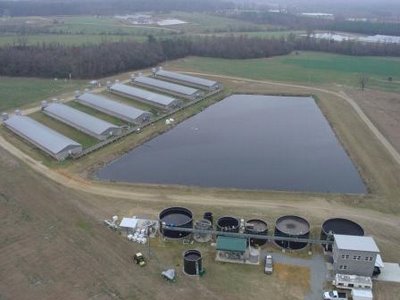
Caption: A typical factory hog farm: the farm's 40,000 hogs are raised in the six long buildings on the left. Each building is longer than a football field. The pool is the waste lagoon for their liquified manure. The round buildings are for feed and feed additives. Photo courtesy of USDA.
Sally Kneidel, co-author of Veggie Revolution.
1. Buy local food. The average food purchase at a grocery store travels 1500 miles from its source to the grocery. A survey of the stickers on "fresh" produce at my nearby Harris Teeter supermarket in North Carolina turned up yellow bell peppers from Holland and red bell peppers from Israel. When I asked the produce manager if any of the produce was local, he said most of it was from South America. The transport of food from other countries, or across the US, uses fossil fuels and generates greenhouse gases.
2. Buy produce from farmers who don't use pesticides. Pesticides are not only dangerous to our health, they poison animals and ecosystems around the agricultural fields, as well as downwind and downstream of sprayed fields.
3. Buy produce from farmers who don't use chemical fertilizers. Runoff from chemical fertilizers is the biggest single source of nutrient pollution in streams, rivers, and groundwater.
4. Choose foods with minimal packaging. Paper packaging creates demand for wood pulp from pine plantations, which are displacing Southeastern native forests. Leftover dyes from the manufacture of packages find their way into our streams and rivers. And most packaging winds up in our landfills.
5. If you consume dairy products, buy from a farmer who uses sustainable farming practices. If this isn't possible, buy certified organic dairy products. This means the cows' feed was grown without pesticides.
6. If you eat meat and eggs, buy products that came from pastured or grass-fed animals. Animals at pasture don't generate the waste-management problems that animals in confinement do. Pastured waste is assimilated back into the soil naturally. In contrast, waste from factory-farmed animals is liquified and stored in vast "lagoons," then sprayed over cropfields, much of it washing into streams and rivers.
7. If you can't buy pastured meat, buy organic meat. The animals' feed was grown without pesticides, and their waste is not laden with antibiotics and hormones. When animal waste washes into streams and rivers, the feed-additives in their waste also enter the aquatic ecosystem.
8. Eat seasonal produce, even in winter. When you buy produce that a local farmer grows in winter, such as greens, you are helping the farmer stay in business year-round, selling locally grown foods in his own community. You are supporting small-scale local farmers who are much more likely to use sustainable farming methods than are farmers on huge farms with corporate contracts.
9. Eat less meat. The average American eats 246 lbs of meat per year, far more than any other country. In the U.S., 66% of our grain goes to livestock, a very inefficient use of our agricultural lands. Feeding the grain to people directly could feed up to 10 times more people than feeding the meat to people. Or, another way of looking at it - we could stop converting natural lands to agricultural lands if we made more efficient use of the farms we have now. The U.S. population will reach 300 million in October, and will increase another 19% by the year 2025.
10. When you choose foods for environmental reasons, be vocal and visible about it. If you're eating out with friends, tell them why you're not eating a fast food burger (fast food burgers are often made of poor-quality Latin American beef grown where rainforests used to be). Ask your local supermarkets and favorite restaurants to carry local, seasonal, and organic foods. And when they do, thank them. Tell them how tasty it was!
Making just small changes, even a couple of days a week, can have a big impact. It doesn't have to be all or nothing to be effective!
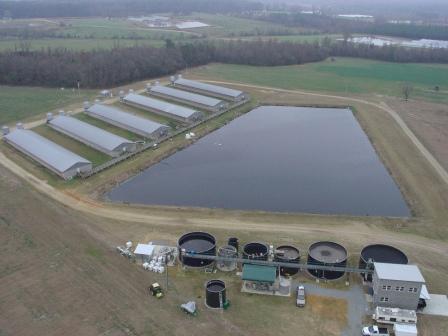
Caption: A typical factory hog farm: the farm's 40,000 hogs are raised in the six long buildings on the left. Each building is longer than a football field. The pool is the waste lagoon for their liquified manure. The round buildings are for feed and feed additives. Photo courtesy of USDA.
Sally Kneidel, co-author of Veggie Revolution.
Friday, September 15, 2006
My Top 10 Eco-Peeves
These are the top 10 environmental offenses that bugged me this week.
The list includes things in my own immediate world: home, work, shopping, and moving around town. And, btw, I don't claim to be innocent or above reproach. The ones I contribute to are the ones that bug me the most! Change is not easy.... I have to start small and chip away at it.
1. My neighbors' Siamese cats on the prowl for prey.
2. Too many gas-guzzling cars on the road, most with one driver.
3. Weak mass-transit options in my city (Charlotte).
4. Smog problems in my city because 61% of the city's electricity is from coal-fired power plants, and because we have no real mass-transit options, and few of us live close to where we work.
5. Streets that are wider than necessary, and sidewalks and driveways not made of paver stones (with openings for water to pass through). All this impervious pavement destroys streams and stream wildlife, by preventing rainwater from percolating through soil. Pavement-runoff into storm drains feeds streams with too much water, too warm and too fast.
6. Lawns lawns everywhere. Lawns are our 5th biggest "crop" and they serve no real purpose at all.
7. Manicured ornamental non-native yard plants. Shrubs and lawns that require trimming use up fossil fuels, generate landfill waste, and generate air and noise pollution. Yards planted only with native plants need no care, no trimming, no watering. With careful selection, native plants can nurture wildlife.
8. Green peppers in the grocery store from Israel or Holland. Apples in the grocery from Washington state. What?? What's wrong with North Carolina apples? Why don't grocery chains buy local food?
9. Carts at the grocery store loaded up with Tyson chicken and Food Lion eggs and Jimmy Dean sausage. These animals produce way more waste than all the people in the United States and not an ounce of it is treated. It's liquified and sprayed on crop fields, where it washes into rivers and streams. Veggie Revolution spells it all out.
10. Citizens who trust that everything President Bush tells them is on the level.
Okay readers. Argue with me. Or tell me what I should add.
Sally
The list includes things in my own immediate world: home, work, shopping, and moving around town. And, btw, I don't claim to be innocent or above reproach. The ones I contribute to are the ones that bug me the most! Change is not easy.... I have to start small and chip away at it.
1. My neighbors' Siamese cats on the prowl for prey.
2. Too many gas-guzzling cars on the road, most with one driver.
3. Weak mass-transit options in my city (Charlotte).
4. Smog problems in my city because 61% of the city's electricity is from coal-fired power plants, and because we have no real mass-transit options, and few of us live close to where we work.
5. Streets that are wider than necessary, and sidewalks and driveways not made of paver stones (with openings for water to pass through). All this impervious pavement destroys streams and stream wildlife, by preventing rainwater from percolating through soil. Pavement-runoff into storm drains feeds streams with too much water, too warm and too fast.
6. Lawns lawns everywhere. Lawns are our 5th biggest "crop" and they serve no real purpose at all.
7. Manicured ornamental non-native yard plants. Shrubs and lawns that require trimming use up fossil fuels, generate landfill waste, and generate air and noise pollution. Yards planted only with native plants need no care, no trimming, no watering. With careful selection, native plants can nurture wildlife.
8. Green peppers in the grocery store from Israel or Holland. Apples in the grocery from Washington state. What?? What's wrong with North Carolina apples? Why don't grocery chains buy local food?
9. Carts at the grocery store loaded up with Tyson chicken and Food Lion eggs and Jimmy Dean sausage. These animals produce way more waste than all the people in the United States and not an ounce of it is treated. It's liquified and sprayed on crop fields, where it washes into rivers and streams. Veggie Revolution spells it all out.
10. Citizens who trust that everything President Bush tells them is on the level.
Okay readers. Argue with me. Or tell me what I should add.
Sally
Yard Drama: A Story of Housecats, Chipmunks, Rats, Ivy and Native Plants
I didn't mean to have a yard full of rats. Not that I object to rats on principle - but the novelty has worn off.
Just two short months ago my beloved Notch was the queen of the realm, with her empire of underground passages and 22 holes in my front yard. Notch is a ferocious chipmunk who rolled and beat up any other chipmunks and any rats that ventured into the yard. She was fearless. She spent every afternoon in the middle of the yard, sitting straight up on her haunches like a meerkat, surveying her turf. When she pounced on intruders, fur would fly in a wild tussle....then the victim would scuttle off, utterly defeated. Notch would once again assume her surveying posture, until at dusk she retreated below.
I loved her. She was everything I wish I was. The fearless part, I mean. I couldn't help but root for her. She's so tiny! But she knew what she wanted and she wasn't afraid to just lay it on the line. "Bring it on" seemed to be her motto.
I took to leaving a raw unsalted peanut or a piece of walnut at the opening to her main hole, just once in a while, as a token of my esteem. Occasionally she would come up and take it while I was still within a few feet of her hole. I know I shouldn't have done that. I never should have. It's bad bad bad to feed wildlife under any circumstances. I don't know why I succumbed to temptation.
But it probably wasn't the peanuts. It was probably the birdfeeders that drew the rats. We had a sunflower feeder and a suet feeder over the ivy. Yes, English ivy covers about a third of our front yard - the part that's too shady for grass to grow. I know that English ivy is bad too. It's an introduced plant and worse, it's a very aggressive invasive species. I mean, it was here when we moved in - I didn't plant it. And while we're at it, listing my crimes - I know that even having a lawn is not an eco-friendly choice. If and when I get real about putting my wildlife-promotion ideas into action, I will get rid of the grass and put in a native meadow, or a native woodland. I mean to. We've gotten advice about how to do it, which I've posted about. It's just a lot of work, and....are we gonna move or not? I don't know.
Anyway, we've been seeing an occasional single rat for a couple of years....just one. Way in the back of the back yard. Under the backyard bird feeder and maybe near the compost. Although theoretically the compost is in a rat-proof container. Just one rat for years.
Until I started working at the front window on the book that's due this fall. I like looking at the front yard while I work. So I got to keeping the suet feeder and the front yard seed feeder full all the time, for the birds. But birds are messy. Suet and seeds were constantly dropping into the ivy. That's probably why Notch defended her territory so fiercely. It was only a few feet from the ivy patch.
And then Ken (husband) a few times threw handfuls of birdseed into the back yard, trying to get rid of some milo seed he'd bought on sale that the birds don't like. We started noticing more than one rat in the back yard. Then before long the rats discovered the gold mine of bird-feeder detritus in the front ivy patch, and then, then....there were a lot of rats in the front yard. They live in the ivy, mostly, so we only see them occasionally. But we can see the ivy rustling....if you look close where the ivy is moving, you can spot a rat.
Now these aren't Norway rats, the kind that infest houses and carried the plague and all that. I'm talking about cotton rats, Sigmodon hispidus. Or hispidis, I forget. They're rounder, have blunter snouts, furry tails - not naked tails like icky Norway rats. Cotton rats are actually quite charming native woodland mammals. They have no more desire to live in a house than a gray squirrel or a raccoon does.
But here's why I'm irked about the rats. We went on vacation in late July-early Aug, and when we came back, Notch was gone. I was sure the Siamese cats across the street had eaten her, and I grieved. But then I saw her one day. She came through the yard, and it was her, torn notch in her ear and all. No mistaking that damaged ear. But she was obviously a visitor. She looked around and then left, for the neighbor's unmanicured shrubby area. What the heck?
I noticed a few days later that some knucklehead creature had tried to drag a huge bundle of pine needles into one of the holes that had been Notch's. A couple of days later we met the knucklehead - a dadgum cotton rat. In Notch's hole!! Acckkk!
The yard seems totally out of control now. I stopped all the feeders. (The next door neighbor has several, no one's gonna starve.) I'm moving the the little waterbowl into the backyard, a few feet every day, so any critter using it will still be able to find it. During the dry part of the summer, everyone used that water bowl. Notch used it, and all the rabbits that ate our garden like it was a cafeteria, they used it too. The rats and squirrels used it. And the songbirds used to literally stand around the bowl waiting their turn, in July. The bowl is only big enough for one bird at a time, and they often liked to bathe in it. But my wildlife viewing days, while at work in the front window, are over.
I don't know where Notch is now, I hope she's still alive. I'm convinced the ivy has to go. To get rid of the rats. I mean, yes they're native, but my mammal field guide says they reproduce every 6 weeks, with an average litter size of 6! (Chipmunks reproduce only twice a year.) I don't want a yard teeming with rats, even cotton rats. I've gotten advice on how to pull up the ivy without spraying herbicides. Just dig. A little bit at a time.
Meanwhile we have a new chipmunk. He stands on top of the brush pile in the back of the back yard and chirps all day long. Sometimes he goes up into the gutter downspout and chirps for hours. A barred owl and a Coopers hawk have been hanging out in the backyard, drawn by Chuck's chirping. (The chirp sounds like "chuck.") They want to eat him. They want him badly.
I love Chuck already, because....he's wild, he's fearless, he looks like Notch. But if the owl or the hawk eat him, that's okay. They were here before we were, before people took over the world. They're native predators and rodents are their native prey. Unlike house cats, who are not native, and who threaten wildlife survival because of their unnaturally high numbers. The cats are not entitled to my chipmunks.
Meanwhile, I'm left with rat-viewing as my only wildlife option, at least from the front window. Maybe I can move my worktable around to the back somehow, and watch the drama with Chuck and the owl and the hawk. I'll root for him, but if the owl eats him....I won't mind...too much.
Just two short months ago my beloved Notch was the queen of the realm, with her empire of underground passages and 22 holes in my front yard. Notch is a ferocious chipmunk who rolled and beat up any other chipmunks and any rats that ventured into the yard. She was fearless. She spent every afternoon in the middle of the yard, sitting straight up on her haunches like a meerkat, surveying her turf. When she pounced on intruders, fur would fly in a wild tussle....then the victim would scuttle off, utterly defeated. Notch would once again assume her surveying posture, until at dusk she retreated below.
I loved her. She was everything I wish I was. The fearless part, I mean. I couldn't help but root for her. She's so tiny! But she knew what she wanted and she wasn't afraid to just lay it on the line. "Bring it on" seemed to be her motto.
I took to leaving a raw unsalted peanut or a piece of walnut at the opening to her main hole, just once in a while, as a token of my esteem. Occasionally she would come up and take it while I was still within a few feet of her hole. I know I shouldn't have done that. I never should have. It's bad bad bad to feed wildlife under any circumstances. I don't know why I succumbed to temptation.
But it probably wasn't the peanuts. It was probably the birdfeeders that drew the rats. We had a sunflower feeder and a suet feeder over the ivy. Yes, English ivy covers about a third of our front yard - the part that's too shady for grass to grow. I know that English ivy is bad too. It's an introduced plant and worse, it's a very aggressive invasive species. I mean, it was here when we moved in - I didn't plant it. And while we're at it, listing my crimes - I know that even having a lawn is not an eco-friendly choice. If and when I get real about putting my wildlife-promotion ideas into action, I will get rid of the grass and put in a native meadow, or a native woodland. I mean to. We've gotten advice about how to do it, which I've posted about. It's just a lot of work, and....are we gonna move or not? I don't know.
Anyway, we've been seeing an occasional single rat for a couple of years....just one. Way in the back of the back yard. Under the backyard bird feeder and maybe near the compost. Although theoretically the compost is in a rat-proof container. Just one rat for years.
Until I started working at the front window on the book that's due this fall. I like looking at the front yard while I work. So I got to keeping the suet feeder and the front yard seed feeder full all the time, for the birds. But birds are messy. Suet and seeds were constantly dropping into the ivy. That's probably why Notch defended her territory so fiercely. It was only a few feet from the ivy patch.
And then Ken (husband) a few times threw handfuls of birdseed into the back yard, trying to get rid of some milo seed he'd bought on sale that the birds don't like. We started noticing more than one rat in the back yard. Then before long the rats discovered the gold mine of bird-feeder detritus in the front ivy patch, and then, then....there were a lot of rats in the front yard. They live in the ivy, mostly, so we only see them occasionally. But we can see the ivy rustling....if you look close where the ivy is moving, you can spot a rat.
Now these aren't Norway rats, the kind that infest houses and carried the plague and all that. I'm talking about cotton rats, Sigmodon hispidus. Or hispidis, I forget. They're rounder, have blunter snouts, furry tails - not naked tails like icky Norway rats. Cotton rats are actually quite charming native woodland mammals. They have no more desire to live in a house than a gray squirrel or a raccoon does.
But here's why I'm irked about the rats. We went on vacation in late July-early Aug, and when we came back, Notch was gone. I was sure the Siamese cats across the street had eaten her, and I grieved. But then I saw her one day. She came through the yard, and it was her, torn notch in her ear and all. No mistaking that damaged ear. But she was obviously a visitor. She looked around and then left, for the neighbor's unmanicured shrubby area. What the heck?
I noticed a few days later that some knucklehead creature had tried to drag a huge bundle of pine needles into one of the holes that had been Notch's. A couple of days later we met the knucklehead - a dadgum cotton rat. In Notch's hole!! Acckkk!
The yard seems totally out of control now. I stopped all the feeders. (The next door neighbor has several, no one's gonna starve.) I'm moving the the little waterbowl into the backyard, a few feet every day, so any critter using it will still be able to find it. During the dry part of the summer, everyone used that water bowl. Notch used it, and all the rabbits that ate our garden like it was a cafeteria, they used it too. The rats and squirrels used it. And the songbirds used to literally stand around the bowl waiting their turn, in July. The bowl is only big enough for one bird at a time, and they often liked to bathe in it. But my wildlife viewing days, while at work in the front window, are over.
I don't know where Notch is now, I hope she's still alive. I'm convinced the ivy has to go. To get rid of the rats. I mean, yes they're native, but my mammal field guide says they reproduce every 6 weeks, with an average litter size of 6! (Chipmunks reproduce only twice a year.) I don't want a yard teeming with rats, even cotton rats. I've gotten advice on how to pull up the ivy without spraying herbicides. Just dig. A little bit at a time.
Meanwhile we have a new chipmunk. He stands on top of the brush pile in the back of the back yard and chirps all day long. Sometimes he goes up into the gutter downspout and chirps for hours. A barred owl and a Coopers hawk have been hanging out in the backyard, drawn by Chuck's chirping. (The chirp sounds like "chuck.") They want to eat him. They want him badly.
I love Chuck already, because....he's wild, he's fearless, he looks like Notch. But if the owl or the hawk eat him, that's okay. They were here before we were, before people took over the world. They're native predators and rodents are their native prey. Unlike house cats, who are not native, and who threaten wildlife survival because of their unnaturally high numbers. The cats are not entitled to my chipmunks.
Meanwhile, I'm left with rat-viewing as my only wildlife option, at least from the front window. Maybe I can move my worktable around to the back somehow, and watch the drama with Chuck and the owl and the hawk. I'll root for him, but if the owl eats him....I won't mind...too much.
Saturday, September 09, 2006
Orcas, Habitat Loss, and American Meat Consumption
In yesterday's post, I said that 70% of biologists believe we're in the middle of a mass extinction of wildlife species. I also said that 75% of the extinctions are due to habitat destruction by human activities. A lot of those activities are related to the way we eat.
Here's an example
I thought about that when I read in the NY Times yesterday (9/8/06) about the clash between fishermen, farmers and developers on the one hand, and environmentalists on the other, over the 90 resident Orca whales in Puget Sound in Washington state. The article featured the community of whale-watchers and researchers on San Juan Island, a place we visited a month ago. I had a post about the island's whale supporters, and the whales themselves, on August 17.
The conflict over these Orcas is a prime example of how our fixation on animal protein (248 lbs of meat per person per year in the U.S.) leads to habitat destruction for wildlife. Habitat includes animals' food sources, as well as their breeding territory, etc. One of the main threats to the Orcas is competition with the fishing industry over salmon. Another major threat is livestock farmers, and farmers raising grain for livestock, whose agricultural runoff pollutes the Puget Sound and the coastal rivers where salmon spawn.
Simply stated, our appetite for salmon is a threat to the whales. And to other marine and coastal wildlife that depend on salmon, such as bears and eagles.
Our appetite for meat is a threat to wildlife throughout the country - to every animal species whose survival depends on water quality, or on the continued existence of woodlands and prairies and wetlands that we instead convert to agricultural lands to feed our meat habit and our growing human population.
A Whale Lawsuit
Farmers and developers have filed a lawsuit to strip the Orcas of their endangered status. The protection of water quality in Puget Sound, as critical habitat for the Orcas, will interfere with farmers' and developers' efforts to provide us with the meats we clamor for, and with coastal real-estate development.
We can exercise control over so much with the simple act of eating. Every meal selection gives us an opportunity for grassroots activism. We don't have to be eating that salmon, or any salmon. We don't need to eat 248 pounds of meat per year. The average meat consumption per person in the world's developing nations is only 66 pounds per year. We're way ahead of even the European countries in our demand for meat. See Danielle Nierenberg's paper "Happier Meals: Rethinking the Global Meat Industry," available from www.worldwatch.org, for more details about global meat consumption. The article isn't free, but if you're really interested in understanding how global patterns of meat consumption impact the environment, it's worth the $7.
I'm not asking everyone to give up meat altogether - I don't believe that's a realistic goal. We'll never be a meatless nation. I'm asking that we eat less meat. We don't need meat every day. Our book Veggie Revolution is about cooking without meat (including recipes) and about the benefits of eating less meat - benefits to our health, to the welfare of farmed animals, to the environment, and to wildlife. Wildlife is, to me, the most precious gift our planet has to offer.
Here's an example
I thought about that when I read in the NY Times yesterday (9/8/06) about the clash between fishermen, farmers and developers on the one hand, and environmentalists on the other, over the 90 resident Orca whales in Puget Sound in Washington state. The article featured the community of whale-watchers and researchers on San Juan Island, a place we visited a month ago. I had a post about the island's whale supporters, and the whales themselves, on August 17.
The conflict over these Orcas is a prime example of how our fixation on animal protein (248 lbs of meat per person per year in the U.S.) leads to habitat destruction for wildlife. Habitat includes animals' food sources, as well as their breeding territory, etc. One of the main threats to the Orcas is competition with the fishing industry over salmon. Another major threat is livestock farmers, and farmers raising grain for livestock, whose agricultural runoff pollutes the Puget Sound and the coastal rivers where salmon spawn.
Simply stated, our appetite for salmon is a threat to the whales. And to other marine and coastal wildlife that depend on salmon, such as bears and eagles.
Our appetite for meat is a threat to wildlife throughout the country - to every animal species whose survival depends on water quality, or on the continued existence of woodlands and prairies and wetlands that we instead convert to agricultural lands to feed our meat habit and our growing human population.
A Whale Lawsuit
Farmers and developers have filed a lawsuit to strip the Orcas of their endangered status. The protection of water quality in Puget Sound, as critical habitat for the Orcas, will interfere with farmers' and developers' efforts to provide us with the meats we clamor for, and with coastal real-estate development.
We can exercise control over so much with the simple act of eating. Every meal selection gives us an opportunity for grassroots activism. We don't have to be eating that salmon, or any salmon. We don't need to eat 248 pounds of meat per year. The average meat consumption per person in the world's developing nations is only 66 pounds per year. We're way ahead of even the European countries in our demand for meat. See Danielle Nierenberg's paper "Happier Meals: Rethinking the Global Meat Industry," available from www.worldwatch.org, for more details about global meat consumption. The article isn't free, but if you're really interested in understanding how global patterns of meat consumption impact the environment, it's worth the $7.
I'm not asking everyone to give up meat altogether - I don't believe that's a realistic goal. We'll never be a meatless nation. I'm asking that we eat less meat. We don't need meat every day. Our book Veggie Revolution is about cooking without meat (including recipes) and about the benefits of eating less meat - benefits to our health, to the welfare of farmed animals, to the environment, and to wildlife. Wildlife is, to me, the most precious gift our planet has to offer.
Friday, September 08, 2006
Mass Extinctions of Wildlife Related to Our Diet Choices
Mass Extinction Underway...
A mass extinction is a catastrophic, widespread, or global event that wipes out 25 to 75 percent of existing species. Most of the mass extinctions that occurred prehistorically — before humans evolved — resulted from global climate changes that killed thousands of species and left behind those able to adapt to the new conditions.
According to a recent survey, 70 percent of biologists believe we are in the midst of a new mass extinction. Although the Earth has experienced other mass extinctions before humans evolved, biologists point out two important differences between the current mass extinction, and those of the past:
1) This mass extinction is taking place in a very short period of time, during a few decades, rather than over thousands or millions of years.
2) We are eliminating or fouling many environments, such as tropical forests, coral reefs, and wetlands, that in the past fostered the evolution of new species during the 5 to 10 million years after a mass extinction.
What’s Going On?
The destruction of habitats by humans is responsible for about 75 percent of the current extinctions. Another major cause is unregulated hunting and fishing. The introduction of nonnative species such as wild boars, Gypsy moths, and European starlings is another leading cause of extinctions.
How Are Extinctions Related to Meat Consumption?
The production of meat requires much more land than producing an equally nutritious amount of plant protein. Because most Americans eat animal products two or three times a day, we devote a hefty portion of our land to either grazing livestock or raising grain or hay to feed livestock. About 40 percent of all land area in the United States is used for grazing livestock for our dinner tables.
Consider this. In the United States, we feed 66 percent of our grain to livestock. But the rest of the world feeds only 3 percent of their grain to livestock. If we weren’t eating so much meat and dairy and eggs, think of all the agricultural land that could be restored to its natural state as forests, prairies, and wetlands. We could also slow the conversion of natural lands to agricultural lands. Our population here in the U.S. is still growing rapidly and our food production will have to increase. This year we reached 300,000. By the year 2025, just 18 years away, we'll add another 50,000 people to the United States population! See www.census.gov, or International Data Base, for more information about that.
The adoption of a vegetarian, or better yet, a vegan diet would vastly improve the outlook on the future for both humankind and wildlife.
Is Our Diet Making Us Healthy and Happy?
About 65 percent of Americans are overweight or obese. We also have high rates of heart disease, high blood pressure, colon cancer, and other ailments related to a diet high in meat, eggs, and milk fat. We’re not healthier.
But are we happier? No. Although our consumption of resources has doubled since 1957, the proportion of Americans who report they are “very happy” has remained the same.
But Wait…
Raising livestock doesn’t have to take so much land and cause so much pollution, if done on a smaller scale. Only a few decades ago, manure naturally fertilized crops and enriched the soil, rather than winding up in “waste lagoons” that leak and spill into rivers. Livestock consumed crop waste and kitchen waste. Animals and people maintained a balance. It’s only since the production of meat, milk, and eggs has become industrial in scale that it has begun to damage the Earth so severely. The damage includes ocean habitats and fish populations as well as land ecosystems.
The average American eats 248 pounds of meat a year, far more per person than any other country. It’s not possible for everyone on the planet to have that much meat. We would need four more Earths to raise enough livestock and fish, if everyone on our planet ate as much meat as Americans do.
The Union of Concerned Scientists says that our American diet is second only to our transportation as our most environmentally damaging consumer activity. We can make better diet choices for a sustainable future.
The loss of countless plant and animal species is at stake.
See our post of September 9 for an example of a wildlife population that's threatened by our consumer demand for animal protein.
A mass extinction is a catastrophic, widespread, or global event that wipes out 25 to 75 percent of existing species. Most of the mass extinctions that occurred prehistorically — before humans evolved — resulted from global climate changes that killed thousands of species and left behind those able to adapt to the new conditions.
According to a recent survey, 70 percent of biologists believe we are in the midst of a new mass extinction. Although the Earth has experienced other mass extinctions before humans evolved, biologists point out two important differences between the current mass extinction, and those of the past:
1) This mass extinction is taking place in a very short period of time, during a few decades, rather than over thousands or millions of years.
2) We are eliminating or fouling many environments, such as tropical forests, coral reefs, and wetlands, that in the past fostered the evolution of new species during the 5 to 10 million years after a mass extinction.
What’s Going On?
The destruction of habitats by humans is responsible for about 75 percent of the current extinctions. Another major cause is unregulated hunting and fishing. The introduction of nonnative species such as wild boars, Gypsy moths, and European starlings is another leading cause of extinctions.
How Are Extinctions Related to Meat Consumption?
The production of meat requires much more land than producing an equally nutritious amount of plant protein. Because most Americans eat animal products two or three times a day, we devote a hefty portion of our land to either grazing livestock or raising grain or hay to feed livestock. About 40 percent of all land area in the United States is used for grazing livestock for our dinner tables.
Consider this. In the United States, we feed 66 percent of our grain to livestock. But the rest of the world feeds only 3 percent of their grain to livestock. If we weren’t eating so much meat and dairy and eggs, think of all the agricultural land that could be restored to its natural state as forests, prairies, and wetlands. We could also slow the conversion of natural lands to agricultural lands. Our population here in the U.S. is still growing rapidly and our food production will have to increase. This year we reached 300,000. By the year 2025, just 18 years away, we'll add another 50,000 people to the United States population! See www.census.gov, or International Data Base, for more information about that.
The adoption of a vegetarian, or better yet, a vegan diet would vastly improve the outlook on the future for both humankind and wildlife.
Is Our Diet Making Us Healthy and Happy?
About 65 percent of Americans are overweight or obese. We also have high rates of heart disease, high blood pressure, colon cancer, and other ailments related to a diet high in meat, eggs, and milk fat. We’re not healthier.
But are we happier? No. Although our consumption of resources has doubled since 1957, the proportion of Americans who report they are “very happy” has remained the same.
But Wait…
Raising livestock doesn’t have to take so much land and cause so much pollution, if done on a smaller scale. Only a few decades ago, manure naturally fertilized crops and enriched the soil, rather than winding up in “waste lagoons” that leak and spill into rivers. Livestock consumed crop waste and kitchen waste. Animals and people maintained a balance. It’s only since the production of meat, milk, and eggs has become industrial in scale that it has begun to damage the Earth so severely. The damage includes ocean habitats and fish populations as well as land ecosystems.
The average American eats 248 pounds of meat a year, far more per person than any other country. It’s not possible for everyone on the planet to have that much meat. We would need four more Earths to raise enough livestock and fish, if everyone on our planet ate as much meat as Americans do.
The Union of Concerned Scientists says that our American diet is second only to our transportation as our most environmentally damaging consumer activity. We can make better diet choices for a sustainable future.
The loss of countless plant and animal species is at stake.
See our post of September 9 for an example of a wildlife population that's threatened by our consumer demand for animal protein.
Monday, September 04, 2006
Puffins and Whales Endangered by Fishing Industry; Online Guides to Choosing Healthiest Fish
Did you read "The Rime of the Ancient Mariner" in high school? The albatross in the poem is an omen of bad luck for the writer and his ship, but in reality the albatross is the butt-end of some god-awful bad luck dished out by the fishing industry. The albatross, a magnificent bird with a wingspan of up to 7 feet, is one of many oceanic birds in serious trouble from the massive-haul fishing techniques of today. Among other seabirds whose luck is running out are the colorful and beloved puffins.
We were lucky to spot a couple of Tufted Puffins and many other seabirds on a recent trip to Washington state and Vancouver Island, B.C. I posted an account of the birds and their habitats, written by Alan Kneidel, on September 1.
Many of the seabirds we saw were in the family Alcidae. Alcids spend their lives floating on the ocean and swimming underwater for fish - birds such Tufted Puffins, Pigeon Guillemots, Rhinoceros Auklets, Common Murres, and Marbled Murrelets. These birds can and do fly, but most of them come ashore only to breed. You can see these seabirds from the ferries of Washington and the B.C. coast, or from coastal cliffs. They look a bit like black and white ducks floating on the water, except that most have narrow pointed bills rather than duck bills. That is, except for the puffins. Puffins have huge, showy, red and gold bills that make them popular subjects for photos. A puffin can catch a dozen or more little fish at once in its bill. The Tufted Puffins are a rare sight, though. We were very fortunate to spot the two that we did from remote Cape Flattery - a naturalist we talked to on a ferry said that he had seen only one Tufted Puffin in the last 12 years! They are listed by Washington state as a "species of concern." A government website says "more data" is needed on the status of Tufted Puffins before adding them to the list of endangered species.
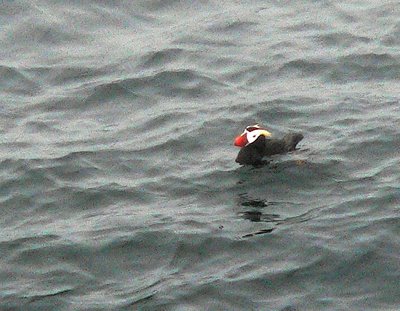 Tufted Puffin from cliffs of Cape Flattery, Washington, Sally Kneidel
So the alcids - the puffins, murrelets, etc. - are seabirds that you can sometimes see from shore and from ferries.
But other seabirds, called "pelagic" species, seldom come close enough to shore to see them from a ferry or a cliff. These include birds like albatrosses, shearwaters, and petrels - and some of the alcids as well. To spot these birds of the open ocean, you have to hire a boat to take you on a "pelagic" birding trip far offshore. Ken and Alan (husband and son) have been on a few pelagic trips.
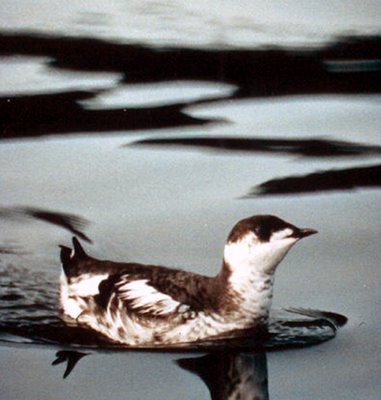
All seabirds of the Pacific Northwest, both coastal and pelagic species, are feeling the impact of the fishing industry. But some more than others. As we learned while visiting the salmon-fishing village of Sequi, on the northwest corner of Washington's Olympic Peninsula, the Marbled Murrelet is endangered because of "gill nets." Gill nets are intended to snag fish by the gill covers when they swim into the net and try to back out. Groups of nets can be tied together to stretch for 3000 meters! In the coastal straits off the n.w. Olympic Peninsula near Sequi and Neah Bay, gill nets are submerged to catch salmon, as the fish head for one of the 20+ rivers in the area where they spawn. One Sequi fisherman told me that gill nets trap much more than the local target species, salmon. The "bycatch" or unusable catch includes other fish species, seals, sea otters, and diving seabirds such as the Marbled Murrelet. All of the air-breathing species are killed by drowning; many of the fish bycatch are killed too by the hauling-in process, and are thrown back, dead. Gill nets are also commonly set in open waters, where they catch and drown porpoises and whales. For more about gill nets, see the Cetacean Bycatch Resource Center
"Longlines" are another fishing technique that is endangering offshore pelagic seabirds such as albatrosses, shearwaters, and petrels, as well as whales, dolphins and porpoises. A longline is a fishing line up to 60 miles long, with up to 30,000 shorter lines with baited hooks trailing from it. Seabirds often take the bait, and are then dragged underwater and drowned. For more about the dangers of longline fishing and what you can do, see the Cetacean Bycatch Resource Center and the American Bird Conservancy. The ABC has published an online document about the impact of longline fishing on seabirds. The document, entitled "Sudden Death, Longline Fishing: A Global Catastrophe for Seabirds," reports that 64 species of seabirds have been killed in longlines worldwide, and that 23 of these species are in danger of extinction from mortality due to longline fishing. This report concludes, on page 13, with a list of measures you can take, as a citizen, to protect wildlife from longline fishing.
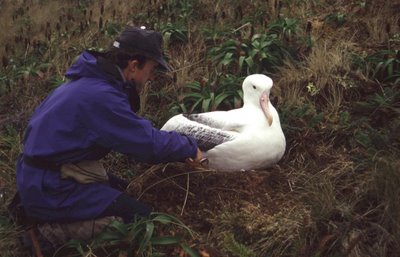 Researcher placing a small bird band for identification on an albatross's leg
We were lucky to spot a couple of Tufted Puffins and many other seabirds on a recent trip to Washington state and Vancouver Island, B.C. I posted an account of the birds and their habitats, written by Alan Kneidel, on September 1.
Many of the seabirds we saw were in the family Alcidae. Alcids spend their lives floating on the ocean and swimming underwater for fish - birds such Tufted Puffins, Pigeon Guillemots, Rhinoceros Auklets, Common Murres, and Marbled Murrelets. These birds can and do fly, but most of them come ashore only to breed. You can see these seabirds from the ferries of Washington and the B.C. coast, or from coastal cliffs. They look a bit like black and white ducks floating on the water, except that most have narrow pointed bills rather than duck bills. That is, except for the puffins. Puffins have huge, showy, red and gold bills that make them popular subjects for photos. A puffin can catch a dozen or more little fish at once in its bill. The Tufted Puffins are a rare sight, though. We were very fortunate to spot the two that we did from remote Cape Flattery - a naturalist we talked to on a ferry said that he had seen only one Tufted Puffin in the last 12 years! They are listed by Washington state as a "species of concern." A government website says "more data" is needed on the status of Tufted Puffins before adding them to the list of endangered species.
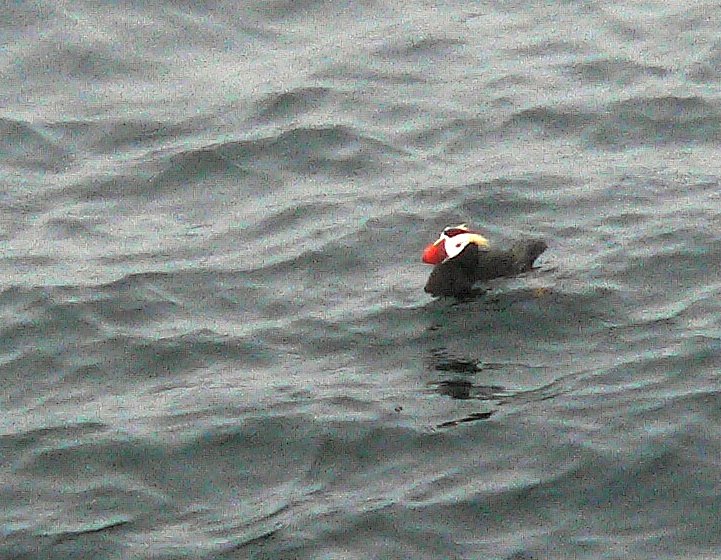 Tufted Puffin from cliffs of Cape Flattery, Washington, Sally Kneidel
So the alcids - the puffins, murrelets, etc. - are seabirds that you can sometimes see from shore and from ferries.
But other seabirds, called "pelagic" species, seldom come close enough to shore to see them from a ferry or a cliff. These include birds like albatrosses, shearwaters, and petrels - and some of the alcids as well. To spot these birds of the open ocean, you have to hire a boat to take you on a "pelagic" birding trip far offshore. Ken and Alan (husband and son) have been on a few pelagic trips.
All seabirds of the Pacific Northwest, both coastal and pelagic species, are feeling the impact of the fishing industry. But some more than others. As we learned while visiting the salmon-fishing village of Sequi, on the northwest corner of Washington's Olympic Peninsula, the Marbled Murrelet is endangered because of "gill nets." Gill nets are intended to snag fish by the gill covers when they swim into the net and try to back out. Groups of nets can be tied together to stretch for 3000 meters! In the coastal straits off the n.w. Olympic Peninsula near Sequi and Neah Bay, gill nets are submerged to catch salmon, as the fish head for one of the 20+ rivers in the area where they spawn. One Sequi fisherman told me that gill nets trap much more than the local target species, salmon. The "bycatch" or unusable catch includes other fish species, seals, sea otters, and diving seabirds such as the Marbled Murrelet. All of the air-breathing species are killed by drowning; many of the fish bycatch are killed too by the hauling-in process, and are thrown back, dead. Gill nets are also commonly set in open waters, where they catch and drown porpoises and whales. For more about gill nets, see the Cetacean Bycatch Resource Center

Marbled Murrelet, endangered by gill nets
"Longlines" are another fishing technique that is endangering offshore pelagic seabirds such as albatrosses, shearwaters, and petrels, as well as whales, dolphins and porpoises. A longline is a fishing line up to 60 miles long, with up to 30,000 shorter lines with baited hooks trailing from it. Seabirds often take the bait, and are then dragged underwater and drowned. For more about the dangers of longline fishing and what you can do, see the Cetacean Bycatch Resource Center and the American Bird Conservancy. The ABC has published an online document about the impact of longline fishing on seabirds. The document, entitled "Sudden Death, Longline Fishing: A Global Catastrophe for Seabirds," reports that 64 species of seabirds have been killed in longlines worldwide, and that 23 of these species are in danger of extinction from mortality due to longline fishing. This report concludes, on page 13, with a list of measures you can take, as a citizen, to protect wildlife from longline fishing.
 Researcher placing a small bird band for identification on an albatross's leg
One thing we can all do, which I don't think the document mentions, is to eat less fish. After what we've learned about global overfishing while researching our new book (from Fulcrum in 2007), I don't eat fish anymore, period. If you must eat fish, check out one of the frequently updated online guides to environmentally-friendly fish selection, and fish that have lower levels of mercury and other heavy metals in their flesh. You can find these guides at Oceans Alive, Audubon's Living Ocean, and Environmental Defense.
Friday, September 01, 2006
In Search of Northwest Birds
In August I posted some info about the wildlife of the Pacific Northwest that we spotted on a recent trip to Washington state and Vancouver Island, B.C. I wrote about humpback whales, mountain goats, harbor seals, and the best place to spot Orcas. We saw a lot of birds too - oceanic and shore birds and mountain birds. I'm not a real bird expert though. So I asked my son Alan, who's 20 and has been an avid birder for some time, to write something about the birds we saw. Well, birds he saw. He was much more determined than I was in tracking down birds he wanted to see, venturing far out onto rocky coastlines, walking long distances, etc. Anyway, for you bird fans, here is Alan's account of the birds on the trip.
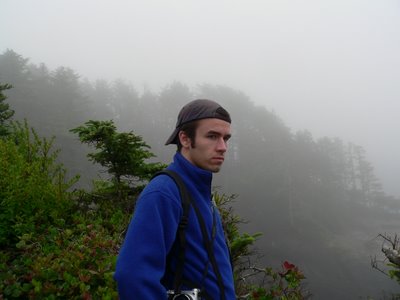 Alan Kneidel at Cape Flattery, Washington
Alan's words:
"From July 25th to August 5th, 2006, we spent time inWashington state and British Columbia , Canada , the trail halted at a stunning overlook of vertical cliffs, sea caves, and foggy waters. Peregrine Falcons perched on stunted spruce, while Tufted Puffins, Rhinoceros Auklets, Pigeon Guillemots, Common Murres and Glaucous-winged Gulls traversed the narrows. Bald Eagles let out their raucous calls, as they soared above us, unseen through the fog. Staying in the town of Sekiu, we woke to scattered Marbled Murrelets in the bay, a threatened species of seabird.
Thanks, Alan.
Alan mentioned that we were on the lookout for several days for Surfbirds, one of the group of birds known as rockpipers that he mentioned above - birds of rocky coastlines. We never did see the Surfbirds, although Alan and his dad sure gave it a go. We were also on the lookout for Varied Thrushes, which are supposedly quite common in Washington. Every park ranger or birder we asked said oh sure, you'll see them. So we kept looking. Finally, on our last day, the day we left the state, we were driving down a 12 mile gravel road, down from the trailhead of the Skyline Divide Trail at Mount Baker, looking at robin after robin who kept flying up from the road (robins look a lot like Varied Thrushes) when finally, finally, a Varied Thrush showed itself in the middle of the gravel road. At first we thought - another robin. But it started its odd bobbing, with its tail up in the air like a wren, and then we saw the band across the chest. A Varied Thrush! Thank you little bird. A nice goodbye to our trip.
 Alan Kneidel at Cape Flattery, Washington
 Alan's words:
"From July 25th to August 5th, 2006, we spent time in
"The next days, traveling into
"Our third stop was on the
"Our final stop was to Mount Baker, back in
Thanks, Alan.
Alan mentioned that we were on the lookout for several days for Surfbirds, one of the group of birds known as rockpipers that he mentioned above - birds of rocky coastlines. We never did see the Surfbirds, although Alan and his dad sure gave it a go. We were also on the lookout for Varied Thrushes, which are supposedly quite common in Washington. Every park ranger or birder we asked said oh sure, you'll see them. So we kept looking. Finally, on our last day, the day we left the state, we were driving down a 12 mile gravel road, down from the trailhead of the Skyline Divide Trail at Mount Baker, looking at robin after robin who kept flying up from the road (robins look a lot like Varied Thrushes) when finally, finally, a Varied Thrush showed itself in the middle of the gravel road. At first we thought - another robin. But it started its odd bobbing, with its tail up in the air like a wren, and then we saw the band across the chest. A Varied Thrush! Thank you little bird. A nice goodbye to our trip.

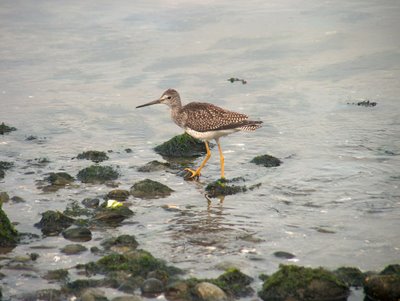
Greater Yellowlegs, Pacific Rim National Park, Vancouver Island by Alan Kneidel
Saturday, August 26, 2006
Just What Is Foie Gras?? Too Fat to Waddle
What is it about foie gras that made the city council of Chicago banish the "gourmet" meat from area restaurants this past week? Many angry restaurant owners chose the very day the ban took effect - Aug 22 - to serve foie gras in their establishments for the first time. Slabs of the oily, buttery-tasting goose liver showed up in unconventional dishes such as foie gras pizza - in defiance of the new city ordinance against it. Some restaurant owners said they were just resisting any effort by city government to regulate what they can and can't serve in their restaurants.
In banning the meat considered a delicacy, the city council acted out of concern for animal cruelty. No one seems to dispute that force-feeding geese and ducks up to 4 lbs of grain and fat per day through a tube pushed down their throats is cruel. The birds are force-fed to produce a huge and fat-laced liver, which grows so large that the animals are eventually unable to move or to breathe normally. The livers are prized as a delicacy for their fatty, "buttery" taste.
Animal-rights and vegetarian groups have documented the details of animal misery in the abusive foie-gras industry, such as this article from GoVeg. The geese and ducks are force-fed three times a day. But between the feedings, they're not swimming around a pond or frolicking through the grass on peaceful spacious farms. Like other fowl raised for food, or for eggs, most are confined indoors in cramped quarters between feedings. Many are housed in rows of battery cages that open from the top, similar to the cages that egg-laying hens customarily spend their lives in. We visited and inspected a factory egg farm for a major supermarket chain, and a massive Tyson broiler farm where chickens for meat are raised, as well as a Tyson breeder farm - all of which are described in detail in our book Veggie Revolution. We also interviewed all the farmers, and heard their stories - none of them were entirely thrilled with operating under contract to meatpacking companies whose guiding ethic is shaving pennies from production costs. Environmental issues, animal welfare, consumer health, and workers' rights all take a back seat to shareholder profits for major meatpacking corporations.
Day laborers on factory farms and meatpacking plants, including foie gras farms, are paid very low wages and are often illegal immigrants too vulnerable to object to exploitive and often dangerous working conditions. Usually working under a quota of animals or carcasses processed per minute, they are forced to rush through procedures such as inseminating turkeys, or force-feeding of geese or ducks for foie gras. Consequently, the throats of the geese and ducks are often perforated and scraped as the tube is pushed into place for each feeding. Birds that survive the rough treatment eventually become grossly bloated from their huge and fatty livers, the consequence of overfeeding.
What can you do? If you see foie gras for sale, tell the proprietor of the shop or restaurant that you find the sale distressing, and tell them why. They may not know much about how the liver is produced. Tell them that you won't shop or dine there as long as they carry the product. We interviewed the manager of a Harris Teeter, a large supermarket chain, about the veal they sell in the store, for Veggie Revolution. He said supermarkets are purely customer-driven. They carry what customers buy. Sales of veal have dropped dramatically in recent years due to publicity from animal rights groups, who have educated the public about what veal is exactly - it's beef from calves that are kept isolated in narrow stalls from the age of 1 day to slaughter at 4 months, often chained at the neck to keep their muscles weak and tender. Although Americans are still eating veal, demand in the U.S. has dropped 62% since 1987. I think the same thing will happen with foie gras. It's starting in Chicago; the state of California will follow suit in 2012. As consumers learn more about foie gras, I believe sales will drop.
It's not just food - the sale of SUVs and light trucks has fallen precipitously in recent months due to rising gas prices. Americans are seeking small, fuel-efficient cars that Detroit is unable to deliver. Hence the sales of Asian cars that get good gas mileage - Toyota, Honda, Nissan - have increased. Now Ford and General Motors are scrambling to meet the changing demands of American consumers. Ford is shifting production to flex-fuel cars that can burn a fuel blend that's up to 85% ethanol. They're too late to get in on the hybrid market; Toyota has that one nailed. See our posts of mid June to mid July, especially 7/15/06, for more about that.
Which all just goes to say that power is in consumers' hands. The city council of Chicago started the ball rolling by banning foie gras - now it may be up to consumers to keep that ball rolling. As consumers, we get what we ask for. We vote with our dollars. Most people care about animals, polls show that the vast majority of Americans object to animal abuse. So let's pay attention to what we're eating, and if we're eating animal products, let's get informed and choose products from humanely raised animals. This usually means animals raised on small and local family-owned farms and animals raised at pasture, rather than in confinement. Ask at your local farmers market or natural food store for providers near you. Or check out www.eatwild.com or www.localharvest.org. Foie gras is just the beginning.
For more about the ban in Chicago, see our August 23 post, Fois Gras from Force-fed Geese is Banned in Chicago.
In banning the meat considered a delicacy, the city council acted out of concern for animal cruelty. No one seems to dispute that force-feeding geese and ducks up to 4 lbs of grain and fat per day through a tube pushed down their throats is cruel. The birds are force-fed to produce a huge and fat-laced liver, which grows so large that the animals are eventually unable to move or to breathe normally. The livers are prized as a delicacy for their fatty, "buttery" taste.
Animal-rights and vegetarian groups have documented the details of animal misery in the abusive foie-gras industry, such as this article from GoVeg. The geese and ducks are force-fed three times a day. But between the feedings, they're not swimming around a pond or frolicking through the grass on peaceful spacious farms. Like other fowl raised for food, or for eggs, most are confined indoors in cramped quarters between feedings. Many are housed in rows of battery cages that open from the top, similar to the cages that egg-laying hens customarily spend their lives in. We visited and inspected a factory egg farm for a major supermarket chain, and a massive Tyson broiler farm where chickens for meat are raised, as well as a Tyson breeder farm - all of which are described in detail in our book Veggie Revolution. We also interviewed all the farmers, and heard their stories - none of them were entirely thrilled with operating under contract to meatpacking companies whose guiding ethic is shaving pennies from production costs. Environmental issues, animal welfare, consumer health, and workers' rights all take a back seat to shareholder profits for major meatpacking corporations.
Day laborers on factory farms and meatpacking plants, including foie gras farms, are paid very low wages and are often illegal immigrants too vulnerable to object to exploitive and often dangerous working conditions. Usually working under a quota of animals or carcasses processed per minute, they are forced to rush through procedures such as inseminating turkeys, or force-feeding of geese or ducks for foie gras. Consequently, the throats of the geese and ducks are often perforated and scraped as the tube is pushed into place for each feeding. Birds that survive the rough treatment eventually become grossly bloated from their huge and fatty livers, the consequence of overfeeding.
What can you do? If you see foie gras for sale, tell the proprietor of the shop or restaurant that you find the sale distressing, and tell them why. They may not know much about how the liver is produced. Tell them that you won't shop or dine there as long as they carry the product. We interviewed the manager of a Harris Teeter, a large supermarket chain, about the veal they sell in the store, for Veggie Revolution. He said supermarkets are purely customer-driven. They carry what customers buy. Sales of veal have dropped dramatically in recent years due to publicity from animal rights groups, who have educated the public about what veal is exactly - it's beef from calves that are kept isolated in narrow stalls from the age of 1 day to slaughter at 4 months, often chained at the neck to keep their muscles weak and tender. Although Americans are still eating veal, demand in the U.S. has dropped 62% since 1987. I think the same thing will happen with foie gras. It's starting in Chicago; the state of California will follow suit in 2012. As consumers learn more about foie gras, I believe sales will drop.
It's not just food - the sale of SUVs and light trucks has fallen precipitously in recent months due to rising gas prices. Americans are seeking small, fuel-efficient cars that Detroit is unable to deliver. Hence the sales of Asian cars that get good gas mileage - Toyota, Honda, Nissan - have increased. Now Ford and General Motors are scrambling to meet the changing demands of American consumers. Ford is shifting production to flex-fuel cars that can burn a fuel blend that's up to 85% ethanol. They're too late to get in on the hybrid market; Toyota has that one nailed. See our posts of mid June to mid July, especially 7/15/06, for more about that.
Which all just goes to say that power is in consumers' hands. The city council of Chicago started the ball rolling by banning foie gras - now it may be up to consumers to keep that ball rolling. As consumers, we get what we ask for. We vote with our dollars. Most people care about animals, polls show that the vast majority of Americans object to animal abuse. So let's pay attention to what we're eating, and if we're eating animal products, let's get informed and choose products from humanely raised animals. This usually means animals raised on small and local family-owned farms and animals raised at pasture, rather than in confinement. Ask at your local farmers market or natural food store for providers near you. Or check out www.eatwild.com or www.localharvest.org. Foie gras is just the beginning.
For more about the ban in Chicago, see our August 23 post, Fois Gras from Force-fed Geese is Banned in Chicago.
Thursday, August 24, 2006
My Pic of Mountain Goats Looks Like Fleas on a Mountainside
We really wanted to see mountain goats at Mt. Baker in Washington - beautiful shaggy white animals, leaping on impossibly steep and narrow rocky crags, where you're sure they'll fall. You've probably seen them on nature shows, or on posters with dumb captions about hanging on. Somehow they cling to the rocks and vertical surfaces like they had suction cups.
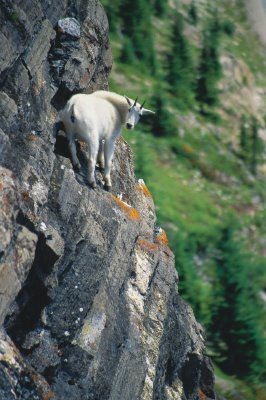 Mountain goat in Banff, courtesy of www.stgeorgesinthepines.org/wildernessspirit.htm
But how do you find a mountain goat? They live only near the timberline in remote mountains. "May be seen at a distance by the adventurer" says our mammal fieldguide. An unlikely find during a 12 day camping trip.
I've learned over the years that the best way to spot wildlife in a new place is to ask other people. I have no pride. If I'm in a national park or a state park, I ask every ranger I see. I ask the people behind the desk at the visitor center, too, if there've been any interesting wildlife sightings in the last couple of days, and where. I ask them every day I'm there. They almost always have an answer. Sometimes they act irritated, but I don't care. Some parks keep a log book of sightings. And if I see a hiker with binoculars or a spotting scope or a handheld radio, I ask them what they've seen and where too.
When we were at Mount Baker in the North Cascade range in Washington state a couple of weeks ago, we ran into a hiker with expensive looking binoculars on the Ptarmigan Ridge trail. We stopped to talk to him. Ken and Alan (husband, son) wanted to ask him about rosy finches and ptarmigans, birds that are common to snowfields and glacier areas around there - birds that we hadn't seen yet. The guy was helpful. Told us where he'd last seen ptarmigans, and said the rosy finches are along the edge of the snow. Yeah, there was still snow there in August.
We never did see the finches or ptarmigans, but we ran into the same guy on a different trail later, and he told us exactly where he'd just seen some mountain goats. So we ran back to the spot. Sure enough, there was a herd of about 20 - mostly mothers and kids. They were on the other side of the valley, not a close-up view by any means, but still good enough to mark down in the field guide as a definitely spotting.
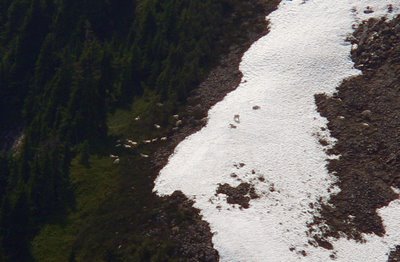 Here's my pathetic picture of the mountain goats - they look like fleas on the mountainside. But we looked at them through the spotting scope and they were definitely mountain goats.
Here's a better picture of a mother mountain goat and her young, taken on Snagtooth Mt in Washington by Alan Bauer:
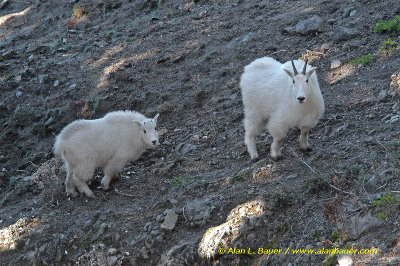
 Mountain goat in Banff, courtesy of www.stgeorgesinthepines.org/wildernessspirit.htm
 But how do you find a mountain goat? They live only near the timberline in remote mountains. "May be seen at a distance by the adventurer" says our mammal fieldguide. An unlikely find during a 12 day camping trip.
I've learned over the years that the best way to spot wildlife in a new place is to ask other people. I have no pride. If I'm in a national park or a state park, I ask every ranger I see. I ask the people behind the desk at the visitor center, too, if there've been any interesting wildlife sightings in the last couple of days, and where. I ask them every day I'm there. They almost always have an answer. Sometimes they act irritated, but I don't care. Some parks keep a log book of sightings. And if I see a hiker with binoculars or a spotting scope or a handheld radio, I ask them what they've seen and where too.
When we were at Mount Baker in the North Cascade range in Washington state a couple of weeks ago, we ran into a hiker with expensive looking binoculars on the Ptarmigan Ridge trail. We stopped to talk to him. Ken and Alan (husband, son) wanted to ask him about rosy finches and ptarmigans, birds that are common to snowfields and glacier areas around there - birds that we hadn't seen yet. The guy was helpful. Told us where he'd last seen ptarmigans, and said the rosy finches are along the edge of the snow. Yeah, there was still snow there in August.
We never did see the finches or ptarmigans, but we ran into the same guy on a different trail later, and he told us exactly where he'd just seen some mountain goats. So we ran back to the spot. Sure enough, there was a herd of about 20 - mostly mothers and kids. They were on the other side of the valley, not a close-up view by any means, but still good enough to mark down in the field guide as a definitely spotting.
 Here's my pathetic picture of the mountain goats - they look like fleas on the mountainside. But we looked at them through the spotting scope and they were definitely mountain goats.
Here's a better picture of a mother mountain goat and her young, taken on Snagtooth Mt in Washington by Alan Bauer:
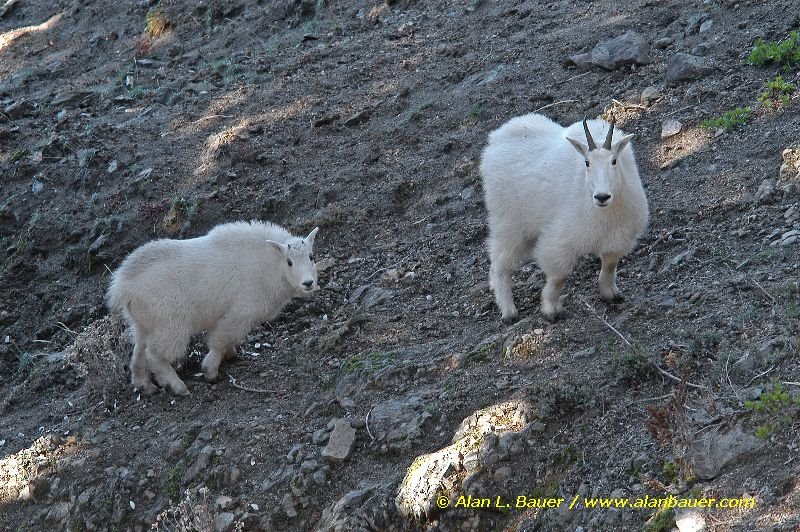
Here (below) is a mature male mountain goat taken by Ron Niebrugge at Glacier National Park in Montana. Aren't they beautiful?
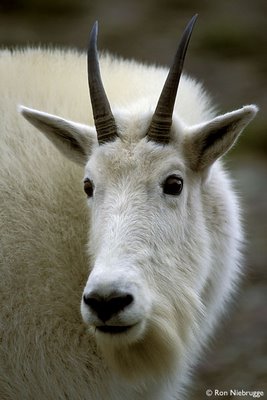
Mountain goats are always white, have a definite "beard," and have black hooves and short smooth dark horns that curve backward. Their habitat is steep slopes and rocky crags near the snowline, often above the timberline in summer. They feed on high mountain vegetation, grow up to 300 lbs says our field guide to the mammals by Wm Burt. Found in national parks of the NW - Mt. Ranier National Park in Washington and Glacier NP in Montana, Banff and Jasper in Canada. Also Black Hills of S. Dakota. They have been introduced into Olympic National Park and North Cascades NP in Washington.
The only animals they could be confused with in high mountains are bighorn sheep, which have very different massive yellowish spiral-shaped horns. We saw a few bighorn sheep in Yellowstone a few years back and they do look very different because of the horns and usually the color of the coat. Here is a mature bighorn sheep:
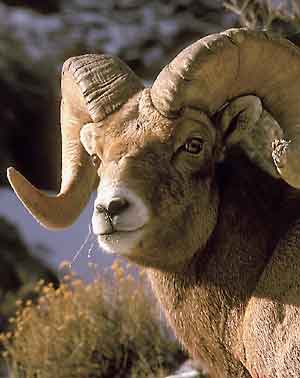 Bighorn sheep can be gray, black, brown or white. Like mt goats, they're found on mt slopes, but their range extends all the way from the NW down into northern Mexico. They don't require cold climates. And they're not as elusive as mountain goats.
You might see pronghorn antelope and deer in national parks, but not at the same elevations as mountain goats. The antlers of a pronghorn project forward; deer antlers are branched - different from mt goats. Here's a pronghorn, easy to spot if you happen to go to Yellowstone.
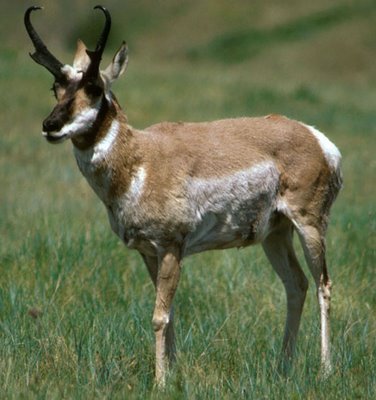 a pronghorn antelope, common in Yellowstone, antlers project forward
Mountain goat populations aren't endangered but are declining. In nature, they're killed by malnutrition, avalanches, rockslides...and falls. They do fall from time to time. Eagles and cougars eat the young.
But their main threat is humans of course. Habitat loss is the biggest factor, due to new roads for mining and logging. And oil drilling. Trophy hunting also takes a big claim on them. Google Images for "mountain goat" and you'll find plenty of photos of hunters grinning over their dead mountain goat. These goats reproduce more slowly than most hooved animals, which makes them less resilient to threats. Estimates of their current population in North America are 40,000 to 100,000. Not too bad but, like I said, declining. What can you do? Let your local legislators know that you care about wildlife. Write them letters and ask them to make habitat conservation a top priority.
For more info about mountain goats, go here.
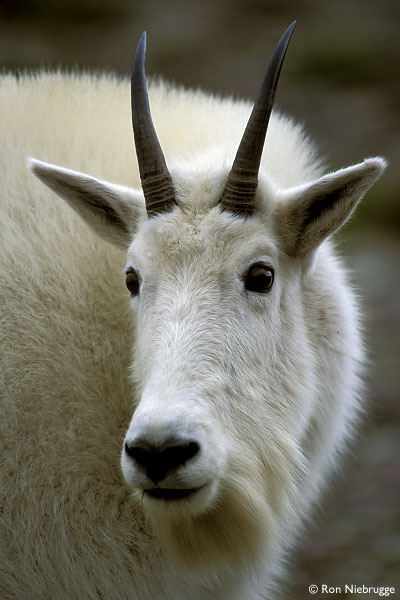
Mountain goats are always white, have a definite "beard," and have black hooves and short smooth dark horns that curve backward. Their habitat is steep slopes and rocky crags near the snowline, often above the timberline in summer. They feed on high mountain vegetation, grow up to 300 lbs says our field guide to the mammals by Wm Burt. Found in national parks of the NW - Mt. Ranier National Park in Washington and Glacier NP in Montana, Banff and Jasper in Canada. Also Black Hills of S. Dakota. They have been introduced into Olympic National Park and North Cascades NP in Washington.
The only animals they could be confused with in high mountains are bighorn sheep, which have very different massive yellowish spiral-shaped horns. We saw a few bighorn sheep in Yellowstone a few years back and they do look very different because of the horns and usually the color of the coat. Here is a mature bighorn sheep:
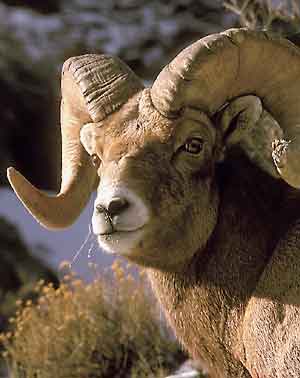 Bighorn sheep can be gray, black, brown or white. Like mt goats, they're found on mt slopes, but their range extends all the way from the NW down into northern Mexico. They don't require cold climates. And they're not as elusive as mountain goats.
You might see pronghorn antelope and deer in national parks, but not at the same elevations as mountain goats. The antlers of a pronghorn project forward; deer antlers are branched - different from mt goats. Here's a pronghorn, easy to spot if you happen to go to Yellowstone.
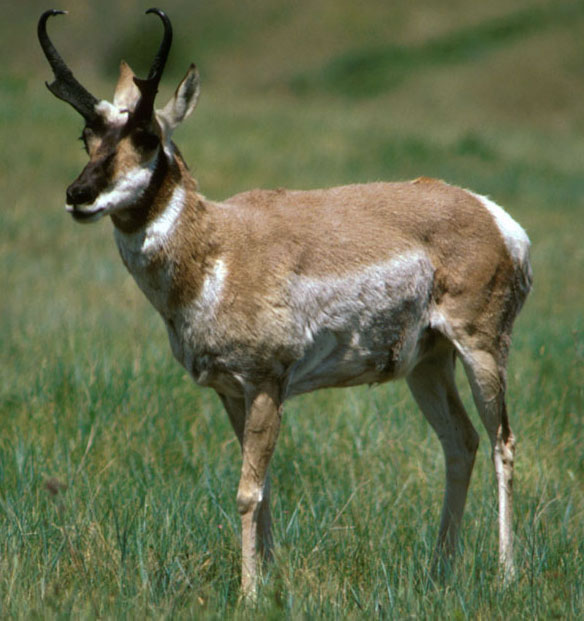 a pronghorn antelope, common in Yellowstone, antlers project forward
Mountain goat populations aren't endangered but are declining. In nature, they're killed by malnutrition, avalanches, rockslides...and falls. They do fall from time to time. Eagles and cougars eat the young.
But their main threat is humans of course. Habitat loss is the biggest factor, due to new roads for mining and logging. And oil drilling. Trophy hunting also takes a big claim on them. Google Images for "mountain goat" and you'll find plenty of photos of hunters grinning over their dead mountain goat. These goats reproduce more slowly than most hooved animals, which makes them less resilient to threats. Estimates of their current population in North America are 40,000 to 100,000. Not too bad but, like I said, declining. What can you do? Let your local legislators know that you care about wildlife. Write them letters and ask them to make habitat conservation a top priority.
For more info about mountain goats, go here.
Wednesday, August 23, 2006
Foie Gras from Force-fed Geese is Banned in Chicago
On Tuesday, Chicago became the first city in the nation to outlaw foie gras - the fattened livers of geese and ducks. The city council banned the stuff from restaurants because they consider the method of producing it to be animal cruelty. Foie gras is made by force-feeding geese and ducks through a pipe stuck down their throats.
To make foie gras, the birds - usually geese - are force fed much more than they would normally eat. The feed is usually corn saturated with fat. The extra food and the fat cause their livers to swell to multiples of their normal size, so big that the geese have trouble walking. The liver becomes laced with fat, giving the liver a smooth buttery taste. So they say.
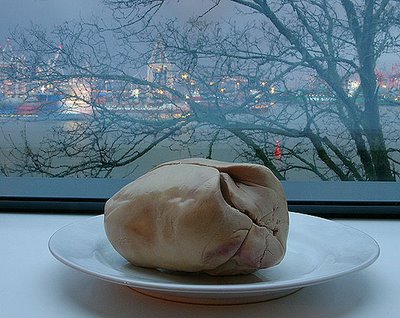 fattened liver of a force-fed goose
The Chicago Department of Public Health will be in charge of enforcing the ban on foie gras. Restaurants violating it will first be given a warning, then fined $250 to $500 for a second offense.
It'll be interesting to see how well the ban is enforced. But regardless, it sets an important precedent. I don't know of any other examples of a meat product being banned due to animal cruelty. California has a foie gras ban planned that will begin in 2012, and New York is working on a similar law. A bunch of European countries, plus Israel and Argentina, have already banned it. Is it possible other kinds of meat could follow? Veal would be a good candidate. From what I read about foie gras on Wikipedia, I think the production of veal is at least as cruel, if not more so. I mean, once you start down that road, where do you stop? As we discovered while visiting the factory farms we wrote about in Veggie Revolution, all meat from animals raised in confinement on factory farms is the result of suffering and cruelty.
This ban on foie gras could actually be a huge watershed event for farmed animals of the future, and their advocates. Let's hope so.
For more about foie gras, see our August 26 post, Just What Is Foie Gras??
To make foie gras, the birds - usually geese - are force fed much more than they would normally eat. The feed is usually corn saturated with fat. The extra food and the fat cause their livers to swell to multiples of their normal size, so big that the geese have trouble walking. The liver becomes laced with fat, giving the liver a smooth buttery taste. So they say.
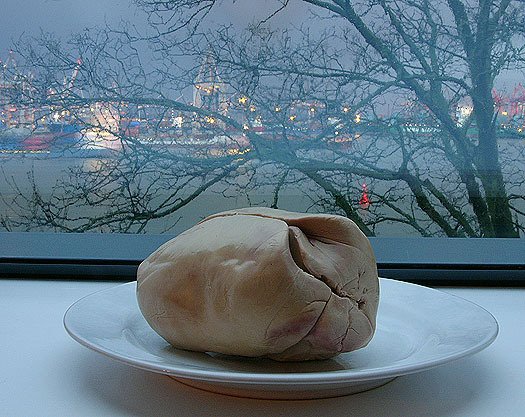 fattened liver of a force-fed goose
The Chicago Department of Public Health will be in charge of enforcing the ban on foie gras. Restaurants violating it will first be given a warning, then fined $250 to $500 for a second offense.
It'll be interesting to see how well the ban is enforced. But regardless, it sets an important precedent. I don't know of any other examples of a meat product being banned due to animal cruelty. California has a foie gras ban planned that will begin in 2012, and New York is working on a similar law. A bunch of European countries, plus Israel and Argentina, have already banned it. Is it possible other kinds of meat could follow? Veal would be a good candidate. From what I read about foie gras on Wikipedia, I think the production of veal is at least as cruel, if not more so. I mean, once you start down that road, where do you stop? As we discovered while visiting the factory farms we wrote about in Veggie Revolution, all meat from animals raised in confinement on factory farms is the result of suffering and cruelty.
This ban on foie gras could actually be a huge watershed event for farmed animals of the future, and their advocates. Let's hope so.
For more about foie gras, see our August 26 post, Just What Is Foie Gras??
Waves of change, rivers of doubt: Global water issues
Water... it's the source of all life. 70 percent of the planet is covered in it, and more than half of your body is made up of it. We use water everyday to refresh, revive, to subsist... yet, water resources are growing increasingly scarce around the world and access to potable water is alarmingly difficult in some regions.
 All life on this planet depends on water, a precious resource. Yet, we are struggling to manage water in ways that are efficient, equitable, and environmentally sound. Many parts of the world will face increasingly dire conditions as populations grow, cities expand, and sources of clean, fresh water disappear.
To avert damaging social and environmental outcomes, we need bold policy reforms. Perverse policies are the main cause of the waste and inefficiency that drive freshwater pollution and over-consumption. Reforming these policies requires governments to implement far-reaching institutional change and promote technical innovation.
. . . Turning ideas into action . . .
 In this edition, we look at some core water issues affecting people around the world, including privatization, access to clean water, desalination technology, bottled water debates, and non-point source pollution. Listen now...
Featuring:
Kapua Sproat, attorney, Earth Justice; Duke Sevilla, co-founder and treasurer, Hui o Na Wai `Eha; Alan M. Arakawa, Mayor of Maui; Avery Chumbley, president, Wailuku Water Company; Wenonah Hauter, executive director, Food and Water Watch; Geoffrey Segal, director, Privatization and Government Reform/Reason Foundation; Chuck Swartzle, president, Besco Water Treatment, Inc.; William E. Lobenherz, Michigan Soft Drink Association; Dave Dempsey, Clean Water Action Great Lakes; Karl B. Stinson, operations manager, Alameda County Water District; Dr. Peter Gleick, director, The Pacific Institute; Richard Stover, Energy Recovery Inc; Conner Everts, director, California Statewide De-Sal Response Group.
by NRP The National Radio Project
World Resource Institute
Greener Magazine
Production:
Senior Producer/Host/Writer: Tena Rubio
Contributing Producers: Robynn Takayama, Lester Graham, Brian Edwards-Tiekert.
An hour-long version of this program is available on PRX at http://www.prx.org/pieces/13203
For more information:
Earth Justice
223 South King Street, #400
Honolulu, HI 96813-4501
808-599-2436; ksproat@earthjustice.org
www.earthjustice.org
Mayor, County of Maui
200 South High Street
Wailuku, Maui, HI 96793
808-270-7855; Fax: 808-270-8073
www.co.maui.hi.us/mayor/
Wailuku Water Company
255 E Waiko Rd.,
Wailuku HI 96793-9355
808-244-9570; Fax: 808-242-7068
Hui o Na Wai `Eha
c/o John and Rose Marie Duey
575A Iao Valley
Wailuku, HI 96793-3007
808-242-8565; jduey@maui.net
Food and Water Watch
1400 16th Street NW, Suite 225
Washington, DC 20036
202-797-6550; Fax: 202-797-6560
foodandwater@fwwatch.org
www.fwwatch.org
Clean Water Action National Office
4455 Connecticut Avenue NW, Suite A300
Washington, DC 20008
202-895-0420
Besco Water Treatment, Inc.
www.bescowater.com/
The Pacific Institute
654 13th Street, Preservation Park
Oakland, CA 94612
510-251-1600;
www.pacinst.org
Energy Recovery Inc.
1908 Doolittle Drive
San Leandro, CA 94577
510-483-7370
www.energy-recovery.com
All life on this planet depends on water, a precious resource. Yet, we are struggling to manage water in ways that are efficient, equitable, and environmentally sound. Many parts of the world will face increasingly dire conditions as populations grow, cities expand, and sources of clean, fresh water disappear.To avert damaging social and environmental outcomes, we need bold policy reforms. Perverse policies are the main cause of the waste and inefficiency that drive freshwater pollution and over-consumption. Reforming these policies requires governments to implement far-reaching institutional change and promote technical innovation.
. . . Turning ideas into action . . .
- Commentary: World's Water Resources in Swift Decline. With the start of the "Water for Life" International Decade for Action, we must take steps to insure that our precious freshwater resources are preserved.
- Nutrient Runoff Creates Dead Zone. The trading of nutrient credits may hold the answer to ending the annual "Dead Zone" in the northern Gulf of Mexico.
- Watersheds of the World: Managing water for people and nature. WRI played a lead role in producing a comprehensive database of the world’s river basins.
In this edition, we look at some core water issues affecting people around the world, including privatization, access to clean water, desalination technology, bottled water debates, and non-point source pollution. Listen now...Featuring:
Kapua Sproat, attorney, Earth Justice; Duke Sevilla, co-founder and treasurer, Hui o Na Wai `Eha; Alan M. Arakawa, Mayor of Maui; Avery Chumbley, president, Wailuku Water Company; Wenonah Hauter, executive director, Food and Water Watch; Geoffrey Segal, director, Privatization and Government Reform/Reason Foundation; Chuck Swartzle, president, Besco Water Treatment, Inc.; William E. Lobenherz, Michigan Soft Drink Association; Dave Dempsey, Clean Water Action Great Lakes; Karl B. Stinson, operations manager, Alameda County Water District; Dr. Peter Gleick, director, The Pacific Institute; Richard Stover, Energy Recovery Inc; Conner Everts, director, California Statewide De-Sal Response Group.
by NRP The National Radio Project
World Resource Institute
Greener Magazine
Production:
Senior Producer/Host/Writer: Tena Rubio
Contributing Producers: Robynn Takayama, Lester Graham, Brian Edwards-Tiekert.
An hour-long version of this program is available on PRX at http://www.prx.org/pieces/13203
For more information:
Earth Justice
223 South King Street, #400
Honolulu, HI 96813-4501
808-599-2436; ksproat@earthjustice.org
www.earthjustice.org
Mayor, County of Maui
200 South High Street
Wailuku, Maui, HI 96793
808-270-7855; Fax: 808-270-8073
www.co.maui.hi.us/mayor/
Wailuku Water Company
255 E Waiko Rd.,
Wailuku HI 96793-9355
808-244-9570; Fax: 808-242-7068
Hui o Na Wai `Eha
c/o John and Rose Marie Duey
575A Iao Valley
Wailuku, HI 96793-3007
808-242-8565; jduey@maui.net
Food and Water Watch
1400 16th Street NW, Suite 225
Washington, DC 20036
202-797-6550; Fax: 202-797-6560
foodandwater@fwwatch.org
www.fwwatch.org
Clean Water Action National Office
4455 Connecticut Avenue NW, Suite A300
Washington, DC 20008
202-895-0420
Besco Water Treatment, Inc.
www.bescowater.com/
The Pacific Institute
654 13th Street, Preservation Park
Oakland, CA 94612
510-251-1600;
www.pacinst.org
Energy Recovery Inc.
1908 Doolittle Drive
San Leandro, CA 94577
510-483-7370
www.energy-recovery.com
Thursday, August 17, 2006
Best Place in the World to Spot Orcas from Shore
The best place in the world for spotting killer whales (Orcas) from shore is the western coast of San Juan Island, Washington. Or so say the whale fans on the island, and the employees at the Whale Museum. We went there a couple of weeks ago hoping to spot Orcas from shore. Watching from shore has no harmful effects on the whales as whale-watching boats can. Lime Kiln State Park is the island's most popular and maybe most successful spot for watching from shore. June, July, and early August are among the best months.
Lime Kiln State Park is the center of a lot of Orca research. The windows of the park's small lighthouse are filled with graphs and data from doctoral research projects, posted there for whale-viewers to peruse while they wait for whales. A small crowd of 2 to 15 people gathers near the lighthouse every summer afternoon, waiting for the killer whales to come tooling down the Strait of Juan de Fuca, which is 8 miles wide at that point. The Orcas are eating salmon as they travel through. Researchers have identified 3 pods or family groups of Orcas that live in the strait - the J, K, and L pods. The members of a pod stay together most of the time. A pod is matriarchal - all are descendents of a single female who leads the group. J and K pods have 20 something members each; L pod has more than 40. The matriarch of each whale pod is several decades old, and great-grandma to some of the youngest whales.
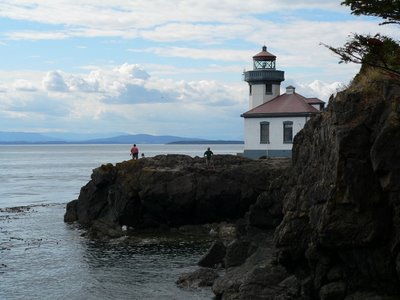 Lighthouse at Lime Kiln State Park, prime viewing spot for Orcas. By Sally Kneidel
The afternoon of August 2 we were hanging out at Lime Kiln State Park by the lighthouse, waiting. We were hoping the whales would come soon, we were hungry and tired. The only other people there were a pair of earnest-looking women perched on the rocky outcropping overlooking the water, discussing Orca sightings. One of them had what looked like an electric toothbrush - but it turned out to be a radio, a most useful tool in locating whales. She was listening in to the radio conversation among the whale-watching boats about the Orcas' whereabouts. I asked her what the scoop was, she told me the killer whales were headed our way. Sure enough, after about 5 minutes we could see the small clot of boats that generally follow the whales - three or four small whale-watching boats with clients, and one or two private boats. We could see the boats long before we could see any whales. The first we saw of the whales themselves was just the splashing water as they breached, or leapt from the water and slapped back down on the surface, something they apparently do just for fun.
 Orca splashes; whale-watching boat with clients. From shore of San Juan Island, by Alan Kneidel
After a few more minutes, we could see more than splashing - we could see the beautiful black and white bodies of the killer whales, swimming and apparently playing.
 Orcas playing. From shore of San Juan Island, by Alan Kneidel
Killer whales are the top of the food chain. No animals can kill adult Orcas, not even Great White Sharks. Orcas can kill almost anything they want to kill - other whales and sharks included. Although the resident J, K, and L pods eat mostly salmon, the "transient" Orcas that just move through the San Juan Island area on the way to somewhere else feed heavily on marine mammals. They can toss a seal in the air like popcorn, can snarf down sea lions that weigh a ton, literally. They don't eat humans though. We saw sea kayakers very near the whales - the whales never bother them. Why? Same with wolves. Wolves never attack humans, although they easily could. I don't know why.
We were told that, on some days at Lime Kiln State Park, the whales swim through the water right below the lighthouse, right through the sea kelp along the shore (which is deep right at the shore line). We weren't so lucky though. The whales we saw were much farther out. We could see and hear their spouts (exhaled breaths) though, at times. A spout started with a puffing sound, like air blown suddenly out of pursed lips. The subsequent whoosh had a resonance as of air coming from a deep and hollow chamber. Hard to describe. I guess the whales were 200 yards offshore.
The boats were keeping their distance pretty well - the guideline is at least 100 yards between whale and boat, to minimize disturbance to the whales. The sound of engines is thought to disrupt the whales' communication with each other. (Each pod has its own dialect!) Also, boat exhaust can be a health hazard when the Orcas come up to breathe. Not to mention just the harrassment factor of being trailed every day by a flotilla of boats. But....on the bright side....one of the graphs posted in the lighthouse showed that during the 1970s, an average of 26 boats followed each pod as it moved past Lime Kiln State Park on any given day. Now the average number of boats following a single pod of whales moving down the strait is 8. That's still a lot. But better than 26. The two days I watched though, I didn't see as many as 8 boats around any single group of whales. It was more like 4 or 5. Sometimes only a couple of boats. But maybe that's because the Orca-watching season begins to wane in August. As we watched, the whales stopped moving from time to time, playing and breaching. Then the pod would take off again, moving on down the Juan de Fuca Strait, seeking salmon.
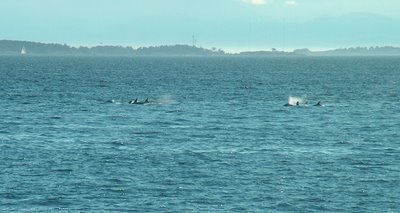 Orcas moving down Juan de Fuca Strait. From shore of San Juan Island, by Alan Kneidel
Salmon populations are declining in the area, overfished like everything else. (See www.wildsalmoncenter.org for info on salmon conservation efforts.) But the population of resident Orcas in Juan de Fuca Strait (pods J, K, and L) is holding steady nonetheless at present, numbering in the low 90s. A few decades ago, they were target practice for salmon fishermen. That "sport" has ended.
Most of the time we were watching the whales, all we could see were the fins sticking up. As the Orcas swim, they undulate up and down in an S-shaped path, so that a part of the back rises out of the water at the high points of the undulations. The whales breathe when the back is up, as in the picture below. The visible spout or cloud that results from their breathing is the warm vapor in their breath condensing into droplets in the cooler air. They even swim while they're sleeping - only half the brain sleeps at any given time.
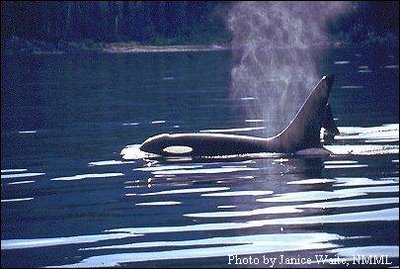 Orca, by Janice Waite of the National Marine Mammal Laboratory
The resident population of Orcas in Juan de Fuca Strait was listed as endangered last year, even though their numbers are steady. They're threatened by water pollution, salmon decline, and boat traffic. In July of 2006, federal officials proposed naming the U.S. half of the strait as critical habitat. You can read more about the critical habitat proposal at Seattlepi.com. To read more about Orca conservation in the San Juan Island area of Washington and Orca biology in general, check out the www.whalemuseum.org. For more about Orca conservation issues in the north Pacific and Alaska area, see the National Marine Mammal Laboratory web site.
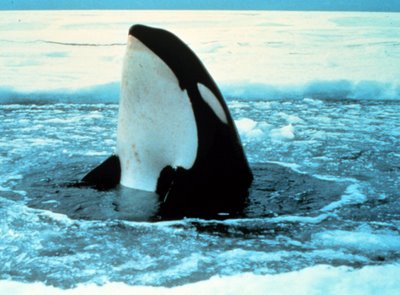 Orca in Alaska; photo from www.noaanews.noaa.gov
Orcas are pretty cool, and very predictable as whales go. I really enjoyed meeting the community of whale fanatics that hang out at Lime Kiln State Park every day, waiting for the whales to show - a group that ranged from kids carrying whale plush toys to research scientists. Wildlife watching used to be a solitary activity for me. But now, I realize that if we as conservationists are to make a difference for wildlife in the future, we have to involve communities of people. We have to develop sustainable ways for people to make a living from the ecosystems around them, such as ecotourism. We especially have to support local people who are trying to transition from "harvesting" of wild animals and plants to more sustainable ways of depending on their environment for their livelihoods. People who depend on the Orcas for their living are more likely to support limits on pollution and boat traffic, more likely to support salmon conservation measures.
If you like whales, if you're interested in seeing a community that is sustainably making a living from local wildlife and ecotourism, visit San Juan Island. And you want to see Orcas from shore, a great place to do it is Lime Kiln State Park.
Sally Kneidel, PhD
Co-author of Veggie Revolution

Orcas; photo from www.estuaries.org
Lime Kiln State Park is the center of a lot of Orca research. The windows of the park's small lighthouse are filled with graphs and data from doctoral research projects, posted there for whale-viewers to peruse while they wait for whales. A small crowd of 2 to 15 people gathers near the lighthouse every summer afternoon, waiting for the killer whales to come tooling down the Strait of Juan de Fuca, which is 8 miles wide at that point. The Orcas are eating salmon as they travel through. Researchers have identified 3 pods or family groups of Orcas that live in the strait - the J, K, and L pods. The members of a pod stay together most of the time. A pod is matriarchal - all are descendents of a single female who leads the group. J and K pods have 20 something members each; L pod has more than 40. The matriarch of each whale pod is several decades old, and great-grandma to some of the youngest whales.
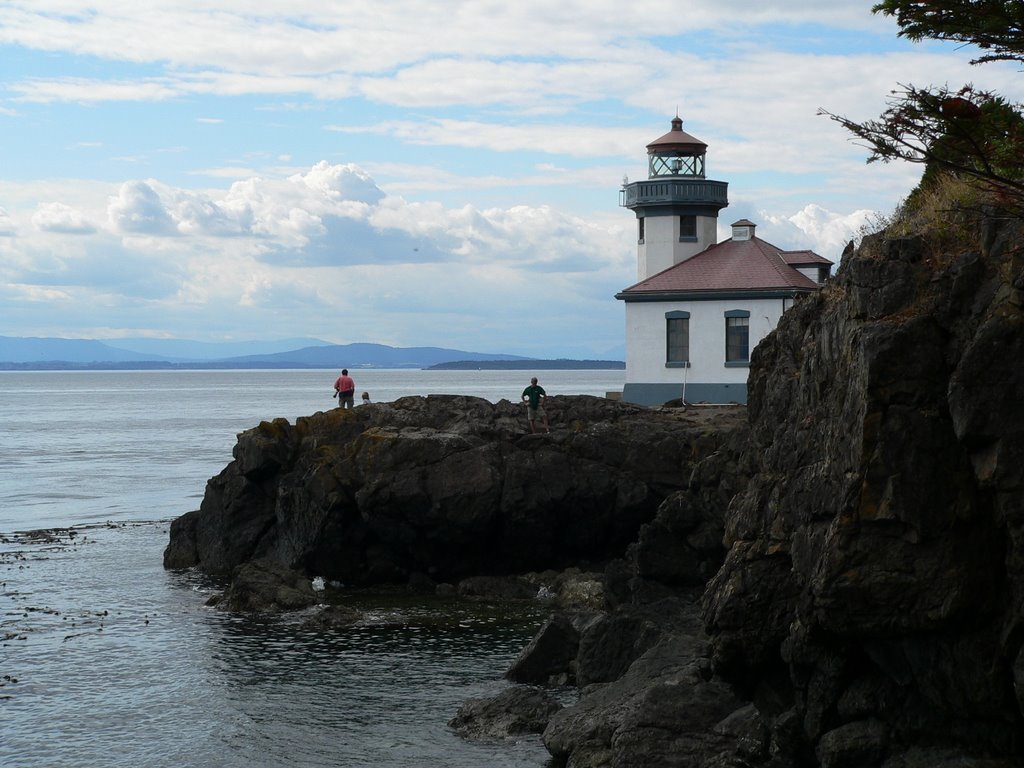 Lighthouse at Lime Kiln State Park, prime viewing spot for Orcas. By Sally Kneidel
The afternoon of August 2 we were hanging out at Lime Kiln State Park by the lighthouse, waiting. We were hoping the whales would come soon, we were hungry and tired. The only other people there were a pair of earnest-looking women perched on the rocky outcropping overlooking the water, discussing Orca sightings. One of them had what looked like an electric toothbrush - but it turned out to be a radio, a most useful tool in locating whales. She was listening in to the radio conversation among the whale-watching boats about the Orcas' whereabouts. I asked her what the scoop was, she told me the killer whales were headed our way. Sure enough, after about 5 minutes we could see the small clot of boats that generally follow the whales - three or four small whale-watching boats with clients, and one or two private boats. We could see the boats long before we could see any whales. The first we saw of the whales themselves was just the splashing water as they breached, or leapt from the water and slapped back down on the surface, something they apparently do just for fun.
.jpg) Orca splashes; whale-watching boat with clients. From shore of San Juan Island, by Alan Kneidel
Orca splashes; whale-watching boat with clients. From shore of San Juan Island, by Alan KneidelAfter a few more minutes, we could see more than splashing - we could see the beautiful black and white bodies of the killer whales, swimming and apparently playing.
.jpg) Orcas playing. From shore of San Juan Island, by Alan Kneidel
Orcas playing. From shore of San Juan Island, by Alan KneidelKiller whales are the top of the food chain. No animals can kill adult Orcas, not even Great White Sharks. Orcas can kill almost anything they want to kill - other whales and sharks included. Although the resident J, K, and L pods eat mostly salmon, the "transient" Orcas that just move through the San Juan Island area on the way to somewhere else feed heavily on marine mammals. They can toss a seal in the air like popcorn, can snarf down sea lions that weigh a ton, literally. They don't eat humans though. We saw sea kayakers very near the whales - the whales never bother them. Why? Same with wolves. Wolves never attack humans, although they easily could. I don't know why.
We were told that, on some days at Lime Kiln State Park, the whales swim through the water right below the lighthouse, right through the sea kelp along the shore (which is deep right at the shore line). We weren't so lucky though. The whales we saw were much farther out. We could see and hear their spouts (exhaled breaths) though, at times. A spout started with a puffing sound, like air blown suddenly out of pursed lips. The subsequent whoosh had a resonance as of air coming from a deep and hollow chamber. Hard to describe. I guess the whales were 200 yards offshore.
The boats were keeping their distance pretty well - the guideline is at least 100 yards between whale and boat, to minimize disturbance to the whales. The sound of engines is thought to disrupt the whales' communication with each other. (Each pod has its own dialect!) Also, boat exhaust can be a health hazard when the Orcas come up to breathe. Not to mention just the harrassment factor of being trailed every day by a flotilla of boats. But....on the bright side....one of the graphs posted in the lighthouse showed that during the 1970s, an average of 26 boats followed each pod as it moved past Lime Kiln State Park on any given day. Now the average number of boats following a single pod of whales moving down the strait is 8. That's still a lot. But better than 26. The two days I watched though, I didn't see as many as 8 boats around any single group of whales. It was more like 4 or 5. Sometimes only a couple of boats. But maybe that's because the Orca-watching season begins to wane in August. As we watched, the whales stopped moving from time to time, playing and breaching. Then the pod would take off again, moving on down the Juan de Fuca Strait, seeking salmon.
 Orcas moving down Juan de Fuca Strait. From shore of San Juan Island, by Alan Kneidel
Salmon populations are declining in the area, overfished like everything else. (See www.wildsalmoncenter.org for info on salmon conservation efforts.) But the population of resident Orcas in Juan de Fuca Strait (pods J, K, and L) is holding steady nonetheless at present, numbering in the low 90s. A few decades ago, they were target practice for salmon fishermen. That "sport" has ended.
Most of the time we were watching the whales, all we could see were the fins sticking up. As the Orcas swim, they undulate up and down in an S-shaped path, so that a part of the back rises out of the water at the high points of the undulations. The whales breathe when the back is up, as in the picture below. The visible spout or cloud that results from their breathing is the warm vapor in their breath condensing into droplets in the cooler air. They even swim while they're sleeping - only half the brain sleeps at any given time.
 Orca, by Janice Waite of the National Marine Mammal Laboratory
The resident population of Orcas in Juan de Fuca Strait was listed as endangered last year, even though their numbers are steady. They're threatened by water pollution, salmon decline, and boat traffic. In July of 2006, federal officials proposed naming the U.S. half of the strait as critical habitat. You can read more about the critical habitat proposal at Seattlepi.com. To read more about Orca conservation in the San Juan Island area of Washington and Orca biology in general, check out the www.whalemuseum.org. For more about Orca conservation issues in the north Pacific and Alaska area, see the National Marine Mammal Laboratory web site.
 Orca in Alaska; photo from www.noaanews.noaa.gov
Orcas are pretty cool, and very predictable as whales go. I really enjoyed meeting the community of whale fanatics that hang out at Lime Kiln State Park every day, waiting for the whales to show - a group that ranged from kids carrying whale plush toys to research scientists. Wildlife watching used to be a solitary activity for me. But now, I realize that if we as conservationists are to make a difference for wildlife in the future, we have to involve communities of people. We have to develop sustainable ways for people to make a living from the ecosystems around them, such as ecotourism. We especially have to support local people who are trying to transition from "harvesting" of wild animals and plants to more sustainable ways of depending on their environment for their livelihoods. People who depend on the Orcas for their living are more likely to support limits on pollution and boat traffic, more likely to support salmon conservation measures.
If you like whales, if you're interested in seeing a community that is sustainably making a living from local wildlife and ecotourism, visit San Juan Island. And you want to see Orcas from shore, a great place to do it is Lime Kiln State Park.
Sally Kneidel, PhD
Co-author of Veggie Revolution
Friday, August 11, 2006
We Saw One Humpback Whale: The Good and Bad on Whale-Watching
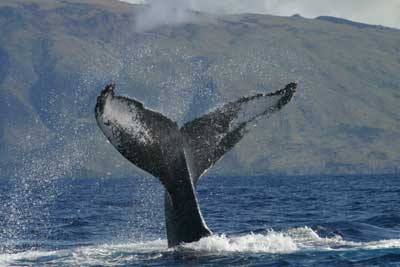 fluke of humpback whale; photo courtesy of National Marine Fisheries Service
www.nmfs.noaa.gov/.../
We wanted to see Pacific marine wildlife, and in pursuit of that, we spent the last week of July at a hostel in Tofino, British Columbia - a small village on the wild Pacific coast of Canada's Vancouver Island. Tofino is on the northern edge of Pacific Rim National Park, halfway "up island" as the locals say.
The hostel is called Whalers on the Point Guesthouse (250 725-3443). It overlooks a relatively unpopulated bay where whales sometimes wander. The hostel has a rack of brochures for local whale-watching outfits that take tourists and photographers out to look for whales. The whales most commonly seen in the Tofino area are gray whales, humpbacks, and orcas. Most are migrating through seasonally. But a few are permanent residents. We learned from talking to various locals that two gray whales in particular spend a part of every day lounging in a specific area of sea kelp near one of the many small offshore islands, and have done so for years. Most of the whale-watching companies take their boats to view these two gray whales.
Whale-watching has good and bad aspects. The good is that it brings in around $10 billion in tourist dollars to North American Pacific coastal towns every year. Because a whale-watching outing usually includes viewing other coastal life as well - seals, sea lions, oceanic birds, sea otters, or bears - the income gives local people a strong incentive to preserve marine ecosystems. It gives coastal communities a good reason to leave enough fish to sustain wildlife populations. Ecotourism, which includes whale-watching, can be a sustainable way to "exploit" or make a living from natural resources without diminishing them. But it must have limits. Like all ecotourism, overzealous viewing is a hazard to wildlife populations. With that in mind, many conservation organizations and government bodies have published guidelines to limit and regulate whale-watching. The most widely accepted guideline is to approach no closer than 100 yards, the length of a football field. Another is to linger around a whale no longer than half an hour.
In my experience from staying in three different towns that cater to whale-watchers, these guidelines are generally respected. One boat I saw get too close was turned in by a whale-enthusiast who jotted down the boat's license tag or ID number.
 So anyway we chose one of the whale-watching groups in Tofino and went out in their high speed "Zodiac" boat to see the two resident gray whales. A Zodiac is a small pontoon boat that jumps and slams over ocean swells in transit to the whales. The boats are constantly in radio contact with each other, so if there are whales in the area, then the guide for a particular outing already knows exactly where the whales are. But the animals may be miles offshore so the Zodiac can take 45 minutes at full throttle to reach the right area. People with back or neck problems or pregnancies not allowed on the boats, with good reason. It nearly jolted my teeth out. A Zodiac holds about 10 people in addition to the driver. We had to wear orange jump suits that looked like space suits, as protection against the cold and as flotation devices. (That's Sara Kate Kneidel suited up in photo.) British Columbia is cool even in late July - out on the ocean moving fast the air was cold.
It turned out the day we went that the two resident gray whales had taken the day off and meandered who knows where. We didn't get to see them. But our guide took us to look at a resident humpback whale that had been spotted instead, farther offshore than the boats usually go. The humpbacks have nicks in their tail flukes that make individual identification easy for the people who study them. The one we saw was #117, said our guide.
When we reached the right spot, we could tell because two other small boats were already there, waiting. Our guide cut the engine - the noise can interfere with whale communication underwater. We sat and waited. I'm not sure what I was expecting - that the whale would breach or what. Someone the night before at the hostel had told me that humpbacks are much more playful than grays - breaching and tail-lobbing (slapping the tail on the water) and flipper-slapping and generally making a spectacle.
But the whale didn't do any of that. What the humpback did do what stick its fluke (tail) up out of the water as it dove to feed. The first time all I saw was a quick blur. We waited ten more minutes and the whale did the same thing again. I saw the fluke that time, but barely. The third time the humpback dove, he/she waved the fluke high up in the air and I saw it clearly. #117 had a big chunk missing from one side of its fluke. If you picture a tail or fluke as having two fins or blades on it, one of the blades looked like a big bite had been taken out of it. Our guide said it was likely that an orca (killer whale) which are common in the area in spring had taken a bite when the whale was a baby. I hope he was right. I hope to God it wasn't an injury from a whale-watching boat.
After the third dive, we left - our half hour was up. I don't know for sure if we were annoying the whale or not. I know that it could have left the area easily and we would never have known. In the intervals we waited, we had no way of knowing where the whale was, or if it was still there. As much as I enjoyed seeing it, I felt guilty too. Whether we annoyed it or not, I felt we were trespassing. Anytime I'm close enough to wildlife to get a good look, I'm probably invading its space in some way, even if I'm being respectful.
We saw a bear later near Tofino, foraging in the woods. A park ranger told me that anytime a bear sees a human it's becoming accustomed to humans in a bad way. He said we should yell and be obnoxious to help the bear develop a fear of humans. Bears that get too fearless start foraging in yards and then towns, and such bears eventually wind up being shot as a danger to the community. I saw a newspaper for the nearby town of Ucluelet while we were there, and it featured an article on the front page about two bears being shot by wildlife officers for foraging in garbage cans in town. Ouch.
As our human population grows (the U.S. will soon reach 300 million, if we haven't already), our relationship with wildlife grows more difficult and more complicated.
But anyway back to humpbacks. They're found in both the Atlantic and Pacific, grow to a length of 50 feet. They have long pectoral fins, nearly a third of their body length and a very small dorsal fin well back on the body. They are black except for the white throat, breast, and underside of fluke and flippers. Their flippers have fleshy knobs along the front border, says my "Field Guide to the Mammals" book by Wm Burt, and the fluke is irregular in outline along the posterior border - hence the ease of individual identification. The spout of a humpback is an expanding column of exhaled air and water vapor about 20 ft high, and the baleen (mouthpart for filtering krill or plankton out of seawater) is black. The shape and height of the spout can be important in identifying them, since that's often all the viewer sees. Gray whale spouts are "quick and low", about 10 feet high.
According to the Pacific Biodiversity Institute, the world population of humpbacks is now about 15,000 and is gradually increasing. They are on our federal endangered species list and have been since 1973 when the Endangered Species Act was first passed. Their world population was at one time around 200,000, but declined due to intensive commercial hunting which has since tapered off. The Northern Pacific population is now around 6000. If it reaches 9000, they will be removed from the U.S. endangered species list.

For more information about humpbacks, check out the humpback-whale fact sheet from the American Cetacean Society. And see the PBS web site about humpback whales.
I would love to hear from readers your views about whale-watching and wildlife watching in general. The good, the bad and the ugly.
Wednesday, August 09, 2006
Fell Off Cliff While Seeking Seals, Whales, other Marine Mammals
 photo courtesy of http://imagesource.allposters.com
The day started serenely enough. We were camping and hiking in Washington State, looking for wildlife - my ecologist husband Ken and our two twenty-something kids, Sara Kate and Alan. On this particular day I was walking along a seaside cliff top on San Juan Island, looking out over the Pacific waters in Puget Sound. I spotted a baby harbor seal on the beach below, parked there by its mom as she went diving for food. I decided to clamber down the cliff to the beach for a better photo angle, while still keeping a respectful distance. (The Northwest Marine Fisheries Service recommends a minimum distance of 100 yards for all marine mammal viewing.) Finding no trail down the cliff, I went anyway, unable to resist the opportunity. I slid on the loose cobble, careened wildly, grabbed a boulder to stop my slide. But I grabbed it a little too vigorously, slammed it actually with my forearm. It hurt, but I didn't do anything about it until yesterday, 5 days after the incident, when we got home to North Carolina. Doctor said forearm is fractured, put a cast on it. C'est la vie ~ a little vacation souvenir. And yes, I discovered, one can hike and camp and manuever for 5 days with an untreated broken arm.
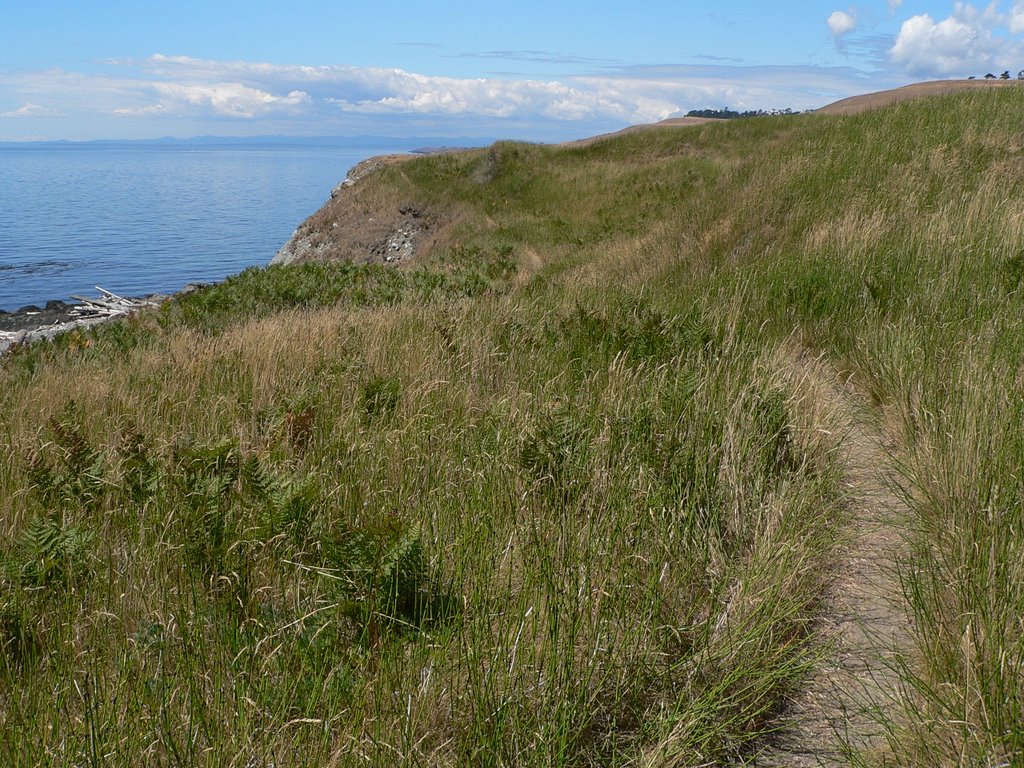 the cliff top I toppled from; Sally Kneidel
But anyway, back to the cliff and the seal....
After my collision with the rock, I sat for a moment or two, cursing the cobble and waiting for the exploding stars in my arm to subside. Then I made my way down the remainder of the cliff face to the beach. The beach has lots of rocky outcroppings so it was easy to find a spot where I could photograph the little seal without alarming it. Here's a photo of the little critter napping, taken from a respectable distance.
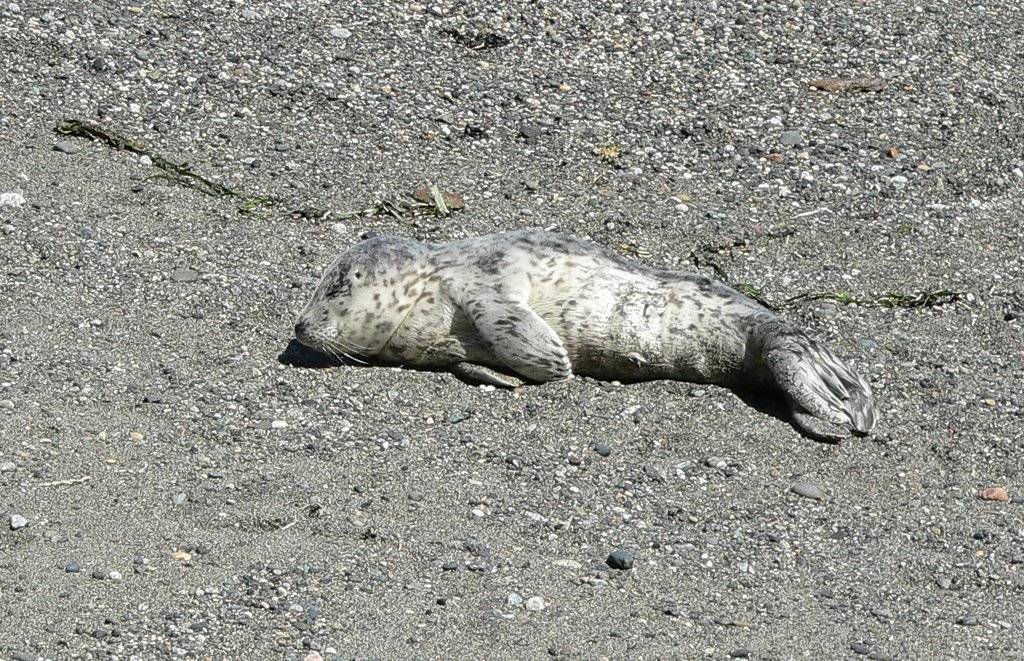 baby harbor seal snoozing on beach at San Juan Island; Sally Kneidel
 There are two different families of seals (pinnipeds) that are easy to tell apart. The most common ones in Washington are harbor seals. Harbor seals have rear flippers that point backwards only, and they move on land with an up-and-down undulating motion called "galluphing." They lack external ears - the ear is just an opening on the side of the head. Harbor seals propel themselves in water with their hind flippers. They have thin fur that doesn't trap air, so they rely on blubber for insulation. These features distinguish them from fur seals and sea lions, who have external ears, rear flippers that can face forward and allow them to move fast on land, dense fur that traps air for insulation, and large powerful fore flippers for moving through water.
 Steller sea lions; photo courtesy of www.amnwr.com (Alaska Maritime Wildlife Refuge)
We saw harbor seals like the baby on the beach at several different spots on the coast of Washington and British Columbia, but saw sea lions only once, off the Pacific coast of Vancouver Island in Canada. I'll write about them in a later post. The male sea lions were huge - they can weigh more 2000 pounds!
After my ill-fated slide down the cliff and a few photos, I checked on the baby harbor seal periodically, from afar, for 2 or 3 hours. But the mom didn't return. So I went to a nearby ranger station for the national park service and told them about the baby - they said they would report it to the "marine mammalogy unit" who would watch it for the next 24 hours to make sure mom came back.
I just now called the park back (San Juan Island National Historical Park) and the fellow who answered the phone, Gordon, told me the beached baby went back out to sea at the next high tide that day, which suggests that mom came back. "They don't go to sea if the mother doesn't come back" said Gordon. I hope Gordon's right. And I hope curious hikers didn't frighten it into the sea before mom came back.
The population of harbor seals on the Pacific coast of the United States seems to be stable from the numbers I've been able to find. According to a 2003 article in the Journal of Wildlife Management, there are about 15,900 harbor seals along the Washington coast and 13,600 around the islands in Puget Sound, and their numbers are holding steady, in spite of challenges. Threats to harbor seals include reduced habitat, increased disturbance, and reduction in populations of fish prey such as hake and herring. I gathered from the journal article that harbor seals also prey on salmon, which generates friction with salmon fishermen. But seals are "protected," according to the federal government's Office of Protected Resources. The office's web site says "All marine mammals are protected under the Marine Mammal Protection Act of 1972."
EXCEPT....and there are a bunch of exceptions. The most insidious exception is "the taking of marine mammals incidental to commercial fishing operations." In other words, it's okay to kill marine mammals if you mean to be catching fish. As we learned while talking to salmon fishermen along Juan de Fuca Strait and Puget Sound and various other waterways of coastal Washington, the "gill nets" set to catch salmon there capture every living thing that comes in contact with the nets, including marine mammals and marine birds such as puffins and auklets. A salmon fisherman we talked with near Cape Flattery on the Olympic Peninsula said his waste "by-catch" from hauling in just one gill net on one day was more than 800 small sharks, all of which drowned, as sharks must keep moving in order to move water across their gills. He tossed all of them back in the water dead, he said.
To voice objections to the use of gill nets, you can check out the action underway by the Whale and Dolphin Conservation Society. Or google "gill net petition" or "gill net campaign" to find other conservation organizations working to limit the use of gill nets and other dangerous fishing techniques. When activists make a stink, things can and do change.
In the next few posts, I'll write about the other marine mammals we were most fortunate to spot - sea otters, Steller sea lions, and orcas. The August 11 post describes our sighting of a humpback whale, which was a thrill, along with links and conservation information. I'll also post a bit on what we learned about Washington's beautiful old-growth forests and the exploitive timber industry. Activists at work have made a difference. Stay tuned.
Subscribe to:
Posts (Atom)