Friday, June 30, 2006

Review of the Documentary "Kilowatt Ours" by Jeff Barrie

image courtesy of www.peaceproject.com


"Kilowatt Ours" knocked my socks off. It's a testament to the power of documentaries to get our attention fast. In this simple but extremely effective film, Jeff Barrie documents how coal-mining power companies are exploiting the Southeast, with dangerous health and environmental consequences. And more appalling, he shows how we consumers are blithely supporting the power companies' clandestine activities with our gluttonous, if ignorant, energy consumption.

Jeff Barrie was smart, he started with the most violent scenes - mountaintops exploding into the air, reduced to river-clogging rubble. For every ton of coal removed from the mountains of West Virginia, the 6 million tons of earth and forest above the coal must first be pulverized and dumped into the valleys below. Barrie uses poignant interviews with locals impacted by the disappearing mountains and ravaged landscapes to document the damage.

Coal-fired power plants are bad news all the way around. The Southeast uses more power than any other part of the country. The average Southeast home uses 1100 kilowatt-hours per month; the national average is 850. In the Southeast, 61% of our power is from coal! According to the Department of Energy , the combustion of 1 ton of coal releases more than 5,000 pounds of planet-warming carbon dioxide into the atmosphere.

And in the Southeast, powering one average household requires a ton of coal every 8 weeks!! Seems unreal. But it is real.

Burning coal also releases sulphate particulates into the air, a major air pollutant. As a result, asthma is now the most prevalent chronic illness in children, the #1 cause of school absences. Barrie has several sad and tender scenes of children displaying the arsenal of drugs and inhalers they need to aid their breathing.

"These are some of the drugs I need to help me," says one somber little boy, gesturing to a counter-top covered with medicine bottles.

Another interesting scene in the movie shows Dick Cheney saying that our energy use in the U.S. is so high (and our population is growing so fast) that we will need one new power plant every week for the next 20 years to keep up.

That is a sobering thought.

Then Barrie gets to the solutions. I love this part. He profiles schools, homes, businesses that are cutting back on their energy use with simple measures. Jeff and his wife Heather live in a basement apartment in Nashville. Simply by replacing all their incandescent bulbs with compact fluorescent bulbs, and buying a used energy-efficient frig for $200, they cut their power usage in half. Then he explains how most or many power companies offer a green-power option. By checking a box on your power bill and paying a small extra amount, you can specify that you want all your power to be drawn from green sources, such as wind and solar. This gives the power company incentive to develop more green sources. I know we have that option in North Carolina. You can learn more about it at NC Green Power. Barrie demonstrates that if we all adopted simple energy saving measures to make our homes more energy efficient, and opted for green power on our power bills, we could get rid of coal-fired power plants altogether. He's pretty convincing. After watching it, we replaced the last of our incandescent bulbs with compact fluorescent from Home Depot. They cost more, but they're supposed to last 6 or 7 years. And use only 10% of the energy of incandescent. The light is the same warm glow as incandescent.

Barrie did a great job. His film makes me want to study how he pulled it off - so simple and powerful a statement of problem and easy solution. It's personal, it's factual, and it's absolutely convincing.

Prisoners at the pump

With the current price of gas, I sure am glad I live on a farm and don't have to drive anywhere most days. As far as cars go, there's just nowhere to go, 'cept maybe the swimming hole - and we get a government subsidy on the diesel for our tractors. Still, on the days when we do have to make the 45-mile trek into town, I remember the good old days, when gas was $0.89 a gallon, with a nostalgic sigh. Oh, 2001... it seems like a dream to me now.

The rest of the time, however, I secretly support the high gas prices. Could financial alarm force environmentally-blind Americans to reconsider the casualness with which we hop behind the wheel? Maybe people who don't care about the environment do care about their own pocketbooks. In researching our next book, I've found out that in just one year, the average driver emits about 10,000 pounds of carbon dioxide into the atmosphere, as well as 300 pounds of carbon monoxide, and close to 10 pounds each of hydrocarbons and NOx. That’s some heavy junk floating around in our air and our lungs! To find out how much your vehicle emits, enter your stats into the EPA’s Tailpipe Talley at www.environmentaldefense.org/TailpipeTally/.

If you didn’t like the results of that test, fortunately there are a number of approaches to changing those stats, even while driving on gasoline. Don’t get me wrong – gas is dirty, no matter how you drive. But a few small changes in your driving habits, from how you drive to when, can have great cumulative effect. If just 10% people used public transportation for their work commute only, it would save 135 million gallons of gas a year – not to mention lots of pennies at the pump. And even in your private car, how you drive makes a huge difference in your environmental impact. A few steps you can take include:

· Don’t warm up your engine before driving. The engine emits the most pollutants when cold, and it heats up faster when driving than idling.

· Combine outings. Even if you have to turn the car on and off at each parking lot, using the car for many errands at once reduces the number of cold starts.

· Drive steadily. The most fuel efficient speed is between 35 and 45 mph. It’s much more efficient to chug along steadily at 45 mph than to race to a stoplight only to slow down, idle, and accelerate again.

· Don’t idle. Leaving the car running for thirty seconds uses just as much gas as it would to restart the engine.

· Maintain your car. A faulty or poorly serviced engine can release up to 10 times the emissions of a well-maintained one. This includes all parts of the car; old tires, for example, impede the car’s movement and decrease its fuel efficiency.

· Share rides. It costs you about 25 cents a mile to drive your car, figuring in all the operating costs as well as fuel. By ridesharing on the daily commute to work, you can save as much as $3,000 a year on gas, insurance, parking, and car maintenance.

· Drive at non-peak times. This is the best way to avoid idling, stop-and-go traffic, and non-fuel-efficient speeds on the road.

If you think all this is insignificant, think again. The amount of gasoline and money wasted by inefficient driving is tremendous, adding up to 753 million gallons of gas per year, or $1,194 per driver in wasted fuel and time. Just think of the catalytic converters you could buy with all that money!

-Sara Kate

Wednesday, June 28, 2006

Three Gorges Dam

Earlier this month the cofferdams designed to temporarily hold back the rising waters of the Yangtse River were removed and China's greatest engineering feat, Three Gorges Dam, cut the heart of the dragon. When completely filled in 2008, the reservoir formed by Three Gorges will stretch 412 miles to Chongqing, creating a long, deep, wide and slow moving river that will enable safe, reliable navigation along China's most important waterway, as well as an important hydroelectric resource for the Chinese economy.

Three Gorges Dam, became a reality after nearly 100 years of planning. In 1919 Chinese Premier Sun Yat-sen speculated about the benefits of constructing a modern hydroelectric project on the Yangtze River. By the end of WW II, the first director of the TVA (Tennessee Vally Authority,) David Lilienthal wrote a book, TVA: Democracy on the March later published in China, which is widely considered to be the inspiration for the Yangtse project.

Three Gorges Dam was envisioned to harness the great river or long river, as the Chinese call it, which winds its way 3,900 miles to the East China Sea. The river coils like a mythical dragon through an area that is home to nearly 400 million people. Three Gorges Dam spans the point where the last of three narrows called gorges funnel the annual runoff from the 20,000-foot high Tibetan plateau. Annual floods have, over the last century, caused billions in damage and the loss of hundreds of thousands of lives. Flooding in 1911 killed unknown thousands and again in 1931, took the lives of another 145,000 people, inundating an area the size of New York State, and submerged more than 3 million hectares of farmland, destroying 108 million houses. In the flood of 1935, 142,000 people were killed. As recently as 1998, flooding along the gorges led to 3,656 fatalities, and affected the lives of 290 million people. In that flood, there were more than 5 million houses destroyed and 21.8 million hectares of farmland submerged. The total economic cost of the flood that year was for $30 billion.
When first proposed, the construction was touted by government officials as reminiscent of last century's development of the Tennessee Valley Authority to control flooding in the United States. Three Gorges Dam, which has 26 generators, will produce 85 billion kilowatts of electricity per year, nearly one-ninth of China's present power needs. The control storage of the Three Gorges Dam reservoir is 22.15 billion cubic meters; the flood causeway is 483 meters, with the maximum discharging capacity at 102,500 meters per second, also a record. The two-way, five-step lock is also the most advanced in the world.

When Chinese authorities announced in 1992 that China would begin construction, at last, of Three Gorges Dam they faced considerable resistance from environmental and humanitarian interests around the world. Entire towns were to be displaced by the rising water, thousands of lives uprooted and moved, ancestral ground submerged forever. As recently as the last Presidential elections in the United States, environmentalists voiced caution that the project would result in increased industrialization along the banks of the Yantgse resulting in elevated levels of pollution across one of the world’s most densely populated regions. Recent spectrographic analysis provided by Envisat orbited by the European Space Agency reveal a trend toward increasing levels of nitrogen dioxide, a compound suspected of being a major contributor to global warming. The potential for accelerated NO2 increases is not without concern for environmentalists.

While it would seem that flood mitigation, with its consequent reduction in the loss of life and property, would be a worthwhile commitment, environmentalists point out that such control projects are unlikely to overcome a 100-year event. During the intervening control cycle, populations increase and the memory of past events fades to the point of dangerous disregard and that in such an event more lives could be lost than in all previous floods combined.

Silt accumulation is another disadvantage of large damming construction, the slowing of the river allows greater amounts of silt to settle out of the stream. The Yangtse is one of the world’s most turbulent rivers pouring 960 billion cubic meters of water into the East China Sea annually. The subsequent silt bloom is visible from space and scientists are uncertain what effect the discontinuance of this sedimentary deposit into the East China Sea will have in the long term.

The Three Gorges Dam, while providing great economic and cultural benefit to a growing Chinese economy, at the same time seems to reprise the doubtful contribution of similar undertakings over the last half century of dam building in the United States. Damming projects here have largely failed to provide long-term solutions to soil erosion, flood control or power supply even while they promoted industrial growth and economic gain. Perhaps, in the end, manipulating nature for short-term advantage may prove to be a double-edged sword afterall and not a true dragon slayer.

by Harlan Weikle
Greener Magazine

Wednesday, June 21, 2006

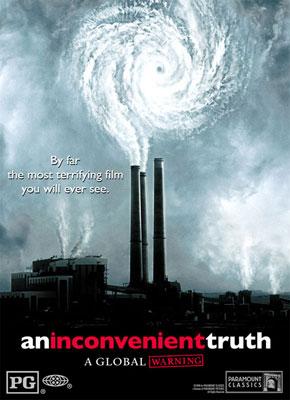
Al Gore's An Inconvenient Truth Is the Most Important Movie I've Ever Seen


I was blown away by Al Gore's new movie, An Inconvenient Truth. It's the most important movie I've ever seen. Forget Hillary or John Edwards - if Al Gore runs for president, he's got my vote.

But it's not a political movie. I'm only saying that because Gore truly "gets it." He understands that if we don't stop what we're doing within the next generation, we'll reach a point of no return - the beginning of an inexorable slide into the destruction of our own civilization and all the other species that share the planet with us. There is no other issue that even comes close in importance.

Gore is brilliant. The movie was a perfectly crafted script and performance, the optimum blend of personal journey and science, of frightening predictions and empowerment.

I just hope it's not all preaching to the choir - I hope the Bush supporters (if there are any left) will go see it. I hope those who still say global warming is a "theory" will see it. Most of what he said, I already knew more or less, as a biologist and a science writer - but it still floored me. The movie was by far the most powerful articulation of any issue that I have ever seen.

Gore pointed out many facts that I know to be true. One of those, a fact that my husband Ken tells his biology classes, is about the unwavering conviction of the scientific community. Of 928 published articles in scientific peer-reviewed journals on the subject of global warming, all 928 agreed that global warming is a fact, and is a result of greenhouse gases from our burning of fossil fuels.

But as the result of a propaganda campaign, the popular media are far from such a consensus. Only 43% of popular media stories fully support that global warming is a fact. They have been swayed by an all-out effort from the oil industry to "reposition global warming as a debate." As Gore points out, these are the same tactics perpetrated by the tobacco industry. Both of my own parents died of smoking-related cancer. My mother smoked three packs a day for five decades, and my dad and brothers and I breathed the secondhand smoke day in and day out. Everyone knows now that the tobacco industry suppressed information and deceived the public as long as possible, just as the fossil fuel industries are doing now. Only now the stakes are higher - we are literally talking about eventual extinction of a planet.


Some of the facts that I managed to scribble on the back of my ticket stub (after leaving my note pad in the car):

The ten hottest years in recorded history have all been within the last 14 years. The hottest of all was 2005.

One reason our production of greenhouse gases is increasing so fast is the increase in world population. "It took 10,000 generations for the world's population to reach two billion, and in a 95-year period, it is expected to go from two to nine billion," Gore said. An undisputed fact. See the International Data Base and Population Connection for more on that topic.

Gore pointed out that we in the US are responsible for a huge proportion of the world's troubles with global warming. Of the worldwide emissions that contribute to global warming, 30.3% are generated by the United States - although we have only 5% of the world's population. There are only two industrialized nations in the world that have not ratified the Kyoto treaty to limit greenhouse gas emissions - the United States and Australia. We guzzle fossil fuels because we're wealthy in relation to the rest of the world, and we can afford to. Wealthy, yet oblivious to the consequences of our consumption. We're oblivious because of the conspiracy by the fossil fuel industries and the Bush pro-oil and pro-industry administration to keep us guzzling and ignorant. (This is my point more than Gore's. He said almost nothing about Bush. As I said, it was not a political movie. He was careful to keep it scientific rather than political.)


The most conservative projections are that worldwide temps will increase (on the average) 5 degrees in the next few decades. But that's not evenly distributed around the globe. During that period, the equator will gain one degree, while the poles will heat up by 12 degrees. One reason for that is the loss of ice. Ice reflects 90% of solar radiation back into space. When ice caps melt, the water in their place absorbs 90% of solar radiation that strikes it, heating up accordingly. The polar ice caps are already melting, as are glaciers around the world. The film had footage of dozens of disappearing glaciers - before and after meltoff. If or when half of Greenland melts, and certain pieces of Arctic ice melt that are already well on their way, then sea levels worldwide will rise 20 feet, inundating coastal cities worldwide. For the first time, scientists are finding significant numbers of polar bears who have drowned, unable to find solid ice to stand on.

Yet, it's not hopeless by any means. We still have the power to reduce those emissions with only minor lifestyle choices. It's not like giving up cigarettes altogether. More like cutting back from three packs to one or two packs a day. Can we do it, so we can send our kids into a future that has some promise?

Here are Gore's tips on what we can do to take action and bring about change.

The recommendations are simple, such as using compact fluorescent bulbs in your light fixtures, and turning off TVs etc when not in use. See the movie's web site at www.climatecrisis.net for more information. The Union of Concerned Scientists and Natural Resources Defense Council and Environmental Defense have useful web sites on the topic too. The World Wildlife Fund has great suggestions about things we can do at home that make a big difference.

We're going to Home Depot tonight to change out the rest of our bulbs. We can still turn this thing around. But we may be the last generation to have that option.

Friday, June 16, 2006

How to Convert a Lawn to a Native Meadow or Woodland


An All-Native Meadow of Wildlife-Friendly Plants in North Carolina

photo by Sally Kneidel

Before yesterday, I'm not sure I'd ever seen a meadow of all native plants anywhere east of the Mississipppi. But I have now, and it was stunning! I interviewed Beth Henry and Mollie Brugh yesterday, about their conversion of a schoolyard to a native meadow and a native woodland in North Carolina. They've gained some local fame with their successful and lovely landscape restoration projects. I'd like to follow their example in my own bedraggled yard, which is neither lawn nor meadow, but a pathetic mixture of trampled invasives, sparse dehydrated grasses, and bare spots.

We took a tour of the schoolgrounds and Beth's property around her own house, which she also converted from lawn to native meadow and woodland. At both sites, home and school, most plants were selected for the seeds or fruit or nectar they provide for wildlife. Although the schoolyard is impressive, Beth's property at home is even more so, since she was able to follow her own whims entirely, and she has full sun for half of it. So I'm going to focus on that.

I was astonished at how beautiful Beth's meadow is. I expected it to be parched, because NC is hot and dry in summer. But it was lush and green. Being all native plants, they're adapted to this climate and need no watering, no fertilizing, no tending whatsoever. So many flowers! Purple coneflowers, lantana, pagoda dogwood, and many many more. She had passion flowers for frittilary butterflies, native grasses for skippers - she knew which plants are hosts for which caterpillars, which plants provide the best nectar, seeds, and fruit.

Beth has had her home meadow and woodland for 4 years now. She got a lot of her ideas from two books by Sara Stein - Noah's Garden and Planting Noah's Garden - which she said were a tremendous inspiration.

Replacing Lawn with Native Meadow
The first thing to do in converting a lawn, Beth said, is to lay down a thick layer of newspapers all over the lawn, and cover the layer heavily with mulch. She ordered two dumptrucks of mulch for her own yard, but she has a couple of acres. Beth said to leave the mulch-covered newspaper down all summer to kill the grass.

After she removed all the dead grass on her own property, Beth was ready to plant. No tilling or fertilizing needed for native plants. She put in plugs of small already-sprouted seedlings. Very young plants. She said there are a lot of good sources of native seedlings that have been propogated by growers rather than wild-dug. Avoid wild-dug plants, obviously. In North Carolina, she uses these sources: North Carolina Native Plants Society, Meadowbrook Nursery in Marion NC, Northcreek Nursery, Carolina Greenery, Winghaven. By googling "native plants" and then your state name, you should be able to find a native plant society in your own state or a nearby state. By asking around, you may find a seed-swapping group that meets periodically in your area to trade seeds. Your state's native plant society may have a list-serve to help find such a group.

To plant a plug of soil holding a young plant, Beth took a narrow shovel, plunged it into the soil and pushed it forward, creating a slit just wide enought to put in the plug. Then she tamped the soil around it with her foot. She put the plugs about a foot apart, watering them only until they were established. She mixed the species up overall. She started both meadows, at the school and her home, with 6 species of native grasses and 17 species of native wildflowers, planting 3 or so plants of one type together, but not all the plants of one type in the same spot. So her meadow looks like a heterogeneous mixture - a small group of coneflowers here, and another small group of coneflowers over there, with several other types of plants in between.

Planting the Woodland
Beth already had a woodland with native trees at her home, but the ground was covered with English ivy and Japanese honeysuckle - both invasive introduced species that spread aggressively. She had to pull all that out by hand first. Then she just started buying shade-loving native wildflowers and shrubs, and planting them, a few at a time, under the canopy of trees. Now they form a substantial underbrush of native plants with seeds that are edible for wildlife, such as "hearts a'bustin," which has gorgeous hot pink and orange seed pods. And delicate little "rue anemone" and "spring beauty."

Beth said that replacing lawn with woodland is more difficult, although it certainly can be done. The trees will self-establish as "volunteers" - from acorns buried by squirrels or maple seeds blown in on the wind. If you're willing to wait. Or if not, you can buy wildlife-friendly native trees from a local nursery, such as persimmon, dogwood, mulberry, blackgum.

The good thing about an already established woodland is that the weeds are suppressed by the ground cover of dead leaves. When you're making a woodland from lawn, there is no leaf cover, and the weeds, Beth said, are "outrageous." Why not just let the weeds go? Because many of them will be invasive "exotics." In this sense, "exotic" means not native, or introduced from another country.

The National Wildlife Federation has state-by-state listings of native plants that are beneficial to wildlife. Click on the red flower that says "Native Gardening." The Cornell Laboratory of Ornithology has lists of bird-friendly trees although they don't appear to all be native trees. By googling "native trees" or "native plants" and your state, you can probably find other lists of native plants and trees that are beneficial to local wildlife.

Ken and I were walking last night, imagining our whole street converted to native meadows and woodlands instead of lawns. Every street a wildlife habitat! Instead of the pointless green lawn after chemically-sustained green lawn....such a pointless and energy-intensive use of space. Could it happen? We can make it happen. Every converted yard sets a precedent, making it easier for others to follow. Seeing Beth's yard was a revelation to me.

For more info about beneficial native landscaping, see my June 12 post, "Lawns Are 5th Largest "Crop" in Terms of Land Use."

Monday, June 12, 2006

Lawns Are 5th Largest "Crop" in Terms of Land Use

photo courtesy of www.summerwindlawn.com

The Southeast is already baking in the summer heat. The grass in our yard is crispy from the heat and lack of rain. Not that I care about our "grass." It's not grass anyway, it's mostly other plants - plantain, wild violets, oxalis, clover, chickweed - mowed to simulate grass. Upon close inspection, the yard also turns out to be a minefield of chipmunk holes. One area has so many holes that the ground is actually starting to sink, which is fine with me. Maybe if we're lucky, some big and interesting wildlife will move into the hole. But not likely, since I saw Animal Control trolling the neighborhood last week for raccoons and possums to tote away.

I would like to get rid of the grass altogether. I learned just last week that grass is the 5th largest "crop" in the United States, after corn, wheat, soybeans, and hay - in terms of land use. I was surprised to learn that the use of pesticides is 20 times greater per acre in residential yards than on farms!! For what purpose? Most yards don't grow a single thing we use for food or clothing or fiber - they're purely ornamental. The practice of covering our yards with a monoculture of grass and manicured non-native shrubs and flowers is chemical-intensive and energy-intensive and high-maintenance. All the trimmings and clippings and mowings required to keep these non-native plants looking tidy generates 20% of our landfill waste, in spite of recent effort to mulch and recycle yard waste. I was surprised at that. So much yet to learn...

I called Scott's lawn service a couple of weeks ago to find out what they would recommend for our yard - just out of curiousity. The lad who came out was quite nice. Said the standard prescription is herbicides to kill all the non-grass plants, such as those named above, the application of 4 lbs of chemical fertilizer per 1000 sq ft of lawn, insecticides to kill "turf-damaging insects," and GrubEx as needed to kill grubs, which are food for moles. This is per visit. The contract includes 5 or 7 visits per year, depending on whether you get the regular or deluxe version. The latter also includes aeration and seeding.

I thanked him for his visit but declined the services.

I would like to just let our yard go to succession - let it just grow untended for a few years and see what happens. One of my neighbors did that. His lawn is about 6 feet tall now, looks heterogeneous and interesting. But....I realize now that that's not necessarily a good idea, because a lot of the plants that colonize our lawns on their own are not native species. When people plant ornamentals, some of them spread aggressively, and wind up in my yard too. Non-native plants that spread aggressively, whether by seed dispersal or vegetatively, are called "invasive species." The county conservation office told me last week that the plant life in one of our urban nature preserves in Charlotte is 30% introduced or non-native species. None of which were planted there intentionally. Some were dumped there as trash before the area became a nature preserve. But a lot of them were started by seeds dispersed by way of wind or animal droppings.

To landscape a yard in a way that's really eco-friendly, I need to choose native plants, and ideally plants that will also feed local wildlife. Wildlife are adapted to survive on the food and shelter provided by the plants they evolved with. These plants could include native holly, mulberry, persimmon, sunflower, dogwood....

Sara Kate learned in a edible plants workshop she attended that the pre-Columbus indigenous people of this area subsisted mainly on mulberry, persimmon, chestnuts, and walnuts, with lesser amounts of wild greens. Supplemented with some meat on occasion, I suppose. Or not. I don't really know about that.

I'm thinking about planting some native wildflowers. But where can I get native wildflowers without digging them up and removing them from their native habitat? Don't want to do that. Maybe I could collect a few seeds from native flowers, after the flowers have gone to seed. That wouldn't hurt the plants. I could leave some seeds behind. Gonna look into that....

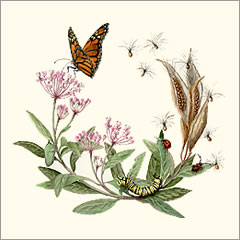
drawing courtesy of NC Botanical Garden at UNC Chapel Hill

Actually just found a good web site about "Landscaping with Native Plants" by googling native plants North Carolina. It lists some nurseries that sell seeds for native plants. I wonder where the seeds come from. I hope they're from propagated plants, so that wild stock are not being depleted of their seeds. One of the nurseries listed is nearby, so I'm gonna check it out....

Sunday, June 11, 2006

Working on an Organic Farm; Book Coming Together

photo courtesy of www.foodsubs.com

The pub date for our next book, about green consumer choices that really matter, has been pushed back to fall of 2007. So suddenly we have more time, which is very nice, as I've been driving myself insane working 14 hours a day. Sara Kate has been working hard on the book too - as her jobs allow - on a unit about the fishing industry. She interviewed a PhD who works for a fish sticks company, who dropped one of the many little gems Sara has discovered about the fisheries world. The scientist told Sara Kate that the workers at her company often pee in the vat where fish sticks are being mixed. Just for the hell of it, because they can.

Sara Kate is working on a unit now about soy products and dairy products. I eat a hell of a lot of soy....but I wish it was local. It's not. I do try to get organic soy products, so I'm not funding companies like Monsanto and Archer Daniels Midland who have already genetically modified most of our soy, corn and cotton crops, and are gearing up to tinker with the rest of our vegetable seed stock. Organic certification is our strongest weapon right now against genetic modification of our food supply.

Sara Kate and Matt are working on an organic farm in the mts of NC - Mountain Harvest Organics. The farm workers are Carl and Julie, the owners, and Mandy and Trapper, the other two hired workers. The farm has 35 clients who get a box of organic veggies and fruits every week, so it's a CSA. (A CSA - for Community Supported Agriculture - is a farm that signs up clients for a yr at a time, for an annual fee. The clients take whatever organic produce the farm has available for any given week.) The farm also sells organic produce at the North Asheville Farmers Market every week, and at the Waynesville Farmers Market.

Alan has done some pieces for the book too. He's written about the longleaf pine community, which used to dominate the Southeastern coastal plain, but has been almost completely replaced by loblolly pine plantations. E.O. Wilson, Harvard biologist and Pulitzer Prize winner, told me in an email last week that at least 90% of the biodiversity in a native forest is lost when the forest is replaced by a pine plantation. Alan did a piece about train travel and bus travel too, for the new book's section on green travel options. Bus travel, as it turns out, is the form of travel least costly in terms of energy use and overall environmental impact. Alan is getting ready to write something for the book about stream restoration - his job at present.

We are still looking for contributors on other topics - anything to do with green travel options, green housing, and eco-friendly diets. If you're interested in writing something for the book, email us at twogreenpencils@hotmail.com with your idea. You don't have to be an expert. We're interested in ordinary struggles of people trying to make sustainable choices.

"Some of them were dreamers....who were making plans and thinking of the future."
Jackson Browne, After the Deluge

Saturday, May 27, 2006

The Wildlife Trade, Forestry, and the Value of Activism

Photo from www.animalsvoice.com

We've been interviewing scientists and environmental activists about the global trade in wildlife, for the new book. We've also been interviewing and reading about the conversion of Southern forests to pine plantations, which are chemically managed monocultures that have only 5% to 10% of the diversity of a native forest, according to Harvard biologist E.O. Wilson. A pine plantation is essentially a factory farm. By the year 2040, estimates a US Forest Service official, 70% of Southern forests will have been clear-cut and replanted as pine plantations. Most of those pines are being used to make paper and fiberboard for construction. One solution to that is use post-consumer recycled paper, use less paper, buy FSC certified wood products and SmartWood certified paper products. But more about that in a later post. Right now, I want to tell you about the wildlife trade, and the power of activism.

According to INTERPOL, the international police agency, the illegal wildlife trade is a $10-billion-a-year business, second only to drugs in the amount of money generated illegally. The animals are sold for food, for laboratory research, for exhibition, and for pets.

Here's what else I discovered last week that shocked me: The United States is the world's biggest consumer of wildlife, both alive and dead. We import four times more primates than any other country, most of which go into biomedical research or pharmaceutical testing. I guess I naively thought that all primates used for medical experiments were bred in captivity. And the World Wildlife Fund says that most of them are. But....we're still importing more than 20,000 a year. An imported wild-caught primate costs only one-third as much as raising a primate from birth in captivity. So some of those raised in labs are sold to foreign labs, and replaced with imports. Obscene! Corporations will just use whatever is cheaper, with no regard for the cost to the planet, or the sustainability of such priorities. I'm tired of seeing that over and over - with farmed animals, with the management of cropfields and forests for timber, with the crops and animals that provide our fabrics, and with unskilled workers, especially agricultural workers and garment workers in the Global South. It's ugly.

The fact that corporations' only true objective is to maximize profits for the shareholder is dangerous to the planet....but we have to remember that those profits come from us, as consumers. We can withhold our money from companies using the most egregious practices. Paul McCartney donates a lot of money to cancer research, in honor of his late wife Linda. But he stipulates that the money cannot go to research that's using animals. Paul has written that money spent on health education, prevention, and screening is more effective in combatting cancer than animal research is. Apparently a lot of the medical research is due to inertia - just using animals because we always have. Some of that research can be done on tissues rather than live animals. We can all start asking more questions of biomedical research companies and drug companies, especially if we're making charitable donations to these companies, or investing in their stocks. They all have web sites with phone numbers to call, and addresses to send letters to. When you get a prescription filled, or buy an OTC drug, ask the pharmacist for the name of the company that made it. Then call them or write them a letter. Ask them for transparency in their testing procedures - tell them you want to know what animals were tested with that drug, and how the animals were housed and treated. Transparency - it's a good word, I keep seeing it in articles about corporate deception. If all of a company's practices are legit and above board, then there's no reason to keep anything secret. When something is secret, then for sure something is going on that the public would object to - if we only knew.

More and more, activist organizations are sending people undercover to work in research labs, in cosmetics testing facilities, in slaughterhouses, in sweatshops. We're seeing footage of what goes on, and we're learning to make demands.


One thing I keep seeing over and over, as I research all these different topics on environmental and labor and humane issues, is that companies often give way as a result of activists' demands. I'm really starting to think that grassroots activism can be just as powerful a tool as trying to get changes the nice and orderly way, such as working with legislators to get new regulations passed. Long and loud protests, with lots of media coverage - companies don't like 'em. Activism has been responsible for a number of reforms in the timber and paper industry, and in the meat industry. Because of PETA's demands, McDonalds changed their policy for the egg factories that provide their eggs. Now the cages can have only 5 hens per cage rather than 7. The egg factory we toured for our recent book Veggie Revolution had 5 hens per cage, and they were too crowded to lift their wings. But with 7 in the cage, they would've been unable to budge at all. It's a small step, yes, but a step in the right direction. And if you're one of the caged hens, it's a significant difference. It's a change that signals a more cooperative corporate attitude - which means more change is coming. In the timber and pulp industry, activist groups such as Forest Ethics and the Dogwood Alliance have been able to get Home Depot to carry 'Forest Stewardship Certified' wood products, and also to stop buying wood from the world's 10 most endangered forests. See The Home Depot web site for details. We (Sara Kate) took part in the Dogwood Alliance demonstrations that got Staples and Office Depot to agree to several forest-conservation measures, including phasing out products from old-growth forests, and carrying post-consumer recycled paper. See the Dogwood Alliance web site for info on those successful office supply campaigns.

From the Dogwood Alliance, a description of their grassroots campaign to change Staples policies:

"On November 12, 2002, Dogwood Alliance joined office supply giant Staples Inc. in a joint press conference to announce the company's public release of landmark environmental paper procurement policy. This announcement marked the end of a two-year campaign led by Dogwood Alliance and our partner ForestEthics and involving dozens of local, regional and national groups and thousands of individuals. Collectively, we generated over 600 demonstrations, 15,000 postcards, thousands of phone calls to the corporate headquarters and regional offices, hundreds of letters from concerned citizens, coverage in more than 10 national media outlets and over 50 local media outlets, introduced a shareholder's resolution, generated a letter to the CEO signed by over 150 religious leaders, and produced a public service announcement with the rock band R.E.M. This campaign victory is testament to the power of citizens joining together to demand corporate environmental accountability."

Now, when we go in Staples, we can buy post-consumer recycled paper. They didn't have it before. Scot Quaranda, one of the leaders of the Dogwood Alliance, says that they're working on new campaigns now with other companies that market forest products.

Being vocal and active can have results, especially when we join together.

But back to the topic of wildlife trade - another big piece of it is the trade in pet birds, especially birds in the parrot family - parakeets, macaws, and some others. They are extremely smart birds. One African gray parrot has learned to count up to 6 objects accurately and to learn language as well as chimps have learned it - combining words in new ways to ask for what he needs or to answer
questions.

But parrots are in trouble. According to the 2002 IUCN Red List of Threatened Species, 94 of the world's parrot species are considered to be threatened with extinction, largely because of habitat loss and excessive capture for trade.


Although the smuggling of wild-caught birds into the US has declined since the Wild Bird Conservation Act was passed in 1992, USF&W officials estimate that as many as 20,000 birds are smuggled in every year, just from Mexico.

What can you do about that? If you buy a pet bird - be sure and double sure that it was bred in captivity. Ask for documentation. Or better yet, call your local Humane Society or Animal Control office and see if there is a sanctuary for homeless pet birds near you. You may be able to adopt one. Sort of like buying vintage clothes, or burning waste veg oil in your diesel tank - you're not creating a market for it, and you're helping an out-of-luck bird.

We can make a difference. Especially when we work together.

Thursday, May 25, 2006

Need Advice about Cat Predation


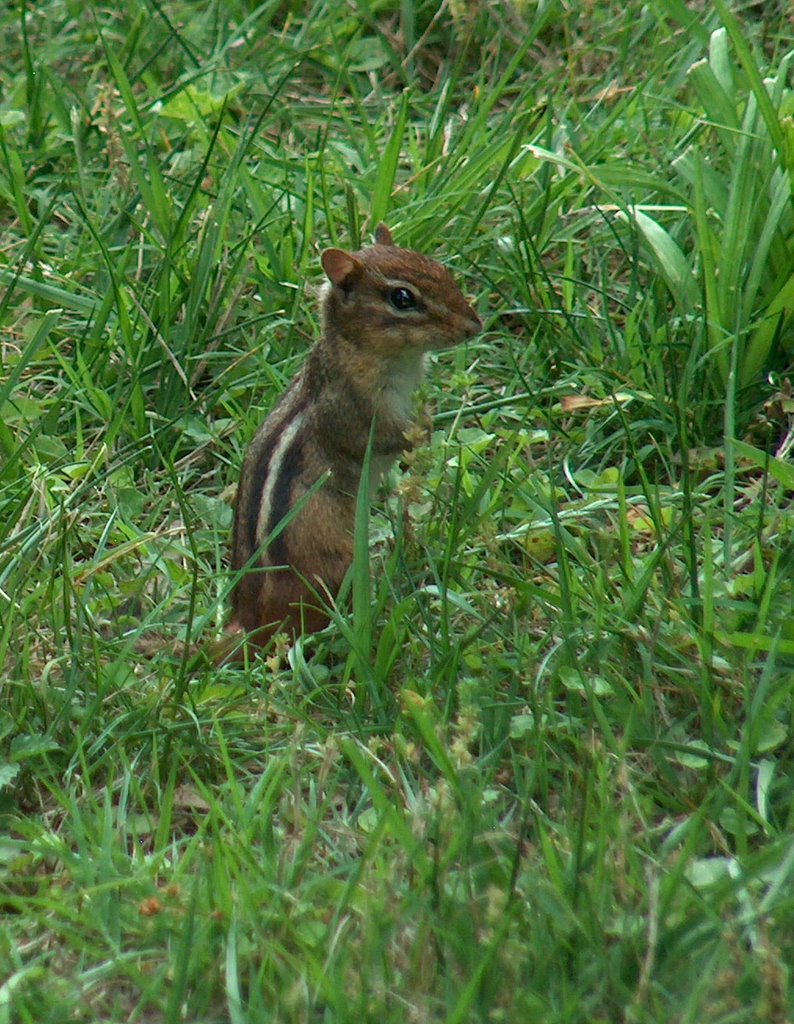
NOTCH the CHIPMUNK, photo by Alan Kneidel

I have to write about our favorite rodent again. This is a picture of our chipmunk matriarch, Notch - named for the notch in her left ear. She lives in our front yard. She chased away two of her almost-grown younguns, letting the third one take ownership of a hole on the edge of her 22 hole underground network. The other two she ran off completely. I watched her chase them repeatedly until they didn't come back. She was tired of nursing them, I think. I could see her nipples shrink back to normal after they left. Notch - what a fiesty little critter! Every afternoon she sits up tall on her haunches, like a meerkat, and surveys her queendom for an hour or two, looking for interlopers. Sometimes one of the cotton rats from the meager "woods" behind the house straggles into the front yard looking for morsels in the grass. If Notch sees the rat, look out! Twice we've watched her light into a rat twice her size, flipping both of them 6 inches into the air. She's a wild woman!

The neighborhood cats are still on the loose. The city gladly brought us out a live trap for the cats. Animal control will deliver and pick up the traps, and take away any cats in the trap. But the cat-owning neighbors saw it being delivered and got very upset, said they'd turn us in for parking on the street if we used it. Parking on the street is not illegal.... But we decided to hold off on the trap until the dust settles. We don't want to alienate the neighbors entirely. Meanwhile they got the collars with bells for the two Siamese cats. They're trying. I haven't told them that, according to the American Bird Conservancy, cats learn to stalk without ringing the bell. I did however deliver the kitties' prey to their front lawn a couple of days after they got the bells, so maybe they'll see for themselves.

What's interesting though is that I've talked to five other neighbors on my street in the last week, and on one street over, who all have major complaints with these same wandering and marauding cats. Three neighbors complained that the cats attack their own pets - both cats and dogs. Two neighbors complained specifically about bird attacks - on a nest of towhees and a nest of mockingbirds. Another neighbor complained that the cats poop in her back yard and her dogs eat it. All of them said they would participate in some sort of group effort to curb the cats.

One neighbor told me that anyone can act as a foster parent to animals from the animal control office, through the Humane Society. For free, all the animals' expenses paid! This is my next door neighbor. Her family gets animals all the time and keep them for a couple of weeks, then take them back. (They have two dogs of their own.) She said that keeping the animals as foster parents makes the animals more adoptable later for some reason. Because they leave notes about what a well-mannered pet it was or something? I'm not sure. Anyway one option for us, in the quest for cat control, is to get a dog for a few weeks. When we had our dog, the cats rarely came in our yard. But we didn't have many yard animals either. Not because the dog caught them, but because her activity kept them from settling here. I like the rodents and the birds. I saw a possum in the yard about a week ago, in broad daylight.

I know that one day, soon, the cats will get Notch. I found a cardinal wing in my next door neighbor's yard today - a cat victim no doubt. My husband the ecologist said, well at least Notch has already reproduced. I just hope I'm not watching from my writing table in front of the bay window when it happens. What should I do? Put out the trap and let the neighbors be mad? And when I catch the cat, what should I do with it? Return it to the neighbors? Or call animal control to come get it? I'll probably only get one chance, because I doubt the cat will go in the trap twice. I will have to tell the neighbors before I set the trap that I'm doing it. So they'll have the option of keeping the cats indoors, and so they can be prepared to pick up kitty and pay whatever it costs to get kitty back. I'll tell them if animal control takes kitty away, and I'll also make sure that the cat will be held there safely for several days awaiting retrieval.

In case you didn't read my last post on this subject, domestic cats in the US kill hundreds of millions of songbirds every year, many species of which are already threatened by habitat loss. Domestic cats also kill a billion small mammals every year, in the US. (US Fish&Wildlife data.) Thirty-five percent of cat owners keep their cats indoors all the time. Two-thirds of vets recommend that cats stay indoors all the time. Indoor cats have a life span of 15-18 years; outdoor cats only 3 years. If you want more stats and sources of official info about cat predation and bird conservation, see the previous post.

And tell me what to do!

Saturday, May 13, 2006

Neighbors' House Cat and My Yard Rodents


Eastern Chipmunk photo by Alan Kneidel


This is an update to a post from May about two cats in my neighborhood killing wildlife, and my efforts to stop them. Things are looking up!

I'm writing on a table by the window in my living room - I'm compelled to sit here because I'm obsessed with my neighbor's two Siamese cats. I feel like I have to keep an eye on the front yard every minute if I want to have any surviving wildlife on our property. This morning I came into the living room to open the blinds, and happily spotted a baby chipmunk bounding through the grass. I turned my attention to the blinds for a moment, and back to the chipmunk just in time to see one of the cats pounce on it. I was out the door in three seconds, and the little chipmunk got away, but whether it'll survive, I don't know. Less than 20% of cat prey that "get away" recover from the attack.

We've really been enjoying our chipmunks this spring. We have 22 chipmunk holes in the front yard! All 22 holes apparently lead to the same burrow, occupied by a mother with a notch in her ear, and her three youngsters. We're not usually the type to give names to yard wildlife, but the chipmunk family has been such a daily presence - I've gotten attached to them in spite of myself. They've moved me to make a spectacle of myself on more than one occasion. Three days ago, in my PJs, hair unbrushed, I chased one of the cats out of the yard with a chipmunk in his mouth, the critter still breathing and struggling. I banged on the neighbors' door; Craig came out pleasantly enough to ask what the trouble was. I explained and implored him in a kindly if highly distressed fashion to please keep the cats out of our yard, especially now in springtime, because we have so many baby birds and small mammals in our yard right now. He helped me try to retrieve the captured chipmunk, but as usual, the cat slunk away with it to who knows where.

We've been living across the street from these people for - what - 12 years now? Can that be right? I think it is. We've been cordial neighbors for all that time, if not bosom buddies. The cat issue has only recently come to a head because we had a Jack Russell terrier up until last year that kept the cats out most of the time. Our dog died of cancer last fall. And now the cats are in our yard constantly.

This morning I called the cat-owners and left a message, asking if I could come over and talk about the cats, in a calm state of mind. So, an hour ago, they called me back and said bring it on. I did. I was prepared. I had spent all morning trolling for research to print out about cats and birds. I've known for years that free-roaming cats kill hundreds of millions of songbirds and more than a billion small mammals every year in the United States. But...once again thanks to google....I found tons of new documents about cats destroying wildlife.

Meeting the neighbors, I decided to start my persuasive arguments on the dangers, to a cat, of a life on the prowl. HSUS, the Humane Society, has a great paper about that. Their most compelling point is that free-roaming cats have an average life span of less than three years, compared to 15-18 years for the average indoor-only cat. Outdoor cats fall victim to cars, predators, and disease, among other things. Two-thirds of vets recommend keeping cats indoors at all times. Many shelters now require adopters to agree to keep cats indoors; more and more communities are passing leash laws for cats as well as dogs.

I also printed out for the neighbors a document from the American Bird Conservancy called "Human Attitudes and Behavior Regarding Cats." It's a really interesting paper full of cat stats, such as:

35% of cat owners keep their cats indoors all the time
53% of cat owners are concerned about cat predation
64% of survey respondents believe putting bells on cats keeps them from killing (untrue)
70% of respondents believe cats should be regulated to prevent roaming

I gave my neighbor these printouts, then I turned in earnest to the wildlife issue. Songbirds in this country are threatened by the growing human population in lots of different ways. The most serious threat is habitat loss. Second is collision with windows. And third is predation by house cats. A recent Wisconsin study cited by the US Fish & Wildlife Service estimated that domestic cats kill more than 39 million birds annually, in Wisconsin alone. Obviously, if it's that high in one state, then it's probably a billion nationwide.

Mention cat predation as a threat to songbirds, and lots of people will say "Oh that's just nature." The major of Charlotte, Pat McCrory, said that when questioned by the media a couple of years ago. Just blew it off as the natural order of things. That really bugs me. Cats are not natural, and they're not native to the US. Domestic cats originated from the European and African Wild Cat, Felis sylvestris. They're an introduced species, like kudzu or starlings. The European colonists brought them to the US, and their numbers are increasing here - from 30 million in 1970 to 60 million in 1990 (according to a University of Maine paper).

Here's what mixes people up. Sure predation is natural. I have no objection to predation by native predators such as Cooper’s Hawks, Great Horned Owls, Bobcats, and Gray Foxes. Populations of native predators are in balance with their prey. If prey numbers decrease, then predator populations decrease too, giving the prey population a chance to rebound. Plus, wild predator populations struggle with other challenges, such as parasites, disease, harsh winters. They’re not always in prime condition, not always efficient at catching prey. They may be able to catch only the sick, the weak, the old, the very young.

House cats operate totally outside of that balance of nature, because they're sustained artificially by their owners. They’re usually well fed, in good health. They’re very efficient predators, able to easily catch small mammals and birds in prime breeding condition. Being well-fed does not diminish cats’ hunting instinct – hunger and hunting are controlled by different parts of the brain. Not only that, but domestic cats prowl in much higher densities than natural predators. There might be a single Great Horned Owl in 10 square miles, but there’s a healthy house cat in every third house.

Turning a house cat loose on a neighborhood of wildlife is like sending a posse armed with assault rifles after a wounded deer. The advantage is that great. I see it every day. I see one of the cats carrying yet another animal out of my yard. I’m sick of it.

So anyway, back to the neighbors. I laid out my arguments in as brief and pleasant a manner as I could, sitting with them on their front steps. "So what is it you want us to do?" asked the wife of the family. “I’m asking you to keep the cats out of our yard,” I said quite plainly, as pleasantly as I could. "We can't do that," she said. She explained that the cats have been outside for ten years, and they like it outside. I knew that, I've been watching them hunt in my yard for ten years. But I had said my thing, it was time to give it a rest. So I thanked them for listening to me and, leaving my articles behind, I walked back across the street, back home.

Two hours later….TWO HOURS LATER....there goes one of their cats down our driveway with a cotton rat. (Cotton rats are native woodland rodents, bearing little resemblance to the introduced Norway rats that invade houses and carry diseases.)

July 22 update: The encounter with the neighbors happened several weeks ago. About a week after the conversation, still seeing kitties day and night, I called Animal Control plus the county Conservation Science office. Both county offices said they would bring me a live cat trap. Animal Control said if I actually caught one of cats, they would come pick it up and take it away, and the neighbors could retrieve it unharmed So I had a trap delivered, for free. It was big enough for a bassett hound - or 4 cats. The cat-owning neighbors saw the trap being delivered. They were not happy about it, and came over to tell us so. But it had its effect. I never actually set the trap. Rather I left it in the yard for a few days. Since I work at a desk that faces out the front window, I also took every opportunity to chase the cats noisily out of the yard, slamming the door on my way out. A couple of weeks after our first conversation, I noticed that the neighbors had put bells on the kitties' collars. I know bells aren't effective, but it was a sign that the neighbors were making an effort. I began to see the kitties less and less. I think they were gradually keeping the kitties inside more. I rarely see the cats now. Maybe twice a week I see them walking down the opposite side of the street. I haven't seen them in my own yard for at least three weeks. In fact, I haven't even seen them on my side of the street for weeks. I also haven't seen any dead birds or wounded mammals in the yard for weeks. Yay!!

I know cats are at the mercy of their instincts, but cat owners are able to make choices. There is no good reason to let house cats roam freely. A 2006 paper by ecologists in Wisconsin lists a number a resources and other papers that will be useful to anyone researching this topic.

I would love to hear from readers any other stories of neighborhood cats on the prowl, with good endings or bad.


"Underground Transit" - A Great Show by Scott Turner Schofield

photo from Scott Turner Schofield's web site

Last night Ken and I went to see "Underground Transit," written and performed by Scott Turner Schofield. It was the most interesting show I've seen in a while - very well done. Turner's one-man show narrates his struggles with gender identity and the happy resolution. I was impressed with the writing and the performance, how easy it was to understand and follow the twists and turns of his personal journey. The show was intensely personal, but not uncomfortably so.

Turner struck me as a well-adjusted and happy individual, at peace with his own process, supported and nurtured by his family and the people he loves. In performing for the last 6 years, he has built up quite a supportive community of followers. In the Q&A session after the performance, he came across as open, funny, articulate, and predisposed to like everyone around him. He's successful, and I understand why. He's not bitter - rather his message seems to be to celebrate the diversity of humanity, including the transgender community. He also wants us to understand that gender identity and sexual orientation issues can be very painful for adolescents, leading to high rates of suicide. Although Scott was student body president at his high school, and "almost home-coming queen," his high school and college years were difficult. The particulars came through clearly in his show.

I came away from the performance feeling glad that the community of gay and transgender youth has such a charismatic messenger. I hope that Scott's success in his one-man shows catapults him into TV, where he can play a transgender character. He would like to do that. I can't imagine a better candidate than Scott, and I think TV is ready for such a consciousness-raising move.

See Scott's web page at http://www.undergroundtransit.com/turnerpage.html

Sunday, May 07, 2006

A Solar Home and NC GreenPower


Wouldn't it be great if everybody made their own electricity, so the power companies would stop building nuclear plants and trucking plutonium down the interstates? Duke Power is planning their fourth nuke plant, in Cherokee County SC, just 50 miles from Charlotte. AACK! We're surrounded!

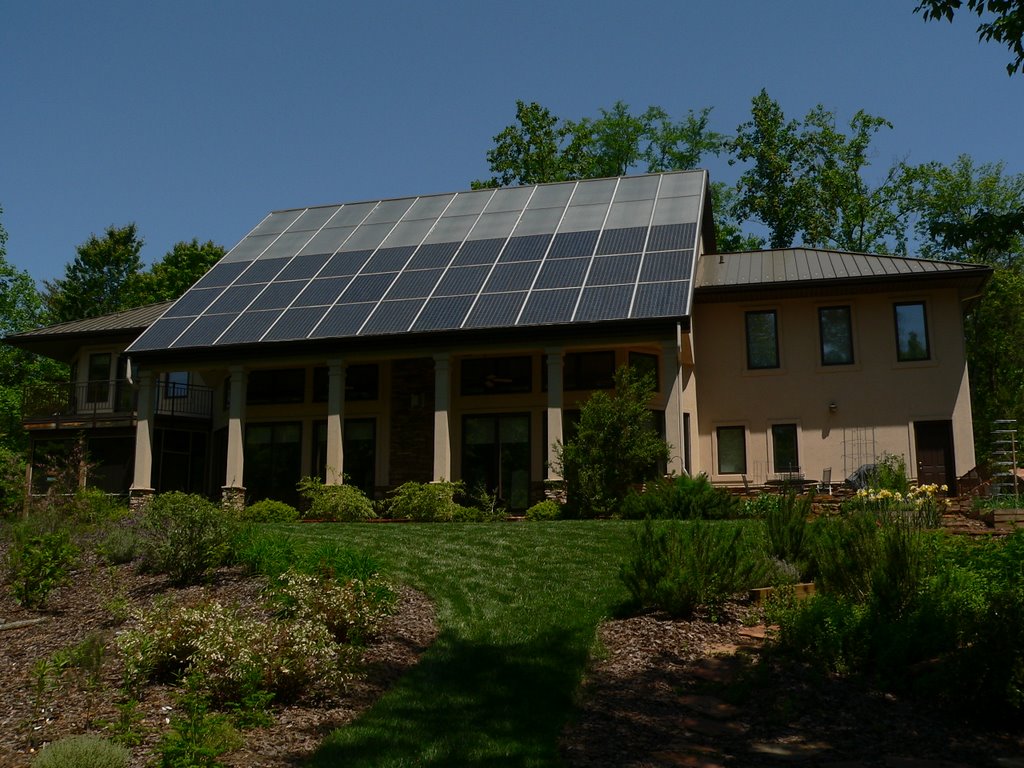
Knowing that makes me appreciate people like Trip Overholt and Jeff and Bronwen Martin all the more. Their two families have gone solar - they've built homes that are mostly powered by photovoltaic panels. You can read about the Martin home in Solar Today magazine. Ken and I got a tour of the Martin home last weekend and it was impressive. I liked the front yard right off. No lawn, just native shrubs and flowers and ground cover. That's very cool. Wildlife benefit much more from native plants that they're adapted to. As soon as you step in the Martin's front door, you can tell the house has a passive solar design - which is totally separate from the photovoltaics. A passive solar home doesn't require any technology, but is heated and cooled passively, by virtue of its orientation, shape, and windows. An ideal passive solar house is a rectangle, with the long axis running north to south. The south wall has lots of big windows to admit warming rays of sunlight during winter. The south wall also has a big overhang to stop the sun from shining directly into the windows in summer. The overhang works because the sun is higher in the sky in summer. A passive solar house also has a thermal mass, something like a concrete floor, to absorb heat during the day and radiate the heat slowly into the air at night. The Martin's home has all these features.

As Jeff explained to me, a homeowner should have a passive solar design before adding photovoltaic panels to generate electricity. PV technology is expensive, and if you want most of your power to come from PV, then you need to do what you can to minimize your power use beforehand. The biggest energy drain in an American home is typically the heating and cooling system. Passive solar cuts way down on the amount of electricity a home might use for heating and cooling. Even just a blower for a heat pump uses a lot of power, and an air conditioner uses a ton. Trip, another PV homeowner, told me, "If you want PV power, that means no AC."

The second biggest user of power in a typical American home is the hot water heater. So a lot of PV homes have solar thermal systems to heat hot water. The Martins had that too. The roof on the southern side of their house had solar thermal panels across the top, and photovoltaic panels across the lower part of the roof. Water travels through channels in the solar thermal panels, which have a special black surface to absorb heat. The hot water travels to a water tank where it's stored until needed. The Martins also have radiant floor heat. Tubes from the hot water tank are imbedded in their concrete or gypcreet floor. When a thermostat triggers the system, hot water moves through the tubes, heating the floors and the rooms. Although, Jeff Martin told me, their passive solar works so well, they never use the thermal floor heat in most parts of the house.

We looked at all the electrical hardware in the Martin's basement for converting the power from the PV panels into AC (alternating current) electricity that the home can use, and the batteries for storing the power for nighttime use. The Martins often produce more power than they need, on very sunny days. They sell their excess power to NC GreenPower, a nonprofit that exists to support sustainable energy sources. We as consumers can get our own power from NC GreenPower by checking the box on our Duke Power bill and paying $4 extra per month. Jeff said NC was the 39th state to give consumers a green power option, so most states already have that. Apparently.

Anyway, it was all very cool. I read this weekend that a single home using conventional power is responsible for 34 tons of greenhouse gas emissions over its lifetime. You can avoid a big part of that by using photovoltaics for electricity, a solar thermal system to heat water, and a passive solar home design. If you can't afford the PV part, the other two are less expensive and go a long way toward cutting power needs.

Mike Beaver, the guy who installed the Martin's solar thermal panels, the radiant floor tubing and all their hot water apparatus was very helpful to me on the phone, answering my questions. Mike's company is Beaver Brothers, Inc. A helpful resource for finding solar professionals across the country is Find Solar. In North Carolina, NC Solar Center at NC State University and NC Sustainable Energy Asso. are useful sources of information and professional contacts. Even though photovoltaics are expensive now, everyone seems to agree that increasing demand will increase production and eventually decrease costs. That's what happened with the computer chip, which not too long ago was considered too expensive for widespread use. With demand, prices dropped. That's how it works. So thanks to folks like Trip and the Martins for being the frontrunners.

Thursday, April 20, 2006

Hemp Clothes

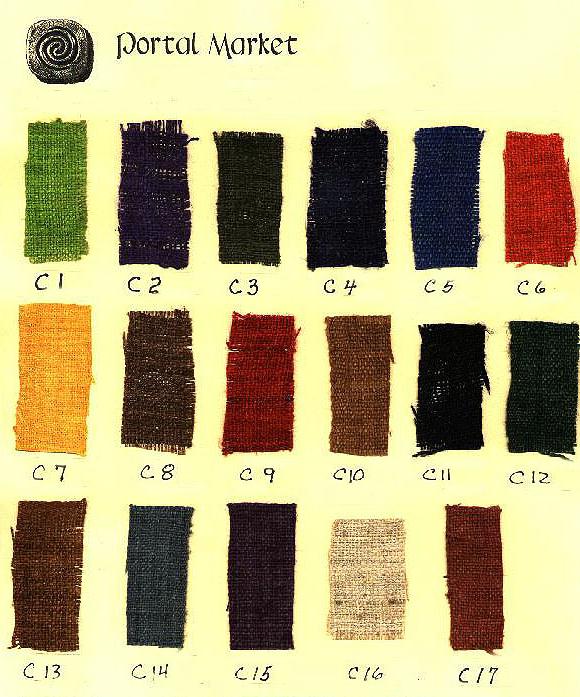
The picture shows hemp swatches. I've been researching hemp clothing for the new book. Just how eco-friendly is it? By all accounts, it's much better than conventionally grown cotton, the most pesticide-intensive crop in the world. I've been wondering though, if hemp is so great, how come most of the hemp-clothing vendors online don't promote their clothing as organic? I got the answer today. I called a major hemp vendor in California; his web site sells hemp clothing and other hemp products. He reminded me that it's illegal to grow hemp in the US, because it's technically the same plant as marijuana. I knew that, just forgot. Hemp however is from a variety of Cannabis that is useless as a mind-altering substance, because it contains hardly any THC. The hemp vendor I called told me that virtually all the hemp sold in the US is grown and manufactured into textiles in either China or Romania. I told him I had just seen the video "Wal-mart: the high cost of low prices" about Chinese sweatshops. I told him I was leery of any clothing manufactured in China. He said he'd been to one of the factories that produces his textiles. What was it like?, I asked him. It was "just a regular factory" he said. I didn't think to ask him about wages or hours per week on the job - those are two things that define sweatshops. Plus child labor and dangerous working conditions. I should call him back. But anyway, he pointed out to me that fabrics grown and manufactured outside of the US are not going to be certified organic by the USDA, because the USDA certifiers are not in China and Romania.

He said even though hemp is not certified organic, it is earth-friendly. My reading has corroborated this. Hemp just doesn't have the voracious insect pests that are attracted to cotton, so pesticides are not needed. At least, they're not needed as much.

I asked him about bamboo fibers. Of course, I expected he might have a biased answer, since he sells hemp clothing and hemp other stuff. But I thought he might also have something interesting to say. He did. He said bamboo is not a natural fiber like hemp or cotton because there is no usable fiber in the bamboo itself. Rather the bamboo is ground up and treated with chemicals that turn it into a liquid. Then the liquid is shot out from something like a showerhead. The extruded streams of liquid harden into the fibers that are woven together to make bamboo fabric. Hmm. Didn't know that. That's not necessarily bad, unless the chemicals are bad. Need to research that, call some bamboo fabric vendors. See what they have to say about that. The plot thickens...

I've discovered in my perusal of various sources this week though that bamboo is grown in China and woven into textiles in China. Just like hemp. Now wait a minute! I don't want to wear clothes made in China! After the "Wal-mart: the high cost of low prices" documentary about abusive labor practices and sweatshops in developing Asian countries, I don't want anything produced there. So we're back to cotton. Organic cotton. Cotton uses a lot of land, even organic cotton. But....at least some of it is made here in the US. I need to research more about wages and working conditions of cotton laborers in the US. And I need to read about linen from flax.

But you know what the best answer is to the "green clothing" dilemma. Buy vintage clothing. I get most of my clothes from thrift stores. Three-fourths of used clothes wind up in the land-fill, so if I'm buying used stuff, I'm pulling it right out of the waste stream. I'm not supporting sweatshops or environmentally damaging practices.

I'm lucky though, we have a couple of really good thrift stores in my town, where the clothes are in good shape and easily accessed. The best one is run by AmVets.

More later on bamboo, hemp, and linen.

Monday, April 17, 2006

Red, Red Mulch


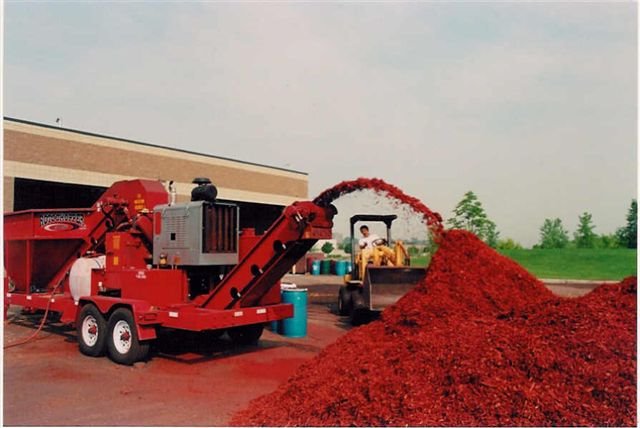
Yesterday afternoon I was holed up at my work table, reading about organic cotton, and conventional textiles and toxic commercial dyes. I was working on the eco-groovy clothing chapter for the new book. Needing a stretch, I wandered out into the front yard. I noticed straightaway that the next-door neighbors had just heavily mulched their flower bed with a kind of mulch that's dyed red; it looks like dyed red hair. It's a garish bright red. Egads I said to myself. Their flower garden is just uphill from our organic vegetable garden, just a few feet away. I picked up a handful of red, red mulch and brought it inside, put it in a cup with a little water. After 30 seconds, I poured the water into a white cup. The water was dark red, opaque; the cup was stained red. I went back outside and looked at one of the mulch bags lying in their yard. It said "Red Colored Mulch." Manufactured by P&L Bark Nursery in Pageland, SC.

I came back inside and looked at one of the textiles articles I was reading. It said, "Virtually all commercial dyes are toxic, made from petrochemicals with heavy metals."

Okay so now what, I wondered. I really like the neighbors, a nice couple with a 14-year-old son. But I definitely didn't want that stuff in the veg garden. So I went and knocked on the door,
next door.

The son came to the door, parents were out. I told him how nice the flowers looked. He bought all the flowers and all the mulch himself, he said, an early mothers day gift. He planted them all and laid all the mulch down himself. (Ouch.) His hands and arms were still red. He liked the red mulch, he explained, even though it cost more than the non-dyed mulch.

I showed him the red cup and explained about the organic garden, and toxic dyes. "But" he said "I thought if the government says it's okay, you know, if they sell it at Home Depot, it must be okay." Well. "I used to think that too," I said. "Then I started reading. Started calling people, interviewing people. Just because someone sells it, doesn't mean it's okay." We talked, in a friendly way. I told him I would be happy to scoop it all up myself, buy more un-dyed mulch and lay it down. I just needed permission to begin. He called his mom on her cell.

An hour later we were all scooping up mulch. In about 30 or 40 minutes we scooped up 8 bags of red, red mulch, enough to fill both roll-out trash bins, theirs and ours. We cleared it out of their flower garden. I offered to buy more mulch, 8 more bags. They declined.

We actually had a very friendly conversation during the whole thing. I was very nice, they were very nice. It probably improved our relationship. I was as extremely affirming of the son as I could be at every step. He deserves it; he's a neat kid.

The next morning I put money to reimburse them for all the mulch into a card, a nice card, and taped it to the inside of their door. Said do what you like with it.

Now they have mulch-less flower bed. The soil is still a little red, from the one watering he gave it before I saw it.

Shouldn't we have more limits on chemicals in the environment? Dye on mulch serves no purpose at all. It's not even pretty. I think about the kid's red arms. I told him to wash them. I hope he did.


Sunday, April 16, 2006

Here's Your Chance to Tell It Like It Is


Blog readers:


We are looking for original content from writers and non-writers on the subject of personal experiences with green choices.


It's for our book, from Fulcrum Publishing, 2007, tentatively titled How Americans' Spending Habits Shape Our World by Sally and Sara Kate Kneidel.


Like our last book, Veggie Revolution, this book will be rich with "community voices," your voices - brief quotes or short essays from actual experience. If you try to use your bike or ride the bus instead of driving, we'd like to hear what that's like for you, good or bad.


The writing does not have to be perfect. A casual, conversational tone is often more effective. If you have comments that are journalistic or op-ed, that could work as well. Most pieces we use are 200-1000 words. Longer or shorter submissions may be considered if especially interesting or unusual.


Your green experiences do not have to be exemplary to make good reading. In fact, imperfect efforts are sometimes more interesting. As Kermit says, It's not easy bein' green.


Some topics we hope to read:


On transportation:

any experience you have with hybrid cars, cars using biodiesel or greasel, mass transportation, walking or biking, communities designed to minimize travel to work and shopping

On green housing:

any experience you have with energy-efficient construction, green building materials, living off the grid, living in a passive solar house, a straw bale house, a rammed earth house, earth bag house or other earthen construction, a recycled house (an older house relocated to a new lot), a home that shares walls and green space with neighbors, close to work

On green fabrics and clothing:

organic cotton or wool, hemp, bamboo, recycled or vintage clothing, etc.

On the trade in pets taken from nature:

tropical birds, reptiles, amphibians, etc., both exotic and local

On green diet choices:

local, seasonal, vegetarian, vegan, pastured, organic, etc.

On green vacation choices:

places you might volunteer to do environmental work, involving less fossil fuel for travel

On green career or volunteer choices, especially ones that you have chosen or considered:

On deforestation by giant lumber companies for the paper industry, especially if you have worked in a chip mill or have personal experience with this

On problems and solutions related to world population growth, especially in terms of land use, fuel, energy

On globalization and sweatshops, especially if you have visited one

On the problems associated with huge corporations like Wal-Mart, International Paper, Smithfield, Tyson, etc.

The deadline is June (prefer early June). We can use your first name, first and last name, or you may pen anonymously. It's up to you.

Please send submissions to treeduck@earthlink.net. Send also a statement, in the email, saying that you (write your name and date) give us permission to use the piece in the book, specifically in How Americans' Spending Habits Shape Our World by Sally and Sara Kate Kneidel, from Fulcrum in 2007.

To help us distinguish submissions from junk mail, please put “book submission” in the email’s subject line. Feel free to query first. Although we may not be able to use all items submitted we will do our best to consider everyone’s experiences as part of the overall project. We’ll also post any omitted submissions on our blog, http://veggierevolution.blogspot.com.

Thanks!

Sally Kneidel

Organic Cotton - It's Worth Every Penny


I've been researching organic and natural fibers for the new book. Fascinating. It makes we want to smack my forehead - for all the years I spent with my head buried in the sand.

Here's the crux of it. Cotton is advertised as a "natural" fiber, as opposed to, say, nylon or rayon. And cotton can be natural. But, as some of you may know, cotton is one of the most pesticide-intensive crops there is. I've been hearing that for a few years, as I went right on buying cotton underwear, jeans, corduroys, T-shirts, sweatshirts. But I didn't really get it until this past week, which I’ve spent reading articles about the textile industry.

It takes a pound, a whole pound, of pesticides and fertilizers to produce enough conventional cotton to make one T-shirt and one pair of jeans!

Cotton uses 25% of the world's insecticides. In the US, cotton is second only to corn in the tonnage of pesticides used. (Corn is the heavy because it's the mainstay of the livestock industry. Fifty-six percent of the corn we grow is fed to farmed animals that will be served up on the dinner table. Now even more corn is being grown to provide ethanol as a gasoline additive. But that's a topic for later.)

What about those pesticides on cotton? Five of the top nine most commonly used cotton pesticides are Class I or Class II chemicals - the most toxic and carcinogenic pesticides. Like all chemicals, they're dispersed to some degree in the environment when they're sprayed on fields or crops. Ingested by birds, mammals, reptiles. Toxic to amphibians and fish living downstream from sprayed fields.

Here's something that surprised me. Two-thirds of the cotton crop winds up in our food chain! So we're eating all those pesticides too! Cottonseed oil is common in processed food. And cottonseed hulls or meal is a common "protein supplement" for cattle.

Cotton is also extremely toxic to workers. Ninety-one percent of laborers in the cotton industry have a diagnosed health disorder of some kind.


What about clothing consumers? All these toxins wash out when the T-shirt or jeans are washed - right? That's what I've been thinking all these years. No. They are slowly emitted during the lifetime of the garment. What about "easy care" or "permanent press" cotton? Formaldehyde. That's what makes them "easy care".

What about the dyes? "Virtually all commercial dyes are toxic petrochemicals, many contain heavy metals," said one of the documents I read last night. Like the pesticides, these dyes have their impact on the workers in the textile mills. They also have a heavy impact on the environment, because, at some point, the dyes wind up as wastewater. Dyes in particular are hard to remove from water, so cleaning or filtering processes, when attempted, often fail. To cut to the chase, even in the best circumstances, the dyes wind up in rivers. In developing nations, where many or most textile mills are located these days, the dyes can often be piped raw and unfiltered right into the rivers, with no effort at all to extract them from the wastewater. That's the beauty of overseas textile mills and sweatshops in empoverished nations - no labor laws to protect workers, no environmental regulations, no functioning governmental infrastructure to care one way or another what goes on.

I hate to be the bearer of bad news. But, man, we need to be supporting the providers who are trying to make a living offering organic fibers. I said to my husband last night, we're not buying anymore conventionally-grown cotton socks or T-shirts or underwear or anything. Period.

Here's the good news:
there are lots of alternatives to conventional cotton.

Here are the alternatives as I see them.

Organic cotton: It’s grown without the massive amounts of pesticides and fertilizers used in conventional cotton cultivation, which is a huge advantage for the environment, for laborers, for consumers. Organic cotton products cost 25 to 50% more, but not choosing organic, for me, feels like once again sticking my head in a hole and saying, it’s not my problem. It is my problem. I want to be engaged with the world enough to say it is my problem, and your problem, and his problem. We have to take responsibility, choose who we wish to fund, refuse to participate in corporate systems that are screwing the environment, laborers, and consumer health.

If you google “organic cotton” or “organic fibers” you’ll find organic cotton vendors online. Organic cotton isn’t perfect – the cotton dust can still cause respiratory ailments for workers. And the USDA organic certification only applies to how it’s grown. It doesn’t apply to the manufacturing process. But the Organic Trade Association offers an additional certification for the manufacturing process, which affects the use of formaldehyde to reduce wrinkling, and the use of toxic dyes.

Vintage clothing: Ah, yes. Being a cheap-skate and bargain-hunter, and being poor (struggling writer married to high school teacher), I partake heavily of the thrift store offerings in my town. We have a great thrift store, operated by AmVets. Every so often, when I’m with Sara Kate, we stop and do an inventory of what we’re wearing at the moment, how much of it came from Community Thrift. Usually I’m about 90% clad in Community Thrift items: shoes and socks included.

Thrift store purchases are guilt-free. The average American buys 48 new clothing items every year and discards an almost equal number. Most of the discards wind up in the landfill, about 10% are recycled. Of the recycled, about half make it to thrift stores. The rest are shredded to make blankets or commercial rags, and I don’t know what else. True, some thrift store items can still have toxic dyes – any dye that bleeds into laundry water is also absorbed into your skin when you wear it. But at least I’m not funding the corporations that are trashing the environment and exploiting laborers to offer cheap new products. Instead, I’m funding a non-profit with a humanitarian mission.

Organic wool:
I was surprised to read about all the toxins used to produce wool, a lot of them in the form of dips applied to the living sheep to kill parasites. Again, these miticides and so on are toxic to both workers and the environment, not to mention the animals themselves. Organic wool is grown without the use of these pesticides.

Linen (from flax) and hemp have their merits as clean and green alternatives to conventional cotton, in some cases. We’ll write more about those in the book, and in later blog entries. I read a good bit about bamboo fiber yesterday. It seems to have a lot going for it, in that it doesn’t require heavy use of pesticides or fertilizers. It also grows to maturity in three years and doesn’t need reseeding. And from what I’ve read, it can be as soft as cotton, which hemp is not. But, bamboo is typically grown and manufactured into textiles in China. After watching the documentary, “Wal-Mart: The High Cost of Low Prices,” I’m leery of anything manufactured in China because of labor concerns. That movie documented exploitive working conditions and abysmal wages for workers in Chinese factories. Also, none of the vendors I came across who are marketing bamboo clothing online are claiming to have an organic product. So…I’m not sure about bamboo yet. I plan to make some phone calls next week.

So. As I discover more, I’ll report it here, and in our upcoming book from Fulcrum in 2007. The working title was The Power of Your Pocketbook, but is now How Americans’ Spending Habits Shape our World. Fulcrum will most likely select a new title altogether after the book is completed.

I would love to hear from you readers about your adventures in trying to sort through the new alternatives to conventionally produced fabrics: your impressions, frustrations, and successes. We’re looking for reader submissions to include in the book. You can send submissions to treeduck@earthlink.net.