Monday, November 23, 2009

A review of Jonathan Safran Foer's book: Eating Animals


A book review by Sally Kneidel, PhD


As a biologist and co-author of two books about the meat industry, I was asked by Jonathan Safran Foer's publicist to review Foer's new non-fiction book Eating Animals. I confess I didn't want to read it, because the topic can be distressing. But I'm glad I did. It's among the best books I've ever read on the topic: remarkably thorough and well-documented.  From the first page, the quality of Foer's writing impressed me. Foer is a novelist, and his talent for telling personal stories was evident throughout. He used his own uncertainty, and his need for answers, to pull me into his journey of discovery, an investigation motivated by the birth of his son.

Among the book's strengths were long quotes from his conversations with people who work with livestock, or work on behalf of livestock. He interviewed factory farmers and farmers who raise livestock more humanely, animal-welfare advocates and animal-rights activists, making clear distinctions between the different points of view, and letting all of them speak for themselves. Foer quoted significant passages from the writings of Michael Pollan and Gail Eisnitz, and described the fascinating work of Temple Grandin. I thought he did a great job of getting at the essence of each person's perspective, and identifying contrasts.

Since I write and blog about diet and livestock myself, I can't say I was surprised at anything I read.  But I was yanked back into full awareness of all the issues, all the arguments, and the disturbing aspects of eating animals. My friend Beth, also a vegetarian, read Foer's book and pointed out that he helps us see how we all rationalize what we do. That's true - and he started with his own rationalizations, which made me as a reader more willing to examine my own.

After I finished the book, I let it sit for a couple of days, and what rose to the surface for me were his descriptions of animal abuse in the meatpacking industry. I've always felt that many controversial issues in our culture, even medical topics, can be resolved simply (for me) if I ask myself about any suffering involved. Which choice will cause the least suffering?

That query can be applied here too. Does raising livestock for consumption involve suffering? It does indeed, on a scale that rivals any other source of suffering on the planet. If you doubt it, read Foer's book. Raising livestock will eventually cause the suffering of every being born onto this planet, human and nonhuman, because raising livestock is responsible for 51% of annual worldwide greenhouse-gas emissions. (Foer's data on that are out-of-date, which is not his fault since the book went to press before the latest analysis by Worldwatch Institute.)  Greenhouse-gas emissions will eventually cause mass-extinctions of wildlife, widespread drought and starvation, inundation of coastal cities, climate refugees, etc.  As time goes on, the global community will become less and less tolerant of Americans' disproportionate consumption of resources (including meat) and our disproportionate generation of waste.  Who knows what lies in store, but change is a-coming, and the livestock sector is largely responsible.

To make one more point on the subject of suffering - where is the suffering in not eating animal products? There is none. As Foer wrote, quoting animal-rights activist Bruce Friedrich, "I certainly agree that if someone is going to eat animals, they should eat only grass-fed, pasture-raised animals - especially cattle. But here's the elephant in the room: Why eat animals at all?"  Indeed. Why?

I highly recommend this book and feel grateful to Foer for the time and effort he invested in covering so vast, so troubling, and so vital a topic. I think his book should be part of every high-school science (or literature) curriculum. What a difference that might make. I can see how the birth of Foer's child could motivate his momentous undertaking; this important volume could impact the future of my children, your children, and our grandchildren from here to the end of our planet.

Some of my previous blog posts on the meat industry:
Livestock account for 51% of annual worldwide greenhouse-gas emissions.

Ground beef: a risky choice for families and the planet.

Is local food the greenest choice?  A new study says no. 

Less meat....smaller footprint.

Smithfield blamed for swine flu by Mexican press

This virus is a swine flu and has roots in N.C., the land of Smithfield

New study: meat impacts climate change more than "buying local" 

More information on the subject:
Sally Kneidel, PhD, and Sadie Kneidel. "Veggie Revolution: Smart Choices for a Healthy Body and Healthy Planet". 2005. Fulcrum Publishing.

Sally Kneidel, PhD, and Sadie Kneidel. "Going Green: A Wise Consumer's Guide to a Shrinking Planet". 2008. Fulcrum Publishing.

Robert Goodland and Jeff Anhang. "Livestock and Climate Change." Worldwatch Institute.

Gail Eisnitz. "Slaugherhouse". 2006. Prometheus Books.

Meet your Meat  A 12-minute video narrated by Alec Baldwin.

The Meatrix. Award-winning videos by Sustainable Table and  Free Range Studios.

Keywords:: Eating Animals Jonathan Safran Foer vegetarian vegan meat industry meatpackers greenhouse gas emissions mass extinctions animal cruelty animal abuse

Wednesday, November 18, 2009

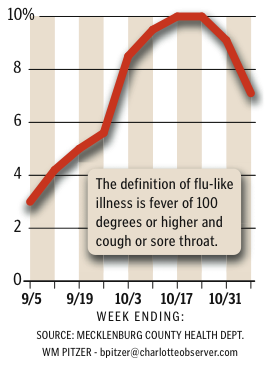
Second wave of H1N1 declining in numbers but not severity; third wave may be worst


Text by Sally Kneidel, PhD
November 18, 2009
See this post now on the front page of www.basilandspice.com


I talked with a knowledgeable nurse friend yesterday, a woman who takes care of the health needs of hundreds of teenagers.  She sees patients all day long every day, many of whom have flu.  She told me yesterday that H1N1 is waning at present.  But it's expected to peak again in another month or two. In the next wave, she predicted, much or most of the U.S. population who haven't had H1N1 will get it - at least, those who haven't been vaccinated.  She said successive outbreaks of a pandemic flu within one year tend to be worse with each successive wave.

Her comments jibe with articles I read today in the Charlotte Observer and on the CDC web site. The CDC says that visits to doctors for flu-like illnesses have decreased nationally for the last two weeks, after climbing for the previous four weeks.  But, says the CDC, "Total influenza hospitalization rates for laboratory-confirmed flu continue to climb and remain higher than expected for this time of year. Hospitalization rates continue to be highest in younger populations, with the highest hospitalization rate reported in children 0-4 years old. The proportion of deaths attributed to pneumonia and influenza....continues to increase and has been higher than what is expected for six weeks now.....Almost all of the influenza viruses identified so far [this fall] continue to be 2009 H1N1 influenza A viruses." [As I reported in an earlier post, pneumonia is the usual cause of death in fatal H1N1 cases.]

So, apparently, the total number of cases has been dropping nationally for the last couple of weeks, but is the H1N1 virus becoming more virulent?  More dangerous?  What else would lead to higher hospitalization and death rates, in spite of dropping numbers of people infected?

Which leads one to wonder about the vaccine.  The limited supplies are supposed to be going to pregnant women, children 6 months and older, young adults up to 24, anyone with a chronic medical condition, health-care workers, and emergency responders.  Yet, that's not always happening.  I went over to my local County Health Department a week ago to get a shingles shot (at least 6 people close to me have had shingles in the last year!), and while I was there, the staff asked me if I wanted to get an H1N1 shot.  I said no, because I'm not in a high-risk group. Corroborating my experience, there are numerous reports in the newspaper of lower-risk people being offered shots.  No one's too upset about that right now. But that could change. I would like to get the vaccine for myself and my family before the January wave hits. Wouldn't we all?  I looked on the CDC web site under "2009 H1N1 Influenza Vaccine Supply Status" dated 11/17/2009.  Unfortunately, it's remarkably not helpful, almost as if they intended to make it indecipherable. I just want to know, when will the vaccine be available for everyone who wants it?  Will it get here before the next wave, which will likely have higher mortality rates?

What's taking so long?

Sources:
Centers for Disease Control and Prevention. "2009 H1N1 Flu: Situation Update." 11/13/2009.  

Lisa Rosetta. "Second wave of H1N1 flu cases starting to wane."  11/16/2009.  Salt Lake Tribune.

Dharm Makwana. "H1N1 second wave ends." 11/18/2009.  24 Hours Vancouver.

Karen Garloch. "Swine flu numbers ease off:  Levels still surpass peak of a regular flu season, and officials predict new surge then."  11/14/2009. Charlotte Observer.

Karen Garloch. "H1N1 vaccine given to low-risk patients."  11/17/2009. Charlotte Observer.

My previous posts about H1N1:

The most dangerous cases of H1N1  11/12/2009

My daughter says elderberry got rid of her H1N1  10/22/2009

Why is swine flu likely to return in winter? It's not because we're cooped up together in winter  5/8/2009

This virus IS a swine flu and has its roots in North Carolina, the land of Smithfield   5/2/2009

Smithfield blamed for swine flu by Mexican press  4/29/2009

Keywords:: H1N1 vaccine swine flu successive waves low-risk patients

Thursday, November 12, 2009

The most dangerous cases of H1N1

by Sally Kneidel, PhD

As I wrote about a couple of weeks ago, my daughter and her boyfriend both had H1N1 recently. They both had fever, headache, severe muscle aches, fatigue, a sore throat and dry cough. They were both pretty miserable for a few days, but then made a very speedy recovery.  Neither one of them ever went to a doctor, because by the time we figured out what they had, it was too late for Tamiflu to have any effect.  A nurse told me that Tamiflu is effective only if taken in the first day or two of a viral illness, because all it does is shorten the duration and severity of the illness.  My daughter and her boyfriend did take elderberry extract capsules (800 mg, 3 times a day) which they felt hastened their recovery.

The same nurse friend I mentioned above also told me that, of all the people she sees in her job, those with H1N1 are in general not as sick as those with the seasonal flu. The population she treats is mostly teens.

When H1N1 Can Be Fatal
But soon after my daughter and her boyfriend recovered, the college-age son of a friend became ill with H1N1. He went to the college infirmary, and was soon in the hospital.  I'm not sure exactly what symptoms he had at first, except that they included a cough, sore throat, and runny nose.  Then, within just a couple of days, I got the word that he was in critical condition, in the ICU with pneumonia!!  There was a day or two after that where no one was sure whether he would live or die.  It was very frightening. He was able to breathe, but due to fluid in his lungs he was not getting enough oxygen, which can lead to organ failure and death.  So he was put on a respirator, which forces air into the lungs. The respirator was put on a high setting, meaning that a lot of air was being forced into his lungs. He was teetering on the brink of life for a couple of days, then I heard that the respirator had been turned down a notch, which was good.  After another day or two, a tracheotomy was performed and the respirator was attached to that instead of being stuck in his mouth.  I'm not sure what the purpose of that procedure was, except that it was a considered a step toward healing, and he was more comfortable having the respirator out of his mouth.  He started writing notes to the nurses, texting his friends, and generally coming around.  Next thing I heard, the respirator was removed, the tracheotomy was closed up and he was going home!  Seems like as soon as he began to get better, the recovery was remarkably fast.

Studies say my friend's experience was typical of serious cases of H1N1
I just recently read articles in the Journal of the American Medical Association (JAMA) and in Science News that detailed a typical scenario in the most serious cases of H1N1. They described cases remarkably similar to that of my friend's son. The articles said that young adults are the most vulnerable.  The most critical patients are those who get pneumonia. The article said inflammation in the lungs leads to fluid build-up in the airways and the lungs.  Says Dr.Robert Fowler of the University of Toronto, "Most patients are still able to take breaths, but those breaths are ineffective."  In a Canadian study reported in JAMA, 168 patients critically ill with H1N1 (average age 32) received intensive treatment, including antivirals such as Tamiflu and ventilators, but 17% of them died.  In another study, patients in Australia and New Zealand with an average age of 34 who were critically ill with H1N1 had a mortality rate of 21%.  In a third study, this time in Mexico, critically ill patients with H1N1 had a mortality rate of 41%, although these patients too were treated with ventilators and antivirals such as Tamiflu or Relenza. In one final study, in California, 11% of patients who became critically ill with H1N1 died - the most common cause of death was "viral pneumonia and acute respiratory distress syndrome."  Note that these percentages are percentages of people who were already critically ill with H1N1, not just percentages of all people with H1N1 flu.

The most important factor seems to be pneumonia. I am not sure what steps can be taken to keep H1N1 from turning into pneumonia, but if I had H1N1, I would see a doctor as fast as possible to get a prescription for an antiviral, and I would stay home and rest, drink lots of fluids, and do whatever the doctor said to help keep my lungs clear. 


The CDC and other sources recommend these steps for keeping well and keeping others well:
Wash hands frequently.
Don't touch eyes, nose, mouth.
Leave the room if someone else is coughing, because inhaling airborne droplets can lead to infection, and that factor is more likely in cold weather. (See my previous post below on why that's true.) 
If you are sick, cover your mouth or nose with a tissue when you cough and throw it away, or with the inside of your elbow, not with your hands.
Stay home if you're sick until you've had no fever for at least 24 hours.
Try to avoid touching doorknobs or things that other people touch constantly when out in public or at work.  Use your own pen to sign receipts.

See the CDC's website for more information on staying well.

Sources: 
Anand Kumar, MD, et al.  "Critically Ill Patients with 2009 Influenza A(H1N1) Infection in Canada". 2009.  Journal of the American Medical Association 302(17):1872-1879. Published online October 12, 2009  

Janice K. Louie, MD, et al. "Factors Asssociated with Death or Hospitalization Due to Pandemic 2009 Influenza A(H1N1) Infection in California". 2009.  Journal of the American Medical Association 302(17):1896-1902.

Nathan Seppa. "Reviewing H1NI flu's worst cases: Antivirals, ventilators help, but fatalities show lungs hit hard."  Nov 7, 2009. Science News. 

My previous posts on H1N1: 

Why is swine flu likely to return in winter?  It's not because we're cooped up together in winter

 
My daughter says elderberry got rid of her H1N1 flu 

Keywords:: H1N1 flu swine flu worst cases pneumonia ventilator how to protect yourself from H1N1 CDC JAMA

Wednesday, November 11, 2009

Budding Scientists Assess the Tiny Critters of Africa

A Great Student Opportunity
In June of 2009, Ken and I helped out with a biodiversity survey in South Africa. Most of the researchers were undergraduates from universities in the U.S. All of them had already taken a semester-long ecology course in South Africa offered by the Organization for Tropical Studies or OTS, whose home base is at Duke University. (Many of the students were also from Duke.) Dr. Laurence Kruger is the Director of OTS's South African course, and a friend of ours for the last three years or so. He lives in Kruger National Park, South Africa, and takes his ecology students all over Kruger Park and to other important ecological  sites and interesting indigenous villages in South Africa, such as Welverdiend and Hamakuya. Most of what I know about South Africa, I've learned through Laurence or his employees and connections.

 The photo above shows part of the biodiversity crew in the field. L-R is Ken Kneidel, guard Oneeka with rifle, students Allison, Sarah, Caroline, and Seth, OTS instructor Taryn in red shirt, and guard Steven Khosa with rifle over his shoulder. An OTS truck is in the background. The survey was funded by NFS, under their "Research Experience for Undergraduates " program.

Setting Up the Temporary Traps
Everyone involved in the survey was staying at Skukusa Rest Camp in Kruger National Park. The first morning at 7 a.m. we piled into a couple of trucks and drove 2-3 miles to an undisturbed area along the Sabie River. At eight different sites, we set up drift fences and drop traps to catch small animals such as frogs, toads, lizards, snakes, insects, mice, shrews, small rats, insects and other invertebrates. We also set out 16 live-traps for small mammals. The next morning, early, we went to check all the traps at all eight sites. All the little animals were measured, identified and released. By park regulations, we had to have two armed guards with us at all times, in case of encounters with angry hippos, elephants, Cape buffalo, cats, rhinos, wart hogs, baboons, or other big animals. One of the guards was our old friend from 2007, Steven Khosa, a biology student and park employee. Ken and I had hired Steven to be our personal guide in northern Kruger Park in 2007, and he was fabulous. We learned so much from him about his culture, as well as wildlife. The other guard for the biodiversity survey in 2009 was the friendly Oneeka, also a park employee, who was interested in everything we caught.

Graham, director of field operations for the South African OTS course, dug the holes for every drop trap, with this heavy power drill (above). The holes had to be big enough to accommodate big buckets sunk to ground level.

After the central bucket was sunk at each site, REU student Hannah (above) and others pounded in stakes to hold up the three plastic fences that radiated outward from the central bucket. The fences, about 1 foot tall each, are called "drift fences." At least, that's what they're called in the States. I used drift fences for my doctoral research at UNC, studying the breeding migrations of terrestrial salamanders, Ambystoma opacum and maculatum.

REU student Seth (above) made tubular traps of fiberglass windowscreen mesh to lie alongside each drift fence, to catch reptiles moving along the fence. Each end of the tubular traps had an inverted funnel of mesh, to allow entry but deter exit.
When we returned the next morning to check the traps, REU student Caroline (above) and others checked for animals in the buckets. Each of the three fences or "spokes" that radiated out from the central bucket had another bucket at the other end. When little animals encountered the fence, they crawled or hopped alongside the fence, eventually falling into one of the buckets. Caroline was studying insect diversity, so she always had a glass jar to carry insects back to the lab to ID.

A New "Old World" Lizard for Me
I don't think we caught any snakes because it was winter there in the southern hemisphere, but we did catch a few lizards like this ground agama (Agama aculeata) below. Lizards in the family Agamidae are the "old world" counterparts to the lizard family Iguanidae found in the Americas.
agamid cropped

Fantastic Frogs and Toads
We also found a variety of frogs and toads, some of which were really different from any I'd seen in the States. Seth knew what all of them were - he was our student expert on reptiles and amphibians. The burrowing toads we caught, Breviceps, were my favorite (below). They looked like grumpy old men. Most of them were covered with damp sand, from burrowing.


Other favorites were the tiny shovel-nosed frogs, below (Hemisus marmoratus). Like Breviceps, they are burrowers in the sandy soil on the floodplain of the Sabie River.


In one of the buckets, we found two beautiful frogs with luminous eyes (above). This frog's common name is the bubbling kassina, or Senegal running frog. Scientific name: Kasina senegalensis.


I think this is a flat-backed toad, Bufo maculatus, found in one of the buckets.

Tiny Biting Mammals
Allison was studying mammals, and every time we caught a mouse, rat, or shrew in one of the buckets, she picked it up, marked it with a red marker (to identify it if recaptured), and put it briefly in a plastic bag to measure its weight and length. The bag kept it from biting her (usually).

A pygmy mouse (Mus minutoides) in Allison's grasp (above).

Oneeka and Allison inspect another pygmy mouse (above).

Above, Allison weighs a mouse in a bag attached to a hand-held spring scale; Taryn shows me a red veld rat (Aethomys chrysophilus). The red on the rat's chest is from the red marker.


I believe this is a musk shrew (Crocidura mariquensis) inside one of the buckets (above).

What Was the Point?
The overall purpose of the survey, in my understanding, was to assess the effect of differences in the tree canopy on the numbers of animals on the ground below. That is, does a heterogeneous tree canopy support more biodiversity on the ground, or less? I don't know what the answer to that question turned out to be, or if there was an answer. Ken and I left for the north of the park before the project was finished. Of course, the fences and buckets were all removed when the students were through monitoring them, and the holes were filled in. But the data that the students collected will set the stage for future studies by OTS students or REU students. If the process is repeated in future years, the results will show any declines in biodiversity. It's easy to think that, within the park where direct human disturbance is minimal, animal populations should remain stable. 

But the Climate Is Changing in Africa
Rain patterns are changing. Rain affects tree diversity, rain affects the flow of rivers and the deposition of sand along river banks. Who knows how these factors will affect animal populations in a riparian, or riverbank, community? That's the point - who knows? Surveys like this will help us understand the effects of climate change. Some scientists predict that 75% of current species will become extinct within this century. The vast majority of scientists agree that we are facing unprecedented mass extinctions, while at the same time destroying the habitats that could foster the evolution of new species. Field exercises like this are barometers of change. They're important, too, in teaching a new generation of ecologists the techniques they'll need to guide us into an unknown and daunting future. On a lighter note, it was fun for Ken and me to see so many new tiny animals, after spending a lot of time looking for and photographing the bigger ones. These little animals are essential to a healthy and stable ecological community. Each one has its unique charms and its own place in the natural world. 

Keywords:: biodiversity climate change South Africa OTS Organization for Tropical Studies REU Research Experience for Undergraduates Skukusa Kruger Park Kruger National Park Laurence Kruger riparian communities undergraduate research Sally Kneidel Ken Kneidel

Monday, November 09, 2009

One-tenth of Louisiana to be submerged by 2100


The Louisiana coast in the year 2100, according to scientists' projections of rising seas and reduced sedimentation. Note that New Orleans is far off the coast.
Photo courtesy of Science News, 7/18/09.

The residents of New Orleans have had it rough the last few years, following the devastation wrought by Hurricane Katrina. Much of the city has been restored and rebuilt, while other damaged areas still remain as they were after the storm.  Unfortunately, due to the particular location of New Orleans, the situation may get worse instead of better in the coming decades. A recent study published in the journal Nature Geoscience predicts that ten percent of Louisiana will be submerged by the year 2100.

Scientist Harry Roberts of Louisiana State University and his colleague Michael D. Blum used computer modeling, based on scientific measurements, to estimate the effect of various factors on the gradual submersion of Louisiana.  One factor is the sinking of land as sediments from the Mississippi River are compacted under their own weight. This compaction is a normal phenomenon. Historically, new sediments have been deposited at a rate that has replaced the sinking sediments, keeping delta land levels constant. But in the fairly recent past, the amount of sediment deposited by the river has been cut in half by dams upriver. Now, with the reduced flow of new sediments, the land is sinking at a net rate of about 8 millimeters per year. Near Baton Rouge, 150 km upstream, sediments are also sinking and not being replaced. The submersion process is just a bit slower upstream.

The lack of new sediment is not the only problem causing southern Louisiana to sink. The other issue is rising sea levels due to climate change. Scientists on the Intergovernmental Panel on Climate Change have reported that sea levels are currently rising at a rate of 3 millimeters per year, and that rate will accelerate as the climate continues to warm. Seas are expected to rise one meter between now and 2100, putting one in ten people across the globe at risk from coastal flooding.

By the year 2100, the combination of these two influences will submerge about 13,500 square kilometers in Louisiana, or 10% of the state's total area.

Even if more sediment-laden water could somehow be diverted to the sinking areas, scientists estimate that 12,600 square kilometers would still be submerged by 2100.

If the computer modeling is correct, New Orleans will be well away from Louisiana's mainland in just 90 years, and largely underwater.

New Orleans and southern Louisiana are not the only delta areas in trouble. Many of the world's largest and most densely populated and heavily farmed deltas are on their way to becoming open ocean.  The causes are the same as those in Louisiana - reduction in the flow of sediment that restores and maintains deltas, and rising sea levels. Scientists James Syvitski and colleagues writing for Nature Geoscience estimate that the amount of delta surface area vulnerable to flooding and inundation will increase at least 50% this century, and more if the capture of sediments upstream continues.

What can you do?  The main thing we as consumers can do is to cut our own greenhouse gas emissions, in order to reduce climate change and rising sea levels. See my blog post of November 2 for at least one powerful solution from the Worldwatch Institute.  For many more consumer strategies to address climate change, see our 2008 book, Going Green: A Wise Consumer's Guide to a Shrinking Planet.

Sources and additional reading:

James Syvitski et al. "Sinking deltas due to human activities." Sept 9, 2009,  Nature Geoscience 2, 681-686.

Sid Perkins. "Louisiana sinks as sea level rises: State's coast threatened by global warming, settling land." July 18, 2009, Science News.

Danny Bradbury. "Louisiana coast will be underwater by 2010."  June 30, 2009. Business Green.

Michael Blum and Harry Roberts. "Drowning of the Mississippi Delta due to insufficient sediment supply and global sea-level rise." June 28, 2009. Nature Geosceince 2, 488-491.

Associated Press. "New Orleans is sinking - and fast. Scientists say subsidence explains Katrina damage, complicates recovery." May 31, 2006.   www.msnbc.msn.com

Key words:: climate change New Orleans deltas rising sea levels Louisiana reduced sedimentation flooding of coastal areas climate refugees Katrina

Monday, November 02, 2009

Livestock account for 51% of annual worldwide greenhouse gas emissions

All photos and text by Sally Kneidel, PhD, of sallykneidel.com and veggierevolution.blogspot.com

  Photo by Sally Kneidel, PhD

I read an article today that blew my socks off - it may be the most significant article I've ever read.  It's online and in the Nov/Dec 2009 print issue of Worldwatch, a publication of Worldwatch Institute - a widely respected think-tank and environmental advocacy organization. The article is entitled "Livestock and Climate Change" (see "Sources" at end of this post).

I've spoken widely, written numerous articles and two books on the subject of the environmental impact of raising and transporting livestock. (See a list my books and blog posts on this topic, below.)  Three or four years ago, I was very excited when the United Nations' Food and Agriculture Organization published "Livestock's Long Shadow" - a scientific document whose authors demonstrated that the livestock sector contributes at least 18% of  greenhouse-gas emissions. They concluded that livestock contribute more to climate change than even the transportation sector does.  I can't count how many times I've quoted that publication, more than 400 pages long, and available on the internet.

This new study goes beyond “Livestock’s Long Shadow”
But this article from Worldwatch Institute goes way beyond the UN's FAO article, and very creditably so. The authors, Robert Goodland and Jeff Anhang, examined the FAO data carefully and explain why their own measurements are more comprehensive and more current than those of the FAO authors. I see no weak spots in these new calculations, they are merely updates to account for the passage of time and our growing population and growing global meat consumption, as well as corrections of omissions in the older FAO article. I have good faith in their carefully detailed figures. I hope to God they're right in their suggestions for solutions.

I'm not going to recount all the new calculations and corrections here, but I will give a couple of examples. First, the FAO's calculations are based on 2002 data, but the tonnage of livestock products between 2002 and 2009 has increased 12%, with a proportionate increase in greenhouse gas emissions (GHG).  Secondly, "Livestock's Long Shadow" reports that 33 million tons of poultry were produced worldwide in 2002, but the FAO's "Food Outlook" corrected that figure, which was actually 72.9 million tons of poultry produced  in 2002.  The authors of the new article describe several underestimates in "Livestock's Long Shadow" such as these, which have a cumulative effect.

As mentioned above, the new Worldwatch document also points out numerous omissions from the original FAO publication, "Livestock's Long Shadow".  For example, the FAO failed to include GHG emissions from
(1) the disposal of livestock waste (feces, urine, bone, fat, spoiled products) all of which emit high amounts of GHG, and (2) fluorocarbons (used for cooling livestock products more than alternatives) which have a global warming potential up to several thousand times higher than that of CO2.  Those are just a couple of examples.

Noting governments' failures, Worldwatch proposes new solutions

I liked that the article ended with several pages of solutions. The authors pointed out that governments have been largely ineffective in developing renewable energy and energy efficiency. GHG emissions have actually increased since the Kyoto Protocol was signed in 1992, and climate change has since that time accelerated. The authors Goodland and Anhang offer suggestions that would achieve at least a 25% reduction in livestock products worldwide between now and 2017. This would yield a minimum 12.5 % reduction in global greenhouse gas emissions from human activities, which would by itself be almost as much as is generally expected to be negotiated at the U.N.'s climate conference in Copenhagen in December 2009.

Analogs are tasty!  Who needs flesh?

The suggestions of Goodland and Anhang (for Worldwatch) focus on businesses rather governments. They point out that consumers listening to food marketing are listening for words that evoke "comfort, familiarity, happiness, ease, speed, low price, and popularity." Based on that, the authors outline a marketing plan whereby food companies can succeed by marketing "meat and dairy analogs" alongside traditional animal products in grocery stores. Analogs are products such soy- and seitan (wheat gluten) imitation beef, chicken and pork products, as well as soy- and rice milk, cheese, yogurt, and ice cream.  "Analogs are less expensive, less wasteful, easier to cook, and healthier than livestock products," they write. Meat and dairy analogs can be positioned in stores, and through marketing, as "clearly superior to livestock products, thus appealing to the same consumer urges that drive purchases of other analog products, such as Rolex knockoffs".  By replacing livestock products with analogs, "consumers can take a powerful action collectively to mitigate most GHGs worldwide.  Labeling analogs with certified claims of GHGs averted can give them a significant edge."

Sounds good to me! Since Ken and I both work, and I have two jobs, we consume a fair amount of pre-made "analogs" such as Morningstar Farms "chik" patties and chik nuggets and Tofurkey sausage or kielbasa, as well as soy milk, soy yogurt, using ground flax seeds to replace eggs in baking, and so on. We've been doing this for years and I never ever miss meat. I did eat one real chicken nugget a few years ago to test the difference, and found it disgustingly greasy and and containing recognizable animal tissues such as little veins and connective tissue.  After years of eating yummy soy-based imitation chicken patties, the real thing was akin to eating  road-kill.
 Photo by Sally Kneidel, PhD

I encourage you to read Goodland's and Anhang's article from Worldwatch, available on the internet. To me, their proposal sounds clearly like the easiest and most realistic scheme yet for quickly and drastically reducing the world's GHG emissions, and possibly averting dramatic climate change. Should that change continue unabated as it is now, new climate patterns will destroy wildlife habitat the world over, destroy essential agricultural areas by altering rainfall, cause famine and create climate refuges from developing nations, raise sea levels, and lead to mass wildlife extinctions that humans have never before witnessed.

Roll the article up with a ribbon for the perfect holiday gift!

Read this important Worldwatch article and forward it to your friends. Or print it out and tack it on the bulletin board at work. Include it in your holiday greeting cards!  Or make a nice little cover for it, and give as a holiday gift to those whose future matters most to you.

by Sally Kneidel, PhD

Sources:
Robert Goodland and Jeff Anhang. "Livestock and Climate Change: What if the key factors in climate change are cows, pigs, and chickens?" Worldwatch 22(6):10-19. Nov/Dec 2009.

The Food and Agriculture Organization of the United Nations. "Livestock's Long Shadow: Environmental issues and options." Rome, 2006.

My books on this topic:
Veggie Revolution: Smart Choices for a Healthy Body and a Healthy Planet. 2005. Sally and Sadie Kneidel. Fulcrum Books.

Going Green: A Wise Consumer's Guide to a Shrinking Planet. 2008. Sally and Sadie Kneidel. Fulcrum Books.

Some of my prior posts on this topic:
"New study: meat impacts climate more than buying local"  May 23, 2008 on Veggie Revolution blog

"Less meat....smaller footprint"  Feb 6, 2009 on Veggie Revolution blog 

"Is local food the greenest choice?  New study says no"  May 14, 2009 on Veggie Revolution blog

"Earth Day: 3 things you can do"  April 22, 2007 on Veggie Revolution blog

"An apple? Bran muffin? or cold cereal?  Top ten sources of easy fiber" Sept 14, 2007on Veggie Revolution blog

"10 hot tips for a green and energy-efficient holiday." Oct 10, 2008 on Veggie Revolution blog


"Obama to fight consolidation of farms: good news for small farms and consumers"  Aug 21, 2009 on Veggie Revolution blog

"Smithfield blamed for swine flu by Mexican press"  April 29, 2009 on Veggie Revolution blog

"The virus is a swine flu and has its roots in North Carolina, the land of Smithfield"  May 2, 2009 on Veggie Revolution blog

"Tyson and Smithfield drooling over untapped profits abroad" March 20, 2006 on Veggie Revolution blog

"Working in a turkey insemination factory"  Nov 20, 2008 on Veggie Revolution blog

"A tasty vegan meat substitute: Tofurkey kielbasa" June 10, 2009 on Veggie Revolution blog

Key words:: climate change livestock and climate change Worldwatch Institute 51% of climate change Robert Goodland Jeff Anhang

Thursday, October 29, 2009

Toad and lizard come to call

 All text and photos by Sally Kneidel, PhD, of sallykneidel.com

I had fun this week. To my joy, I was twice asked to retrieve or rescue a little animal in a bad situation. One was an Anolis lizard on my neighbors' living-room curtain. It took me just a few seconds to nudge her into a little carrying cage. The second was a Fowler's toad trapped in the bottom of a stairwell at the school where I work. The disgruntled toad had dozens of loud students stomping over its hiding place, and long human hairs tangled around its legs.

I took both of them home, just long enough to offer them food and rest. Back in the days when I wrote Creepy Crawlies and the Scientific Method, and Pet Bugs, and Classroom Critters and so on, I was catching ordinary little animals and bugs almost daily and keeping them just long enough to share with my science classes and write about them for my books. Then let I let them go where I found them, usually with fuller bellies. But I haven't done it much lately. Living on a suburban lot close to downtown, we don't see that many toads, frogs, lizards, snakes, or turtles around my house. I wish we did, I miss them.  The ones we do see are usually squashed on the road. I've gotten pretty good at identifying completely flattened road kill. I know that Brown Snakes (Storeria dekayi) must spend a lot of time sunning themselves in the road, because 95% of the squashed snakes I see are Brown Snakes.

The lizard
The lizard I retrieved from my neighbor's curtain this week was Anolis carolinensis or a Carolina anole. A lot of people call them "chameleons" because they change colors, from green to dark brown. But it's not for  camouflage, like in some African chameleons (below).


The color change in anoles is an indication of their emotional state or their body temperature.When they're calm and relaxed, or warm, they tend to be green. When they're upset about an intruder, or if they're cold, they tend to be dark brown (like the pic below). My anole was not happy in the sleeve cage where I put her, despite the fact that I set it up like a natural habitat with sticks to climb on and leaves, and sprayed it with a mister to provide droplets to drink. (There she is in the sleeve cage, below. I knew it was a female because males have pink skin on the throat for displays.)


Below, you can see the whole sleeve cage, which allows you to move things in and out of the cage without taking the top off.  Especially useful if you have flying insects.


I did a bunch of sweeps through the brush out back with my sweep net (below) to provide a variety of insect prey for the carnivorous little Anolis lizard.


 Ken holds the sweep net (above) so I can show you the size of it. He insisted I not show his face.


In spite of my efforts to provide comfort and a tasty diet, I did not once see the anole eat. I gave her living crickets, leaf hoppers, little spiders, a stilt bug, a beetle - a wide selection of active prey. I put them all in the sleeve cage.

I took her out just once, to have a close look and see what she'd do.  Anoles can get quite friendly, if you keep them for a long time. But I don't encourage anyone to keep wild animals as pets, including myself.  So I let her crawl around on my arm just once for a few minutes, to enjoy watching her, then I took her out to the brush pile between our yard and the field and let her go. I did it reluctantly, but knowing I had to.

The toad
Then I had only the Fowler's toad left.  I had set him up in a big cardboard box.


A jar lid provided water for the toad (below). A thin plastic food container cut in half lengthwise made a little house, which he preferred to the wide open spaces of the box.  I also kept two damp and slightly crumpled paper towels in the box so the toad could go under them if his skin got too dry.  I know from experience that toads will sit in a jar lid of water and take the water into their cloaca if they need moisture. The cloaca is sort of like a bladder and a colon in reptiles, amphibians, and birds, except that it's also the end of the reproductive tract. Three functions in one. I've never seen a toad lap up water into its mouth, I don't think they do that.


I knew this toad was a Fowler's toad (Bufo fowleri) because those are the most common toads in our area (the piedmont of N.C.)  and because it had a single dark spot on its chest. It didn't have the prominent cranial crests of a Southern toad (Bufo terrestris) nor the 1 to 2 warts per spot of the American toad (Bufo americanus). Most of its spots had 2 or 3 warts, the number typical of Fowler's.

I gave that toad so much to eat. Toads are predators too, so I gave him four fat earthworms from our compost - I know toads eat worms, because I used to have toads that would snatch worms draped across my finger.  I know they love crickets, I've fed crickets to dozens of toads in science classes. Yet for two days this one would not eat the fat mature crickets I put in its sleeve cage, or the earthworms. I could only conclude that both the lizard and the toad were looking for somewhere to hole up for the winter and were no longer interested in eating. Or else it just takes a while for them to get accustomed to captivity before they will begin to eat. Maybe I've forgotten how long that period is.

Anyway, it's the end of October, time for the toad to burrow down for the winter.  So, today, I took the toad to release it.  I put him in the sleeve cage and walked down into the woods at the school where I work. I followed the creek until I came to place where a lot of dead wood was on the ground near the creek - an acceptable place for a toad to burrow down for the winter. I know they sometimes spend all winter hunkered under logs, because I've found them in such places in the dead of winter. 


I put the toad on a rotted log and away he went. I let the crickets go too. And, happily, when I shook out the damp paper towels in the cage, I noticed that all the worms but one were gone!  He did eat them!  Yay!

Conservation status
Like most wildlife, Fowler's toads are threatened by loss of habitat. Protection of breeding sites for Bufo fowleri is essential to their survival. Most toads breed in shallow waters such as woodland ponds, farm ponds, lake edges, and marshes. The soft permeable skin of toads and other amphibians makes them especially vulnerable to agricultural chemicals, which tend to drain into their breeding ponds. Such wetland areas are also filled-in for housing developments, agriculture, or roads. In the Charlotte multi-county where I live, 41 acres per day are being developed!  Even now, you have to get out in the country really to find toads these days.

Although all natural habitats are diminishing as our population increases, anoles are not as vulnerable as toads and other amphibians. They lay their eggs in moist soil or rotting wood, so they're not exposed to agricultural runoff in shallow pools. However, they do pick up pesticides in the bodies of their insect prey.  Anoles are also impacted by the pet trade. When I was kid, you could buy an anole in a small box at the circus, with no care instructions whatsoever. They are still sold in pet stores everywhere in the Southeast. Housecats are also a menace to all small animals.More than a billion small animals and birds are killed by housecats in the United States every year. I know frogs are among their victims, because I found my neighbor's cat chewing on two of the bullfrogs in my backyard pond (that particular cat is gone now).  But in spite of all that, anoles are still fairly common in the southeastern United States, outside of cities.

Anyway I'm grateful that lizard and toad dropped in for a couple of days. I'm glad they're gone too - finding live insects to feed them every day is a chore.  And they deserve to be free.  I'm glad I was able to let them go in good habitats.  It was the highlight of my week, by a long shot.

Key words:: wildlife Fowlers toads Bufo fowleri Anolis carolinensis lizards anoles animals in captivity Creepy Crawlies Pet Bugs Classroom Critters

Wednesday, October 28, 2009

New studies confirm that circumcision saves lives in Africa


 The Swazi chief in the center, surrounded by her family and, on the far right, our friend Sonny

I was intrigued by a story I saw in Science News recently about circumcision and its effect on HIV. Africa has been impacted by HIV more than any other continent. In 2007 and 2009, my husband and I were in South Africa and Swaziland, two of the hardest hit countries. We had the priviledge of visiting the chief of a rural village in Swaziland.  We were welcomed into her family's small round hut with its earthen floor, along with our friend Sonny who lives and works nearby. I asked the chief, with Sonny as translator, how Swazi life had changed during her lifetime (the chief was an older woman). She wouldn't say much, except how the younger generation won't eat traditional foods any more, wanting junk food instead. But as we were leaving, she stopped us outdoors and asked us to pray for her village. She asked us to pray that someone will find a solution to HIV, which is devastating her village and her country.  The sad look of hopelessness on her face haunted me as I read the Science News article last week.

In Swaziland, 22% of adults are infected with HIV. Life expectancy used to be 57 years; now it's 31 years. In the year 2007 alone, 10,000 Swazis died of AIDS.  The country has 56,000 AIDS orphans.  And so on....you get the picture.  In South Africa, the impact of AIDS has been so great that the country's population has stopped the rapid expansion characteristic of most African countries. Life expectancy in 1995 was 64; in 2005 it was 49. See International Data Base (IDB) for more population data.

So what's being done?  As far as research, some big strides have been made, and some of that research has to do with protection offered by circumcision.

In humans, the three most common sexually-transmitted viral diseases are HIV, genital herpes, and HPV (human papillomavirus). All three are incurable.

But all three are are less likely to be transmitted when a male is circumcised.

Earlier studies have shown that male circumcision reduces the risk of acquiring HIV by up to 60%.

Another article, published this year in the New England Journal of Medicine, reports that circumcision also provides partial protection against both genital herpes and HPV. This study, funded by Bill & Melinda Gates and the NIAID, involved 3,393 Ugandan males ranging in age from 15 to 49, all of whom wanted to be circumcised and none of whom had herpes. Half the males were circumcised right away, and half had the procedure deferred for two years. After the two years, the earlier-circumcised volunteers were 1/4 less likely to have genital herpes and 1/3 less likely to have a dangerous form of HPV. Because circumcision provided only partial protection, the researchers cautioned that it "should not be considered a full shield."

Even so, the partial protection could have a major public health benefit, says the director of the National Institute of Allergy and Infections Diseases, Dr. Anthony Fauci.  Human herpes ulcers make a man more vulnerable to HIV infection. Dr. Fauci says that circumcision not only reduces the incidence of HIV infection outright, but by protecting against genital herpes, circumcision increases the protection against HIV infection.  This is a significant finding: in Kenya, where 4/5 of the people infected with HIV are also infected with genital herpes, says Dr. Robert Bailey of the University of Illinois at Chicago.

Although much of the research centers on protection of men, women benefit too. Yet another study in South Africa reports that circumcised men are 1/3 less likely to have a dangerous form of HPV that can cause cervical cancer when transmitted to female partners.

A research team in Kenya is nearing publication of their study of circumcision's effect on STDs. One scientist in the research team has said the results show similar effects to the already published studies.

An Overwhelming Game Changer

Says Dr. Judith Wasserheit of the University of Washington, "I think this trio of trials is certainly a landmark in prevention, not only of HIV but of these other sexually transmited infections. These new data really are a game changer."

Dr. Thomas Quinn of Johns Hopkins University says that the medical evidence of long-term benefits to male circumcision "is now overwhelming."

Good News, But Is It Being Used?

Unfortunately, this information is so far having little effect on the transmission of these diseases in Africa.  According to www.avert.org, an international AIDS nonprofit, "only one clinic in South Africa currently offers free male circumcisions, with public facilities only offering the service for medical reasons. The government is reviewing evidence on circumcision, but has yet to issue further guidance on the practice."

One hindrance toward progress in South Africa is the amazing quantity of misinformation among the general public about the transmission of HIV.  While in Johannesburg, we read an editorial in the city's major newpaper about the common folklore regarding how a man can determine whether he has HIV or not. If he has sex with a virgin and she does not become infected, then he can assume he is uninfected himself.  If he has sex with a virgin, and she does become infected, then she must be a witch. I hate to relay such nonsense about a country I love passionately, but every country has its own damaging dogma. My sympathy in this situation lies with the young girl who's used as meaningless litmus paper, and perhaps paying with her life.

Some of the schools we visited in South Africa showed us herb gardens where they're growing herbs to prevent or treat HIV. Beet root has been a well-known "cure" in the country for years, even promoted as such by the government in earlier years.  I'm not aware that any herbs or plants offer protection against this disease.

My hope is that Bill & Melinda Gates or NIAID will invest some of their billions into building free circumcision clinics and distributing information about real-life diagnosis and protection - as well as promoting development and distribution of the promising new vaccine, which appears to offer protection to 1/3 of those who receive it (see NY Times article cited below).

And if you're wondering whether to circumcise your own newborn son, it appears that doing so could offer him some protection against some STDs. Although condoms could most likely provide a higher degree of protection, without the cutting that some object to.

Sources:
1. Nathan Seppa. "Many benefits to circumcision: Operation in males fends off three common viral STDs." Science News, April 25, 2009.

2. Nathan Seppa  "Defense Mechanism: Circumcision averts some HIV infections."  Science News,  October 29, 2005

3. Aaron, A.L. et al. "Male Circumcision for the Prevention of HSV-2 nad HPV Infections and Syphilis." New England Journal of Medicine, March 26, 2009.


4. Averting HIV and AIDS. "HIV and AIDS in South Africa." http://www.avert.org/aidssouthafrica.htm

5. Donald G. McNeil Jr. "For First Time, AIDS Vaccine Shows Some Success," New York Times, Sept. 24, 2009. http://www.nytimes.com/2009/09/25/health/research/25aids.html

6. International Data Base.  http://www.census.gov

Key words:: circumcision HIV AIDS Africa Swaziland STDs

Thursday, October 22, 2009

My daughter says elderberry got rid of her H1N1 virus


Sadie with little Henry

Written by Sally Kneidel, PhD, of sallykneidel.com. This post is now on www.basilandspice.com and is a Google News link.

My daughter Sadie, in her 20s, got sick a few days ago with a flu-like illness.  We didn't figure out for a couple of days, after talking to a nurse, that her affliction was almost certainly swine flu.  Fever of 102 degrees, headache, severe body aches, fatigue, sore throat and cough, slight sniffles. On Monday she was too sick to go to work. One of her housemates came home with some elderberry capsules from a natural-foods store.  Sadie (my daughter) took 800 mg capsules, 3 times a day, on Monday and Tuesday. I talked to her on Wednesday and she said she was 100% recovered with no symptoms whatsoever. Maybe the flu had just run its course and she would have felt fine even without the elderberry.  But I was curious enough to look it up on the internet, and was astonished at the volume of credible articles I found about black elderberry as a treatment for the flu. My daughter's whole household is taking elderberry now, to avoid getting what Sadie had, including elderberry in syrup form for the baby.

Now, I'm not a health professional, and I am not recommending a particular flu treatment to anyone. Flu can be dangerous. But I am saying these articles on the internet are interesting.  Have a look for yourself. A few of them are listed below. You can find many more by googling "elderberry flu" or "elderberry H1N1."

Tamiflu, an antiviral commonly prescribed for flu, is very expensive. It only shortens the duration and may reduce the severity of the flu. It also has common side effects that can include vomiting and headache. Of course, there are flu cases where reducing the severity even a little can be life-saving, so I'm not knocking Tamiflu.


Articles about elderberry and flu:
Paul Fassa.  "Elderberry Trumps Tamiflu for Flu Remedy". Natural News.com, May 30, 2009 

Cathy Wong. "Flu remedies."  About.com: Alternative Medicine. Dec 4, 2007.

Chris Bolwig. "Flu cure found in the elderberry."  Ice News - Daily News. Nov 12, 2007.

Elderberry extract prevents H1N1 infection in vitro.   The Medical News. September 11,. 2009.

Teresa Koby.  Elderberry flavonoids bind to and prevent H1N1 infection in vitro. Herb News, Herb Research Foundation. August 28, 2009.

Nicky Blackburn. "Study shows Israeli elderberry extract effective against avian flu."  Israeli21c: Innovative News Service. January 29, 2006.

Key words:: alternative medicine elderberry flu H1N1 herbal medicine herbal remedies swine flu

Saturday, October 17, 2009

Ground beef: a risky choice for families and the planet

Story by Sally Kneidel, PhD, of sallykneidel.com

The New York Times reported on October 11 that eating ground beef is still risky. Well, yes, but what's new about that? Of course it's still risky. Every now and then the media decide to write up something about the hazards of beef as though it were new, but the situation remains as it has been for some time.

The New York Times article focused on E. coli, a short name for the bacterium Escherichia coli. We all have E. coli in our intestines; most strains of E. coli are harmless. But one strain can be deadly to humans, causing bloody diarrhea and kidney failure. That strain is E. coli 0157. It lives in the bowels of half of the beef cattle in the United States. A very small number of these bacteria can kill you - some say as few as ten bacterial cells.

 A beef-cattle feedlot in photo above. Photo courtesy of http://oceanworld.tamu.org

Virtually all cattle in feedlots spend their days and nights standing around in manure, and so their coats are usually contaminated with E. coli 0157. Keeping the bacteria out of their meat is a challenge. After cattle are killed in a slaughterhouse, the carcasses pass through a hot-steam area, then are sprayed with a disinfectant to get rid of E. coli 0157. In some slaughterhouses and processing plants, the carcasses are irradiated. The radiation kills bacteria, although there is some debate about effects that irradiated food may have on human consumers.

Young Dancer Paralyzed by E. coli

In the U.S., there are occasional outbreaks of E.coli 0157 poisoning, where several people in one town will become extremely ill and a few may die. Since children eat half the hamburgers sold in the U.S., the victims are often children. The poisoning is usually traced to a single hamburger restaurant that has a batch of meat contaminated with E. coli 0157. The New York Times article featured a children's dance instructor, Stephanie Smith, who was left paralyzed at the age of 22 after ingesting a hamburger contaminated with E.coli 0157 in 2007.

Before the advent of feedlots, dangerous E. coli from cattle could not survive in human digestive tracts because our stomachs were too acidic for them. But the unnatural corn diet fed to beef cattle in feedlots, to marble their flesh and increase their weight gain, increases the acidity of cattle's stomachs so that it's more similar to ours. So the cattle's E. coli 0157 have adapted to a more acidic stomach and now can survive in our stomachs too.

A Possible Solution

It doesn't have to be this way. According to a study by Dr. James Russell at Cornell University, feeding cows their natural diet of hay instead of corn for only five days before slaughter will reduce the acidity in their stomachs and get rid of the acid-loving and dangerous E. coli 0157. Any remaining E. coli would not be able to survive in our acidic stomachs and so would not be dangerous to humans..

Of course, if cows were not fed corn in the first place, but were fed hay or allowed to graze, then we wouldn't have any problem at all with the dangerous E. coli 0157. So, remind me, why is it that cattle are fed corn? Oh yes, it's that familiar corporate incentive: shaving pennies from production costs to maximize profits. Because corn-fed cattle gain more weight and gain it faster, they make more money for beef producers. And we Americans have gotten used to that fat-laced meat and now prefer it.

Is beef worth the risks, and the ecological down-side? You might be surprised at how fast you can get used to a life without beef. Aside from the E. coli issue, consider that a recent Worldwatch document declared beef and dairy products to be the two ecological "hot spots" in our diet - that is, the two diet items whose production does the most long-lasting damage to the planet.

Anyone for a Tofurkey sausage? All plant-based and indescribably delicious.

Sources:
Sally Kneidel, PhD, and Sadie Kneidel. 2005. Veggie Revolution: Smart Choices for a Healthy Body and a Healthy Planet. Fulcrum Books.

BBC Online Network. "Change of Diet Could Defeat Killer Bug." http://news.bbc.co.uk/1/hi/health/169255.stm

Sarah DeWeerdt. "Is Local Food Better?" Worldwatch Institute

Michael Moss."E. coli path shows flaws in beef inspection." October 11, 2009. New York Times.

Photo courtesy of http://oceanworld.tamu.org 

Key words:: beef feedlots E. coli health meat cattle diet hot spots

Thursday, October 08, 2009

New study: chicks can add and subtract

This post now on Google News (10/9/09)

Chickens get a pretty bum rap as the dumbest of animals. Maybe that's why few people have much sympathy for the plight of chickens in our food industry. Take, for example, the hatcheries that produce the hens that lay our table eggs. Male chicks from these hatcheries are superfluous, since table eggs are infertile. The egg industry needs females only, for the most part. So male chicks are tossed, alive, into dumpsters. Take a look at the film Peaceable Kingdom by Tribe of Heart for clear footage of this interesting phenomenon. Or the photos in Animal Factories by Jim Mason and Peter Singer.

Live male chicks in a dumpster. Photo courtesy of www.tomregan-animalrights.com

Anyway - this post is good news about chicks! Interesting news. I read in Science News that chicks only 3 or 4 days old show evidence of adding and subtracting. Italian scientist Rosa Rugani and her colleagues from the University of Trento Center for Mind/Brain Sciences designed experiments that involved adding and removing objects from little piles hidden behind screens. She reports in the Proceedings of the Royal Society B that the chicks did a pretty good job of keeping track of the objects, equivalent to problems such as 4 - 2 = 2 and 1 + 2 = 3.

Rugani says this is the first demonstration of adding and subtracting in young animals other than humans. Other animals, such as dogs and chimps, have demonstrated mathematical talents as adults. Karen Wynn, of Yale University, says that Rugani's work is "compelling evidence that numerical understanding comprises a built-in system of unlearned knowledge."

So why would chicks need to know how to count? Chicks hang out in groups. As youngsters, they'll even hang out with little plastic balls about the same size as a chick. In the experiment, each chick watched as an experimenter hid balls behind two screens, then moved some of the balls from one screen to the other. When the ball-moving was over, each chick was allowed to wander. Around 75% of the time, the chicks scampered over to the screen that wound up with the most balls - indicating that they'd been keeping track of the adding and subtracting.

Photo courtesy of Science News and Rosa Rugani et al.

I have serious reservations about animal experiments in general. But behavioral experiments such as these, that demonstrate animal intelligence, are valuable. I can't help but hope that some day more people will "get it." Animals, especially vertebrates, are sentient beings that deserve a lot more consideration than we give them.

Sources:
Susan Milius. Hatchlings may add, subtract: results point to built-in numerical understanding. Science News, April 25, 2009.

Jim Mason and Peter Singer. Animal Factories.


Tribe of Heart. Peaceable Kingdom.


Tom Regan - Animal Rights

Key words: chickens animal rights animal intelligence chicks can count